

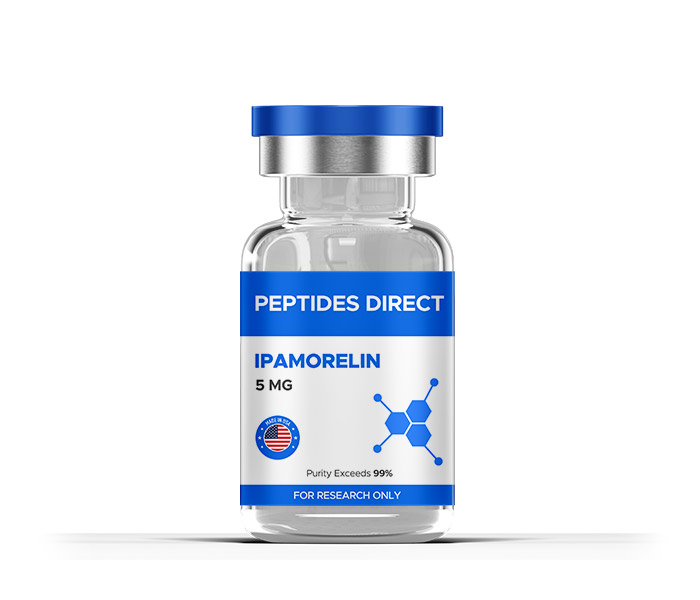
Ipamorelin (5mg)
Original price was: $53.00.$46.00Current price is: $46.00.
Ipamorelin peptides are Synthesized and Lyophilized in the USA.
Ipamorelin Peptide
Ipamorelin is a small pentapeptide that binds to the receptor of ghrelin/growth hormone secretagogue (GHS), and is speculated to trigger the release of growth hormone via pituitary cells. Research has suggested the peptide to be selective in its mode of action.[1] Ipamorelin, researchers report, does not appear to induce non-specific release of hormones like prolactin, thyroid-stimulating hormone, ACTH, luteinizing hormone, follicle-stimulating hormone, or cortisol. The high specificity of the peptide makes it an ideal model for the study of selectivity in receptor binding. It appears to function through interaction with cognate receptors on the target cell surface and mediates a cellular response. Ipamorelin may induce secretions from the pituitary gland, promoting growth in animal study models.[2] In addition, it may not only trigger the expression of insulin-like growth factor-1(IGF-1) but may also inhibit the secretion of somatostatin. IGF-1 is considered to be the main anabolic mediator of growth hormone.
Specifications
Molecular Formula: C38H49N9O5
Molecular Weight: 711.86 g/mol
Sequence: Aib-His-D-2Nal-D-Phe-Lys-NH2
Ipamorelin Research
Ipamorelin and The Growth Hormone Secretagogue Receptors
Ipamorelin may function as a growth hormone secretagogue receptor agonist, stimulating endogenous growth hormone (hGH) release. More specifically, Ipamorelin is classified as a growth hormone secretagogue receptor 1a (GHS-R1a) agonist — the same receptor targeted by the endogenous hormone ghrelin. Ghrelin, recognized as the hunger hormone, also appears to regulate hGH release through activation of GHS-R1a in pituitary cells.[3] In vitro experiments indicate that Ipamorelin’s interaction with GHS-R1a may influence somatotroph cells located in the anterior segment of the pituitary gland,[4] potentially initiating a cascade of cellular signaling mechanisms. A key component of this cascade is phospholipase C (PLC), an enzyme hypothesized to facilitate the production of inositol triphosphate (IP3) and diacylglycerol (DAG). The emergence of these secondary messenger molecules — particularly IP3 — may stimulate the release of calcium ions (Ca2+) from the cell’s internal reserves, while DAG is understood to potentially activate protein kinase C (PKC), a family of enzymes recognized for their roles in various cellular functions. The proposed increase in intracellular calcium concentration, combined with potential PKC activation, may lead to the exocytosis of growth hormone-containing vesicles. Research in clinical settings has suggested that Ipamorelin exposure may produce notable increases in hGH synthesis by pituitary cells, with the peptide observed to elevate growth hormone concentrations to approximately 80 milli-international units per liter (mIU/l), equivalent to roughly 26.6 nanograms per milliliter (ng/ml). When compared against a placebo baseline of 1.31 mIU/l or 0.4 ng/ml, this represents an apparent enhancement potentially exceeding 60 times baseline levels.[5]
Ipamorelin and the Musculoskeletal System
Prolonged reductions in bone density may increase fracture risk. Ipamorelin studies in rats have indicated that the peptide may help prevent bone loss following extended glucocorticoid exposure and may induce up to a fourfold increase in bone formation.[6] Researchers reported that “the decrease in muscle strength and bone formation found in GC-rats was counteracted by simultaneous administration of the growth hormone secretagogue.” The peptide may potentially improve bone mineral density in both existing and newly formed bone. Further research suggests that Ipamorelin may activate osteoblasts — cells essential for bone formation — through hGH-mediated mechanisms that may enhance their proliferation, growth, and differentiation. In one study, mouse models were exposed to either Ipamorelin or a control substance,[7] with the peptide’s effects on bone mineral density monitored using real-time dual X-ray absorptiometry (DEXA) focused on key areas including the femur and L6 vertebra. Following the trial, femur samples underwent additional analysis via mid-diaphyseal peripheral quantitative computed tomography (pQCT) scans. Early results suggested that the peptide may have contributed to increased body mass and potentially elevated bone mineral content (BMC) in the tibia and vertebrae relative to controls, as indicated by DEXA measurements. pQCT data further tentatively indicated that the observed increase in cortical BMC may be associated with an increase in bone cross-sectional area.[7] Ipamorelin may additionally help mitigate or reverse secondary effects such as muscle wasting and visceral fat deposition.[6]
Ipamorelin and Diabetes
Studies in murine diabetes models have suggested potential efficacy of Ipamorelin in promoting insulin release from islet cells of the pancreas.[8] The peptide may mediate insulin release through indirect excitation of calcium channels on islet cells. The proposed mechanism of Ipamorelin action offers insight into the limitations of type 2 diabetes management and may be of interest for further research.
Ipamorelin and Muscle Cells
Glucocorticoids are a class of corticosteroids commonly recognized for their anti-inflammatory effects across conditions ranging from cancer to autoimmune disease, though ancillary actions have also been reported. Over extended durations, higher hormone concentrations may be required to overcome physiological secondary effects. Researchers studying Ipamorelin have proposed its potential to attenuate certain unintended consequences associated with glucocorticoid exposure. Specifically, studies suggest that Ipamorelin may help restore nitrogen balance and reduce nitrogen wasting in the livers of glucocorticoid-exposed rats.[9] These observed actions may be tentatively attributed to Ipamorelin’s proposed capacity to modulate hGH and subsequently IGF-1 production. The research examined the liver’s ability to generate urea-N (CUNS) as an indicator of nitrogen metabolism efficacy, alongside a detailed analysis of messenger RNA (mRNA) levels for enzymes involved in the hepatic urea cycle, overall nitrogen homeostasis, and theoretical nitrogen distribution across various body organs. Results tentatively indicated that Ipamorelin may produce an approximately 20% reduction in CUNS compared to artificially induced catabolic conditions, alongside a potential reduction in urea cycle enzyme expression, a possible restoration of nitrogen equilibrium, and hypothetical modifications to nitrogen levels across different tissues.[9]
Ipamorelin as Ghrelin Receptor Probe
Ipamorelin appears to bind strongly to the ghrelin receptor and may function as a selective agonist. The ghrelin receptor has been observed in the context of cardiac failure and certain cancer types including carcinomas, with researchers proposing investigation of Ipamorelin as a probe in positron emission tomography (PET) scans to support diagnostic research.[10] Further investigation is ongoing.
Ipamorelin and Food Intake
Ipamorelin has been evaluated in multiple proof-of-concept studies for its potential to reduce postoperative ileus (POI), with findings indicating it may shorten the time to first meal intake by approximately 12 hours.[11] Researchers concluded that “Ipamorelin accelerates gastric emptying in a rodent model of postoperative ileus through the stimulation of gastric contractility by activating a ghrelin receptor-mediated mechanism involving cholinergic excitatory neurons.” Related research observations suggested that residual radiolabeled food remaining in the stomachs of POI-affected rats was reduced following Ipamorelin exposure — even relative to rats without POI — suggesting the peptide may accelerate food transit through the digestive system following ingestion.
Additionally, some researchers propose that Ipamorelin may influence total food intake through its potential action on ghrelin receptors in the nervous system.[12] Ghrelin receptors are recognized for their role in appetite regulation, and their activation may heighten hunger signaling, potentially contributing to increased body mass. In certain experimental settings, animal subjects exposed to Ipamorelin experienced an approximately 15% increase in body weight, with the augmented body weight appearing to correlate with an increase in adipose tissue mass relative to overall body composition. Adipose tissue contributes to energy storage and hormone regulation, and dual-energy X-ray absorptiometry (DEXA) scans measuring bone mineral density and body composition may potentially reflect elevated body fat percentage as a consequence of Ipamorelin exposure. Researchers concluded that “GHSs increase body fat by GH-independent mechanisms that may include increased feeding.”[12]
Disclaimer: The products mentioned are not intended for human or animal consumption. Research chemicals are intended solely for laboratory experimentation and/or in-vitro testing. Bodily introduction of any sort is strictly prohibited by law. All purchases are limited to licensed researchers and/or qualified professionals. All information shared in this article is for educational purposes only.
References
- Raun K, Hansen BS, Johansen NL, Thøgersen H, Madsen K, Ankersen M, Andersen PH. Ipamorelin, the first selective growth hormone secretagogue. Eur J Endocrinol. 1998 Nov;139(5):552-61. doi: 10.1530/eje.0.1390552. PMID: 9849822.
- Johansen PB, Nowak J, Skjaerbaek C, Flyvbjerg A, Andreassen TT, Wilken M, Orskov H. Ipamorelin, a new growth-hormone-releasing peptide, induces longitudinal bone growth in rats. Growth Horm IGF Res. 1999 Apr;9(2):106-13. doi: 10.1054/ghir.1999.9998. PMID: 10373343.
- Sinha DK, Balasubramanian A, Tatem AJ, Rivera-Mirabal J, Yu J, Kovac J, Pastuszak AW, Lipshultz LI. Beyond the androgen receptor: the role of growth hormone secretagogues in the modern management of body composition in hypogonadal males. Transl Androl Urol. 2020 Mar;9(Suppl 2):S149-S159. doi: 10.21037/tau.2019.11.30. PMID: 32257855; PMCID: PMC7108996 https://www.ncbi.nlm.nih.gov/pmc/articles/PMC7108996/
- Jiménez-Reina, L., Cañete, R., de la Torre, M. J., & Bernal, G. (2002). Influence of chronic treatment with the growth hormone secretagogue Ipamorelin, in young female rats: somatotroph response in vitro. Histology and histopathology, 17(3), 707–714. https://doi.org/10.14670/HH-17.707
- Gobburu, J.V.S., Agersø, H., Jusko, W.J. et al. Pharmacokinetic-Pharmacodynamic Modeling of Ipamorelin, a Growth Hormone Releasing Peptide, in Human Volunteers. Pharm Res 16, 1412–1416 (1999).
- Andersen NB, Malmlöf K, Johansen PB, Andreassen TT, Ørtoft G, Oxlund H. The growth hormone secretagogue ipamorelin counteracts glucocorticoid-induced decrease in bone formation of adult rats. Growth Horm IGF Res. 2001 Oct;11(5):266-72. doi: 10.1054/ghir.2001.0239. PMID: 11735244.
- Svensson, J., Lall, S., Dickson, S. L., Bengtsson, B. A., Rømer, J., Ahnfelt-Rønne, I., Ohlsson, C., & Jansson, J. O. (2000). The GH secretagogues ipamorelin and GH-releasing peptide-6 increase bone mineral content in adult female rats. The Journal of endocrinology, 165(3), 569–577. https://doi.org/10.1677/joe.0.1650569
- Adeghate E, Ponery AS. Mechanism of ipamorelin-evoked insulin release from the pancreas of normal and diabetic rats. Neuro Endocrinol Lett. 2004 Dec;25(6):403-6. PMID: 15665799.
- Aagaard, N. K., Grøfte, T., Greisen, J., Malmlöf, K., Johansen, P. B., Grønbaek, H., Ørskov, H., Tygstrup, N., & Vilstrup, H. (2009). Growth hormone and growth hormone secretagogue effects on nitrogen balance and urea synthesis in steroid treated rats. Growth hormone & IGF research: official journal of the Growth Hormone Research Society and the International IGF Research Society, 19(5), 426–431. https://doi.org/10.1016/j.ghir.2009.01.001
- Childs MD, Luyt LG. A Decade’s Progress in the Development of Molecular Imaging Agents Targeting the Growth Hormone Secretagogue Receptor. Mol Imaging. 2020 Jan-Dec;19:1536012120952623. doi: 10.1177/1536012120952623. PMID: 33104445; PMCID: PMC8865914.
- Greenwood-Van Meerveld B, Tyler K, Mohammadi E, Pietra C. Efficacy of ipamorelin, a ghrelin mimetic, on gastric dysmotility in a rodent model of postoperative ileus. J Exp Pharmacol. 2012 Oct 19;4:149-55. doi: 10.2147/JEP.S35396. PMID: 27186127; PMCID: PMC4863553.
- Lall, S., Tung, L. Y., Ohlsson, C., Jansson, J. O., & Dickson, S. L. (2001). Growth hormone (GH)-independent stimulation of adiposity by GH secretagogues. Biochemical and biophysical research communications, 280(1), 132–138. https://doi.org/10.1006/bbrc.2000.4065
Reviews
There are no reviews yet.