

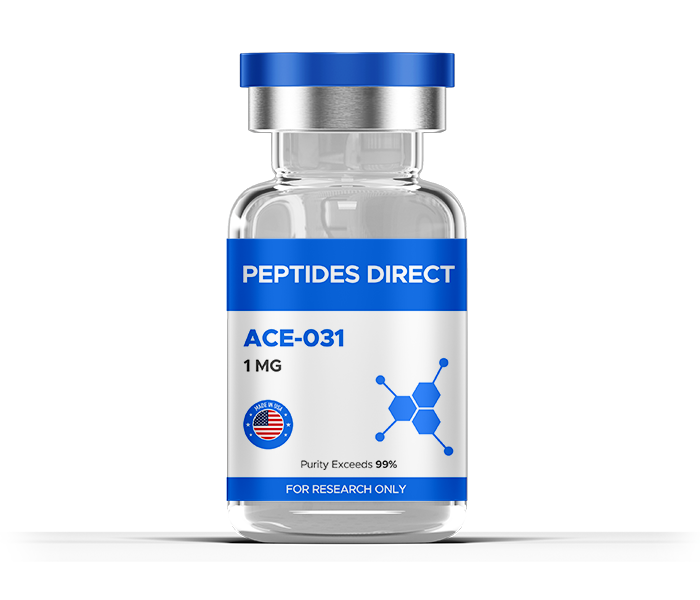


ACE-031 (1mg)
$161.00
ACE-031 peptides are Synthesized and Lyophilized in the USA.
ACE-031 is a soluble protein comprising the type IIB activin receptor (ACVR2B) and the immunoglobulin G1-Fc (IgG1-Fc), and has been studied for its potential in binding and inactivating myostatin, a protein that hampers muscle cell growth. It has been examined during the course of various research studies involved in muscle-wasting disorders and neuromuscular conditions such as Duchenne Muscular Dystrophy (DMD), as well as certain cancers such as those of the prostate or colorectal regions and lipid storage and bone metabolism.
Specifications
Other Known Titles: Ramatercept, ActRIIB-IgG1, ACVR2B/Fc
ACE-031 Research
ACE-031 and Muscle Cells
ACE-031 appears to support muscle growth and bone metabolism while potentially limiting lipid accumulation. Experimental studies observed a notable improvement in lean body mass and thigh muscle volume within one month of ACE-031 exposure.[1] These outcomes carry the additional potential benefit of an improved bone and fat metabolic profile. Research in this area remains ongoing. ACE-031 introduction also appears to attenuate muscle wasting through its proposed capacity to bind myostatin in muscle cells.[2] While not among the most extensively studied peptide compounds, researchers have posited that ACE-031 may elicit a synergistic effect when combined with certain growth hormone analogs, such as IGF-1.
ACE-031 and Energy Metabolism
Research has proposed that inhibiting endogenous ACE-031 proteins may impair the reduction of serum lactate levels, potentially allowing metabolic damage to muscles and compromising vascularization of muscle tissue. These effects may potentially be offset through ACE-031 supplementation. The compound has been hypothesized to support muscle cell growth by blocking myostatin-mediated wasting, and may help delay the onset of fatigue and oxidative damage by enhancing oxygenation of muscle tissue.
ACE-031 and Muscle Force
ACE-031 has been investigated for its potential influence on muscle function. Beyond its role in blocking myostatin activity, ACE-031 has been studied for its possible capacity to improve muscle thermodynamics by promoting oxidative respiration — thereby enhancing the force-generating capacity of muscles, with reported improvements of up to 50% in maximum force and 25% in total contractile force.[3] Experimental studies have indicated that ACE-031 may improve muscle strength without significantly affecting energy dynamics, ATP levels, or contractile efficiency within muscle tissue.
ACE-031 and Muscle Repair
Muscle wasting disorders such as Duchenne Muscular Dystrophy (DMD) are frequently associated with significant physical impairment. Research models of this condition display pronounced muscle loss despite elevated fat reserves — primarily because dystrophin proteins in these models appear to be non-functional. Compounding this, myostatin released from damaged muscle cells may affect adjacent cells, further slowing their growth. Research has nonetheless suggested that ACE-031 may reduce the rate of muscle damage by addressing the downstream effects of myostatin release.[4] The peptide appears to preserve muscle function, increase lean body mass, improve bone mineral density, and reduce fat reserves. Investigation in this area is ongoing.
ACE-031 and Bone Density
Researchers observed that weekly ACE-031 administration over seven consecutive weeks appeared to improve total body weight, muscle mass, and bone mineral density in experimental research models.[5] A reduction in the osteoclast population appeared to underlie the observed improvement in bone mineral content, which also appeared to enhance biomechanical properties including stiffness and maximum force tolerance. Research has proposed that ACE-031 may increase bone mass by approximately 30%, suggesting a potential role in managing osteoporosis progression. Beyond its proposed myostatin-inhibiting properties, studies have indicated that ACE-031 may increase bone density by approximately 132% in the femur — the thigh bone commonly affected by age-related deterioration — and by 27% in vertebrae.
ACE-031 and Cancer, Muscle Loss
Molecular cascades leading to muscle loss through cell death or necrosis are frequently observed in cancer-related research. The primary driver is metabolic stress on muscle tissue resulting from alterations in aerobic respiration status, compounded by an elevated free radical population within cells that indirectly contributes to muscle damage. Activation of the ERK1/2 pathway through ACE-031 introduction appears to help avert muscle fiber atrophy associated with apoptosis. Research studies also observed improvements in energy consumption efficiency and mitochondrial metabolism, alongside a reduction in free radical concentrations. Additionally, myostatin is produced in certain cancers and may contribute to muscle wasting and loss, while transformed cancer cells are often associated with inactivated activin receptors, mitochondrial loss, and diminished ATP levels. Research has suggested that ACE-031 exposure may reverse these effects. Further potential outcomes associated with myostatin inhibition include improved insulin sensitivity, reduced fat storage, attenuated inflammation, and enhanced bone metabolism and structural integrity.
References
- Attie, K. M., Borgstein, N. G., Yang, Y., Condon, C. H., Wilson, D. M., Pearsall, A. E., Kumar, R., Willins, D. A., Seehra, J. S., & Sherman, M. L. (2013). A single ascending-dose study of muscle regulator ACE-031 in healthy volunteers. Muscle & nerve, 47(3), 416–423. https://doi.org/10.1002/mus.23539
- Cadena, S. M., Tomkinson, K. N., Monnell, T. E., Spaits, M. S., Kumar, R., Underwood, K. W., Pearsall, R. S., & Lachey, J. L. (2010). Administration of a soluble activin type IIB receptor promotes skeletal muscle growth independent of fiber type. Journal of applied physiology (Bethesda, Md. : 1985), 109(3), 635–642. https://doi.org/10.1152/japplphysiol.00866.2009
- Muramatsu, H., Kuramochi, T., Katada, H., Ueyama, A., Ruike, Y., Ohmine, K., Shida-Kawazoe, M., Miyano-Nishizawa, R., Shimizu, Y., Okuda, M., Hori, Y., Hayashi, M., Haraya, K., Ban, N., Nonaka, T., Honda, M., Kitamura, H., Hattori, K., Kitazawa, T., Igawa, T., … Nezu, J. (2021). Novel myostatin-specific antibody enhances muscle strength in muscle disease models. Scientific reports, 11(1), 2160. https://doi.org/10.1038/s41598-021-81669-8
- Campbell, C., McMillan, H. J., Mah, J. K., Tarnopolsky, M., Selby, K., McClure, T., Wilson, D. M., Sherman, M. L., Escolar, D., & Attie, K. M. (2017). Myostatin inhibitor ACE-031 treatment of ambulatory boys with Duchenne muscular dystrophy: Results of a randomized, placebo-controlled clinical trial. Muscle & nerve, 55(4), 458–464. https://doi.org/10.1002/mus.25268
- Maïmoun, L., Mariano-Goulart, D., Huguet, H., Renard, E., Lefebvre, P., Picot, M. C., Dupuy, A. M., Cristol, J. P., Courtet, P., Boudousq, V., Avignon, A., Guillaume, S., & Sultan, A. (2022). In patients with anorexia nervosa, myokine levels are altered but are not associated with bone mineral density loss and bone turnover alteration. Endocrine connections, 11(5), e210488. https://doi.org/10.1530/EC-21-0488




Reviews
There are no reviews yet.