

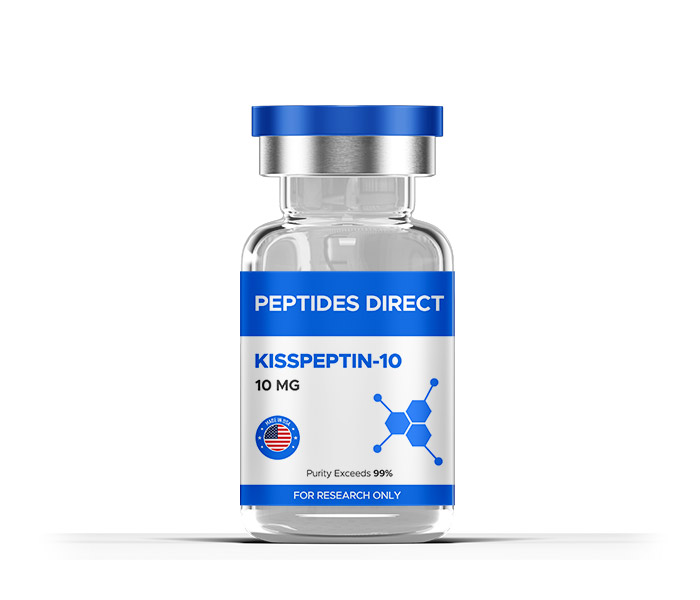
Kisspeptin-10 (10mg)
$52.00
Kisspeptin peptides are Synthesized and Lyophilized in the USA.
Kisspeptin-10 Peptide
Kisspeptin-10 is a peptide fragment derived from the full-length Kisspeptin (also referred to as Kisspeptin-54 or Metastin). Specifically, Kisspeptin-10 is a fragment containing the 45-54 sequence from the larger parent molecule. Research into this peptide has suggested that the compound may act as a mediator of endocrine signaling between various endocrine cells.
Originating from the KISS1 gene, which is thought to play a critical role in reproductive cell signaling and physiology, Kisspeptin-10 is particularly interesting to researchers for its potential to influence the secretion of gonadotropin-releasing hormone (GnRH). This, in turn, may affect the release of other reproductive hormones from cells with receptors for GnRH. In addition, researchers posit that the compound may potentially impact the development and regulation of blood vessels and renal function, and some studies have suggested it may mitigate cancer cell proliferation and metastasis.[1]
Specifications
Molecular Weight: 1302.4 g/mol
Molecular Formula: C63H83N17O14
Sequence: YNWNSFGLRF
Other Known Titles: KISS-1, Protein KISS-1, Metastin, Kp-10 peptide
Kisspeptin-10 Research
Kisspeptin-10 and Gonadotropin-Releasing Hormone Signalling
Researchers have proposed that Kisspeptin-10 may influence the hypothalamic-pituitary-gonadal axis — a system in which hypothalamic cells produce GnRH, which in turn interacts with pituitary cells, potentially increasing the rate of LH and FSH release. Studies suggest this release may induce an approximately threefold increase in testosterone synthesis by male gonadal cells.[2] Kisspeptin appears to act at the apex of the hypothalamic-pituitary-gonadal axis, engaging hypothalamic cells responsible for GnRH production.
Researchers suggest that, similar to its parent molecule Kisspeptin-54, Kisspeptin-10 may demonstrate some degree of biological activity toward GPR54 receptors — also referred to as KISS1 receptors (KISS1Rs).[3] These smaller peptides have been proposed to bind with low affinity to GPR54 receptors, potentially stimulating calcium mobilization, arachidonic acid release, and phosphorylation of extracellular signal-regulated protein kinases 1 and 2 (ERK1, ERK2) and p38 MAP kinase. These events may depolarize GnRH neurons and modulate GnRH release, though this modulation may not necessarily be stimulatory.
While Kisspeptin-10 may initially upregulate GnRH production, data from KP-54 studies suggests that repeated exposure may potentially desensitize KISS1R receptors, reducing their responsiveness to endogenous kisspeptins and potentially contributing to suppression of the hypothalamic-pituitary-gonadal axis. Observations indicate that frequent exposure to kisspeptin analogs such as KP-54 may diminish luteinizing hormone responses over time and nearly abolish follicle-stimulating hormone responsiveness within a relatively short period — a phenomenon possibly attributable to receptor downregulation or internalization, though the precise mechanisms remain to be fully characterized.[4]
Kisspeptin-10 and Energy Metabolism
Researchers have proposed a “novel role of kisspeptin neurons as active players within the neuronal circuits that govern energy balance, offering [data supportive] of a bidirectional role of these neurons as a nexus between metabolism and reproduction.”[5] Kisspeptin-10 interacts with hypothalamic cells — a brain region understood to be involved in the regulation of hunger hormone signaling. Recent experimental observations suggest that Kisspeptin-10 may influence the expression of genes associated with neuropeptide Y (NPY) and brain-derived neurotrophic factor (BDNF).[6] In this context, NPY is a neurotransmitter proposed to play a central role in appetite regulation and energy balance, while BDNF is a protein considered essential for neuron survival and synaptic plasticity.
Kisspeptin-10 is further hypothesized to potentially affect concentrations of certain neurotransmitters and their metabolites within hypothalamic neurons — specifically in the Hypo-E22 cell line derived from the hypothalamus. Neurotransmitters potentially impacted include dopamine, norepinephrine, and serotonin (5-hydroxytryptamine or 5-HT), with metabolites of interest including dihydroxyphenylacetic acid (DOPAC) — a primary dopamine metabolite — and hydroxyindoleacetic acid (5-HIAA), the principal serotonin metabolite. Experimental findings suggest that Hypo-E22 cells may respond to Kisspeptin-10 by increasing NPY gene expression, potentially supporting neuropeptide Y production and enhancing satiety following caloric intake.
Kisspeptin-10 and Cancer Cells
Kisspeptin has been proposed to influence the malignancy of melanoma cells through interaction with KISS1 receptors, with its potential to reduce the migratory capacity of cancerous cells attributed to decreased cellular adhesion. Cancer cell cultures derived from breast, urinary bladder, gastrointestinal tract, prostate, pancreas, ovarian, epidermal, and thyroid tissues of research models all appeared to exhibit reduced Kisspeptin expression — suggesting that peptide exposure may create conditions less conducive to malignant cell metastasis. Research has also linked endogenous Kisspeptin levels and melatonin production to sunlight exposure,[7] with murine models assessed following extensive sun exposure reporting elevated production of both Kisspeptin and melatonin.
Kisspeptin-10 and Behavioral Regulation
Hormonal release cycles are understood to influence reproductive activities, energy levels, and certain behavioral factors. Researchers propose that Kisspeptin levels may affect both reproduction and energy homeostasis. Recent studies have observed enhanced limbic brain activity — including increased reward-seeking behavior and motivation — in association with elevated Kisspeptin exposure.[8] Research in this area remains ongoing.
Kisspeptin-10 and Kidney, Heart
Beyond its proposed role in attenuating tumor metastasis, Kisspeptin appears to exert regulatory capacity within the kidney and heart. Kisspeptin-10 and its receptors appear to be expressed in renal tissues, with studies reporting that Kiss-1 receptor knockout models fail to appropriately regulate glomerular development.[9] Scientists have noted that “kisspeptins and kisspeptin receptors are altered in the kidney tissues of chronic renal impairment, raising the possibility of their pathophysiological roles in chronic renal failure.” Kisspeptin has additionally been observed to regulate vasoconstriction and, under specific laboratory conditions, cardiac output.[10] Such regulatory capacity may be related to Kisspeptin’s potential influence on vascular development and response to injury, though the precise mechanisms underlying this effect remain to be fully characterized.
Kisspeptin-10 and Neuroprotection
Kisspeptin-10 may potentially protect nerve cells in laboratory settings by attenuating the adverse effects associated with alpha-synuclein (alpha-syn) — a protein implicated in neurodegenerative conditions.[11] In experiments using cholinergic-like neurons engineered to overexpress either wild-type or mutant forms of alpha-syn, Kisspeptin-10 appeared to reduce the rate of apoptosis and attenuate mitochondrial depolarization induced by excessive alpha-syn accumulation. Computational models have proposed that Kisspeptin-10 may directly interact with alpha-syn by fitting into binding pockets at the protein’s C-terminal region, with this potential direct binding hypothesized to inhibit the formation of toxic alpha-syn aggregates and thereby reduce neurotoxicity.
Notably, the neuroprotective actions of Kisspeptin-10 appear to be independent of its conventional receptor GPR54, as the presence of a GPR54 antagonist did not diminish the peptide’s protective effects — suggesting that Kisspeptin-10 may exert its neuroprotective influence through a receptor-independent mechanism. Furthermore, Kisspeptin-10 was observed to decrease the immunoreactivity of both alpha-syn and choline acetyltransferase (ChAT) in neurons overexpressing alpha-syn, potentially implying an influence on alpha-syn expression levels or aggregation state, as well as an effect on cholinergic neuronal function.
Disclaimer: The products mentioned are not intended for human or animal consumption. Research chemicals are intended solely for laboratory experimentation and/or in-vitro testing. Bodily introduction of any sort is strictly prohibited by law. All purchases are limited to licensed researchers and/or qualified professionals. All information shared in this article is for educational purposes only.
References
- Jayasena CN, Nijher GM, Comninos AN, Abbara A, Januszewki A, Vaal ML, Sriskandarajah L, Murphy KG, Farzad Z, Ghatei MA, Bloom SR, Dhillo WS. The effects of kisspeptin-10 on reproductive hormone release show sexual dimorphism in humans. J Clin Endocrinol Metab. 2011 Dec;96(12):E1963-72. doi: 10.1210/jc.2011-1408. Epub 2011 Oct 5. PMID: 21976724; PMCID: PMC3232613.
- George JT, Veldhuis JD, Roseweir AK, Newton CL, Faccenda E, Millar RP, Anderson RA. Kisspeptin-10 is a potent stimulator of LH and increases pulse frequency in men. J Clin Endocrinol Metab. 2011 Aug;96(8):E1228-36. doi: 10.1210/jc.2011-0089. Epub 2011 Jun 1. PMID: 21632807; PMCID: PMC3380939.
- Rønnekleiv OK, Kelly MJ. Kisspeptin excitation of GnRH neurons. Adv Exp Med Biol. 2013;784:113-31. doi: 10.1007/978-1-4614-6199-9_6. PMID: 23550004; PMCID: PMC4019505.
- Jayasena CN, Nijher GM, Abbara A, Murphy KG, Lim A, Patel D, Mehta A, Todd C, Donaldson M, Trew GH, Ghatei MA, Bloom SR, Dhillo WS. Twice-weekly administration of kisspeptin-54 for 8 weeks stimulates release of reproductive hormones in women with hypothalamic amenorrhea. Clin Pharmacol Ther. 2010 Dec;88(6):840-7. doi: 10.1038/clpt.2010.204. Epub 2010 Oct 27. PMID: 20980998.
- Navarro VM. Metabolic regulation of kisspeptin – the link between energy balance and reproduction. Nat Rev Endocrinol. 2020 Aug;16(8):407-420. doi: 10.1038/s41574-020-0363-7. Epub 2020 May 19. PMID: 32427949; PMCID: PMC8852368.
- Orlando G, Leone S, Ferrante C, Chiavaroli A, Mollica A, Stefanucci A, Macedonio G, Dimmito MP, Leporini L, Menghini L, Brunetti L, Recinella L. Effects of Kisspeptin-10 on Hypothalamic Neuropeptides and Neurotransmitters Involved in Appetite Control. Molecules. 2018 Nov 24;23(12):3071. doi: 10.3390/molecules23123071. PMID: 30477219; PMCID: PMC6321454.
- Pazarci P, Kaplan H, Alptekin D, Yilmaz M, Lüleyap U, Singirik E, Pelit A, Kasap H, Yegani A. The effects of daylight exposure on melatonin levels, Kiss1 expression, and melanoma formation in mice. Croat Med J. 2020 Feb 29;61(1):55-61. doi: 10.3325/cmj.2020.61.55. PMID: 32118379; PMCID: PMC7063558.
- Comninos AN, Wall MB, Demetriou L, Shah AJ, Clarke SA, Narayanaswamy S, Nesbitt A, Izzi-Engbeaya C, Prague JK, Abbara A, Ratnasabapathy R, Salem V, Nijher GM, Jayasena CN, Tanner M, Bassett P, Mehta A, Rabiner EA, Hönigsperger C, Silva MR, Brandtzaeg OK, Lundanes E, Wilson SR, Brown RC, Thomas SA, Bloom SR, Dhillo WS. Kisspeptin modulates sexual and emotional brain processing in humans. J Clin Invest. 2017 Feb 1;127(2):709-719. doi: 10.1172/JCI89519. Epub 2017 Jan 23. PMID: 28112678; PMCID: PMC5272173.
- Shoji I, Hirose T, Mori N, Hiraishi K, Kato I, Shibasaki A, Yamamoto H, Ohba K, Kaneko K, Morimoto R, Satoh F, Kohzuki M, Totsune K, Takahashi K. Expression of kisspeptins and kisspeptin receptor in the kidney of chronic renal failure rats. Peptides. 2010 Oct;31(10):1920-5. doi: 10.1016/j.peptides.2010.07.001. Epub 2010 Jul 17. PMID: 20621140.
- Sato K, Shirai R, Hontani M, Shinooka R, Hasegawa A, Kichise T, Yamashita T, Yoshizawa H, Watanabe R, Matsuyama TA, Ishibashi-Ueda H, Koba S, Kobayashi Y, Hirano T, Watanabe T. Potent Vasoconstrictor Kisspeptin-10 Induces Atherosclerotic Plaque Progression and Instability: Reversal by its Receptor GPR54 Antagonist. J Am Heart Assoc. 2017 Apr 14;6(4):e005790. doi: 10.1161/JAHA.117.005790. PMID: 28411243; PMCID: PMC5533042.
- Simon, C., Soga, T., & Parhar, I. (2023). Kisspeptin-10 Mitigates α-Synuclein-Mediated Mitochondrial Apoptosis in SH-SY5Y-Derived Neurons via a Kisspeptin Receptor-Independent Manner. International journal of molecular sciences, 24(7), 6056. https://doi.org/10.3390/ijms24076056
Reviews
There are no reviews yet.