

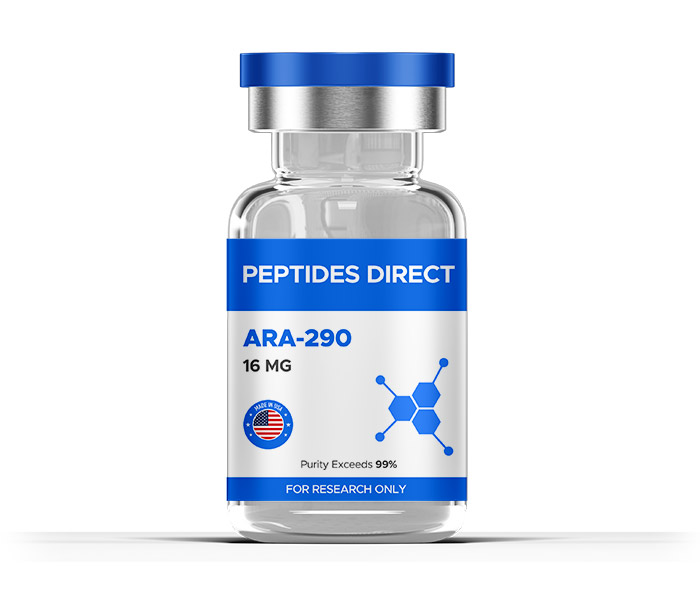
ARA – 290 (16mg)
$88.00
ARA-290 peptides are Synthesized and Lyophilized in the USA.
ARA-290 Peptide
Erythropoietin (EPO) is a kidney-derived glycoprotein made of 11 amino acids that has been studied for its potential to promote blood vessel growth and repair, and possible neuroprotection in the case of diabetic neuropathy. ARA-290 is a peptide derived from the beta-helix domain of EPO.[1] ARA-290 was developed with the intention of stimulating pain-mitigating and neuroprotective activity of EPO, though without promoting blood cell formation. ARA-290 has been proposed by researchers to exhibit anti-apoptotic, anti-inflammatory, and anti-permeability characteristics, akin to the endogenous glycoprotein, EPO. The peptide is being evaluated for its potential in neuropathic wound healing, immunomodulation, and within the context of Systemic Lupus Erythematosus (SLE) research.
Specifications
Other Known Titles: Cibinetide, PH-BSP
Sequence: ZEQLERALNSS
Molecular Formula: C51H54N16O21
Molecular Weight: 1257.3 g/mol
ARA-290 Research
ARA-290 and Blood Vessels
Retinal ischemia is recognized as a potential consequence of various diseases and may ultimately result in damage to retinal epithelial cells. The peptide has been studied for its potential to protect endothelial colony-forming cells in repairing blood vessels and rebuilding damaged tissue. Findings from one murine study suggested the peptide may significantly enhance the proliferation and migration of blood cells.[2] More specifically, the study explored the potential role of ARA-290 in engaging an inherent system of tissue protection and repair hypothesized to be mediated by EPO. The innate repair receptor (IRR), believed to be composed of EPO receptor and CD-131 subunits, may be upregulated in response to cellular stress. This receptor is presumed to be activated by both EPO and ARA-290, potentially initiating anti-inflammatory and reparative responses across various cell populations including macrophages/microglia, endothelial cells, and neurons. These responses may include a reduction in pro-inflammatory cytokines, preservation of the blood-retinal barrier (BRB), and prevention of cell apoptosis. In murine models of diabetic retinopathy (DR), ARA-290 exposure appeared to inhibit vascular leakage and edema, protect against retinal degeneration, and potentially improve metabolic control.[2]
A further study examined mechanisms that may enhance endothelial colony-forming cells (ECFCs) as a method of fostering reparative angiogenesis in retinal ischemia — a condition frequently associated with vision-threatening diseases. The research investigated ARA-290’s capacity to potentially attenuate the pro-inflammatory environment in the ischemic retina and its possible influence on ECFC-facilitated vascular regeneration. Tests assessed the influence of ARA-290 on pro-survival signaling and function within ECFC cultures, with findings indicating that ARA-290 may activate pro-survival signaling and enhance cell viability in ECFCs under oxidative stress induced by H2O2. The study also evaluated the potential efficacy of ECFC transplantation in advancing retinal vascular repair in mouse models of retinal ischemia using the oxygen-induced retinopathy (OIR) model, comparing outcomes with and without ARA-290. Inflammatory cytokine profiles and microglial activation were assessed as indicators of inflammation. Results suggested that preconditioning ECFCs with either EPO or ARA-290 prior to transplantation did not appear to enhance their vasoreparative function in the ischemic retina. However, systemic ARA-290 administration in OIR mice appeared to reduce the expression of pro-inflammatory cytokines including IL-1beta and TNF-alpha in the mouse retina, suggesting anti-inflammatory potential. ECFC transplantation into the vitreous humor appeared to result in their incorporation into the damaged retinal vasculature, with a notable reduction in the avascular area. Notably, the presence of ARA-290 appeared to enhance the vasoreparative function of ECFCs, whereas EPO did not exhibit a comparable effect — leading the study to posit that ARA-290 may enhance regulation of the pro-inflammatory environment in the ischemic retina.[3]
ARA-290 and Inflammatory Cytokines
ARA-290 has been proposed by researchers to inhibit macrophage activation, potentially enhancing the survival and proliferation of transplanted islet cells in murine models of diabetes. Islet cell transplantation has long been regarded as a key objective in endocrinology for addressing chronic diabetes symptoms, offering physiological blood sugar control and reducing the long-term adverse effects of insulin supplementation. However, the host immune response typically results in the destruction of transplanted islet cells. Researchers suggest ARA-290 may suppress pro-inflammatory cytokines including IL-6, IL-2, and TNF-Alpha, potentially enabling graft acceptance.[4] The researchers stated that “ARA-290 protected islets from cytokine-induced damage and apoptosis. Secretion of pro-inflammatory cytokines (IL-6, IL-12, and TNF-alpha) from macrophages was significantly inhibited by ARA-290.” Results suggested ARA-290 may have preserved the viability and function of cultured islets when exposed to proinflammatory cytokines, with decreased caspase 3/7 activity implying a potential defense against cytokine-induced apoptosis.
In a murine model, ARA-290 administration appeared to improve glucose metabolism and potentially reduce blood glucose levels. Introduction of the peptide may have enhanced the normoglycemic rate and improved the function of transplanted islet grafts. ARA-290 also appeared to suppress the expression of proinflammatory cytokines in the liver following transplantation, pointing to a potential inhibitory influence on intrahepatic inflammatory responses. The proposed mechanism of action involves activation of the EPOR-betacR complex, which may trigger downstream signaling pathways that inhibit proinflammatory gene transcription and encourage cell survival — potentially through activation of the PI3K-Akt and JAK2-STAT5 pathways and suppression of NF-kB-driven gene transcription. ARA-290 may bind to the upregulated EPOR-betacR complex, likely expressed in response to tissue or cellular injury, potentially protecting islets from damage caused by proinflammatory cytokines released by activated macrophages and the transplantation process itself.[4]
ARA-290 has also been observed to bind to the tissue-protective receptor (TPR) on the cell surface, mediating a protective response against inflammatory cytokines and potentially modulating the immune system response. While EPO may also interact with TPR, its ancillary cardiovascular and hematopoietic actions may limit its suitability in this context. ARA-290, by contrast, appears to replicate the protective responses of EPO while avoiding these secondary effects — resulting in reduced cellular apoptosis and lower levels of inflammatory cytokines. Consequently, tissue survival and proliferation may be significantly improved, potentially leading to accelerated tissue repair and recovery, decreased mortality and morbidity, reduced scar formation, and faster post-injury functional recovery.
ARA-290 and Immune System Regulation
TPRs are considered prevalent on immune cell surfaces including T lymphocytes, mast cells, macrophages, and dendritic cells. A growing body of scientific research has suggested that ARA-290 and related peptides may bind to these receptors to directly influence their function. TPR activation by ARA-290 may lead to macrophage inactivation and reduced inflammatory cytokine levels — potentially diminishing pathogen clearance during infection while limiting overall disease progression. With the macrophage chemokine pathway restricted through TPR-ARA-290 interaction, resident macrophages may be recruited to sites of injury, typically associated with accelerated tissue healing. ARA-290 also appears to modify antigen presentation by dendritic cells to T lymphocytes, suggesting a potential role in modulating the adaptive immune response — a key determinant of graft acceptance or rejection. Peptides such as ARA-290 may therefore assist in fine-tuning the immune response to support acceptance of kidney, heart, and other experimental grafts.
One particularly promising area of ARA-290 research involves immune modulation in the context of autoimmune disorders such as colitis. Research in the context of Systemic Lupus Erythematosus (SLE) has reported significantly reduced levels of autoantibodies including ANA and anti-ds DNA following ARA-290 exposure, with the peptide potentially helping to mitigate the risk of kidney damage and renal failure associated with the condition.[5] Researchers also noted that “ARA-290 inhibited the inflammatory activation of macrophages and promoted the phagocytotic function of macrophages to apoptotic cells.”
ARA-290 and Pain Perception
The immune system is widely recognized as a prominent regulator of pain, particularly neuropathic pain. Targeting the IRR may offer a pathway for alleviating such pain, and ARA-290 has been suggested to bind to the IRR — potentially making it of value in pain mitigation research. The peptide appears to bind to IRR and inhibit TRPV1 channel activity.[6] The TRPV1 channel, also referred to as the capsaicin receptor, is understood to mediate the perception of heat associated with neuropathic pain. Researchers investigated the effects of ARA-290 in C57/BL6 murine models using dissociated neurons from the dorsal root ganglion (DRG) and trigeminal ganglion (TG) for calcium imaging. Cells were loaded with the calcium indicator fluo-4 AM and imaged under a confocal microscope, with neuronal responses to ARA-290, capsaicin, and KCl solutions measured. Behavioral assessments were also conducted, including a paw withdrawal threshold assay examining the response to varying concentrations of ARA-290 or a control solution (PBS) introduced into the hind paw, followed by capsaicin to induce hypersensitivity. The von Frey filament pressure was incrementally increased until the withdrawal threshold was reached. A paw withdrawal frequency assay further examined the rate of withdrawal responses to capsaicin over a 24-hour period, with ARA-290 administered post-capsaicin to assess effects on hypersensitivity.
Results suggested that ARA-290 specifically inhibited capsaicin-evoked calcium responses in DRG and TG neurons without appearing to affect other thermo-receptors, potentially indicating targeted action on TRPV1 channels. ARA-290 may have elevated the activation threshold of TRPV1 channels, as suggested by a potential shift in the concentration-response curve of capsaicin. The suppressive capacity of ARA-290 on TRPV1 channels was further explored in TRPV1 over-expressed HEK293 cells. ARA-290 may also have reversed capsaicin-induced mechanical hypersensitivity in live mice, as assessed by paw withdrawal threshold and frequency tests.[6] Small nerve fiber loss is commonly observed in conditions such as HIV, diabetes, celiac disease, and thyroid dysfunction — with small nerve fibers in the skin understood to mediate pain and heat sensation. The onset of neuropathy may produce a burning sensation in affected areas, and ARA-290 research has suggested the peptide may hold potential in supporting the management of neuropathic conditions.
Disclaimer: The products mentioned are not intended for human or animal consumption. Research chemicals are intended solely for laboratory experimentation and/or in-vitro testing. Bodily introduction of any sort is strictly prohibited by law. All purchases are limited to licensed researchers and/or qualified professionals. All information shared in this article is for educational purposes only.
References
- Brines, M., Dunne, A. N., van Velzen, M., Proto, P. L., Ostenson, C. G., Kirk, R. I., Petropoulos, I. N., Javed, S., Malik, R. A., Cerami, A., & Dahan, A. (2015). ARA-290, a nonerythropoietic peptide engineered from erythropoietin, improves metabolic control and neuropathic symptoms in patients with type 2 diabetes. Molecular medicine (Cambridge, Mass.), 20(1), 658–666. https://doi.org/10.2119/molmed.2014.00215
- Lois, N., Gardner, E., McFarland, M., Armstrong, D., McNally, C., Lavery, N. J., Campbell, C., Kirk, R. I., Bajorunas, D., Dunne, A., Cerami, A., & Brines, M. (2020). A Phase 2 Clinical Trial on the Use of Cibinetide for the Treatment of Diabetic Macular Edema. Journal of clinical medicine, 9(7), 2225. https://doi.org/10.3390/jcm9072225
- O’Leary, O. E., Canning, P., Reid, E., Bertelli, P. M., McKeown, S., Brines, M., Cerami, A., Du, X., Xu, H., Chen, M., Dutton, L., Brazil, D. P., Medina, R. J., & Stitt, A. W. (2019). The vasoreparative potential of endothelial colony-forming cells in the ischemic retina is enhanced by cibinetide, a non-hematopoietic erythropoietin mimetic. Experimental eye research, 182, 144–155. https://doi.org/10.1016/j.exer.2019.03.001
- Watanabe, M., Lundgren, T., Saito, Y., Cerami, A., Brines, M., Östenson, C. G., & Kumagai-Braesch, M. (2016). A Nonhematopoietic Erythropoietin Analogue, ARA-290, Inhibits Macrophage Activation and Prevents Damage to Transplanted Islets. Transplantation, 100(3), 554–562. https://doi.org/10.1097/TP.0000000000001026
- Huang, B., Jiang, J., Luo, B., Zhu, W., Liu, Y., Wang, Z., & Zhang, Z. (2018). Non-erythropoietic erythropoietin-derived peptide protects mice from systemic lupus erythematosus. Journal of cellular and molecular medicine, 22(7), 3330–3339. https://doi.org/10.1111/jcmm.13608
- Zhang, W., Yu, G., & Zhang, M. (2016). ARA-290 relieves pathophysiological pain by targeting TRPV1 channel: Integration between immune system and nociception. Peptides, 76, 73–79. https://doi.org/10.1016/j.peptides.2016.01.003
Reviews
There are no reviews yet.