

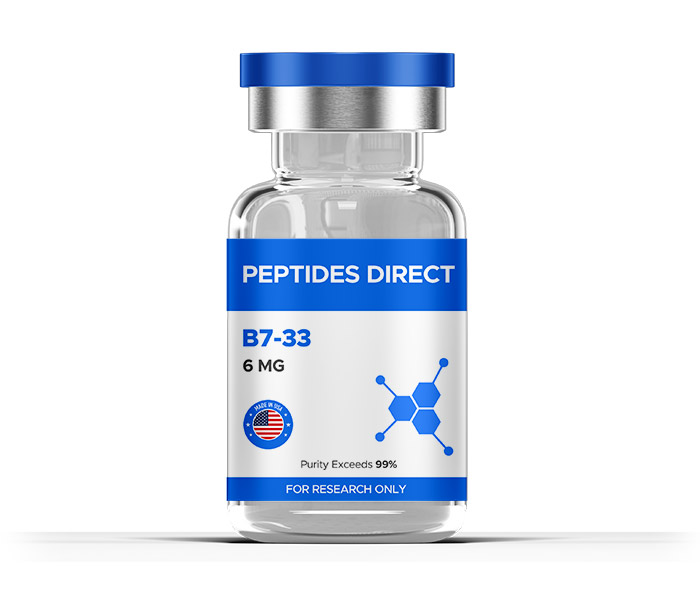
B7-33 (6mg)
$62.00
B7-33 peptides are Synthesized and Lyophilized in the USA.
B7-33 Peptide
B7-33 is a soluble synthetic single-chain peptide obtained from the larger, naturally occurring protein H2-relaxin (Relaxin), which is considered to induce pleiotropic actions impacting the musculoskeletal system, cardiovascular system, and reproduction.[1] B7-33 appears to retain the anti-fibrotic properties of Relaxin without enhancing cAMP production, it may also stimulate ERK1/2 phosphorylation and promote matrix metalloproteinase 2 (MMP2) expression and the degradation of extracellular collagen. The Relaxin family of peptides has four endogenous receptors divided into two pairs (RXFP1/2 and RXFP3/4).[2] The Relaxin receptors appear to be stimulated by cAMP, orexin, corticotropin-releasing factor (CRF), several insulin-like peptides, and GLP-1. The agonists have been observed to exhibit anti-inflammatory, antioxidant, and tissue-repairing characteristics.
Specifications
Other Known Titles: (B7-33)H2, GTPL9321
Sequence: VIKLSGRELVRAQIAISGMSTWSKRSL
PubChem: 318164840
B7-33 Peptide Research
B7-33 Peptide Function
Researchers have suggested that “B7-33 represents the first functionally selective agonist of […] RXFP1.” They further note that while H2-relaxin appears to also activate RXFP2, B7-33 does not appear to influence cAMP activity in HEK-RXFP2 cells. B7-33 demonstrates notable potency in elevating the activity of the collagen-degrading enzyme metalloproteinase (MMP)-2 in cardiac fibroblasts and murine renal myofibroblasts — a property potentially relevant to fibrosis prevention — though this potency appeared to be blocked by an RXFP1-specific antagonist. B7-33 appears to have activated pERK1/2, leading researchers to conclude it may function as a functionally selective agonist of RXFP1. Studies further suggested that both H2-relaxin and B7-33 may exert their biological activity through RXFP1 and potentially through RXFP1-AT2R heterodimers. B7-33 appears to preferentially stimulate the pERK pathway over the cAMP pathway.[3] The pERK pathway is involved in cell cycle arrest at the G1 phase and has been implicated in conditions such as Alzheimer’s disease and Creutzfeldt-Jakob disease. By restricting cell cycle progression in cells expressing RXFP1 receptors, B7-33 appears to exert anti-fibrotic potential through its proposed capacity to stimulate RXFP1-angiotensin II type 2 receptor heterodimer formation, activating pERK1/2 signaling and thereby increasing production of the collagen-degrading enzyme matrix metalloproteinase (MMP)-2.
B7-33 has demonstrated potential in activating pERK1/2 in fibroblasts, possibly attributable to a proposed coupling of ERK1/2 to RXFP1 in these cell types. It has been speculated that B7-33 may serve as a potential anti-fibrotic agent with limited activity at cAMP pathways. Testing in a murine model of cardiac damage suggested the peptide may exhibit anti-fibrotic activity broadly comparable to that of H2-relaxin. Additionally, B7-33 appeared to display anti-remodeling and anti-fibrotic potential in a murine model of chronic allergic reaction. It has been hypothesized that B7-33 binding to RXFP1 may mediate anti-fibrotic actions through a pERK1/2-neuronal nitric oxide (NO) synthase (nNOS)-NO-cGMP-dependent pathway, potentially inhibiting myofibroblast differentiation and excessive ECM/collagen deposition. Similar to H2-relaxin, B7-33 appears to stimulate MMPs associated with collagen degradation and may signal through constitutive RXFP1-AT2R heterodimers. Notably, despite its high potency, B7-33 is largely unstructured in solution, suggesting it may adopt the appropriate conformation for RXFP1 binding upon interaction. Researchers also note that, in contrast to H2-relaxin, B7-33 does not appear to promote tumor cell growth.
B7-33 and Ease of Production
B7-33 offers practical advantages in terms of production, being less complex and more cost-effective to synthesize. Its comparatively simpler two-dimensional and three-dimensional structures make producing a functional B7-33 protein considerably more straightforward than producing a full H2-relaxin protein.
B7-33 and Anti-Fibrotic Properties
Fibrosis involves scarring or disorganized tissue regeneration and represents the end stage of at least half of all chronic diseases. Research has indicated that H2-relaxin introduction may produce immediate vasodilation and reduce long-term scarring following cardiac damage.[4] The peptide was also reported to promptly alleviate dyspnea and other manifestations associated with heart failure. B7-33 is currently under investigation for its potential to increase MMP-2 production, potentially at a slightly elevated rate compared to H2-relaxin. Research studies noted this capacity, observing that the peptide appeared to significantly reduce cardiac fibrosis in rat models of MI-induced heart failure and improve cardiac function.[5] Comparable effects have been observed in mouse models of asthma and lung fibrosis. Furthermore, B7-33 appeared to inhibit tumor growth even when introduced at concentrations exceeding those required to produce anti-fibrotic effects. It appears to function almost exclusively through the pERK pathway without stimulating cAMP production.
B7-33 and Blood Vessel Protection
H2-relaxin has been investigated for its potential to protect the vasculature against endothelial dysfunction and long-term scarring. Murine model studies suggested that both B7-33 and H2-relaxin may selectively enhance bradykinin-mediated endothelium-dependent relaxation — an effect appearing to arise from the capacity of these compounds to increase endothelium-derived hyperpolarization. No clearly significant impact on relaxation in the small renal artery or aorta was observed. The study proceeded to compare the actions of B7-33 and H2-relaxin using an experimental model of vascular disease, in which mesenteric arteries from murine models were pre-incubated in placental trophoblast conditioned media to induce endothelial dysfunction. Co-incubation of these arteries with B7-33 or H2-relaxin appeared to inhibit the onset of endothelial dysfunction. The study suggested that equimolar concentrations of B7-33 may replicate the acute vascular actions of H2-relaxin in murine mesenteric arteries, and that B7-33 may exert a preventative effect on endothelial dysfunction induced by placental trophoblast conditioned media.[5]
B7-33 thus appears to replicate the vasoprotective effects of H2-relaxin by enhancing bradykinin-mediated endothelium-dependent relaxation through augmentation of endothelium-derived hyperpolarization in select vascular beds.[5] Marshal et al. noted that “equimolar [concentrations] of B7-33 replicated the acute beneficial vascular effects of serelaxin in rat mesenteric arteries and also prevented endothelial dysfunction induced by placental trophoblast conditioned media in mouse mesenteric arteries.”
B7-33 and Preeclampsia
Preeclampsia is a potentially life-threatening pregnancy complication characterized by elevated blood pressure and reduced fetal weight. Research suggests that relaxin and its analogs, including B7-33, may hold potential in managing preeclampsia even in severe presentations.[6] B7-33 has demonstrated binding potential at the RXFP-1 receptor, possibly contributing to increased VEGF production in cytotrophoblasts — cells found in the developing fetus that are considered essential to establishing blood flow between the maternal circulation and the developing fetal unit. A study focused on the potential actions of the recently developed B7-33 and its lipidated derivative on impaired cytotrophoblast (CTB) function.[6] CTBs were exposed to varying concentrations of MBG (marinobufagenin) — a cardiotonic bufadienolide steroid — or differing glucose levels, and were introduced in combination with B7-33 or its lipidated derivative, either in the presence or absence of MBG or hyperglycemia exposure.
Some CTBs were pre-exposed to a relaxin antagonist (RXFP1) prior to MBG or hyperglycemia exposure. Levels of vascular endothelial growth factor (VEGF), placental growth factor (PlGF), and soluble fms-like tyrosine kinase-1 (sFlt-1) were measured using ELISA kits. The study suggested that lipidation of B7-33 may notably improve its pharmacodynamic profile without visibly affecting its activity. Under glucose exposure, CTBs appeared to show increased sFlt-1 secretion alongside decreased VEGF and PlGF — potentially yielding an anti-angiogenic profile. When combined with B7-33 or its lipidated derivative, CTBs appeared to be protected from this anti-angiogenic profile induced by both MBG and hyperglycemia. Both agents appeared to stimulate increased VEGF expression in CTBs without significantly influencing other factors, though this increase appeared to be attenuated by the RXFP1 antagonist. The study concluded that B7-33 and its lipidated derivative may reduce CTB dysfunction caused by MBG and hyperglycemia, attenuating the anti-angiogenic phenotype. Through stimulation of VEGF production, B7-33 may carry potential to promote blood vessel development and improve maternal-fetal circulation. Studies also indicate that lipidated B7-33 appears to have a prolonged half-life, with lipidation showing no apparent adverse effect on peptide activity.[6]
B7-33 and Anti-Fibrotic Materials
B7-33 appears to demonstrate potential in the development of anti-fibrotic materials or coatings designed to resist the foreign body response. Fibrosis poses a significant challenge in the context of implantable devices such as cardiovascular stents, where it may lead to device dysfunction or degradation, arterial occlusion, impaired blood supply, and potentially myocardial infarction. B7-33 has been proposed as a candidate coating material for implantable devices. Research conducted under experimental conditions suggested that the release of B7-33 from a device coating appeared to reduce fibrotic capsule thickness by approximately 50% over a 6-week period, raising the possibility of a range of enhanced implantable device applications.[7] B7-33 and related peptides may reduce the need for systemic agents to control fibrosis in implanted devices. Research in this area is ongoing.
Disclaimer: The products mentioned are not intended for human or animal consumption. Research chemicals are intended solely for laboratory experimentation and/or in-vitro testing. Bodily introduction of any sort is strictly prohibited by law. All purchases are limited to licensed researchers and/or qualified professionals. All information shared in this article is for educational purposes only.
References
- Praveen, P., Kocan, M., Valkovic, A., Bathgate, R., & Hossain, M. A. (2019). Single chain peptide agonists of relaxin receptors. Molecular and cellular endocrinology, 487, 34-39.
- Yegorov, S., Bogerd, J., & Good, S. V. (2014). The relaxin family peptide receptors and their ligands: new developments and paradigms in the evolution from jawless fish to mammals. General and comparative endocrinology, 209, 93–105. https://doi.org/10.1016/j.ygcen.2014.07.014
- Hossain, M. A., Kocan, M., Yao, S. T., Royce, S. G., Nair, V. B., Siwek, C., Patil, N. A., Harrison, I. P., Rosengren, K. J., Selemidis, S., Summers, R. J., Wade, J. D., Bathgate, R. A. D., & Samuel, C. S. (2016). A single-chain derivative of the relaxin hormone is a functionally selective agonist of the G protein-coupled receptor, RXFP1. Chemical science, 7(6), 3805–3819. https://doi.org/10.1039/c5sc04754d
- Teerlink, J. R., Cotter, G., Davison, B. A., Felker, G. M., Filippatos, G., Greenberg, B. H., Ponikowski, P., Unemori, E., Voors, A. A., Adams, K. F., Jr, Dorobantu, M. I., Grinfeld, L. R., Jondeau, G., Marmor, A., Masip, J., Pang, P. S., Werdan, K., Teichman, S. L., Trapani, A., Bush, C. A., … RELAXin in Acute Heart Failure (RELAX-AHF) Investigators (2013). Serelaxin, recombinant human relaxin-2, for treatment of acute heart failure (RELAX-AHF): a randomised, placebo-controlled trial. Lancet (London, England), 381(9860), 29–39. https://doi.org/10.1016/S0140-6736(12)61855-8
- Marshall, S. A., O’Sullivan, K., Ng, H. H., Bathgate, R. A. D., Parry, L. J., Hossain, M. A., & Leo, C. H. (2017). B7-33 replicates the vasoprotective functions of human relaxin-2 (serelaxin). European journal of pharmacology, 807, 190–197. https://doi.org/10.1016/j.ejphar.2017.05.005
- Afroze, S. H., Pantho, A. F., Sprague, D. C., Kuehl, T. J., Bathgate, R., Zawieja, D. C., … & Uddin, M. N. (2019). Abstract P3042: Novel Peptide B7-33 and It’s Lipidated Derivative Protect Cytotrophoblasts From Preeclampsia Phenotype in a Cellular Model of the Syndrome. Hypertension, 74(Suppl_1), AP3042-AP3042.
- Welch, N. G., Mukherjee, S., Hossain, M. A., Praveen, P., Werkmeister, J. A., Wade, J. D., … & Thissen, H. (2019). Coatings releasing the relaxin peptide analogue B7-33 reduce fibrotic encapsulation. ACS applied materials & interfaces, 11(49), 45511-45519.
Reviews
There are no reviews yet.