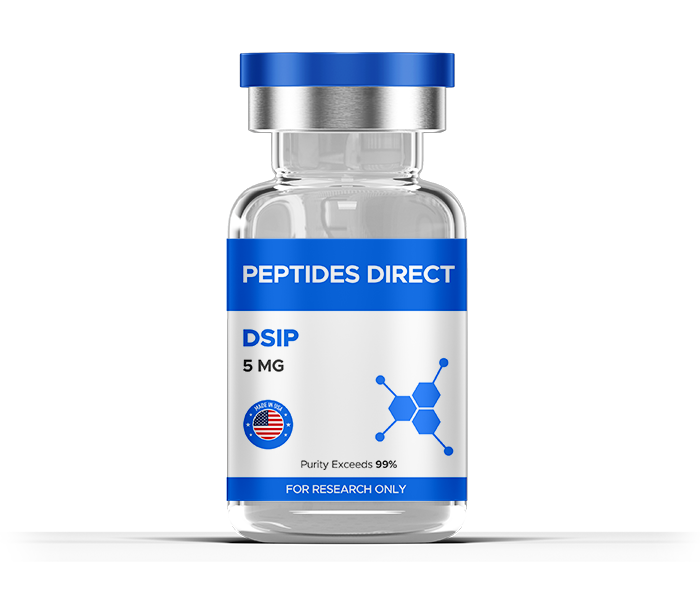
DSIP (Delta Sleep-Inducing Peptide)
DSIP is a naturally occurring neuropeptide composed of 9 amino acids that may play a role in various endocrine and physiological pathways within the central nervous system. It has attracted scientific interest due to its potential involvement in managing oxidative stress and supporting myocardial contractility. The peptide is also being explored as a research candidate in studies related to major depressive disorder.
Delta sleep-inducing peptide (DSIP) is a short-chain endogenous peptide. Its name originates from early research suggesting a possible role in sleep induction in rabbits, as well as its initial isolation from rat brain tissue during slow-wave sleep (SWS) in 1977.[1]
Slow Wave Sleep (SWS), commonly referred to as deep sleep, represents a critical phase of the overall sleep cycle, which consists of non-rapid eye movement (NREM) and rapid eye movement (REM) stages. Sleep follows a cyclical pattern, alternating between NREM and REM phases multiple times throughout the night. SWS, categorized within NREM sleep, is characterized by low-frequency, high-amplitude delta waves observed in electroencephalogram (EEG) recordings.
The sleep cycle typically begins with NREM sleep, which is divided into three stages: N1, N2, and N3. The N1 and N2 stages correspond to lighter sleep, while N3 represents the deepest phase, also known as SWS. Following this stage, the cycle transitions into REM sleep, associated with increased brain activity and dreaming.
Over time, researchers have investigated DSIP for its potential roles in endocrine and physiological regulation. Beyond its possible effects on sleep, DSIP has been suggested to influence corticotropin levels, suppress somatostatin production, reduce stress-related hormone release, support blood pressure regulation, and potentially affect pain perception.[2]
Specifications
Other Known Titles:Delta Sleep-Inducing Peptide
Molecular Formula: C35H48N10O15
Molecular Weight: 848.82 g/mol
Sequence: Trp-Ala-Gly-Gly-Asp-Ala-Ser-Gly-Glu
DSIP Research
DSIP and Potential Mechanisms
DSIP is believed to influence sleep structure and quality through its interaction with the central nervous system. It has been hypothesized that the peptide may reduce sleep onset time and improve sleep quality by modulating neurotransmitter activity in the brain. However, the exact mechanisms underlying these effects remain to be fully clarified.
One proposed mechanism suggests that DSIP interacts with specific receptors, including N-methyl-D-aspartate (NMDA) receptors and gamma-aminobutyric acid (GABA) receptors. NMDA receptors are associated with excitatory neurotransmission via glutamate, while GABA receptors are involved in inhibitory signaling, which helps reduce neural activity and promote relaxation.
Experimental findings in murine models indicate that DSIP may enhance GABA-mediated inhibitory activity, potentially reducing neuronal excitability and facilitating sleep onset.[3] At the same time, it may attenuate NMDA receptor activity, further supporting its potential sleep-related effects.[4]
Research also suggests a possible interaction between DSIP and opioid receptors, which may contribute to its role in sleep regulation and the modulation of withdrawal-related processes.[5,6] Additionally, the alpha-1 adrenergic receptor in the pineal gland has been identified as a potential target. Early findings indicate that DSIP’s influence on this receptor may affect sleep patterns and stress responses. These observations highlight the complex and multifaceted nature of DSIP’s activity, although further research is required to fully define its biological functions.[7]
DSIP and Stress
Studies investigating DSIP in animal models exposed to controlled stress conditions have examined its effects on biomarkers such as substance P, beta-endorphin, and corticosterone.[4] These markers are closely associated with stress response mechanisms.
Preliminary findings suggest that DSIP exposure may lead to significant changes in these biomarker levels, indicating a potential role in stress modulation. For example, an initial decrease followed by an increase in beta-endorphin levels has been observed, suggesting involvement in the opioidergic system and possible adaptation to stress.
Additionally, a reduction in corticosterone levels shortly after DSIP exposure has been reported. These observations imply that DSIP may influence a range of biochemical pathways, potentially initiating a cascade of molecular responses linked to stress regulation.
DSIP and Sleep Activity
Extensive research has explored the relationship between DSIP and sleep regulation. While early findings in rabbits suggested a sleep-inducing effect, subsequent studies have produced mixed results.[8]
In some cases, DSIP did not appear to significantly affect sleep, while other findings indicated an enhancement of slow-wave sleep or paradoxical sleep phases. Some studies have reported an initial period of increased alertness followed by sedation.
Overall, DSIP may contribute to the normalization of sleep patterns and the correction of disruptions in sleep cycles. Research related to insomnia has been particularly relevant, with some findings suggesting potential improvements in sleep quality and reduced sleep latency in experimental models.[9]
Polysomnographic studies have indicated statistically significant improvements in sleep parameters; however, the available evidence remains limited and requires further validation.[10][11]
DSIP and Depression
Research has explored the potential effects of DSIP on mitochondrial function under hypoxic conditions. The peptide has been observed to potentially influence monoamine oxidase type A (MAO-A) activity and serotonin levels, suggesting a possible role in mood-related processes.[12]
Lower levels of DSIP have been identified in cerebrospinal fluid in experimental models of depression compared to controls. Given the strong relationship between sleep regulation and mood, peptides influencing sleep may also affect depressive behaviors.
DSIP has also been associated with the hypothalamic-pituitary-adrenal (HPA) axis, although no established approach currently exists for directly regulating DSIP levels in clinical settings.
DSIP and Metabolism
Studies in animal models suggest that DSIP may influence metabolic responses under stress conditions.[13] It may support mitochondrial function by promoting oxidative phosphorylation, even in low-oxygen environments.
This activity may help maintain metabolic balance and reduce the formation of harmful byproducts associated with inefficient energy production. DSIP may also assist in protecting tissues during conditions such as ischemia by supporting cellular function until normal oxygen supply is restored.
Additionally, research indicates that DSIP may possess antioxidant properties, potentially reducing free radical formation.
DSIP and Withdrawal, Addiction
Research has indicated that DSIP may improve outcomes in animal models undergoing withdrawal from substances such as ethanol and opiates. Reported findings suggest recovery rates of approximately 97% for ethanol withdrawal and 87% for opiate withdrawal.
Opiate dependence may require longer exposure to DSIP due to its more persistent nature.[6]
DSIP and Cancer Cells
Researchers have explored the possibility that DSIP may influence cancer cell development indirectly through its effects on sleep and immune function. Improved sleep may enhance immune surveillance, potentially aiding in the identification and elimination of abnormal cells.
In animal studies, female mice exposed to DSIP periodically throughout their lifespan showed a 2.6-fold reduction in tumor development compared to control groups. A reduction in chromosomal abnormalities in bone marrow cells was also observed.
These findings remain preliminary, and further research is required to confirm their significance.[13]
DSIP and Muscle Cells
Delta Sleep-Inducing Peptide was initially identified in the brains of rabbits during slow-wave sleep and has since been associated with research on sleep regulation and central nervous system activity. However, its synthesis and full range of biological functions remain incompletely understood.
The presence of DSIP in both central and peripheral tissues suggests that its role may extend beyond sleep regulation. It has been proposed that DSIP may act as a hypothalamic hormone with broader physiological effects.
In one study, DSIP was observed to inhibit somatostatin, a protein that can suppress muscle growth.[9] By reducing somatostatin activity, DSIP may potentially influence muscle cell growth processes such as hypertrophy and hyperplasia.
In animal models, DSIP has also been associated with the regulation of blood pressure, heart rate, thermogenesis, and immune-related signaling. Some of these effects appear prior to sleep onset, suggesting that DSIP may play a role in preparing the body for sleep.
Disclaimer
The products referenced are not intended for human or animal consumption. Research chemicals are strictly designated for laboratory research and/or in vitro experimentation. Any form of bodily administration is prohibited by law. All purchases are restricted to licensed researchers and qualified professionals. All information provided in this article is for educational and informational purposes only.
References
- Monnier M, Dudler L, Gächter R, Maier PF, Tobler HJ, Schoenenberger GA. The delta sleep inducing peptide (DSIP). Comparative properties of the original and synthetic nonapeptide. Experientia. 1977 Apr 15;33(4):548-52. doi: 10.1007/BF01922266. PMID: 862769.
- Koval’zon VM. DSIP: peptid sna ili neizvestnyĭ gormon gipotalamusa [DSIP: the sleep peptide or an unknown hypothalamic hormone?]. Zh Evol Biokhim Fiziol. 1994 Mar-Apr;30(2):310-9. Russian. PMID: 7817664.
- Grigor’ev VV, Ivanova TA, Kustova EA, Petrova LN, Serkova TP, Bachurin SO. Effects of delta sleep-inducing peptide on pre- and postsynaptic glutamate and postsynaptic GABA receptors in neurons of the cortex, hippocampus, and cerebellum in rats. Bull Exp Biol Med. 2006 Aug;142(2):186-8. English, Russian. doi: 10.1007/s10517-006-0323-9. PMID: 17369935
- Sudakov KV, Umriukhin PE, Rayevsky KS. Delta-sleep inducing peptide and neuronal activity after glutamate microiontophoresis: the role of NMDA-receptors. Pathophysiology. 2004 Oct;11(2):81-86. https://pubmed.ncbi.nlm.nih.gov/15364118/
- Nakamura A, Nakashima M, Sakai K, Niwa M, Nozaki M, Shiomi H. Delta-sleep-inducing peptide (DSIP) stimulates the release of immunoreactive Met-enkephalin from rat lower brainstem slices in vitro. Brain Res. 1989 Feb 27;481(1):165-8. doi: 10.1016/0006-8993(89)90498-8. PMID: 2706459.
- Dick P, Grandjean ME, Tissot R. Successful treatment of withdrawal symptoms with delta sleep-inducing peptide, a neuropeptide with potential agonistic activity on opiate receptors. Neuropsychobiology. 1983;10(4):205-8. doi: 10.1159/000118012. PMID: 6328354.
- Graf MV, Schoenenberger GA. Delta sleep-inducing peptide modulates the stimulation of rat pineal N-acetyltransferase activity by involving the alpha 1-adrenergic receptor. J Neurochem. 1987 Apr;48(4):1252-7. doi: 10.1111/j.1471-4159.1987.tb05654.x. PMID: 3029331.
- Nakagaki K, Ebihara S, Usui S, Honda Y, Takahashi Y, Kato N. [Effects of intraventricular injection of anti-DSIP serum on sleep in rats]. Yakubutsu Seishin Kodo. 1986 Jun;6(2):259-65. Japanese. PMID: 3776352.
- Iyer KS, Marks GA, Kastin AJ, McCann SM. Evidence for a role of delta sleep-inducing peptide in slow-wave sleep and sleep-related growth hormone release in the rat. Proc Natl Acad Sci U S A. 1988 May;85(10):3653-6. doi: 10.1073/pnas.85.10.3653. PMID: 3368469; PMCID: PMC280272.
- Schneider-Helmert D, Gnirss F, Monnier M, Schenker J, Schoenenberger GA. Acute and delayed effects of DSIP (delta sleep-inducing peptide) on human sleep behavior. Int J Clin Pharmacol Ther Toxicol. 1981 Aug;19(8):341-5. PMID: 6895513.
- Larbig W, Gerber WD, Kluck M, Schoenenberger GA. Therapeutic effects of delta-sleep-inducing peptide (DSIP) in patients with chronic, pronounced pain episodes. A clinical pilot study. Eur Neurol. 1984;23(5):372-85. doi: 10.1159/000115716. PMID: 6548970.
- Lesch KP, Widerlöv E, Ekman R, Laux G, Schulte HM, Pfüller H, Beckmann H. Delta sleep-inducing peptide response to human corticotropin-releasing hormone (CRH) in major depressive disorder. Comparison with CRH-induced corticotropin and cortisol secretion. Biol Psychiatry. 1988 Jun;24(2):162-72. doi: 10.1016/0006-3223(88)90271-5. PMID: 2839244.
- Khvatova EM, Samartzev VN, Zagoskin PP, Prudchenko IA, Mikhaleva II. Delta sleep inducing peptide (DSIP): effect on respiration activity in rat brain mitochondria and stress protective potency under experimental hypoxia. Peptides. 2003 Feb;24(2):307-11. doi: 10.1016/s0196-9781(03)00040-8. PMID: 12668217.


Reviews
There are no reviews yet.