

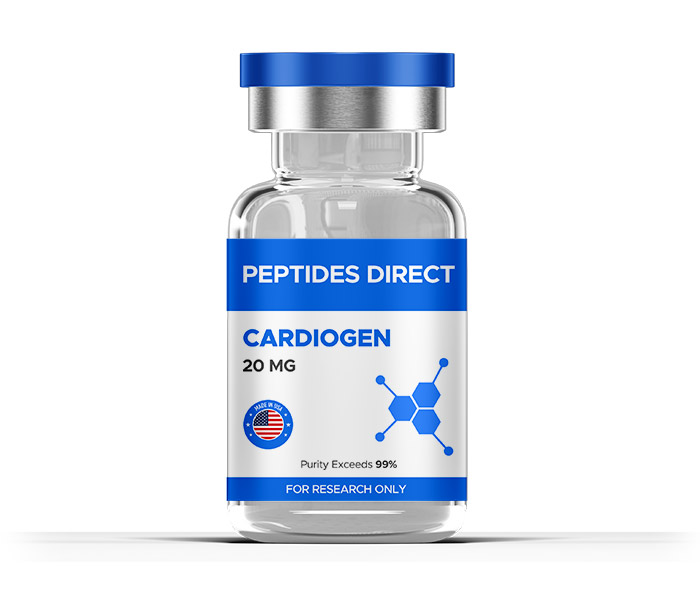
Cardiogen (20mg)
$62.00
Cardiogen peptides are Synthesized and Lyophilized in the USA.
Cardiogen Peptide
Cardiogen is a cardiovascular bioregulator peptide complex. Results obtained from research studies suggest that Cardiogen’s primary functions may be correlated to fibroblast action, cells considered responsible for scar formation and tissue repair. The peptide has a sequence of H-Ala-Glu-Asp-Arg-OH (AEDR).[1] Research posits that the synthetic tetrapeptide Cardiogen may potentially stimulate cell proliferation in myocardial tissue. Additionally, it appears that Cardiogen may possibly inhibit myocardial cell apoptosis (cell death), hypothetically through the reduction of p53 protein expression.[2]
Specifications
Molecular Formula: C18H31N7O9
Molecular Weight: 489.5 g/mol
Peptide complex AKS-K (peptide-linked amino acids): Glutamic, aspartic, alanine, arginine.
Cardiogen Research
Cardiogen Peptide and the Heart
Research studies propose that Cardiogen may stimulate the proliferation of cardiomyocytes, through which the compound may reduce the growth and development of fibroblasts, potentially limiting scar formation and contributing to improved long-term outcomes in cardiac remodeling associated with congestive cardiac failure. The synthetic tetrapeptide Cardiogen appears to exert a notable stimulatory effect on cell proliferation in both young and aged murine models, supporting the hypothesis that Cardiogen may promote cell growth in cardiac muscle tissue. Researchers further suggest that Cardiogen may reduce the expression of the p53 protein, potentially resulting in a decreased rate of apoptosis. The p53 protein is widely referred to as the “guardian of the genome” due to its recognized role in regulating the cell cycle and its proposed function as a tumor suppressor — when active, p53 is considered capable of initiating apoptosis, or programmed cell death. A reduction in p53 expression through Cardiogen exposure may therefore inhibit apoptosis in myocardial tissue.[2] The authors noted that “this fact can testify that cardiogen inhibits the apoptosis process in the myocard tissue.” In mature test models, Cardiogen has been investigated in the context of hypertension, heart failure, angina pectoris, coronary heart disease, myocardial hypertrophy, myocarditis, and myocardiodystrophy, as well as for its potential to enhance endurance under conditions of high physical demand and adverse environmental factors.
Cardiogen Peptide and the Prostate
Cardiogen, alongside several structurally related peptides, may potentially induce favorable changes in the expression of signaling factors within fibroblast proteins — factors understood to be involved in fostering the development and progression of prostate cancer. In aging and senescent fibroblasts, these signaling factors appear to undergo alterations, which may help explain the observation that prostate cancer is more prevalent in older cell cultures and rarely evident in younger ones. Research suggests that Cardiogen may play a potential role in restoring these signaling factors to levels comparable to, or more favorable than, those observed in young cell cultures.[3]
Cardiogen Peptide and Cancer Cells
Research indicates that while Cardiogen may reduce apoptosis in cardiomyocytes through decreased p53 expression, it may exert an opposing effect in tumor cells.[4] Studies examining the tumor-modifying potential of Cardiogen in rat models of M-1 sarcoma reported that apoptosis in tumor cells appeared elevated beyond control levels.[5] This was suggested to be attributable to the development of necrotic hemorrhagic changes and an enhancement of tumor cell apoptosis. This proliferative activity may indicate that tumor growth inhibition is not the result of a direct cytostatic effect on the tumor, but rather a specific mechanism of peptide action. The authors noted that “morphological signs indicate a specific mechanism of cardiogen action, realized through the vascular network of the tumor” — suggesting that apoptotic effects on tumor cells may be mediated through alterations in their vascular supply.
Cardiogen Peptide and Fibroblasts, Cardiomyocyte Metabolism
Research suggests that Cardiogen may penetrate into the cytoplasm, nucleus, and nucleolus of HeLa cells, and may potentially inhibit the hydrolysis of DNA fragments by endonucleases.[6] The study was conducted in murine models using embryonic fibroblasts (MEF+/+, knockout LMNA mice), cultured in a humid atmosphere in DMEM supplemented with approximately 10% embryonic calf serum. Cells were grown in culture medium for approximately 5 days and divided into two groups — an intact control group and a group incubated with H-Ala-Glu-Asp-Arg-OH (Cardiogen) for approximately 30 minutes. Results indicated that in cultures incubated with H-Ala-Glu-Asp-Arg-OH, the expression of cytoplasmic proteins actin, vimentin, and tubulin appeared to increase by 2 to 5 times, and nuclear matrix proteins lamin A and lamin C by 2 to 3 times, relative to controls. These findings suggest that H-Ala-Glu-Asp-Arg-OH may activate the expression of cytoskeletal proteins actin, vimentin, and tubulin, as well as nuclear matrix proteins lamin A and C. Researchers hypothesize that by potentially regulating DNA-associated proteins including enzymes and transcription factors, this peptide may improve the accessibility of genes encoding cytoskeletal proteins for transcription, potentially activating intracellular metabolism and inducing cell proliferation and differentiation. The apparent increase in lamin A and lamin C production may be interpreted as a further indicator of the antiapoptotic action of Cardiogen. The authors concluded that “the previously reported cardioprotective activity of this tetrapeptide is determined by its capacity to activate synthesis of cytoskeletal and nuclear matrix proteins, which stimulates cell proliferation and reduces apoptosis.”
A subsequent investigation examined the potential action of Cardiogen in an experimental murine model of myocardial damage induced through coronary artery ligation.[7] The peptide appeared to considerably reduce post-injury mortality, with researchers observing an approximately threefold decrease relative to the control group. Cardiogen may also contribute to a reduction in necrotic zones within myocardial tissue — areas of cell death associated with impaired blood flow. The peptide is further proposed to help preserve glycogen content in myocardial tissue, suggesting that cells may better maintain their energy reserves in the presence of the peptide, potentially improving cellular survival and function following a cardiac event. The study additionally posited that Cardiogen may exert a protective effect on mitochondria — the intracellular structures responsible for energy production — and may stimulate reparative processes that could theoretically support recovery from cardiac damage and improve overall cardiomyocyte metabolism.
Disclaimer: The products mentioned are not intended for human or animal consumption. Research chemicals are intended solely for laboratory experimentation and/or in-vitro testing. Bodily introduction of any sort is strictly prohibited by law. All purchases are limited to licensed researchers and/or qualified professionals. All information shared in this article is for educational purposes only.
References
- Fedoreyeva, L. I., Kireev, I. I., Khavinson, V. K.h, & Vanyushin, B. F. (2011). Penetration of short fluorescence-labeled peptides into the nucleus in HeLa cells and in vitro specific interaction of the peptides with deoxyribooligonucleotides and DNA. Biochemistry. Biokhimiia, 76(11), 1210–1219. https://doi.org/10.1134/S0006297911110022
- Chalisova NI, Lesniak VV, Balykina NA, et al. [The effect of the amino acids and cardiogen on the development of myocard tissue culture from young and old rats]. Advances in Gerontology = Uspekhi Gerontologii. 2009 ;22(3):409-413. PMID: 20210190.
- Kheĭfets OV, Poliakova VO, Kvetnoĭ IM. [Peptidergic regulation of the expression of signal factors of fibroblast differentiation in the human prostate gland in cell aging]. Advances in Gerontology = Uspekhi Gerontologii. 2010 ;23(1):68-70. PMID: 20586252.
- Zakutskiĭ, A. N., Chalisova, N. I., & Subbotina, T. F. (2008). Bioorganicheskaia khimiia, 34(2), 149–159. https://doi.org/10.1134/s1068162008020015
- Levdik, N. V., & Knyazkin, I. V. (2009). Tumor-modifying effect of cardiogen peptide on M-1 sarcoma in senescent rats. Bulletin of experimental biology and medicine, 148(3), 433–436. https://doi.org/10.1007/s10517-010-0730-9
- Khavinson, V. K.h, Lin’kova, N. S., Polyakova, V. O., Kvetnoy, I. M., Benberin, V. V., D’yakonov, M. M., & Titkov, Y. S. (2012). Tetrapeptide H-Ala-Glu-Asp-Arg-OH stimulates expression of cytoskeletal and nuclear matrix proteins. Bulletin of experimental biology and medicine, 153(4), 559–562. https://doi.org/10.1007/s10517-012-1766-9
- Khavinson, V., Linkova, N., Dyatlova, A., Kantemirova, R., & Kozlov, K. (2022). Senescence-Associated Secretory Phenotype of Cardiovascular System Cells and Inflammaging: Perspectives of Peptide Regulation. Cells, 12(1), 106.
Reviews
There are no reviews yet.