

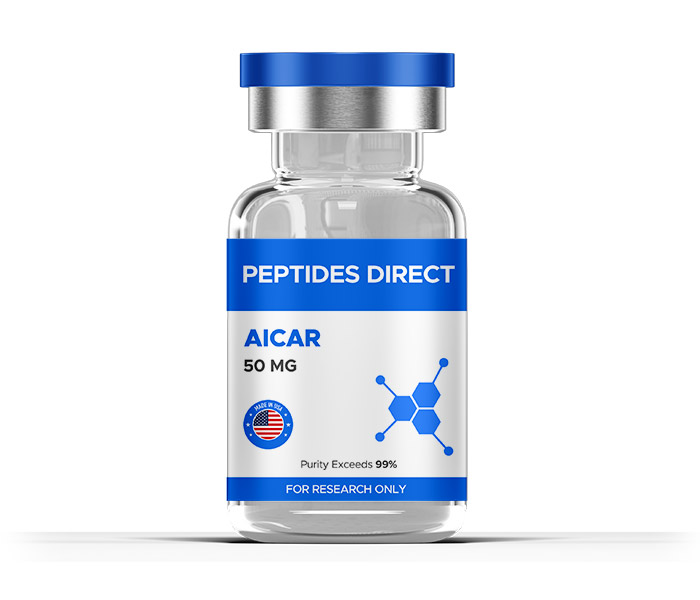
AICAR (50mg)
$56.00
AICAR peptides are Synthesized and Lyophilized in the USA.
AICAR Peptide
AICAR or 5-Aminoimidazole-4-carboxamide ribonucleotide, is a synthetic adenosine monophosphate analog. It was developed to stimulate the AMP-dependent protein kinase (AMPK) activity.[1][2] It is currently being investigated as a protective agent against ischemic damage in the cardiac myocytes during cardiac injury. The AMP-activated protein kinase is an enzyme and a protein that may play a regulatory role in several metabolic pathways. Its expression has been observed in several tissues, including the skeletal muscles, liver, and brain. In all these tissues, it is considered to exert a potential net effect on lipogenesis and may inhibit cholesterol synthesis and ketogenesis. It may also modulate insulin secretion and skeletal muscle fatty acid oxidation with glucose uptake. Several energy deficit states may trigger the release of AMPK, like hypoxia or hypoglycemia.
Specifications
SYNONYMS: Z-nucleotide, 5-amino-4-imidazolecarboxamide ribotide, 5′-Phosphoribosyl-5-amino-4-imidazolecarboxamide
MOLECULAR WEIGHT: 338.213 g/mol
MOLECULAR FORMULA: C9H15N4O8P
AICAR Research
AICAR and the Heart
AICAR has been investigated for its potential dual protective role in shielding the heart from ischemia associated with cardiovascular disease (CVD). Inflammation is widely recognized as a significant contributor to disease pathology in atherosclerosis and related cardiac conditions. Research conducted in rabbit models proposed that AICAR may suppress vascular smooth muscle proliferation.[3] Modulating vascular inflammation may reduce the risk of both short- and long-term complications associated with stent placement and may contribute positively to overall cardiac function. One immune response implicated in triggering heart attacks involves macrophage proliferation in response to elevated LDL levels — a response AICAR may play a role in suppressing.[4]
AICAR has also been studied for its potentially protective properties following a heart attack, with researchers suggesting the peptide may act by delaying cell death through a preconditioning mechanism. In the context of an ischemic heart, AICAR has been proposed to potentially reduce both the frequency and size of infarcts by up to 25%, while also improving overall blood flow to the heart.
One study set out to examine the mechanisms potentially involved in promoting myocardial glycogenolysis through AMPK activation.[5] Experiments were conducted using isolated working hearts from halothane-anesthetized murine models, perfused in the presence or absence of AICAR — an adenosine analog proposed to activate AMPK with capacity to penetrate cells. AICAR appeared to increase glycogen degradation (glycogenolysis) in the myocardium, while glycogen synthesis appeared to remain unaffected — suggesting that AMPK activation may play a specific role in glycogenolysis. AICAR also appeared to elevate myocardial levels of 5-aminoimidazole-4-carboxamide 1-beta-d-ribofuranotide (ZMP), the active intracellular form of AICAR. However, AICAR did not appear to alter the activity of glycogen synthase (GS) or glycogen phosphorylase (GP) in tissue homogenates, nor did it appear to affect glucose-6-phosphate or adenine nucleotide levels in freeze-clamped tissue. These findings suggest that ZMP may hypothetically allosterically activate GP, potentially initiating glycogenolysis in the intact murine heart.[5]
AICAR and Insulin Resistance
Insulin resistance is understood to arise from reduced muscle sensitivity to insulin alongside increased uptake in fatty tissues, a process that may also promote elevated inflammation. This results in raised insulin and blood glucose levels. Suppression of inflammation is associated with improved insulin sensitivity and enhanced glucose homeostasis. AICAR may improve insulin sensitivity and lipid metabolism through its proposed anti-inflammatory influence across various metabolic pathways. In diabetic murine models, AICAR was observed to reduce blood glucose levels without producing accompanying weight changes.[6] The compound appears to replicate the effect that physical activity may exert on muscle glucose uptake, with researchers suggesting it may upregulate GLUT-4 receptors on muscles — primary transporters involved in glucose uptake.
A separate study investigated the potential mechanisms underlying AMPK activation in preventing obesity-related diabetes using murine models.[7] AMPK, a central regulator of glucose and lipid metabolism, is hypothesized to mediate many of the beneficial metabolic effects attributed to physical activity. To examine the long-term effects of exercise and AMPK activation, male Zucker diabetic fatty (ZDF) murine models — an established genetic model of type 2 diabetes — were subjected to either daily treadmill running or AICAR administration over an 8-week period and compared to a control group. Results suggested that both the exercise and AICAR groups did not develop hyperglycemia during the intervention period, in contrast to controls. Whole-body insulin sensitivity appeared to be improved in both the exercised and AICAR-treated models relative to control ZDF animals, potentially indicating enhanced glucose metabolism and reduced insulin resistance. Additionally, pancreatic beta cell morphology — responsible for insulin production — appeared nearly normal in both intervention groups, suggesting that chronic AMPK activation may help preserve beta cell function, which is typically impaired in type 2 diabetes. The researchers posited that “activation of AMPK may represent a therapeutic approach to improve insulin action and prevent a decrease in beta-cell function associated with type 2 diabetes.”
AICAR and Cancer
AICAR, through its activation of AMPK, may play a role in modulating cancer cell metabolism. Research conducted in cell cultures and rat models indicated that prolonged AICAR exposure appeared to slow cancer cell metabolism and, consequently, their rate of proliferation.[8] It may also increase the vulnerability of cancerous cells to adverse environmental conditions — a characteristic that may support future research directions. Studies in thyroid cancer cells have further suggested that AICAR may induce apoptosis through p21 induction and caspase-3 activation, potentially inhibiting cancer cell proliferation.
A further study proposed that AICAR may induce apoptosis across all tested samples of B-CLL (B-cell chronic lymphocytic leukemia) cells.[9] The activation of caspase-3, -8, and -9, along with cytochrome c release, was suggested to be involved in AICAR-induced apoptosis. Incubation of B-CLL cells with AICAR also appeared to lead to AMPK phosphorylation, indicating likely activation of this protein. To assess whether AICAR incorporation into cells and its subsequent phosphorylation to AICA ribotide (ZMP) were necessary for apoptosis induction, the study employed various inhibitors. Nitrobenzylthioinosine (NBTI), a nucleoside transport inhibitor, 5-iodotubercidin, an adenosine kinase inhibitor, and adenosine were each suggested to potentially inhibit both AICAR-induced apoptosis and AMPK phosphorylation. In contrast, inhibitors of protein kinase A and mitogen-activated protein kinases did not appear to protect B-CLL cells from AICAR-induced apoptosis. AICAR was also not observed to affect the levels or phosphorylation of p53, suggesting the mechanism of apoptosis may be p53-independent. A comparison of normal B lymphocytes and T cells revealed that both normal B lymphocytes and B-CLL cells displayed similar sensitivity to AICAR-induced apoptosis, while T cells from B-CLL subjects showed only marginal sensitivity. Notably, AMPK phosphorylation did not appear to occur in T cells exposed to AICAR, and intracellular ZMP levels were apparently higher in B-CLL cells than in T cells — suggesting that ZMP accumulation may play a role in AMPK activation and apoptosis induction. The researchers concluded that AICAR may present a promising “new pathway involving AMPK in the control of apoptosis in B-CLL cells.”[9]
AICAR and Fertility
A considerable body of AICAR research has been directed toward its proposed role in potentially improving fertility in male subjects. Multiple studies in murine models have observed that AMPK activation appeared to positively influence fertility outcomes.[10] Given AICAR’s proposed role as an AMPK activator, sustained exposure may improve sperm motility. Should AICAR prove capable of regulating the activity of enzymes involved in sperm motility, it may hold potential for a meaningful positive effect on fertilization outcomes.
AICAR and Inflammation
AMPK activation appears to exert a broad anti-inflammatory effect at the cellular level. Inflammation underlies the pathogenesis of numerous diseases, including diabetes — positioning AICAR as a subject of interest in metabolic research. Animal studies have indicated potential beneficial effects across a range of inflammatory conditions including hepatitis, acute lung injury, asthma, colitis, and atherosclerosis.[11] AICAR may carry significant cardioprotective properties and has additionally been studied for its possible capacity to improve metabolic health and associated complications.
One study examined the mechanisms potentially underlying AMPK activation and its apparent effects on glucose transport in muscle cells.[12] Researchers investigated the role of AMPK activators — specifically AICAR — and physical activity in potentially interacting with atypical protein kinase C (aPKC) and extracellular signal-regulated kinase (ERK) in muscle cells. In cultured L6 myotubes, AMPK activation by AICAR appeared necessary to activate both aPKC and ERK. aPKC activation seemingly involved phosphorylation of Thr410-PKC-z by phosphoinositide-dependent kinase 1 (PDK1), with MEK1-dependent ERK also appearing to be required for Thr410 phosphorylation and aPKC activation. The effects of AICAR on glucose transport were reportedly inhibited upon introduction of dominant-negative AMPK, kinase-inactive PDK1, MEK1 inhibitors, kinase-inactive PKC-z, or RNA interference (RNAi)-mediated knockdown of PKC-z. Studies in murine models further demonstrated that muscle-specific depletion of aPKC (PKC-lambda) appeared to impair AICAR-induced glucose disposal and the stimulatory effects on muscle glucose uptake, while AMPK activation itself remained unaffected. Notably, treadmill exercise-induced glucose uptake stimulation was not impaired in aPKC-knockout models, suggesting aPKC activation may not be essential for exercise-induced glucose transport. Finally, examination of aPKC activation in intact rodent muscle and liver tissue indicated that aPKC was potentially activated by AICAR in muscle but not in the liver, despite apparent AMPK activation occurring in both tissues.[12]
Disclaimer: The products mentioned are not intended for human or animal consumption. Research chemicals are intended solely for laboratory experimentation and/or in-vitro testing. Bodily introduction of any sort is strictly prohibited by law. All purchases are limited to licensed researchers and/or qualified professionals. All information shared in this article is for educational purposes only.
References
- Corton, J. M., Gillespie, J. G., Hawley, S. A., & Hardie, D. G. (1995). 5-aminoimidazole-4-carboxamide ribonucleoside. A specific method for activating AMP-activated protein kinase in intact cells?. European journal of biochemistry, 229(2), 558–565. https://doi.org/10.1111/j.1432-1033.1995.tb20498.x
- Sun, N., Youle, R. J., & Finkel, T. (2016). The Mitochondrial Basis of Aging. Molecular cell, 61(5), 654–666. https://doi.org/10.1016/j.molcel.2016.01.028
- Stone, J. D., Narine, A., & Tulis, D. A. (2012). Inhibition of vascular smooth muscle growth via signaling crosstalk between AMP-activated protein kinase and cAMP-dependent protein kinase. Frontiers in physiology, 3, 409. https://doi.org/10.3389/fphys.2012.00409
- Ishii, N., Matsumura, T., Kinoshita, H., Motoshima, H., Kojima, K., Tsutsumi, A., Kawasaki, S., Yano, M., Senokuchi, T., Asano, T., Nishikawa, T., & Araki, E. (2009). Activation of AMP-activated protein kinase suppresses oxidized low-density lipoprotein-induced macrophage proliferation. The Journal of biological chemistry, 284(50), 34561–34569. https://doi.org/10.1074/jbc.M109.028043
- Longnus, S. L., Wambolt, R. B., Parsons, H. L., Brownsey, R. W., & Allard, M. F. (2003). 5-Aminoimidazole-4-carboxamide 1-beta -D-ribofuranoside (AICAR) stimulates myocardial glycogenolysis by allosteric mechanisms. American journal of physiology. Regulatory, integrative and comparative physiology, 284(4), R936–R944. https://doi.org/10.1152/ajpregu.00319.2002
- Buhl, E. S., Jessen, N., Pold, R., Ledet, T., Flyvbjerg, A., Pedersen, S. B., Pedersen, O., Schmitz, O., & Lund, S. (2002). Long-term AICAR administration reduces metabolic disturbances and lowers blood pressure in rats displaying features of the insulin resistance syndrome. Diabetes, 51(7), 2199–2206. https://doi.org/10.2337/diabetes.51.7.2199
- Pold, R., Jensen, L. S., Jessen, N., Buhl, E. S., Schmitz, O., Flyvbjerg, A., Fujii, N., Goodyear, L. J., Gotfredsen, C. F., Brand, C. L., & Lund, S. (2005). Long-term AICAR administration and exercise prevents diabetes in ZDF rats. Diabetes, 54(4), 928–934. https://doi.org/10.2337/diabetes.54.4.928
- Su, C. C., Hsieh, K. L., Liu, P. L., Yeh, H. C., Huang, S. P., Fang, S. H., Cheng, W. C., Huang, K. H., Chiu, F. Y., Lin, I. L., Huang, M. Y., & Li, C. Y. (2019). AICAR Induces Apoptosis and Inhibits Migration and Invasion in Prostate Cancer Cells Through an AMPK/mTOR-Dependent Pathway. International journal of molecular sciences, 20(7), 1647. https://doi.org/10.3390/ijms20071647
- Campàs, C., Lopez, J. M., Santidrián, A. F., Barragán, M., Bellosillo, B., Colomer, D., & Gil, J. (2003). Acadesine activates AMPK and induces apoptosis in B-cell chronic lymphocytic leukemia cells but not in T lymphocytes. Blood, 101(9), 3674–3680. https://doi.org/10.1182/blood-2002-07-2339
- Martin-Hidalgo, D., Hurtado de Llera, A., Calle-Guisado, V., Gonzalez-Fernandez, L., Garcia-Marin, L., & Bragado, M. J. (2018). AMPK Function in Mammalian Spermatozoa. International journal of molecular sciences, 19(11), 3293. https://doi.org/10.3390/ijms19113293
- Idrovo, J. P., Yang, W. L., Jacob, A., Aziz, M., Nicastro, J., Coppa, G. F., & Wang, P. (2015). AICAR attenuates organ injury and inflammatory response after intestinal ischemia and reperfusion. Molecular medicine (Cambridge, Mass.), 20(1), 676–683. https://doi.org/10.2119/molmed.2014.00134
- Sajan, M. P., Bandyopadhyay, G., Miura, A., Standaert, M. L., Nimal, S., Longnus, S. L., Van Obberghen, E., Hainault, I., Foufelle, F., Kahn, R., Braun, U., Leitges, M., & Farese, R. V. (2010). AICAR and metformin, but not exercise, increase muscle glucose transport through AMPK-, ERK-, and PDK1-dependent activation of atypical PKC. American journal of physiology. Endocrinology and metabolism, 298(2), E179–E192. https://doi.org/10.1152/ajpendo.00392.2009
Reviews
There are no reviews yet.