

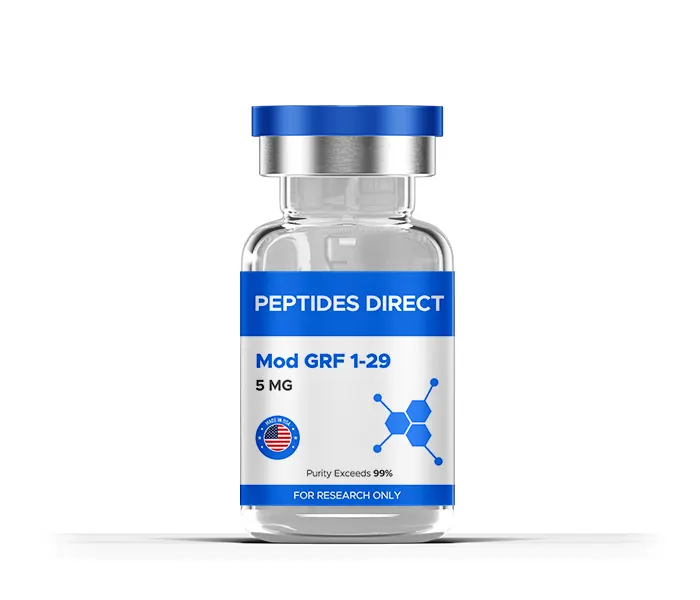
Mod GRF 1-29 (CJC-1295 NO DAC) (5mg)
$46.00
Mod GRF 1-29 (CJC-1295 NO DAC) peptides are Synthesized and Lyophilized in the USA.
Modified GRF (1-29) Peptide
Modified GRF (1-29), or Mod GRF (1-29), is a synthetic peptide that is a modified fragment of the endogenously occurring growth hormone-releasing hormone (GHRH). It was first developed in the 1980s when studies indicated that the first 29 amino acids of GHRH may possess all of the biological potential associated with the full-length 44 GHRH molecule.[1]
This discovery led to the development of a truncated version called GRF (1-29), also referred to as Sermorelin by researchers. Mod GRF (1-29) introduces specific modifications to support the peptide’s stability and efficacy. Four amino acids in the sequence are substituted at positions 2, 8, 15, and 27.[2] Here is what some researchers believe about these modifications:
– Position 2: The amino acid alanine is replaced with its mirror image, D-alanine. This substitution aims to increase resistance to enzymatic degradation, thereby improving the peptide’s stability.
– Position 8: Asparagine is substituted with lysine, an amino acid with a positively charged side chain. This change may support the peptide’s binding affinity to GHRH receptors, potentially increasing its biological activity.
– Position 15: Histidine is replaced with D-phenylalanine, another D-amino acid. This modification is intended to protect the peptide from further enzymatic breakdown.
– Position 27: Cysteine is substituted with N-methylglycine, also referred to as sarcosine. This alteration may extend the peptide’s half-life by mitigating enzymatic cleavage.
These modifications collectively aim to produce a peptide with increased stability, a longer half-life, and better-supported interaction with GHRH receptors compared to the original GRF (1-29). Modified GRF (1-29) is structurally identical to CJC-1295 without DAC. The DAC in CJC-1295 serves to modify its pharmacokinetic properties.
Specifications
Molecular Weight: 3367.95 g/mol
Molecular Formula: C152H252N44O42
Sequence: H-Tyr-D-Ala-Asp-Ala-Ile-Phe-Thr-Gln-Ser-Tyr-Arg-Lys-Val-Leu-Ala-Gln-Leu-Ser-Ala-Arg-Lys-Leu-Leu-Gln-Asp-Ile-Leu-Ser-Arg-NH2
Synonyms: Mod GRF (1-29)
Mod GRF (1-29) Research
Modified GRF 1-29 and Somatotroph Cells
Modified GRF (1-29) is believed to stimulate growth hormone release by binding to growth hormone-releasing hormone (GHRH) receptors on somatotroph cells in the anterior pituitary gland — cells considered responsible for producing and secreting growth hormone. Research suggests that when Modified GRF (1-29) attaches to these receptors, it may induce a conformational change, initiating a series of intracellular signaling events.[3] This receptor activation may lead to stimulation of G-proteins located on the inner surface of the cell membrane, which may in turn promote the production of secondary messenger molecules such as cyclic adenosine monophosphate (cAMP) and inositol triphosphate (IP3).
Elevated cAMP levels may activate protein kinases — enzymes that add phosphate groups to specific target proteins — with these phosphorylated proteins potentially including transcription factors that translocate into the cell nucleus and influence the transcription of genes involved in growth hormone synthesis and secretion. As a result of these molecular events, somatotroph cells accumulate growth hormone-containing vesicles, which may subsequently fuse with the cell membrane to facilitate hormone release.
Modified GRF 1-29 and Growth Hormone Synthesis
Scientific investigations have examined partially modified versions of Mod GRF 1-29 and the potential magnitude of their influence on growth hormone synthesis. In one notable study, researchers observed a significant increase in growth hormone secretion by anterior pituitary somatotroph cells following exposure to a Mod GRF 1-29 analog — specifically an approximate 70% to 107% rise in the average amount of growth hormone released over a 12-hour period.[4] This substantial effect suggests that modified peptides may carry a pronounced capacity to stimulate growth hormone production.
Whether these elevated growth hormone levels are sustained over time or represent a transient response remains to be clarified. Additional research has provided data indicating that Mod GRF 1-29 may elevate total RNA content in the pituitary gland and increase growth hormone messenger RNA (mRNA) levels,[5] suggesting a possible expansion of the somatotroph cell population. Researchers proposed that the peptide-induced increases in both total pituitary RNA and growth hormone mRNA levels were indicative of somatotroph cell proliferation.
Modified GRF 1-29 and Anabolic Potential
By potentially promoting growth hormone secretion, Mod GRF 1-29 may activate anabolic signaling pathways in experimental models. Studies have suggested that exposure to Mod GRF 1-29 in laboratory settings may lead to elevated levels of insulin-like growth factor 1 (IGF-1) — a critical mediator of growth hormone’s anabolic effects.[4] IGF-1 is primarily produced in liver cells but is also synthesized in various other tissues under the influence of growth hormone, with research indicating that IGF-1 levels may rise by approximately 28% following Mod GRF 1-29 exposure.
This elevation in IGF-1 has been associated with increased dermal tissue thickness, potentially attributable to the anabolic actions of growth hormone and IGF-1 on collagen-producing cells such as fibroblasts. Some data also supports observations of significant muscular tissue hypertrophy in laboratory settings, with certain trials reporting an average gain in lean muscle mass of approximately 2.77 lbs. These observations suggest that Mod GRF 1-29 may support anabolic processes under experimental conditions.
Modified GRF 1-29 and Cardiac Function
Research in rodent models has suggested that GHRH analogs structurally similar to Mod GRF 1-29 may support the heart’s capacity to pump blood, even following events typically associated with cardiac dysfunction.[6] Researchers noted that “various studies [suggest] that GHRH agonists promote repair of cardiac tissue, producing improvement of ejection fraction and reduction of infarct size in rats, reduction of infarct scar in swine, and attenuation of cardiac hypertrophy in mice.” These beneficial effects are understood to occur through activation of the GHRH receptor and may therefore be inhibited by receptor-blocking substances.
The proposed protective mechanisms may involve stimulation of intracellular signaling pathways including the adenylyl cyclase/cyclic AMP/protein kinase A (PKA) pathway, as well as activation of MAPK ERK1/2 and phosphatidylinositol 3-kinase/Akt pathways. GHRH analogs may additionally counteract artificially induced increases in pro-apoptotic signaling within these cells and may oppose experimentally induced cardiomyocyte hypertrophy — whether in adult heart cells or those derived from induced pluripotent stem cells. This includes inhibition of hypertrophy-associated gene expression and modulation of related signaling pathways, supporting signaling through Galphas/cAMP/PKA and promoting phosphorylation of phospholamban at the serine 16 position — an action considered to carry anti-hypertrophic potential.
The anti-hypertrophic properties of GHRH analogs are also proposed to involve blocking the phenylephrine-induced expression of exchange protein directly activated by cAMP1 (Epac1) — a protein recognized as a significant contributor to hypertrophic development. Despite these findings, it remains currently unclear whether Mod GRF 1-29 shares this cardioprotective and anti-hypertrophic potential with other GHRH analogs.
Modified GRF 1-29 and Thyroid, Growth Hormone
Thyroid gland dysfunction is frequently associated with concurrent irregularities in growth hormone release. Research studies have suggested that models of hyperthyroidism under the influence of thyroid replacement hormone may exhibit enhanced responses to GRF, potentially indicating a link between thyroid hormone and growth hormone regulation.[7] Scientists noted that “these data indicate that thyroid hormone enhances the responsiveness of the somatotroph to GRF 1-29.”
Modified GRF 1-29 and the Intestine
Research conducted in monkey models suggested that Modified GRF 1-29 may bind to vasoactive intestinal peptide (VIP) receptors, potentially supporting bowel motility — a function considered particularly relevant in the context of inflammatory bowel diseases. The peptide appears to interact with VPAC1, present on the smooth muscle of the reproductive, gastrointestinal, and urinary systems.[8][9] Dysfunction within these systems may contribute to a significant degree of associated morbidity.
Disclaimer: The products mentioned are not intended for human or animal consumption. Research chemicals are intended solely for laboratory experimentation and/or in-vitro testing. Bodily introduction of any sort is strictly prohibited by law. All purchases are limited to licensed researchers and/or qualified professionals. All information shared in this article is for educational purposes only.
References
- Cen, L. P., Ng, T. K., Chu, W. K., & Pang, C. P. (2022). Growth hormone-releasing hormone receptor signaling in experimental ocular inflammation and neuroprotection. Neural regeneration research, 17(12), 2643–2648. https://doi.org/10.4103/1673-5374.336135
- Jetté, L., Léger, R., Thibaudeau, K., Benquet, C., Robitaille, M., Pellerin, I., Paradis, V., van Wyk, P., Pham, K., & Bridon, D. P. (2005). Human growth hormone-releasing factor (hGRF)1-29-albumin bioconjugates activate the GRF receptor on the anterior pituitary in rats: identification of CJC-1295 as a long-lasting GRF analog. Endocrinology, 146(7), 3052–3058. https://doi.org/10.1210/en.2004-1286
- Zhou, F., Zhang, H., Cong, Z., Zhao, L. H., Zhou, Q., Mao, C., Cheng, X., Shen, D. D., Cai, X., Ma, C., Wang, Y., Dai, A., Zhou, Y., Sun, W., Zhao, F., Zhao, S., Jiang, H., Jiang, Y., Yang, D., Eric Xu, H., … Wang, M. W. (2020). Structural basis for activation of the growth hormone-releasing hormone receptor. Nature communications, 11(1), 5205. https://doi.org/10.1038/s41467-020-18945-0
- Khorram, O., Laughlin, G. A., & Yen, S. S. (1997). Endocrine and metabolic effects of long-term administration of [Nle27]growth hormone-releasing hormone-(1-29)-NH2 in age-advanced men and women. The Journal of clinical endocrinology and metabolism, 82(5), 1472–1479. https://doi.org/10.1210/jcem.82.5.3943
- Alba M, Fintini D, Sagazio A, Lawrence B, Castaigne JP, Frohman LA, Salvatori R. Once-daily administration of CJC-1295, a long-acting growth hormone-releasing hormone (GHRH) analog, normalizes growth in the GHRH knockout mouse. Am J Physiol Endocrinol Metab. 2006 Dec;291(6):E1290-4. doi: 10.1152/ajpendo.00201.2006. Epub 2006 Jul 5. PMID: 16822960.
- Schally, A. V., Zhang, X., Cai, R., Hare, J. M., Granata, R., & Bartoli, M. (2019). Actions and Potential Therapeutic Applications of Growth Hormone-Releasing Hormone Agonists. Endocrinology, 160(7), 1600–1612. https://doi.org/10.1210/en.2019-00111
- Valcavi, R., Jordan, V., Dieguez, C., John, R., Manicardi, E., Portioli, I., Rodriguez-Arnao, M. D., Gomez-Pan, A., Hall, R., & Scanlon, M. F. (1986). Growth hormone responses to GRF 1-29 in patients with primary hypothyroidism before and during replacement therapy with thyroxine. Clinical endocrinology, 24(6), 693–698. https://doi.org/10.1111/j.1365-2265.1986.tb01666.x
- Ito, T., Igarashi, H., Pradhan, T. K., Hou, W., Mantey, S. A., Taylor, J. E., Murphy, W. A., Coy, D. H., & Jensen, R. T. (2001). GI side-effects of a possible therapeutic GRF analog in monkeys are likely due to VIP receptor agonist activity. Peptides, 22(7), 1139–1151. https://doi.org/10.1016/s0196-9781(01)00436-3
- Waelbroeck, M., Robberecht, P., Coy, D. H., Camus, J. C., De Neef, P., & Christophe, J. (1985). Interaction of growth hormone-releasing factor (GRF) and 14 GRF analogs with vasoactive intestinal peptide (VIP) receptors of rat pancreas. Discovery of (N-Ac-Tyr1,D-Phe2)-GRF(1-29)-NH2 as a VIP antagonist. Endocrinology, 116(6), 2643–2649. https://doi.org/10.1210/endo-116-6-2643
Reviews
There are no reviews yet.