

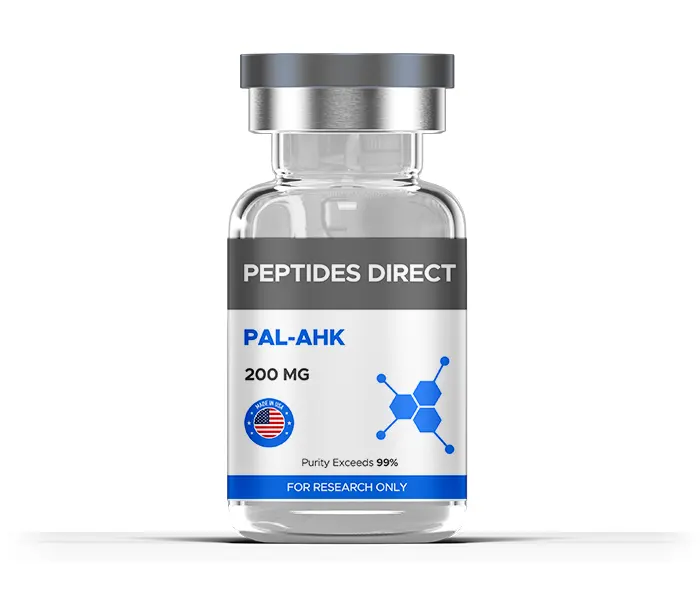
Pal-AHK (200mg)
Original price was: $192.00.$180.00Current price is: $180.00.
PAL-AHK (Palmitoyl Tripeptide-3) peptides are Synthesized and Lyophilized in the USA.
Pal-AHK Peptide
Pal-AHK, also referred to as Palmitoyl Tripeptide-3, is a tripeptide with a fatty acid attachment. It consists of amino acid sequences (alanine-histidine-lysine) and appears to be attached to a Palmitoyl fatty acid molecule. The fatty-acid component of AHK makes it lipophilic (soluble in fat), which may increase the potential of the peptide for penetration and absorption by epidermal cells in experimental models while maintaining the same mechanisms of action as regular AHK. AHK appears to be a multifunctional copper-binding peptide that has been studied for its potential role in supporting cellular functions related to the kin’s extracellular matrix.
Research indicates that AHK-Cu may increase the proliferation and viability of dermal fibroblasts—the primary cells responsible for producing collagen and other essential proteins in the extracellular matrix (ECM).[1] Moreover, the peptide appears to possess significant antioxidative potential compared to other tripeptides when investigated via chromatographic evaluations. This appears to be related to its potent metal-chelating properties.[2]
Specifications
Molecular Formula: C31H56N6O5
Molecular Weight: 592.80 g/mol
Sequence: Palimitoyl-Ala-His-Lys
Synonyms: Palmitoyl Tripeptide-3
Pal-AHK Research
Pal-AHK (Palmitoyl Tripeptide-3) and ECM Proteins
In vitro studies have examined the potential effects of AHK on cultured dermal fibroblasts.[1] Researchers observed that introducing AHK-Cu to these cells may stimulate cell proliferation and support cell viability. Assays including neutral red uptake — assessing cell viability — and sulforhodamine B staining — quantifying cell proliferation — indicated that AHK-Cu-exposed fibroblasts demonstrated increased growth relative to controls. The peptide also appears to influence collagen synthesis, particularly collagen type I — a primary extracellular matrix component.
Using sandwich ELISA assays to measure collagen levels in culture media, studies reported that AHK-exposed fibroblasts produced up to 300% more collagen type I than control cells.[1] This substantial increase suggests AHK-Cu may play a role in stimulating the biosynthetic pathways governing collagen production, though the underlying mechanisms are not yet fully characterized. It is proposed that AHK-Cu may support growth factor expression within fibroblasts — essential for cell proliferation and extracellular matrix formation — and may additionally activate matrix metalloproteinases (MMPs), enzymes involved in extracellular matrix remodeling through the degradation and reorganization of its components. MMP activation may facilitate the removal of damaged matrix proteins and promote deposition of new ones. There is also speculation that AHK-Cu may support angiogenesis — new blood vessel formation — through upregulation of vascular growth factors, potentially supporting nutrient and oxygen delivery to cells and further promoting extracellular matrix renewal and overall cellular function.
Pal-AHK (Palmitoyl Tripeptide-3) and Angiogenesis
The binding properties of the AHK tripeptide were investigated using in silico molecular docking techniques.[3] The tripeptide was docked onto vascular endothelial growth factor receptor 2 (VEGFR2) — a protein with a recognized role in angiogenesis. Through potential interaction with VEGFR2, AHK may influence pathways involved in endothelial cell proliferation and migration. This in silico approach provides a foundation for further experimental work exploring AHK tripeptide’s potential to promote angiogenesis, with murine in vivo models representing a proposed avenue for future investigation.
Pal-AHK and Hair Follicle Growth
Research suggests AHK may influence the proliferation of dermal papilla cells (DPCs) — specialized cells considered important for hair follicle morphogenesis and growth cycles. In laboratory settings, AHK has served as a reference compound for evaluating the biological effects of newly synthesized peptide derivatives on cell proliferation.[4] While certain peptide derivatives appear to stimulate cell proliferation more potently than AHK, findings suggest AHK itself may influence cell growth through mechanisms involving activation of signaling pathways such as the mitogen-activated protein kinase (MAPK) extracellular signal-regulated kinase (ERK1/2) pathway. AHK may also affect the expression of regeneration-related genes including vascular endothelial growth factor (VEGF) and fibroblast growth factors FGF-2 and FGF-7 — key regulators of blood vessel growth and keratinocyte activity.
Further research on dermal papilla cells suggests that AHK-Cu may exert its effects through modulation of apoptotic pathways within DPCs.[5] Researchers noted that the copper-containing AHK complex “stimulated the elongation of hair follicles and the proliferation of DPCs.” Exposure to the peptide may elevate the ratio of anti-apoptotic Bcl-2 to pro-apoptotic Bax proteins, potentially reducing DPC apoptosis. AHK additionally appears to decrease levels of cleaved caspase-3 and poly ADP-ribose polymerase (PARP) — proteins involved in the execution phase of apoptosis — suggesting AHK-Cu may promote hair growth by both stimulating DPC proliferation and inhibiting programmed cell death.
The complex also appears to influence growth factor production — potentially increasing VEGF secretion, which may support vascularization around hair follicles and promote their growth, while conversely reducing transforming growth factor-beta1 (TGF-beta1) secretion, a factor considered to suppress epithelial cell growth.
Disclaimer: The products mentioned are not intended for human or animal consumption. Research chemicals are intended solely for laboratory experimentation and/or in-vitro testing. Bodily introduction of any sort is strictly prohibited by law. All purchases are limited to licensed researchers and/or qualified professionals. All information shared in this article is for educational purposes only.
References
- Patt, Leonard M., and A. Procyte. “Neova® DNA Repair Factor Nourishing Lotion Stimulates Collagen and Speeds Natural Repair Process.” skin 1 (2009): 2.
- Tsuge, N., Eikawa, Y., Nomura, Y., Yamamoto, M., & Sugisawa, K. (1991). The anti-oxidative activity of peptides prepared by enzymatic hydrolysis of egg-white albumin. Journal of the Agricultural Chemical Society of Japan.
- Kecel-Gunduza, S., Kocb, E., Bicaka, B., Kokcub, Y., Ozela, A. E., & Akyuzc, S. (2020). IN SILICO ANALYSIS FOR CHARACTERIZING THE STRUCTURE AND BINDING PROPERTIES OF ALA-HIS-LYS (AHK) TRIPEPTIDE. The Online Journal of Science and Technology-July, 10(3).
- Jeong, J., Park, K. Y., & Kim, J. (2021). Synthesis and biological evaluation of dimeric peptide derivatives as proliferation‐stimulating agents in human follicle dermal papilla cells. Bulletin of the Korean Chemical Society, 42(11), 1435-1439.
- Pyo, H. K., Yoo, H. G., Won, C. H., Lee, S. H., Kang, Y. J., Eun, H. C., Cho, K. H., & Kim, K. H. (2007). The effect of the tripeptide-copper complex on human hair growth in vitro. Archives of pharmacal research, 30(7), 834–839. https://doi.org/10.1007/BF02978833
🤑 36,824.98 USDT withdraw. Continue 🚀→ graph.org/BALANCE-3682444-USD-04-21-4?hs=6b8efeafc199502a444ca8001609235d& 🤑 –
6btkhc