

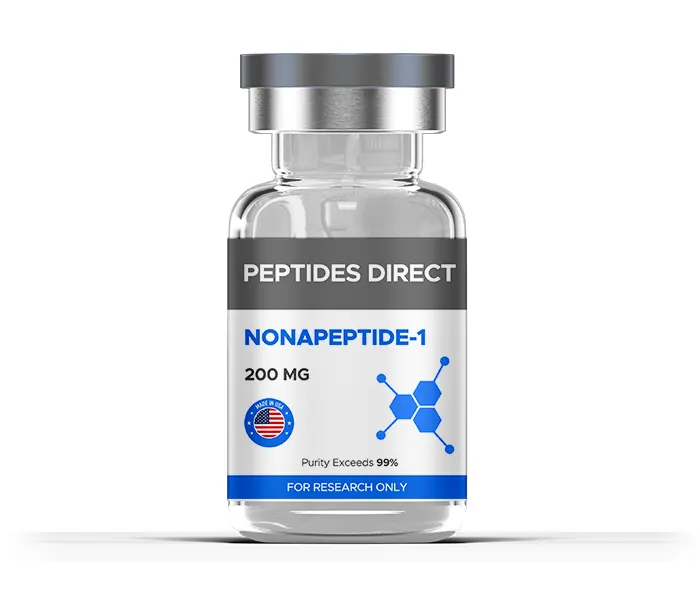
Nonapeptide-1 (200mg)
Original price was: $228.00.$219.00Current price is: $219.00.
Nonapeptide-1 peptides are Synthesized and Lyophilized in the USA.
Nonapeptide-1 Peptide
Nonapeptide-1, also designated Melanostatine-5, is a peptide proposed to inhibit the activation of melanocytes — the pigment-producing cells in the skin. It appears to be among the most potent inhibitors of the melanocortin-1 receptor (MC1R) found in these cells. Researchers examining a peptide library containing 31,360 structurally distinct compounds identified Met-Pro-D-Phe-Arg-D-Trp-Phe-Lys-Pro-Val-NH2 — designated Nonapeptide-1 — as the most potent inhibitor identified.[1] Structural analysis revealed that specific amino acids, including D-Trp at position 5 and Phe at position 6, are considered important for antagonistic potential, with D-Phe at position 3 further contributing to this profile. Research in animal models suggests that Nonapeptide-1 may inhibit melanin synthesis, bringing it to the forefront of research into conditions affecting skin pigmentation such as melasma, with studies in animal models proposing that the peptide may reduce melanin synthesis and potentially decrease pigmentation considerably.[2]
Specifications
Sequence: Met-Pro-D-Phe-Arg-D-Trp-Phe-Lys-Pro-Val
Molecular Formula: C61H87N15O9S
Molecular Weight: 1206.52g/mol
Synonyms: Melanostatine, Oxytocin Intermediate-nine peptide, Melanostatine-5
Nonapeptide-1 and General Mechanisms
Emerging research suggests that Nonapeptide-1 may reduce melanin production through multiple pathways. One proposed mechanism involves interaction with the melanocortin-1 receptor (MC1R) in melanocytes — the skin cells responsible for melanin synthesis. By binding to MC1R, Nonapeptide-1 may prevent alpha-melanocyte-stimulating hormone (alpha-MSH) from activating this receptor. Under normal conditions, alpha-MSH — a neuropeptide produced by the pituitary gland and skin cells — is proposed to bind to MC1R and trigger a signaling cascade activating the enzyme tyrosinase, leading to increased melanin production and elevated skin pigmentation, with potential added UV protection. By blocking MC1R activation by alpha-MSH, Nonapeptide-1 may therefore disrupt the signaling pathway typically resulting in elevated tyrosinase activity and melanin synthesis in experimental models of dysregulated melanin production.
In vitro studies using HaCaT keratinocytes and epidermal melanocytes (HEM) exposed to UV radiation suggest Nonapeptide-1 may also reduce MC1R expression levels, potentially further diminishing melanocyte responsiveness to alpha-MSH. The peptide additionally appears to significantly lower the expression of key melanin production proteins including tyrosinase-related proteins 1 and 2 (TRP1 and TRP2) and microphthalmia-associated transcription factor (MITF). Cells exposed to Nonapeptide-1 may consequently exhibit a reduced capacity to elevate melanin synthesis even under UVA radiation exposure.
Nonapeptide-1 and Skin Cell Pigmentation
Recent studies have explored Nonapeptide-1 as a potential research compound in investigations examining skin lightening in experimental models, with researchers hypothesizing the compound may reduce skin pigmentation by approximately 33% with potential for ongoing improvement over time.[4] The primary investigation was a prospective, double-blind, parallel-group, randomized controlled pilot study spanning eight months and divided into three phases.[5] Researchers observed apparent improvements in melasma severity scores — in experimental models of a condition characterized by dark, discolored skin patches — and in mean melanin index values quantifying pigmentation levels. They noted that “the melasma area and severity index score showed a consistent reduction in the case group, whereas it increased in the control group from baseline,” suggesting a positive potential of Nonapeptide-1 in managing experimental melasma models.
Nonapeptide-1 and Tumor Cells
Research indicates that MC1R may play a role in the growth and survival of specific tumor cell types under experimental conditions — more specifically, melanoma cells.[6] Mutations in the MC1R gene may be associated with variations in melanoma occurrence risk. In one study, MC1R inhibition using natural inhibitors structurally similar to Nonapeptide-1 appeared to reduce melanin synthesis and decrease morphological heterogeneity in murine B16-F10 melanoma cells, resulting in slower tumor cell growth. These findings suggest MC1R may be significant in regulating melanoma growth and morphology, with persistent receptor inhibition potentially slowing the proliferation of MC1R-expressing tumor cells. It is important to note that Nonapeptide-1 has not yet been specifically studied for potential effects on melanoma cells, and further research would be required to determine any relevant impact.
Nonapeptide-1 and Neurotransmitter Interactions
Scientific research proposes that Nonapeptide-1 may interact with dopaminergic and opioid receptors in the central nervous system.[7] Specifically, MC1Rs may be present in the periaqueductal gray (PAG) matter — a midbrain region considered important for pain perception and modulation, known as nociception.[8] In one notable study, genetically modified murine models engineered to overproduce an endogenous MC1R antagonist were compared to unaltered controls.[9] Researchers evaluated responses to painful and non-painful stimuli, examined reactions to induced inflammatory and neuropathic pain, and assessed aversion to capsaicin — the active compound in chili peppers that activates the TRPV1 receptor involved in harmful heat sensation — using the paired preference paradigm behavioral test. Models overexpressing the MC1R antagonist appeared to exhibit reduced inflammatory pain responses and slower development of hypersensitivity and allodynia, alongside reduced avoidance of moderate capsaicin concentrations. While comparable research has not yet been conducted specifically with Nonapeptide-1 as an MC1R antagonist, the peptide may produce analogous effects given potential similarities in receptor interaction mechanisms.
Disclaimer: The products mentioned are not intended for human or animal consumption. Research chemicals are intended solely for laboratory experimentation and/or in-vitro testing. Bodily introduction of any sort is strictly prohibited by law. All purchases are limited to licensed researchers and/or qualified professionals. All information shared in this article is for educational purposes only.
References
- Jayawickreme, C. K., Quillan, J. M., Graminski, G. F., & Lerner, M. R. (1994). Discovery and structure-function analysis of alpha-melanocyte-stimulating hormone antagonists. Journal of Biological Chemistry, 269(47), 29846-29854.
- Boo YC. Up- or Downregulation of Melanin Synthesis Using Amino Acids, Peptides, and Their Analogs. Biomedicines. 2020 Sep 1;8(9):322. doi: 10.3390/biomedicines8090322. PMID: 32882959; PMCID: PMC7555855.
- Chen J, Li H, Liang B, Zhu H. Effects of tea polyphenols on UVA-induced melanogenesis via inhibition of α-MSH-MC1R signalling pathway. Postepy Dermatol Alergol. 2022 Apr;39(2):327-335. doi: 10.5114/ada.2022.115890. Epub 2022 May 9. PMID: 35645678; PMCID: PMC9131962.
- Mohammed, Y. H., Moghimi, H. R., Yousef, S. A., Chandrasekaran, N. C., Bibi, C. R., Sukumar, S. C., Grice, J. E., Sakran, W., & Roberts, M. S. (2017). Efficacy, Safety and Targets in Topical and Transdermal Active and Excipient Delivery. Percutaneous Penetration Enhancers Drug Penetration Into/Through the Skin: Methodology and General Considerations, 369–391. https://doi.org/10.1007/978-3-662-53270-6_23
- Chatterjee, M., Neema, S., & Rajput, G. R. (2021). A randomized controlled pilot study of a proprietary combination versus sunscreen in melasma maintenance. Indian journal of dermatology, venereology and leprology, 88(1), 51–58. https://doi.org/10.25259/IJDVL_976_18
- Kansal, R. G., McCravy, M. S., Basham, J. H., Earl, J. A., McMurray, S. L., Starner, C. J., Whitt, M. A., & Albritton, L. M. (2016). Inhibition of melanocortin 1 receptor slows melanoma growth, reduces tumor heterogeneity and increases survival. Oncotarget, 7(18), 26331–26345. https://doi.org/10.18632/oncotarget.8372
- Puciłowski O, Płaźnik A, Kostowski W. Melanostatyna (MIF-1): działania ośrodkowe i próby kliniczne [Melanostatin (MIF-1): central action and clinical use]. Pol Tyg Lek. 1983 Jun 13;38(24):739-41. Polish. PMID: 6139794.
- Xia, Y., Wikberg, J. E., & Chhajlani, V. (1995). Expression of melanocortin 1 receptor in periaqueductal gray matter. Neuroreport, 6(16), 2193-2196.
- Delaney, A., Keighren, M., Fleetwood-Walker, S. M., & Jackson, I. J. (2010). Involvement of the melanocortin-1 receptor in acute pain and pain of inflammatory but not neuropathic origin. PloS one, 5(9), e12498. https://doi.org/10.1371/journal.pone.0012498
Reviews
There are no reviews yet.