

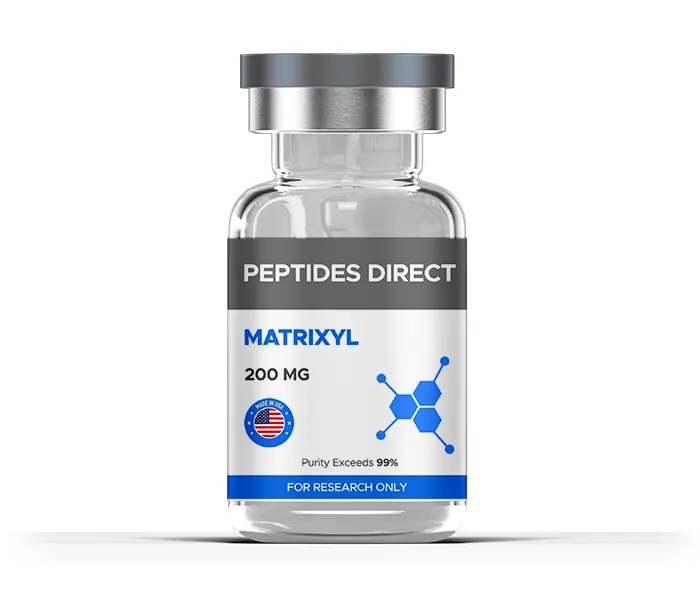
Matrixyl (200mg)
$190.00
Matrixyl peptides are Synthesized and Lyophilized in the USA.
Matrixyl Peptide
Matrixyl is a lipopeptide that combines fatty acids with amino acids. The peptide is also sometimes referred to as palmitoyl pentapeptide-4 or palmitoyl pentapeptide-3. The palmitoylated sequence of Lys-Thr-Thr-Lys-Ser-OH, which makes up the peptide, is posited to be a signal peptide fragment of the C-terminal propeptide of type I collagen.[1] Researchers report that “The conjugation with the palmitoyl moiety [may] result in more [impactful] delivery across the skin and better stability to skin proteases.” Overall, this signal peptide is posited to act as a stimulus to fibroblasts and stimulate them into producing extracellular matrix (ECM) proteins such as collagen. Therefore, Matrixyl is considered by researchers to be a matrikine – a messenger peptide capable of regulating cell activities by interacting with their specific receptors.
Specifications
MOLECULAR WEIGHT: 802.05 g/mol
MOLECULAR FORMULA: C39H75N7O10
SEQUENCE: Pal-Lys-Thr-Thr-Ser-OH or Pal-KTTS-OH
SYNONYMS: palmitoyl pentapeptide-3
Matrixyl Research
Matrixyl and Fibroblasts
Fibroblasts are cells responsible for producing collagen — a key structural protein in dermal tissue. When skin cells are exposed to varying concentrations of Matrixyl, researchers have observed what appeared to be a concentration-dependent increase in collagen synthesis, particularly at concentrations approaching a specific threshold known as the critical aggregation concentration (CAC).[2] The CAC represents the concentration at which Matrixyl molecules begin to self-assemble into larger nanostructures. One proposed explanation for this increased collagen production is that Matrixyl may self-assemble around the CAC, forming organized nanostructures such as nanotapes or fibrils.
These formations are thought to present peptide sequences in a configuration that supports interaction with fibroblasts, potentially facilitating increased collagen synthesis. The specific arrangement of peptides within these nanostructures may make it easier for fibroblasts to recognize and respond to the peptide, thereby supporting collagen deposition. Notably, while Matrixyl appeared to reduce the rate of fibroblast cell division — known as cell proliferation — the amount of collagen produced per cell appeared to increase, suggesting Matrixyl may encourage fibroblasts to prioritize collagen production over division.
Further research proposes that by potentially enhancing fibroblast collagen output, Matrixyl may help counteract dermal matrix degradation associated with photoaging.[3] This degradation is frequently linked to wrinkle formation and loss of skin elasticity, positioning Matrixyl as a candidate for laboratory research focused on attenuating dermal cell photoaging through support of collagen-based structural integrity.
Matrixyl and Wound Closure
Researchers investigating Matrixyl have noted that the “delicate balance between the wound healing properties and pro-fibrotic abilities of pentapeptide should be considered” in the context of wound closure.[4] More specifically, Matrixyl is believed to modulate fibroblast activity — particularly in relation to fibroblast trans-differentiation into myofibroblasts, a key process in wound contraction and scar formation. Myofibroblasts are proposed to contribute to wound closure through their contractile capacity, though their persistence beyond the normal healing period may lead to excessive scarring. Experimental studies have examined Matrixyl’s proposed influence on the expression of alpha-smooth muscle actin (alpha-SMA) and connective tissue growth factor (CTGF), both associated with fibrotic processes.
Observations indicate that Matrixyl may reduce alpha-SMA expression in fibroblasts, suggesting a possible decrease in myofibroblast formation that may influence the extent of wound contraction and scarring. Matrixyl may also influence CTGF levels, which play a role in collagen production and extracellular matrix remodeling. Through potential CTGF modulation, Matrixyl is proposed to affect the balance between tissue repair and fibrotic scarring, given that sustained overexpression of both CTGF and alpha-SMA is associated with fibrotic tissue formation.
In experimental murine models, Matrixyl has been investigated for its potential role in supporting tissue healing,[5] with the peptide proposed to reach dermal fibroblasts, potentially bind to cell surface receptors, and activate signaling pathways similar to the TGF-beta pathway. This activation may lead to increased collagen production and inhibited collagenase activity, potentially supporting extracellular matrix formation. Studies suggest Matrixyl may accelerate wound closure and support collagen density relative to controls, with scientists noting that “the macroscopic results indicated that wound healing was raised from 63.5 up to 81.81% in Matrixyl groups compared to that in the negative control group” — implying potential as a tissue repair and regeneration agent in laboratory settings.
Matrixyl and Wrinkles
Researchers suggest Matrixyl may stimulate production of multiple collagen types including types I, III, and IV, alongside potential upregulation of other ECM proteins such as elastin, fibronectin, and glycosaminoglycans. By potentially supporting the synthesis of these structural proteins, Matrixyl may contribute to improved tissue firmness and elasticity, potentially reducing wrinkle appearance. Experimental observations have indicated that formulations containing Matrixyl may produce measurable reductions in wrinkle depth and thickness alongside improvements in tissue firmness,[6] with reductions in fold depth of 18%, fold thickness of 37%, and firmness increases of 21% reported in certain settings.
These findings suggest Matrixyl may positively influence tissue properties associated with wrinkling. Laboratory studies employing advanced topometric techniques including Fast Optical Topometry have additionally proposed support for improvements in dermal layer roughness parameters,[7] with reductions in mean and maximum dermal roughness observed in research models — potentially indicating decreased wrinkle depth and improved overall dermal tissue smoothness.
Disclaimer: The products mentioned are not intended for human or animal consumption. Research chemicals are intended solely for laboratory experimentation and/or in-vitro testing. Bodily introduction of any sort is strictly prohibited by law. All purchases are limited to licensed researchers and/or qualified professionals. All information shared in this article is for educational purposes only.
References
- Errante F, Ledwoń P, Latajka R, Rovero P, Papini AM. Cosmeceutical Peptides in the Framework of Sustainable Wellness Economy. Front Chem. 2020 Oct 30;8:572923. doi: 10.3389/fchem.2020.572923. PMID: 33195061; PMCID: PMC7662462.
- Jones RR, Castelletto V, Connon CJ, Hamley IW. Collagen stimulating effect of peptide amphiphile C16-KTTKS on human fibroblasts. Mol Pharm. 2013 Mar 4;10(3):1063-9. doi: 10.1021/mp300549d. Epub 2013 Feb 4. PMID: 23320752.
- Robinson LR, Fitzgerald NC, Doughty DG, Dawes NC, Berge CA, Bissett DL. Palmitoyl pentapeptide provides improvement in photoaged human facial skin. Int J Cosmet Sci. 2005 Jun;27(3):155-60. doi: 10.1111/j.1467-2494.2005.00261.x. PMID: 18492182.
- Park H, An E, Cho Lee AR. Effect of Palmitoyl-Pentapeptide (Pal-KTTKS) on Wound Contractile Process in Relation with Connective Tissue Growth Factor and α-Smooth Muscle Actin Expression. Tissue Eng Regen Med. 2017 Jan 19;14(1):73-80. doi: 10.1007/s13770-016-0017-y. PMID: 30603464; PMCID: PMC6171572.
- Kachooeian M, Mousivand Z, Sharifikolouei E, Shirangi M, Firoozpour L, Raoufi M, Sharifzadeh M. Matrixyl Patch vs Matrixyl Cream: A Comparative In Vivo Investigation of Matrixyl (MTI) Effect on Wound Healing. ACS Omega. 2022 Jul 11;7(28):24695-24704. doi: 10.1021/acsomega.2c02592. PMID: 35874243; PMCID: PMC9301720.
- Aruan RR, Hutabarat H, Widodo AA, Firdiyono MTCC, Wirawanty C, Fransiska L. Double-blind, Randomized Trial on the Effectiveness of Acetylhexapeptide-3 Cream and Palmitoyl Pentapeptide-4 Cream for Crow’s Feet. J Clin Aesthet Dermatol. 2023 Feb;16(2):37-43. PMID: 36909866; PMCID: PMC10005804.
- Kaczvinsky JR, Griffiths CE, Schnicker MS, Li J. Efficacy of anti-aging products for periorbital wrinkles as measured by 3-D imaging. J Cosmet Dermatol. 2009 Sep;8(3):228-33. doi: 10.1111/j.1473-2165.2009.00444.x. PMID: 19735523.
Reviews
There are no reviews yet.