

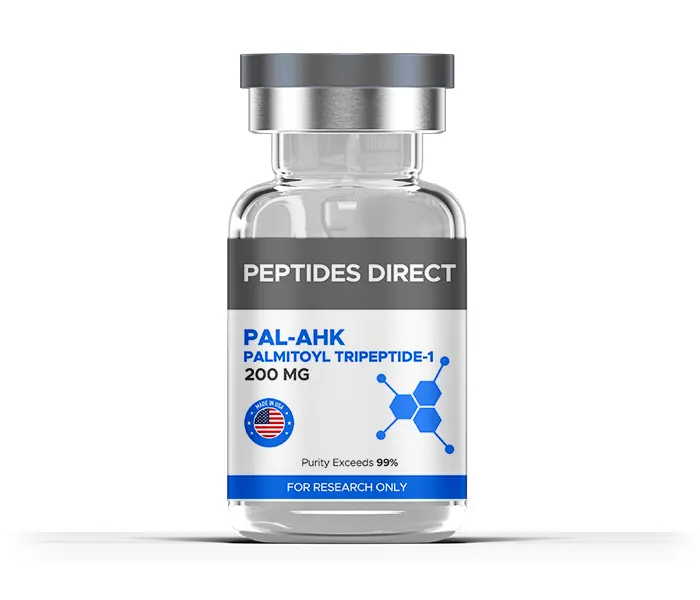
Pal-GHK (Palmitoyl Tripeptide-1) (200mg)
$199.00
Pal-GHK (Palmitoyl Tripeptide-1) peptides are Synthesized and Lyophilized in the USA.
Pal-GHK (Palmitoyl Tripeptide-1) Peptide
Pal-GHK, also known as Palmitoyl Tripeptide-1 and Palmitoyl Oligopeptide, is a synthetic peptide developed to function in protein production to support the skin’s extracellular matrix (ECM), and skin pigmentation. Pal-GHK is a synthetic hybrid peptide with one fatty acid and one peptide. “Pal” represents Palmitoyl—the covalent attachment of fatty acid to the end of the structure. “GHK” represents glycine-histidine-lysine—the peptide’s amino acid structure. This sequence is thought to be a small fraction of the large protein collagen, which is one of the main proteins in the extracellular matrix of skin and other tissues. The GHK sequence appears to be present in the “alpha 2(I) chain of type I collagen”, and researchers suggest that such a “tripeptide might be liberated by proteases at the site of a wound” as a signal of injury and thus, may be a powerful stimulant for repair.[1] Particularly, it may signal and attract fibroblasts—cells responsible for synthesizing collagen, elastin, and other proteins in the skin’s extracellular matrix, bones, and connective tissues. “Pal” represents Palmitoyl—the covalent attachment of fatty acid to the end of the structure. The addition of palmitoyl to the molecule is thought to result in better penetration through skin cells and, more specifically, stratum corneum.[2]
Specifications
Sequence: Palmitoyl-Gly-His-Lys
Molecular Formula: C30H54N6O5
Molecular Weight: 578.8 g/mol
Synonyms: Palmitoyl Tripeptide-1, Palmitoyl Oligopeptide
Pal-GHK Research
Pal-GHK Antioxidative Potential
Research suggests there is “biological data demonstrating positive effects of GHK in skin and proposes interaction with antioxidant-related genes as a possible explanation of its antioxidant activity.”[3] The antioxidative potential of the GHK sequence in Pal-GHK may offer protective effects for skin cells, potentially reducing their susceptibility to accelerated aging driven by active radicals and oxidative stress factors such as UV radiation. Active radicals that may mediate UV-induced oxidative stress in skin cells include reactive oxygen species (ROS), reactive nitrogen species (RNS), and reactive carbonyl species (RCS). Studies suggest Pal-GHK may carry anti-RCS properties — particularly against radicals including acrolein, malondialdehyde, and 4-hydroxynoneal — potentially reducing the risk of protein glycation in skin cell and ECM structures.[4]
Pal-GHK and Skin Thickness
Pal-GHK may function as a messenger for collagen renewal, potentially stimulating collagen and glycosaminoglycan synthesis and contributing to epidermal reinforcement. Some data suggests Pal-GHK may influence transforming growth factor beta (TGF-beta) — a cytokine involved in cell growth and differentiation — to stimulate fibrillogenesis, the formation of collagen fibrils, which may contribute to increased skin thickness. In a placebo-controlled setting, researchers observed a small yet statistically significant apparent increase in skin thickness of approximately 4% following Pal-GHK exposure relative to placebo.[5] A separate 12-week clinical experiment also suggested that the peptide’s amino acid sequence may enhance collagen synthesis in dermal fibroblasts.[6] Researchers noted that the GHK sequence significantly improved collagen production and stimulated dermal keratinocyte proliferation, with the research confirming increased skin thickness, improved hydration, notable skin smoothing through stimulated collagen synthesis, improved skin elasticity, and increased type I collagen production — further supported by immunohistological assessments indicating GHK may promote procollagen and collagen synthesis in these cells.
Pal-GHK and Skin Appearance
Researchers suggest Pal-GHK may also be associated with enhanced moisture retention.[7] When combined with short peptides, Pal-GHK appears to act cooperatively to reduce skin wrinkling prevalence and increase the moisture retention capacity of skin cells. Pal-GHK has additionally been suggested to contribute to reductions in redness and discolored skin following photodamage (melasma) in animal models.[8]
Pal-GHK and Skin Repair
Studies have examined the potential of the GHK amino acid sequence in enhancing skin tissue recovery under laboratory conditions. Researchers reported that when large plantar ulcers were exposed to the peptide, a pronounced improvement in closure was observed and the incidence of ulcer infections was lower in the GHK group relative to placebo — with scientists noting that “the incidence of ulcer infections was significantly lower (7% incidence compared with 34% for vehicle, p less than 0.05) in the plantar ulcers.”[9] A separate laboratory experiment suggested GHK may facilitate faster wound filling to skin level with granulation tissue compared to controls,[10] with the time required for wounds to fill reduced from 25 days in controls to 14 days in the GHK group, and average complete healing time shorter in the GHK group (approximately 29.8 days) compared to controls (34.6 days).
Histopathological evaluations suggested GHK may contribute to decreased neutrophil counts and increased neovascularization within the wound area — implying promotion of a more favorable inflammatory response and enhanced new blood vessel formation, both considered critical to wound healing. Further research into GHK’s effects on wound closure in ischemic conditions over 13 days suggested the peptide may produce a notable reduction in wound area compared to control and vehicle groups.[11] By day 13, the initial wound area had decreased by approximately 64.5% in the GHK group, compared to approximately 45.6% in the vehicle group and 28.2% in controls. Biopsies collected on days 6, 10, and 13 additionally revealed that GHK-Cu-exposed wounds contained lower concentrations of pro-inflammatory markers including TNF-alpha, MMP-2, and MMP-9.
Disclaimer: The products mentioned are not intended for human or animal consumption. Research chemicals are intended solely for laboratory experimentation and/or in-vitro testing. Bodily introduction of any sort is strictly prohibited by law. All purchases are limited to licensed researchers and/or qualified professionals. All information shared in this article is for educational purposes only.
References
- Maquart, F. X., Pickart, L., Laurent, M., Gillery, P., Monboisse, J. C., & Borel, J. P. (1988). Stimulation of collagen synthesis in fibroblast cultures by the tripeptide-copper complex glycyl-L-histidyl-L-lysine-Cu2+. FEBS letters, 238(2), 343–346. https://doi.org/10.1016/0014-5793(88)80509-x
- Gorouhi F, Maibach HI. Role of topical peptides in preventing or treating aged skin. Int J Cosmet Sci. 2009 Oct;31(5):327-45. doi: 10.1111/j.1468-2494.2009.00490.x. Epub 2009 Jun 30. PMID: 19570099.
- Pickart, L., Vasquez-Soltero, J. M. & Margolina, A. GHK-Cu may Prevent Oxidative Stress in Skin by Regulating Copper and Modifying Expression of Numerous Antioxidant Genes. Cosmetics 2, 236–247 (2015).
- Cebrián J, Messeguer A, Facino RM, García Antón JM. New anti-RNS and -RCS products for cosmetic treatment. Int J Cosmet Sci. 2005 Oct;27(5):271-8. doi: 10.1111/j.1467-2494.2005.00279.x. PMID: 18492208.
- Lintner K, Peschard O. Biologically active peptides: from a laboratory bench curiosity to a functional skin care product. Int J Cosmet Sci. 2000 Jun;22(3):207-18. doi: 10.1046/j.1467-2494.2000.00010.x. PMID: 18503476.
- Abdulghani, A. A., Sherr, A., Shirin, S., Solodkina, G., Tapia, E. M., Wolf, B., & Gottlieb, A. B. (1998). Effects of topical creams containing vitamin C, a copper-binding peptide cream and melatonin compared with tretinoin on the ultrastructure of normal skin-A pilot clinical, histologic, and ultrastructural study. Disease Management and Clinical Outcomes, 4(1), 136-141.
- Trookman, N. S., Rizer, R. L., Ford, R., Mehta, R. & Gotz, V. Clinical assessment of a combination lip treatment to restore moisturization and fullness. J. Clin. Aesthetic Dermatol. 2, 44–48 (2009).
- Dupont, E. et al. Clinical efficacy of a serum integrating multiple cosmetic ingredients in the management of erythema of the face in aging skin. J. Cosmet. Dermatol. 11, 207–212 (2012)., Bradley, E. J., Griffiths, C. E. M., Sherratt, M. J., Bell, M. & Watson, R. E. B. Over-the-counter anti-ageing agents and their ability to protect and repair photoaged skin. Maturitas 80, 265–272 (2015). DOI: 10.1016/j.maturitas.2014.12.019
- Mulder GD, Patt LM, Sanders L, Rosenstock J, Altman MI, Hanley ME, Duncan GW. Enhanced healing of ulcers in patients with diabetes by topical treatment with glycyl-l-histidyl-l-lysine copper. Wound Repair Regen. 1994 Oct;2(4):259-69. doi: 10.1046/j.1524-475X.1994.20406.x. PMID: 17147644.
- Gul NY, Topal A, Cangul IT, Yanik K. The effects of topical tripeptide copper complex and helium-neon laser on wound healing in rabbits. Vet Dermatol. 2008 Feb;19(1):7-14. doi: 10.1111/j.1365-3164.2007.00647.x. PMID: 18177285.
- Canapp SO Jr, Farese JP, Schultz GS, Gowda S, Ishak AM, Swaim SF, Vangilder J, Lee-Ambrose L, Martin FG. The effect of topical tripeptide-copper complex on healing of ischemic open wounds. Vet Surg. 2003 Nov-Dec;32(6):515-23. doi: 10.1111/j.1532-950x.2003.00515.x. PMID: 14648529.
Reviews
There are no reviews yet.