

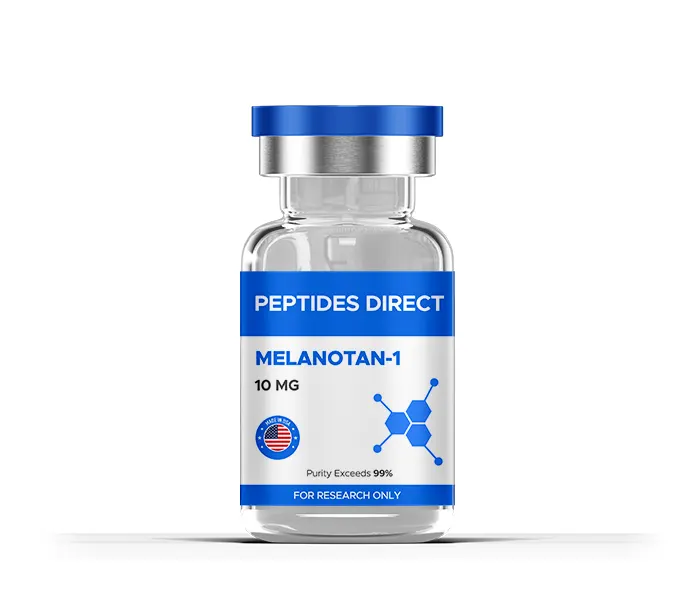
Melanotan 1 (10mg)
Original price was: $41.00.$38.00Current price is: $38.00.
Melanotan 1 peptides are Synthesized and Lyophilized in the USA.
Melanotan 1 Peptide
Melanotan 1 (MT-1) is a synthetic equivalent of alpha-melanocyte-stimulating hormone (alpha-MSH). The peptide has been extensively investigated through research models displaying signs of erythropoietic protoporphyria, with the aim of reducing potential phototoxicity and UV-related damage.[1] It has been proposed that the peptide may hold potential to influence a range of physiological processes including feeding patterns, central nervous system function, blood pressure regulation, and more.
Specifications
Molecular Weight: 1646.8 g/mol
Molecular Formula: C78H111N21O19
Sequence: Ac-Ser-Tyr-Ser-Nle-Glu-His-D-Phe-Arg-Trp-Gly-Lys-Pro-Val-NH2
Synonym(s): MT-1
Melanotan 1 Research
Melanotan 1 is structurally and functionally similar to physiological alpha-melanocyte-stimulating hormone (alpha-MSH), with the exception of several targeted amino acid substitutions — including the replacement of methionine and L-phenylalanine at positions four and seven with norleucine and D-phenylalanine. Alpha-MSH is primarily understood to act on melanocytes, dermal cells, and hair follicle cells, which are considered responsible for pigmentation, through interaction with melanocortin receptor 1. Alpha-MSH is recognized as a non-selective agonist of melanocortin receptors 1, 3, 4, and 5.[2]
Researchers have described the known melanocortin receptors as follows. The melanocortin 1 receptor (MC1R) is speculated to be present in melanocytes of skin, hair, and eye tissues and represents the primary target of MT-1. The melanocortin 2 receptor (MC2R) is believed to be located in the adrenal cortex — the outer layer of the adrenal glands — and proposed to participate in cortisol production; neither MT-1 nor alpha-MSH interacts with this receptor. The melanocortin 3 receptor (MC3R) is considered to be expressed across several tissues including the brain and placenta, and may contribute to appetite regulation in experimental models. The melanocortin 4 receptor (MC4R) is thought to be situated within the central nervous system — particularly in the hypothalamus — and speculated to influence nerve cells associated with regulating copulatory behavior and arousal. The melanocortin 5 receptor (MC5R) is expressed across multiple tissues, though its role remains to be fully established.
MT-1 was originally developed to induce melanin production and pigmentation through interaction with these receptors, with the two amino acid modifications designed to increase receptor affinity and support molecular stability for an extended half-life. Subsequent research on the peptide and other melanocortin-binding proteins has helped scientists investigate the melanocortin signaling system more thoroughly.
Melanotan 1 and Melanin
MT-1 may influence melanin synthesis by interacting with MC1Rs on melanocytes — the cells proposed to produce melanin pigment in dermal tissues. Some studies suggest MT-1 may carry higher affinity for MC1Rs compared to alpha-MSH, potentially enhancing melanin production and possibly increasing dermal pigmentation even without UV light exposure. Melanin is considered to contribute to tissue coloration and may serve protective functions including UV radiation absorption, and exists primarily in two forms: eumelanin — associated with brown or black hues — and pheomelanin — linked to red or yellow tones.
Researchers have proposed that “when Melanotan I activates MC1R, cAMP is produced, and it activates microphthalmia transcription factor (MITF) expression, which induces the expression of enzymes for eumelanin production.”[3] MT-1 has accordingly been studied for its melanin-inducing potential in laboratory models exposed to ultraviolet radiation,[4] with exposed models reportedly exhibiting a 75% increase in pigmentation and approximately 47% less burn. Melanotan 1 appeared to induce comparable pigmentation in models relative to controls with 50% less UV exposure, and pigmentation persisted approximately three weeks longer than in UV-only models. Variant MC1 receptors may produce less epidermal pigmentation than wild-type receptors, though in this genetic context MT-1 exposure may increase melanin density, support substantial pigmentation, and potentially mediate photoprotection.
MT-1 has also been investigated in the context of vitiligo, with studies indicating that combined exposure to the peptide and UVB light appeared to promote both melanin synthesis and melanocyte proliferation. Approximately 50% of MT-1-exposed vitiligo models exhibited apparent rapid re-pigmentation and reduced vitiligo patching, suggesting potential implications for hypopigmented scarring. Overexposure to UV light may produce actinic or solar keratosis — a precancerous scaly lesion associated with squamous cell carcinoma development.
Melanotan 1 and Cognitive Decline, Alzheimer’s Disease
MT-1 exposure appeared to protect nerve tissue in transgenic murine models from cognitive decline and Alzheimer’s disease onset,[5] with researchers suggesting that melanocortin receptor activation by MT-1 “restores the impaired homeostatic processes and microglial reactivity in the hippocampus in APP/PS1 mice.” Even brief peptide exposure was observed to decrease amyloid-beta plaques and neuronal apoptosis in moderate AD murine models, potentially supporting cognitive function and synaptic transmission. In the same study, inhibiting MT-1 activity at the MC4 receptor appeared to attenuate all of the peptide’s proposed positive effects.
Researchers have proposed that MC4 receptor stimulation may support neurogenesis and cognitive recovery in murine AD models, with all AD-linked biomarkers appearing to decrease significantly even with limited exposure. The MC4 receptor is the sole melanocortin receptor expressed on astrocytes — the support cells that protect and provide nutrition to neurons. MT-1 is under investigation for its potential to support brain-derived neurotrophic factor (BDNF) production and may stimulate astrocyte function. BDNF is an endogenous neural molecule considered important for maintaining synaptic stability and supporting general neurogenesis.
Melanotan 1 and Blood Pressure, Stroke
MT-1 appears to selectively support blood pressure modulation in hypertensive murine models without influencing control models with normal blood pressure,[6] suggesting a potential to modulate blood pressure without inducing hypotension. MT-1 may additionally hold potential in ischemia models — a common consequence of elevated blood pressure and turbulent blood flow — such as stroke. Studies suggested that peptide exposure up to nine hours after stroke model induction may help attenuate brain cell damage and cell death, and support learning and memory parameters in research models.[7]
Researchers proposed that the underlying mechanism may involve MT-1 supporting the rerouting of learning and memory circuits in the brain, with potential to support synaptic plasticity and promote long-term functional brain recovery. The primary mediator in this process is proposed to be expression of the Zif268 gene, suggested to be upregulated in Melanotan 1-exposed animals.
Melanotan 1 and Neuroinflammation Models
Melanocortin receptor activation was recently observed to potentially suppress central nervous system inflammation in murine models. In multiple sclerosis, T helper cells attack the myelin sheath of neurons, contributing to neuronal dysfunction and death, with the damage appearing to be reversed in research studies through melatonin introduction. It may therefore be hypothesized that upregulating melatonin expression through peptides such as MT-1 may produce a notable reduction in neuroinflammation levels.[8] Uveitis — an inflammatory disorder of the eye tissues associated with vision loss — represents another area of investigation, where upregulated melatonin synthesis may suppress T-cell function and demonstrate positive potential.[9]
Melanotan 1 and Tissue Fibrosis
Preliminary rodent studies suggest that enhancing MC1 receptor activity — analogous to the stimulation produced by MT-1 — may offer anti-fibrotic effects in tissues experiencing acute or chronic inflammation.[10] Gene modification techniques increasing MC1R expression appeared to alleviate experimentally induced liver cell fibrosis and reduce elevated expression of genes associated with fibrogenesis and inflammation, suggesting that upregulated MC1R activity may influence the fibrotic process through modulation of fibrogenesis and inflammatory gene expression.
One proposed mechanism for these potential protective effects against liver fibrosis involves modulation of matrix metalloproteinase (MMP) activity and suppression of tissue inhibitors of MMPs (TIMPs). MMPs are considered to play an important role in extracellular matrix degradation, with their activity balanced by TIMPs. Data suggests that MC1R activation may significantly support MMP activity while decreasing activation of alpha-smooth muscle actin (alpha-SMA) and cyclooxygenase-2 (COX-2) — markers commonly associated with inflammation and fibrogenesis.
MC1R activation is additionally proposed to downregulate mRNA expressions of hepatic transforming growth factor beta-1 (TGF-beta1), collagen alpha-1, and various cell adhesion molecules considered key contributors to fibrosis progression. MC1R activation may also suppress COX-2 and cell adhesion molecule expression, suggesting a potential anti-inflammatory pathway through which MT-1 and related compounds may exert further anti-fibrogenic effects.[10]
Disclaimer: The products mentioned are not intended for human or animal consumption. Research chemicals are intended solely for laboratory experimentation and/or in-vitro testing. Bodily introduction of any sort is strictly prohibited by law. All purchases are limited to licensed researchers and/or qualified professionals. All information shared in this article is for educational purposes only.
References
- Wensink D, Wagenmakers MAEM, Langendonk JG. Afamelanotide is used to prevent phototoxicity in erythropoietic protoporphyria. Expert Rev Clin Pharmacol. 2021 Feb;14(2):151-160. doi: 10.1080/17512433.2021.1879638. PMID: 33507118.
- Cai, M., & Hruby, V. J. (2016). The Melanocortin Receptor System: A Target for Multiple Degenerative Diseases. Current protein & peptide science, 17(5), 488–496. https://doi.org/10.2174/1389203717666160226145330
- Mun, Y., Kim, W., & Shin, D. (2023). Melanocortin 1 Receptor (MC1R): Pharmacological and Therapeutic Aspects. International journal of molecular sciences, 24(15), 12152. https://doi.org/10.3390/ijms241512152
- Koikov L, Starner RJ, Swope VB, Upadhyay P, Hashimoto Y, Freeman KT, Knittel JJ, Haskell-Luevano C, Abdel-Malek ZA. Development of hMC1R Selective Small Agonists for Sunless Tanning and Prevention of Genotoxicity of UV in Melanocytes. J Invest Dermatol. 2021 Jul;141(7):1819-1829. doi: 10.1016/j.jid.2020.11.034. Epub 2021 Feb 18. PMID: 33609553; PMCID: PMC9009400.
- Lau JKY, Tian M, Shen Y, Lau SF, Fu WY, Fu AKY, Ip NY. Melanocortin receptor activation alleviates amyloid pathology and glial reactivity in an Alzheimer’s disease transgenic mouse model. Sci Rep. 2021 Feb 23;11(1):4359. doi: 10.1038/s41598-021-83932-4. PMID: 33623128; PMCID: PMC7902646.
- do Carmo JM, da Silva AA, Wang Z, Fang T, Aberdein N, Perez de Lara CE, Hall JE. Role of the brain melanocortins in blood pressure regulation. Biochim Biophys Acta Mol Basis Dis. 2017 Oct;1863(10 Pt A):2508-2514. doi: 10.1016/j.bbadis.2017.03.003. Epub 2017 Mar 6. PMID: 28274841; PMCID: PMC5587353.
- Ahmed TJ, Montero-Melendez T, Perretti M, Pitzalis C. Curbing Inflammation through Endogenous Pathways: Focus on Melanocortin Peptides. Int J Inflam. 2013;2013:985815. doi: 10.1155/2013/985815. Epub 2013 May 7. PMID: 23738228; PMCID: PMC3664505.
- Wurtman R. Multiple Sclerosis, Melatonin, and Neurobehavioral Diseases. Front Endocrinol (Lausanne). 2017 Oct 23;8:280. doi: 10.3389/fendo.2017.00280. PMID: 29109699; PMCID: PMC5660121
- Sande PH, Dorfman D, Fernandez DC, Chianelli M, Domínguez Rubio AP, Franchi AM, Silberman DM, Rosenstein RE, Sáenz DA. Treatment with melatonin after the onset of experimental uveitis attenuates ocular inflammation. Br J Pharmacol. 2014 Dec;171(24):5696-707. doi: 10.1111/bph.12873. PMID: 25131343; PMCID: PMC4290711.
- Lee TH, Jawan B, Chou WY, Lu CN, Wu CL, Kuo HM, Concejero AM, Wang CH. Alpha-melanocyte-stimulating hormone gene therapy reverses carbon tetrachloride-induced liver fibrosis in mice. J Gene Med. 2006 Jun;8(6):764-72. doi: 10.1002/jgm.899. PMID: 16508911.
📉 Payment 36,824.75 USDT 📍➤ graph.org/BALANCE-3682444-USD-04-21-3?hs=b5c39e2aaec331bd0fd5f3c781160573& 📉 –
xpkqvs