

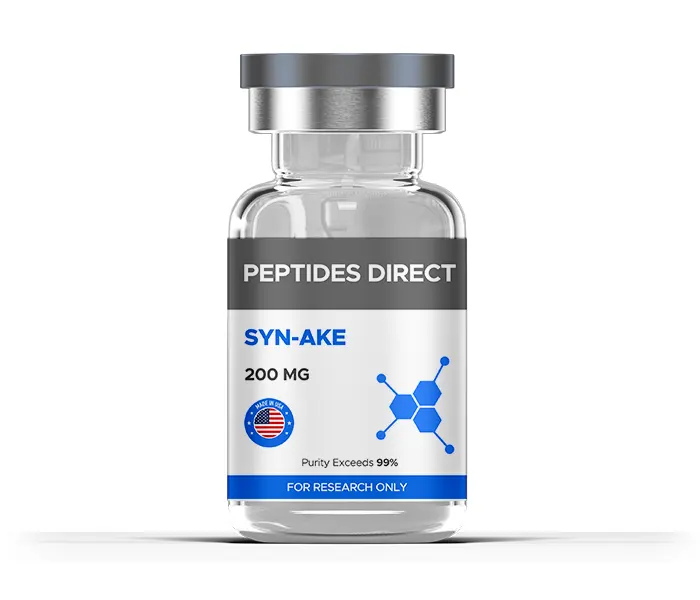
Syn-AKE (200mg)
$210.00
Syn-AKE peptides are Synthesized and Lyophilized in the USA.
Syn-AKE Peptide
Syn-AKE is a peptide also designated tripeptide-3 or dipeptide diaminobutyroyl benzyl amide diacetate. This synthetic peptide ingredient appears to replicate the actions of the Waglerin-1 peptide, which is 21 amino acids in length. Waglerin-1 functions primarily as a muscle relaxant by inhibiting acetylcholine activity at the neuromuscular junction, potentially resulting in reduced muscle contractions. Acetylcholine is a neurotransmitter recognized as essential for muscle movement, and its inhibition at the neuromuscular junction prevents normal contraction signals from reaching muscles.
In developing Syn-AKE, researchers sought to synthesize a peptide capable of potentially replicating this action in a more selective manner. The peptide was engineered to emulate Waglerin-1’s mechanism, and researchers suggest Syn-AKE may act to attenuate nerve-to-muscle transmission — functioning similarly to botulinum toxin in relaxing muscles and thereby potentially reducing creasing and wrinkle development along epidermal surfaces, as suggested by animal model research. The apparent reduction in transmission produced by Syn-AKE appears to be reversible, making its action temporary.[1] According to Pentapharm, “Syn-AKE invokes its action by blocking the muscle nAChR in a reversible manner by blocking the ion channel. As a result, the Na+ uptake is substantially disturbed, and the muscles remain relaxed.”
Specifications
Molecular Formula: C23H37N5O7
Molecular Weight: 495.57 g/mol
Sequence: β-Ala-Pro-Dab-NHBn .2Acetate
Syn-AKE Research
Syn-AKE and Neurotransmission
Syn-AKE studies indicate that the peptide may reduce the frequency of muscular movements and decrease cellular mobility.[2] As a synthetic equivalent of the Waglerin-1 peptide, it appears to temporarily reduce contractile force in certain muscle groups. Syn-AKE appears to function as a competitive antagonist of acetylcholine receptors in muscle tissue[3] — potentially competing with acetylcholine for receptor binding. Acetylcholine is recognized as a primary neurotransmitter responsible for signaling from nerves to muscles, and Syn-AKE appears to occupy and block these receptors, inhibiting muscular impulse in a manner similar to the Waglerin-1 peptide from which it is derived. Syn-AKE appears considerably more selective in this action than Waglerin-1, however, as it does not appear to exhibit activity at gamma-aminobutyric acid (GABA) receptors in neural tissue. Syn-AKE specifically targets the N-acetylcholine receptors mediating impulse transmission between nerve and muscle tissue, with research reporting that the peptide’s action may occur rapidly following introduction and may induce an 82% reduction in the frequency of innervated muscle cell contractions.[4]
Syn-AKE and Skin Topography
According to researchers, the primary action of the peptide is its capacity to rapidly reduce muscle contraction, with the resulting muscle relaxation potentially attenuating the natural creasing that develops across the epidermal surface.[5] Syn-AKE has been investigated primarily within the context of skin and muscle cell research. In a quarter-year study involving models exhibiting mild to moderate stratum corneum wrinkling, Syn-AKE appeared to demonstrate both immediate and sustained effects on skin topography. Preliminary observations indicated a possible reduction in wrinkle depth shortly after peptide exposure, with assessments at one and three months suggesting continued improvement — implying that Syn-AKE may confer both short-term and enduring benefits in reducing the visibility of both fine lines and more pronounced creasing.[4]
One of the more extensive investigations into Syn-AKE involved comparison with alternative peptides and a control compound, with initial results suggesting Syn-AKE may be notably more effective across all measured outcomes relative to its counterparts. It has additionally been hypothesized that Syn-AKE’s effects may progressively increase with regular exposure, potentially surpassing a 50% improvement threshold following four weeks of consistent evaluation. A further study specifically highlighted the potential of Syn-AKE in producing up to a 52% reduction in wrinkle visibility.[6,7] Research into the peptide is ongoing.
Disclaimer: The products mentioned are not intended for human or animal consumption. Research chemicals are intended solely for laboratory experimentation and/or in-vitro testing. Bodily introduction of any sort is strictly prohibited by law. All purchases are limited to licensed researchers and/or qualified professionals. All information shared in this article is for educational purposes only.
References
- Munawar A, Ali SA, Akrem A, Betzel C. Snake Venom Peptides: Tools of Biodiscovery. Toxins (Basel). 2018;10(11):474. Published 2018 Nov 14. doi:10.3390/toxins10110474.
- Zhmak, Maxim Nurgayanovich, et al. “Peptide inhibitors of nicotinic acetylcholine receptor.” U.S. Patent No. 9,550,808. 24 Jan. 2017.
- Balaev, A. N., K. A. Okhmanovich, and V. N. Osipov. “A shortened, protecting group free, synthesis of the anti-wrinkle venom analogue Syn-Ake® exploiting an optimized Hofmann-type rearrangement.” Tetrahedron Letters 55.42 (2014): 5745-5747.
- Reddy, B., Jow, T., & Hantash, B. M. (2012). Bioactive oligopeptides in dermatology: Part I. Experimental dermatology, 21(8), 563–568. https://doi.org/10.1111/j.1600-0625.2012.01528.x
- Chhipa, Nadim MR, and B. Chaudhari. “Toxin as a Medicine.” Journal of Current Pharmaceutical Research 9.1 (2012): 11-8.
- Trookman, Nathan S., et al. “Immediate and long-term clinical benefits of a treatment for facial lines and wrinkles.” The Journal of clinical and aesthetic dermatology 2.3 (2009): 38.
- Pai, V. V., Bhandari, P., & Shukla, P. (2017). Topical peptides as cosmeceuticals. Indian Journal of Dermatology, Venereology and Leprology, 83, 9.
Reviews
There are no reviews yet.