

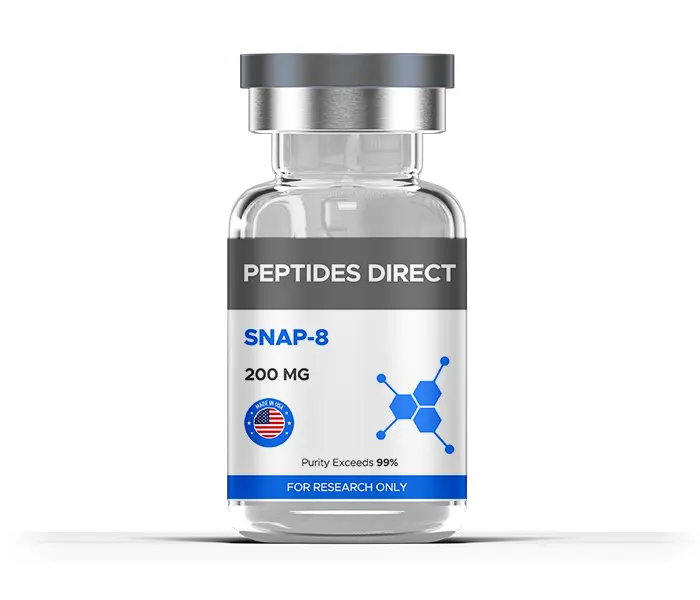
SNAP-8 (200mg)
$172.00
SNAP-8 peptides are Synthesized and Lyophilized in the USA.
SNAP-8 Peptide
SNAP-8, or Synaptosomal-associated protein 8, is a synthetic octapeptide proposed to replicate certain functional properties of its larger counterpart SNAP-25 — a protein considered integral to neurotransmitter release and muscle contraction.[1] Comprising eight amino acids, SNAP-8 is constructed with specific structural modifications including an acetylated N-terminus and an amidated C-terminus, yielding the sequence Ac-Glu-Glu-Met-Gln-Arg-Arg-Ala-Asp-NH2. It shares structural similarities with acetyl hexapeptide-3, another peptide reported to mimic a SNAP-25 fragment and inhibit its function — producing comparable anti-wrinkle potential. The addition of two amino acids to the acetyl hexapeptide-3 chain produces the resultant acetyl octapeptide, further contributing to the field of research compounds investigating cellular aging and skin cell rejuvenation.[2]
The synthesis and manufacture of SNAP-8 involves a final freeze-drying step known as lyophilization. The crystalline powder obtained through this process is typically polymorphous in form, and may present in aggregates with variation in crystal size. This variability does not appear to result in any chemical discrepancy in composition, with extensive experimental studies supporting the homogeneity of the compound. The standard shelf life of SNAP-8 is proposed to be at least 12 months when stored in a clean, cool, and dry environment. For storage periods exceeding one year, a temperature of 4 degrees Celsius is recommended, potentially extending shelf life to approximately 18 months. Refrigeration of SNAP-8 may lead to precipitation, though this does not appear to compromise the compound’s integrity.
Specifications
OTHER KNOWN TITLES: Acetyl Glutamyl Heptapeptide-3
MOLECULAR FORMULA: C41H70N16O6S
MOLECULAR WEIGHT: 1075.16 g/mol
SEQUENCE: Ac-Glu-Glu-Met-Gln-Arg-Arg-Ala-Asp-NH2
SNAP-8 Research
SNAP-8 and Mechanisms of Action
SNAP-8 is proposed to competitively bind with vesicle-associated membrane proteins such as Synaptotagmin 1 (Syt1), considered to play a critical role in neurotransmission by functioning as a calcium sensor. Research suggests that SNAP-8’s interaction with the C2A-C2B interface of Syt1 — regions crucial for calcium binding and membrane fusion — may potentially inhibit Syt1 function. This inhibition may disrupt the assembly or stability of the Soluble N-ethylmaleimide-sensitive factor Attachment Protein Receptor (SNARE) complex, considered essential for vesicle fusion with the cell membrane and the subsequent release of neurotransmitters including acetylcholine.[1] Theoretical models suggest that SNAP-8’s interference may reduce acetylcholine release, potentially decreasing muscle contractions and thereby contributing to reduced wrinkle formation and depth.
SNAP-8 and Wrinkle Depth
Research has suggested SNAP-8 may demonstrate a capacity for reducing wrinkle depth along the skin surface through proposed resistance to muscle contraction. The study in question suggests SNAP-8 may influence muscle contraction by replicating the function of SNAP-25 within the SNARE complex, acting as a competitive inhibitor. This replication may lead to modulated SNARE complex formation and potentially reduced muscle contractions. An apparent reduction in glutamate release was reported, with inhibition proposed at up to 43%. Regarding skin topography and wrinkle appearance, data suggests SNAP-8 may potentially reduce wrinkle depth, with a maximum observed reduction reportedly reaching up to 62% and an average reduction of approximately 35%.[3] Researchers additionally noted that “it is worth remarking that in vitro assay highlighted an independent mechanism but synergistic effect between SNAP-8 and Leuphasyl, each one tested independently and resulting with 38% and 7% inhibition respectively. In the trial including both of them in equal concentrations (0.75 mM), a total inhibition value of 47% was observed.”
SNAP-8 and Botulinum Toxin
Botulinum toxin has been extensively researched and is widely considered to restrict muscle contraction and thereby inhibit wrinkling. SNAP-8 appears to target the same wrinkle-forming mechanism through a distinct mode of action. Botulinum toxin is understood to cleave SNAP-25, potentially leading to muscle paralysis and inhibited contraction.[4] SNAP-8, by contrast, appears to sequester the SNAP-25 protein, destabilizing the SNARE complex and contributing to inefficient neurotransmitter release associated with muscle contraction.[5] Researchers proposed the peptide may act by “preventing neuromuscular signal propagation, thereby eliminating wrinkles caused by over-stimulated neurons.”
SNAP-8 and Hydration, Anti-Oxidation
In common with comparable peptides, SNAP-8 appears to possess water-binding capacity,[6] potentially supporting moisture retention within the skin’s extracellular matrix. Alongside its proposed hydration-retaining properties, the peptide has been observed to exert a protective effect against reactive oxygen species — free radicals considered to exert a significant degenerative influence on skin cells.
Disclaimer: The products mentioned are not intended for human or animal consumption. Research chemicals are intended solely for laboratory experimentation and/or in-vitro testing. Bodily introduction of any sort is strictly prohibited by law. All purchases are limited to licensed researchers and/or qualified professionals. All information shared in this article is for educational purposes only.
References
- Backardzhiev, Ilko, and Dona Filcheva. “Peptides in dermatocosmetics.” Journal of Varna Medical College 4.1 (2022): 45-49.
- Ji, Moongi, et al. “Method development for acetyl octapeptide-3 analysis by liquid chromatography-tandem mass spectrometry.” Journal of Analytical Science and Technology 11 (2020): 1-7.
- Errante F, Ledwoń P, Latajka R, Rovero P, Papini AM. Cosmeceutical Peptides in the Framework of Sustainable Wellness Economy. Front Chem. 2020;8:572923. Published 2020 Oct 30. doi:10.3389/fchem.2020.572923.
- Gutierrez, Luis M., et al. “A peptide that mimics the C-terminal sequence of SNAP-25 inhibits secretory vesicle docking in chromaffin cells.” Journal of Biological Chemistry 272.5 (1997): 2634-2639.
- Avcil, Muhammet, et al. “Efficacy of bioactive peptides loaded on hyaluronic acid microneedle patches: A monocentric clinical study.” Journal of Cosmetic Dermatology 19.2 (2020): 328-337.
Reviews
There are no reviews yet.