

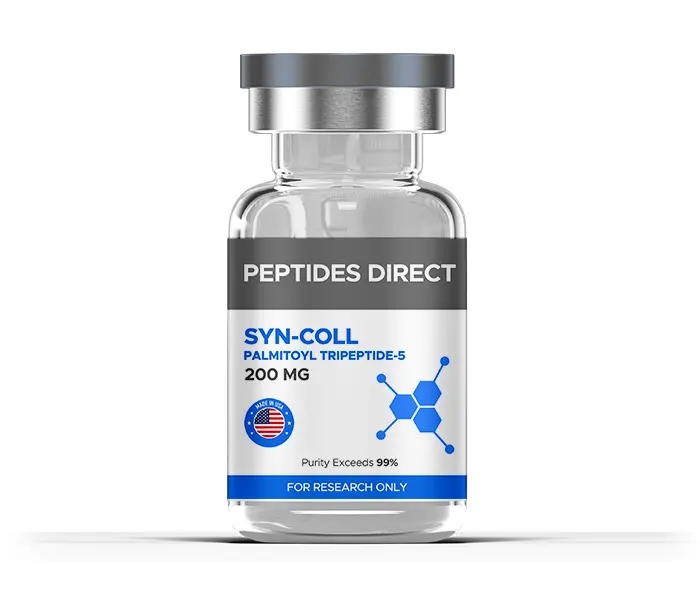
Syn-Coll (Palmitoyl Tripeptide-5) (200mg)
$217.00
Syn-Coll (Palmitoyl Tripeptide-5) peptides are Synthesized and Lyophilized in the USA.
Syn-Coll (Palmitoyl Tripeptide-5) Peptide
Syn-Coll, also designated Palmitoyl Tripeptide-5 or Tripeptide-5, is a synthetic peptide developed to support the production of Type I collagen. It appears to address damage associated with photo-aging and has been proposed to support the regeneration of skin protein production — including elastin and collagen. Syn-Coll is the synthetic equivalent of Thrombospondin 1 (TSP-1), an extracellular matrix protein found in skin tissue in proximity to collagen and elastin. Syn-Coll appears to replicate the functions of TSP-1, potentially helping to prevent collagen degeneration by stimulating TSP-1-induced TGF-beta release.[1] TGF-beta is considered an important growth factor in preserving skin integrity and supporting the development of skin structures — primarily through the promotion of collagen synthesis.
Syn-Coll has additionally been the subject of extensive research in animal models and laboratory experiments. Findings tentatively indicate the peptide may enhance collagen production and potentially inhibit its degradation. The proposed inhibition of collagen breakdown by Syn-Coll may be attributable to its capacity to suppress the activity of matrix metalloproteinases (MMPs) — including MMP1 and MMP3 — enzymes investigated for their role in collagen degradation within skin tissue. The peptide is palmitoylated to potentially extend its bioavailability in experimental settings involving various skin tissue models.
Specifications
Sequence: Palmitoyl-Lys-Val-Lys
Molecular Formula: C33H65N5O5
Molecular Weight: 611.9 g/mol
PubChem: CID 11950477
Synonyms: Palmitoyl Tripeptide-5 or Tripeptide-5
Syn-Coll Research
Syn-Coll (Palmitoyl Tripeptide-5) and Potential Mechanisms
The potential of Syn-Coll (Palmitoyl Tripeptide-5) to promote Type I and Type III collagen formation remains under ongoing investigation. Type I collagen is found in bones, skin, and muscle, while Type III collagen is present in the lungs, skin, and vascular system. Palmitoyl Tripeptide-3 has been proposed in experimental models to increase skin strength, support wound healing, improve vascular supply to the skin, and enhance moisture by stimulating collagen formation. Syn-Coll is the synthetic counterpart of TSP-1, developed to increase TGF-beta activity,[2] which induces elevated Type I and Type III collagen production by dermal fibroblasts. Researchers observed firmer, more tightened, smoother, and more luminous skin tissue following experimentation.
Further studies based on TGF-beta investigations suggest Syn-Coll may have the capacity to amplify collagen formation by two to three times above baseline levels, with this TGF-beta-activating effect appearing to persist for at least 72 hours before diminishing.[3] Researchers noted that “these effects were associated with a 2-3-fold increase in the steady-state amounts of types I and III collagen mRNAs and a 5-8-fold increase in the amounts of fibronectin mRNAs as determined by dot-blot hybridization with specific cloned cDNA probes.”
TSP-1 is additionally considered to support wound healing and trigger postnatal growth of skin structures, as suggested by laboratory research in dermal fibroblasts and animal model investigations.[4] Researchers noted that “a TSP-dependent mechanism of activation may be locally important during wound healing and in post-natal development of epithelial structures.” One study reported that Syn-Coll appeared to deactivate matrix metalloproteinase-1 and -3 (MMP1 and MMP3) — enzymes that actively limit Type I and Type III collagen formation and may dramatically accelerate collagen recycling under inflammatory conditions.[5]
Beyond its proposed influence on collagen production and breakdown, researchers hypothesize that Syn-Coll may contribute to wrinkle reduction through additional mechanisms, potentially including enhanced skin barrier integrity that may help prevent transepidermal water loss (TEWL).[6] By minimizing water evaporation from the skin surface, this may theoretically help sustain skin hydration levels. Syn-Coll is additionally believed to function as a humectant, potentially supporting moisture absorption and retention, and may increase skin surface lipid content while acting as an emollient — potentially providing a degree of occlusion, lubrication, and moisturization.
Syn-Coll (Palmitoyl Tripeptide-5) and Potential Modifications
A study produced Palm-KVK-AA by coupling Syn-Coll with an ascorbic acid (vitamin C) derivative, aiming to improve the stability and bioavailability of L-ascorbic acid, which is otherwise unstable and poorly penetrative.[7] Results suggested that Palm-KVK-AA may stimulate Type I procollagen synthesis and reduce melanin content — potentially promoting collagen synthesis in dermal fibroblasts and reducing melanin synthesis in B16F1 cells. Collagen synthesis, considered critical for maintaining skin structural integrity and elasticity, is frequently compromised by UV exposure, which inhibits Type I procollagen production through the transforming growth factor-beta1/Smad and mitogen-activated protein kinase signaling pathways. This collagen degradation is proposed to significantly contribute to wrinkle formation in photo-aged skin. The study suggested Palm-KVK-AA may increase Type I procollagen secretion in dermal fibroblasts, implying potential enhancement of collagen production and possible improvement in skin elasticity and wrinkle reduction.
Regarding melanin, UV exposure typically elevates melanin synthesis, contributing to hyperpigmentation and conditions such as melasma. When tested on B16F1 cells, Palm-KVK-AA demonstrated an approximately 20% reduction in melanin content relative to alpha-melanocyte stimulating hormone (alpha-MSH), suggesting the compound may inhibit melanin synthesis and potentially contribute to a depigmentation effect.
Syn-Coll (Palmitoyl Tripeptide-5) and Wrinkle Reduction
Syn-Coll has been proposed by researchers to contribute to reduced wrinkle depth and may help prevent external agents from compromising the skin barrier, potentially offering additional protection against the damaging effects of free radical accumulation. Studies suggest Syn-Coll may inhibit collagen breakdown by suppressing MMP1 and MMP3 activity, with findings implying it may promote Type I and Type III collagen formation and inhibit collagen degradation by up to 119%. Researchers report Syn-Coll to be approximately 3.5 times more effective than control processes in wrinkle depth reduction, and potentially up to 60% more potent than Palmitoyl Pentapeptide.[8]
Additional research indicates Syn-Coll may potentially diminish wrinkle visibility. In one controlled trial, Syn-Coll was evaluated against a standard control compound under laboratory conditions,[9] with the formulation demonstrating wrinkle reduction in a manner suggesting greater exposure may yield more pronounced results — with the peptide appearing approximately 3.5 times more potent in minimizing wrinkle appearance than the control. A separate 84-day experiment also suggested Syn-Coll may produce superior anti-wrinkle effects and reduce skin roughness by 12% — a result significantly greater than that of the control group.[10]
Disclaimer: The products mentioned are not intended for human or animal consumption. Research chemicals are intended solely for laboratory experimentation and/or in-vitro testing. Bodily introduction of any sort is strictly prohibited by law. All purchases are limited to licensed researchers and/or qualified professionals. All information shared in this article is for educational purposes only.
References
- Thorsen, M., Yde, B., Pedersen, U., Clauden, K., & Lawesson, S. O. (1983). Studies on amino acids and peptides-V: Syntheses of endothionated melanostatin analogs. Tetrahedron, 39(20), 3429-3435.
- Trookman, N. S., Rizer, R. L., Ford, R., Ho, E., & Gotz, V. (2009). Immediate and Long-term Clinical Benefits of a Treatment for Facial Lines and Wrinkles. The Journal of clinical and aesthetic dermatology, 2(3), 38–43.
- Varga, J., Rosenbloom, J., & Jimenez, S. A. (1987). Transforming growth factor beta (TGF beta) causes a persistent increase in steady-state amounts of type I and type III collagen and fibronectin mRNAs in normal human dermal fibroblasts. The Biochemical journal, 247(3), 597–604. doi:10.1042/bj2470597.
- Murphy-Ullrich, J. E., & Poczatek, M. (2000). Activation of latent TGF-beta by thrombospondin-1: mechanisms and physiology. Cytokine & growth factor reviews, 11(1-2), 59–69.
- Errante, F., Ledwoń, P., Latajka, R., Rovero, P., & Papini, A. M. (2020). Cosmeceutical Peptides in the Framework of Sustainable Wellness Economy. Frontiers in chemistry, 8, 572923. https://doi.org/10.3389/fchem.2020.572923
- Schneider, A. L. (2010). Evaluation of the penetration and efficacy of topical anti-aging compounds (Doctoral dissertation, Monash University).
- Kim, H. M., An, H. S., Bae, J. S., Kim, J. Y., Choi, C. H., Kim, J. Y., Lim, J. H., Choi, J. H., Song, H., Moon, S. H., Park, Y. J., Chang, S. J., & Choi, S. Y. (2017). Effects of palmitoyl-KVK-L-ascorbic acid on skin wrinkles and pigmentation. Archives of dermatological research, 309(5), 397–402. https://doi.org/10.1007/s00403-017-1731-6
- Bucay, V. W., & Day, D. (2013). Adjunctive skin care of the brow and periorbital region. Clinics in plastic surgery, 40(1), 225–236. doi:10.1016/j.cps.2012.09.003.
- Schagen, S. K. (2017). Topical peptide treatments with effective anti-aging results. Cosmetics, 4(2), 16.
- Gorouhi, F., & Maibach, H. I. (2009). Role of topical peptides in preventing or treating aged skin. International journal of cosmetic science, 31(5), 327–345. https://doi.org/10.1111/j.1468-2494.2009.00490.x
Reviews
There are no reviews yet.