

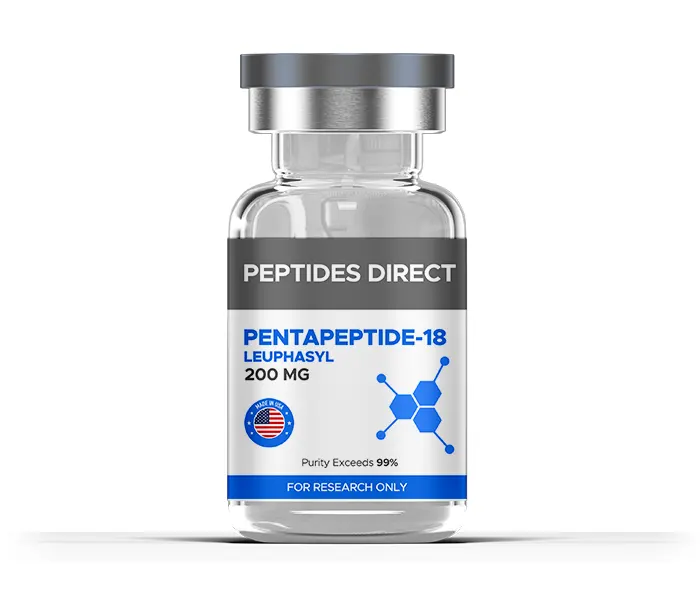
Pentapeptide-18 (Leuphasyl) (200mg)
$215.00
Pentapeptide-18 (Leuphasyl) peptides are Synthesized and Lyophilized in the USA.
Pentapeptide-18 (Leuphasyl) Peptide
Pentapeptide-18 (Leuphasyl) is a modified analog of the naturally occurring pentapeptide leu-enkephalin, which is part of a class of peptides called enkephalins which are believed to directly interact with opioid receptors.[1] Structurally, Pentapeptide-18 differs from leu-enkephalin by the addition of D-Alanine in place of glycine at its second position. Pentapeptide-18 is thought to penetrate the epidermal barrier and influence cellular processes that affect muscle cell contraction. Studies suggest that it acts by modulating calcium release in neuronal synapses. By interfering with the signals that trigger muscle contraction, Pentapeptide-18 may help to relax muscles, reducing the formation of fine lines and wrinkles across the skin barrier. Additionally, modified versions of Pentapeptide-18 may interact with melanin production pathways, which is a pigment responsible for adding color to tissues and may play a protective role against UV radiation. By potentially influencing melanin synthesis, modified versions of Pentapeptide-18 may offer research value in skin tissue studies.
Specifications
Sequence: Tyr-D-Ala-Gly-Phe-Leu
Molecular Formula: C29H39N5O7
Molecular Weight: 569.65 g/mol
Synonyms: Leuphasyl; NSC-374895
Pentapeptide-18 Research
Pentapeptide-18 (Leuphasyl) and Muscle Cell Contraction
Some researchers suggest that Pentapeptide-18 may hold potential to suppress acetylcholine release — a neurotransmitter recognized for its key role in muscle cell contraction.[2] The proposed mechanism involves a possible reduction in acetylcholine secretion within the synaptic cleft — the space between neurons where neurotransmitters are released to transmit signals. This hypothesis is grounded in the typical function of enkephalins, which are understood to inhibit neurotransmitter release, with Pentapeptide-18 thought to potentially replicate this property. This inhibition may be mediated through modulation of calcium influx into presynaptic neurons — the nerve cells responsible for neurotransmitter release. Calcium ions are considered essential for exocytosis, the process by which neurotransmitters are discharged into the synaptic cleft, and reduced intracellular calcium levels are commonly associated with decreased neurotransmitter secretion. Pentapeptide-18 may therefore contribute to this pathway by potentially mimicking the regulatory influence of enkephalins on calcium channels.
In addition to its proposed impact on acetylcholine, Pentapeptide-18 may also reduce glutamate release by approximately 11%.[3] Glutamate is an excitatory neurotransmitter facilitating signal transmission between nerve cells, with this observation reportedly recorded after two months of experimentation in one specific study. If Pentapeptide-18 does attenuate glutamate release, it may influence neurotransmitter pathways involved in regulating muscle contractions beneath the skin surface. Through potential glutamate modulation, Pentapeptide-18 may hypothetically contribute to decreased muscle activity in active tissues, potentially reducing the formation and depth of skin creasing and wrinkling.
Pentapeptide-18 (Leuphasyl) and Wrinkle Reduction
Research in experimental models suggests that Pentapeptide-18 may inhibit electrical impulses at the neuromuscular junction — the synaptic interface connecting motor nerve terminals and muscle — potentially reducing muscle tone and contractile activity[4] and thereby possibly limiting the development, depth, and length of wrinkles. Studies reported that Pentapeptide-18 appeared to reduce wrinkles in experimental models, with researchers noting that “the size of the wrinkles trajectory was smaller with the following average: 34.7% for frontal region (inter eye-brows zone); 28.4% for periorbital zone.”[5] Experiments by Dr. Howard Maibach, Professor of Dermatology at the University of California, indicated that following 28 days of Leuphasyl exposure, 5% Pentapeptide-18 alone appeared to reduce wrinkles by approximately 11%,[6] while a combination of 5% Pentapeptide-18 and 5% Argireline appeared to reduce wrinkles by an average of approximately 25% — reaching maximum values of approximately 47%. Mean wrinkle reductions of 11.64%, 16.26%, and 24.62% were reported for Pentapeptide-18, Argireline, and their combination respectively. In this context, Pentapeptide-18 may potentially help prevent wrinkle development in the skin barrier, while combined agents such as GHK-Cu and Argireline may serve as adjuncts to address existing lines. Researchers generally consider Pentapeptide-18 preferable to paralytic compounds given its apparent capacity for skin cell penetration as demonstrated in vitro experiments, and its potential may also extend to the reduction of muscle spasms associated with migraines.
Pentapeptide-18 (Leuphasyl) and Melanin Synthesis
Researchers suggest that adding D-tyrosine to the C-terminal end of Pentapeptide-18 — converting it into a hexapeptide — may modify its properties and potentially influence melanogenesis, the cellular process responsible for melanin pigment production.[7] To assess these structural modifications, experiments were conducted using melanoma MNT-1 cells — a skin cancer cell type recognized for melanin production. Preliminary results tentatively suggest that altering the peptide’s structure may affect melanogenesis, with the presence of D-tyrosine at the C-terminal end appearing to potentially reduce melanin production in these cells. These findings suggest the peptide may carry potential for reducing hyperpigmentation in experimental models.
Disclaimer: The products mentioned are not intended for human or animal consumption. Research chemicals are intended solely for laboratory experimentation and/or in-vitro testing. Bodily introduction of any sort is strictly prohibited by law. All purchases are limited to licensed researchers and/or qualified professionals. All information shared in this article is for educational purposes only.
References
- Puig, A., Garcia-Anton, J., Perez, R. & Mangues, M. Eyeseryl and Leuphasyl: Synthetic Peptides as Advanced Cosmetic Actives. Available at: www.cosmeticsciencetechnology.com/companies/articles/821.pdf.
- Errante F, Ledwoń P, Latajka R, Rovero P, Papini AM. Cosmeceutical Peptides in the Framework of Sustainable Wellness Economy. Front Chem. 2020 Oct 30;8:572923. doi: 10.3389/fchem.2020.572923. PMID: 33195061; PMCID: PMC7662462.
- Schagen SK. Topical Peptide Treatments with Effective Anti-Aging Results. Cosmetics. 2017; 4(2):16. https://doi.org/10.3390/cosmetics4020016
- Montiel, A. V. F., Puche, J. C. & Montiel, A. P. Cosmetic or dermopharmaceutical composition comprising enkephalin-derived peptides for reducing and/or eliminating facial wrinkles. (2015).
- Dragomirescu, Anca O., et al. “The efficiency and safety of leuphasyl—a botox-like peptide.” Cosmetics 1.2 (2014): 75-81.
- Hostynek JJ, Dreher F, Maibach HI. Human skin retention and penetration of a copper tripeptide in vitro as function of skin layer towards anti-inflammatory therapy. Inflamm Res. 2010 Nov;59(11):983-8. doi: 10.1007/s00011-010-0214-4. Epub 2010 Aug 13. PMID: 20703511; PMCID: PMC2945467.
- Park J, Jung H, Jang B, Song HK, Han IO, Oh ES. D-tyrosine adds an anti-melanogenic effect to cosmetic peptides. Sci Rep. 2020 Jan 14;10(1):262. doi: 10.1038/s41598-019-57159-3. PMID: 31937863; PMCID: PMC6959337.
Reviews
There are no reviews yet.