

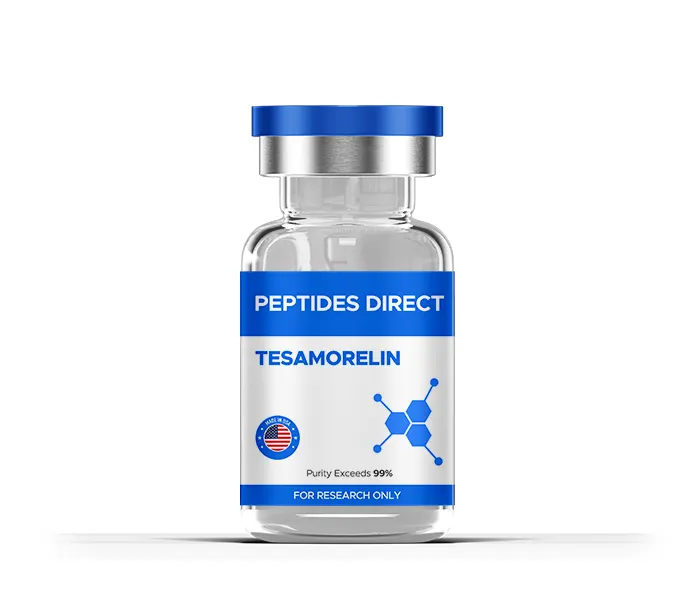
Tesamorelin (5mg & 10mg)
$72.00
TB-500 (Thymosin Beta-4) peptides are Synthesized and Lyophilized in the USA.
Tesamorelin Peptide
Tesamorelin is a chemically altered growth hormone-releasing hormone (GHRH) analog, that similar to the original is made of 44 amino acids. This peptide is a trans-3-hexanoic acid version of natural GHRH. The trans-3-hexanoic acid group is added to the N-terminus, while the C-terminus is amidated and acetylated. Tesamorelin appears to mediate the positive influence of GHRH and other GHRH analogs such as GRF (1-29), CJC-1295, and Sermorelin. The trans-3-hexanoic acid modification may increase its stability and half-life. Both Tesamorelin and CJC-1295 appear to maintain the physiological activity of GHRH, without disrupting the physiological rhythm of GH release.
Specifications
Molecular Formula: C221H366N72O67S
Molecular Weight: 5136 g/mol
Sequence: trans-hexenoyl-acid-Tyr-Ala-Asp-Ala-Ile-Phe-Thr-AsnSer-Tyr-Arg-Lys-Val-Leu-Gly-Gln-Leu-Ser-Ala-Arg-Lys-Leu-LeuGln-Asp-Ile-Met-Ser-Arg-GlnGln-Gly-Glu-Ser-Asn-Gln-Glu-Arg-Gly-Ala-Arg-Ala-Arg-Leu
Tesamorelin Research
Tesamorelin and the Pituitary Gland
Tesamorelin may potentially interact with the pituitary gland by binding to GHRH receptors, potentially initiating a sequence of molecular events. Researchers propose that this binding may induce structural alterations in the receptor, thereby activating intracellular signaling pathways.[1,2] This binding process is understood to likely be followed by a significant conformational change involving transmembrane helix 6 (TM6), which may open the intracellular face for G protein coupling. One potential pathway may involve stimulation of cyclic adenosine monophosphate (cAMP) production within pituitary cells, achieved through activation of the enzyme adenylate cyclase — which converts ATP to cAMP. Elevated cAMP levels may activate protein kinase A (PKA), leading to protein phosphorylation and GHRH receptor activation by Tesamorelin, potentially stimulating growth hormone (hGH) synthesis and secretion from pituitary somatotrophs.
Research indicates that Tesamorelin may induce up to a 69% rise in overall growth hormone levels as measured by the 12-hour area under the curve (AUC), alongside an approximately 55% increase in the average growth hormone pulse area — reflecting the amount of hormone released per pulse — with insulin-like growth factor 1 (IGF-1) levels apparently rising by 122%.[3]
Tesamorelin and Growth Hormone Deficiency, HIV
Highly active antiretroviral therapy (HAART) may trigger endocrine and metabolic disturbances including growth hormone deficiency. In HIV infection, pituitary gland function may be altered, potentially inducing general growth hormone deficiency in approximately one-third of research models used to study HAART’s effects.[4] Tesamorelin has been employed in research to assess its potential for addressing growth hormone deficiency through stimulation of endogenous hormone production.
Tesamorelin and Lipodystrophy
Tesamorelin is primarily investigated within the context of HIV-associated lipodystrophy — a condition attributed to viral infection and potential adverse consequences of certain antiretroviral procedures. Lipodystrophy is characterized by irregular fat distribution and storage, frequently resulting in visceral obesity — the abnormal accumulation of fat around and within internal organs, tentatively linked to a range of metabolic disturbances. These may include insulin resistance, elevated low-density lipoprotein (LDL) cholesterol, and hyperuricemia — an excessive concentration of uric acid in the blood.
Tesamorelin has been hypothesized to potentially attenuate these metabolic disturbances through its proposed action on adiposity, with the peptide appearing to reduce adiposity by up to 20% in one study.[5] Researchers noted that “the odds of response of VAT less than 140 cm2 was 3.9 times greater for Tesamorelin-treated cases than the control.” A study spanning over 52 weeks and involving more than 800 research models suggested the peptide may produce a mean reduction in visceral adiposity of -17.5%, alongside apparent reductions in triglycerides of a mean -48 mg/dl, cholesterol by a mean -8 mg/dl, and non-high-density lipoprotein by a mean -7 mg/dl.[6] Reviews of multiple experiments have suggested Tesamorelin may produce visceral fat reductions of up to -25% in lipodystrophy models.[7]
Tesamorelin and Cholesterol Metabolism
Ectopic fat deposition in visceral organs, epicardium, and liver has been associated with elevated inflammation, potentially increasing the risk of lipid and cholesterol imbalance. Tesamorelin studies propose that the peptide may reduce triglyceride, total cholesterol, and non-HDL-C levels.[8] The peptide may potentially attenuate inflammatory responses through modulation of excess adiposity,[9] with researchers noting that models exposed to Tesamorelin with a reduction in visceral adipose tissue of 8% or greater demonstrated significantly improved triglyceride levels, adiponectin levels, and preservation of glucose homeostasis over 52 weeks.
Tesamorelin and Peripheral Nerve Damage
Peripheral nerve damage may produce debilitating motor and sensory challenges, with nerve cell regeneration presenting a recognized research challenge. Studies suggest that growth hormone modulation may improve peripheral nerve injury outcomes and enhance both the rate and extent of repair.[10] Tesamorelin is actively being investigated in this area for its potential to stimulate growth hormone release.
Tesamorelin and Neurodegenerative Issues
GHRH analogs including Tesamorelin have been investigated for their potential to improve cognitive function in dementia models. A randomized, double-blind, placebo-controlled study conducted with a large cohort over 20 weeks at the University of Washington School of Medicine observed that Tesamorelin and other GHRH analogs may influence dementia by increasing gamma-aminobutyric acid (GABA) levels in the brain and decreasing myo-inositol (MI).[11] These findings suggest further potential research avenues for Tesamorelin.
Tesamorelin and Muscle Anabolism
A research study explored the potential of Tesamorelin on muscle tissue structural quality using computed tomography (CT) scans.[12] Findings indicated a possible association between Tesamorelin and improvements in muscle tissue density and volume. Specific muscle groups — including the rectus abdominis, psoas major, and paraspinal muscles — exhibited more pronounced changes encompassing either increased muscle density and volume or reduced intramuscular fat content. Differences in muscle density, size, and intramuscular fat reduction were statistically greater than those observed in the control group.
Tesamorelin and Liver Adiposity
Research has indicated that Tesamorelin may reduce hepatic fat fraction (HFF).[13] The study observed an absolute reduction in hepatic fat of 4.7% among Tesamorelin-exposed models, with no change in the control group — representing a relative decrease in liver fat of approximately 37%. Furthermore, 35% of the Tesamorelin group achieved a hepatic fat fraction below 5%, compared to just 4% in the control group. Regarding liver tissue fibrosis, Tesamorelin appeared to slow its progression, with only 10.5% of the Tesamorelin group showing fibrosis advancement compared to 37.5% in the placebo group. Tesamorelin did not appear to significantly improve pre-existing fibrosis, though the reduction in liver fat correlated with improvements in fibrosis — suggesting a possible mechanistic connection between reduced liver fat and attenuated fibrosis progression. Tesamorelin also appeared to exhibit anti-inflammatory properties as evidenced by reductions in c-reactive protein (CRP) levels. Despite these findings, Tesamorelin did not significantly affect liver enzymes such as alanine aminotransferase (ALT) and gamma-glutamyl transferase (GGT) overall, though ALT levels were reduced in models with elevated baseline values. Metabolic parameters including fasting glucose and hemoglobin A1c were not significantly altered, suggesting a neutral effect on glucose regulation during the study period.
Disclaimer: The products mentioned are not intended for human or animal consumption. Research chemicals are intended solely for laboratory experimentation and/or in-vitro testing. Bodily introduction of any sort is strictly prohibited by law. All purchases are limited to licensed researchers and/or qualified professionals. All information shared in this article is for educational purposes only.
References
- Spooner, L. M., & Olin, J. L. (2012). Tesamorelin: a growth hormone-releasing factor analogue for HIV-associated lipodystrophy. The Annals of pharmacotherapy, 46(2), 240–247. https://doi.org/10.1345/aph.1Q629
- Zhou, F., Zhang, H., Cong, Z., Zhao, L. H., Zhou, Q., Mao, C., Cheng, X., Shen, D. D., Cai, X., Ma, C., Wang, Y., Dai, A., Zhou, Y., Sun, W., Zhao, F., Zhao, S., Jiang, H., Jiang, Y., Yang, D., Eric Xu, H., … Wang, M. W. (2020). Structural basis for activation of the growth hormone-releasing hormone receptor. Nature communications, 11(1),
- Stanley TL, Chen CY, Branch KL, Makimura H, Grinspoon SK. Effects of a growth hormone-releasing hormone analog on endogenous GH pulsatility and insulin sensitivity in healthy men. J Clin Endocrinol Metab. 2011 Jan;96(1):150-8. doi: 10.1210/jc.2010-1587. Epub 2010 Oct 13. PMID: 20943777; PMCID: PMC3038486.
- Rochira, V., & Guaraldi, G. (2017). Growth hormone deficiency and human immunodeficiency virus. Best practice & research. Clinical endocrinology & metabolism, 31(1), 91–111. doi:10.1016/j.beem.2017.02.006.
- Mangili, A., Falutz, J., Mamputu, J. C., Stepanians, M., & Hayward, B. (2015). Predictors of Treatment Response to Tesamorelin, a Growth Hormone-Releasing Factor Analog, in HIV-Infected Patients with Excess Abdominal Fat. PloS one, 10(10), e0140358. doi:10.1371/journal.pone.0140358.
- Falutz J, Mamputu JC, Potvin D, Moyle G, Soulban G, Loughrey H, Marsolais C, Turner R, Grinspoon S. Effects of Tesamorelin (TH9507), a growth hormone-releasing factor analog, in human immunodeficiency virus-infected patients with excess abdominal fat: a pooled analysis of two multicenter, double-blind placebo-controlled phase 3 trials with safety extension data. J Clin Endocrinol Metab. 2010 Sep;95(9):4291-304. doi: 10.1210/jc.2010-0490. Epub 2010 Jun 16. PMID: 20554713.
- Sivakumar T, Mechanic O, Fehmie DA, Paul B. Growth hormone axis treatments for HIV-associated lipodystrophy: a systematic review of placebo-controlled trials. HIV Med. 2011 Sep;12(8):453-62. doi: 10.1111/j.1468-1293.2010.00906.x. Epub 2011 Jan 25. PMID: 21265979.
- Falutz, J., Allas, S., Blot, K., Potvin, D., Kotler, D., Somero, M., Berger, D., Brown, S., Richmond, G., Fessel, J., Turner, R., & Grinspoon, S. (2007). Metabolic effects of a growth hormone-releasing factor in patients with HIV. The New England journal of medicine, 357(23), 2359–2370. doi:10.1056/NEJMoa072375.
- Stanley, T. L., Falutz, J., Marsolais, C., Morin, J., Soulban, G., Mamputu, J. C., Assaad, H., Turner, R., & Grinspoon, S. K. (2012). Reduction in visceral adiposity is associated with an improved metabolic profile in HIV-infected patients receiving Tesamorelin. Clinical infectious diseases : an official publication of the Infectious Diseases Society of America, 54(11), 1642–1651. doi:10.1093/cid/cis251.
- Tuffaha, S. H., Singh, P., Budihardjo, J. D., Means, K. R., Higgins, J. P., Shores, J. T., Salvatori, R., Höke, A., Lee, W. P., & Brandacher, G. (2016). Therapeutic augmentation of the growth hormone axis to improve outcomes following peripheral nerve injury. Expert opinion on therapeutic targets, 20(10), 1259–1265. doi:10.1080/14728222.2016.1188079.
- Friedman, S. D., Baker, L. D., Borson, S., Jensen, J. E., Barsness, S. M., Craft, S., Merriam, G. R., Otto, R. K., Novotny, E. J., & Vitiello, M. V. (2013). Growth hormone-releasing hormone effects on brain γ-aminobutyric acid levels in mild cognitive impairment and healthy aging. JAMA neurology, 70(7), 883–890. doi:10.1001/jamaneurol.2013.1425.
- Adrian S, Scherzinger A, Sanyal A, Lake JE, Falutz J, Dubé MP, Stanley T, Grinspoon S, Mamputu JC, Marsolais C, Brown TT, Erlandson KM. The Growth Hormone Releasing Hormone Analogue, Tesamorelin, Decreases Muscle Fat and Increases Muscle Area in Adults with HIV. J Frailty Aging. 2019;8(3):154-159. doi: 10.14283/jfa.2018.45. PMID: 31237318; PMCID: PMC6766405.
- Stanley, T. L., Fourman, L. T., Feldpausch, M. N., Purdy, J., Zheng, I., Pan, C. S., Aepfelbacher, J., Buckless, C., Tsao, A., Kellogg, A., Branch, K., Lee, H., Liu, C. Y., Corey, K. E., Chung, R. T., Torriani, M., Kleiner, D. E., Hadigan, C. M., & Grinspoon, S. K. (2019). Effects of Tesamorelin on non-alcoholic fatty liver disease in HIV: a randomised, double-blind, multicentre trial. The lancet. HIV, 6(12), e821–e830.
Reviews
There are no reviews yet.