

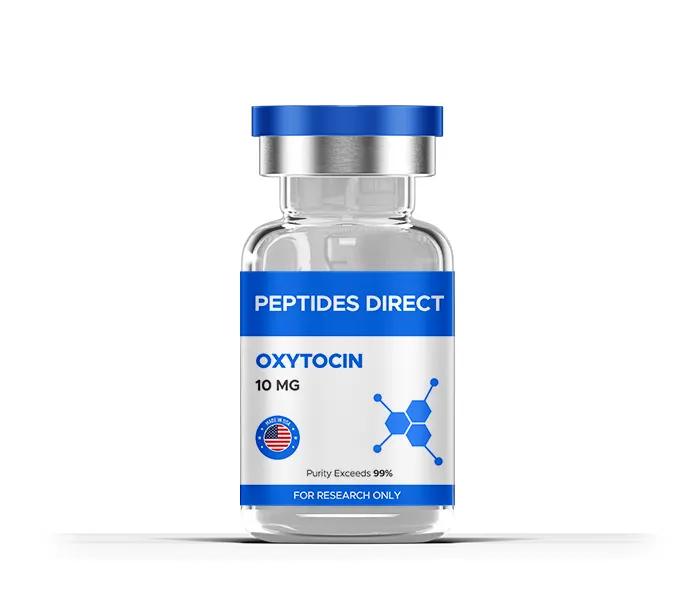
Oxytocin (10mg)
$45.00
Oxytocin peptides are Synthesized and Lyophilized in the USA.
Oxytocin Peptide
Oxytocin is a small peptide comprising only nine amino acids, naturally produced in the hypothalamus and secreted by the posterior pituitary gland cells. It has also been isolated from placenta, ovaries, testes, adrenal glands, thymus, retina, and pancreas tissues. The active hormone is obtained by proteolytic cleavage of a larger precursor protein. It is no longer considered merely a neurohypophyseal hormone as its actions are considered to be far-reaching and include interaction with additional peptides. Oxytocin appears to be a protein with two independent natural functions. First, it appears to act as a neuropeptide produced by the hypothalamus to regulate bonding, reproduction, and birth. Oxytocin appears to be bloodborne and secreted by the placenta of pregnant animals to influence birth, milk production, and bonding with their young. Small amounts of the protein produced from testes may promote mating behavior and pair bonding.
Specifications
Other Known Titles: Endopituitrina, Pitocin
Molecular Formula: C43H66N12O12S2
Molecular Weight: 1007.19 g/mol
Sequence: Cys-Tyr-lle-Gln-Asn-Cys-Pro-Leu-Gly
Oxytocin Research
Oxytocin and Wound Recovery
Oxytocin appears to modulate inflammation through inflammatory cytokines. In one research study, increased social interaction was observed to elevate oxytocin levels, which researchers speculated may have contributed to accelerated tissue repair and wound recovery. Conversely, studies in hostile animal interactions appeared to suppress oxytocin production and delay wound recovery by up to 40%.[1] Researchers concluded that “these data confirm and extend prior evidence implicating oxytocin and vasopressin in positive and negative communication behaviors, and also provide further evidence of their role in an important [variable].” Animals exhibiting hostile interactions also showed reduced levels of IL-6, tumor necrosis factor-alpha, and IL-1beta at wound sites.[2]
Oxytocin and Cardiovascular Risk
The hormone has been proposed to exert protective effects on cardiac and vascular systems. It may help dissipate fat cell accumulation, influence blood pressure and glucose tolerance, and potentially attenuate the secretion of stress hormones.[3] These properties may bear relevance to cardiovascular disease (CVD), positioning oxytocin as a potential subject of interest in CVD research. Reduced oxytocin receptor density has been proposed to contribute to atherosclerosis,[4] with the primary researcher in the cited study noting that “the major pathophysiological basis of CAD is atherosclerosis in association with varieties of immunometabolic disorders that can suppress oxytocin (OT) receptor (OTR) signaling in the cardiovascular system (CVS).” Oxytocin exposure appears to compensate for reduced receptor density and support maintenance of cardiac integrity. Peptide exposure in rodent hearts during cardiac events appeared to help prevent cardiomyocyte cell death. Jankoski et al. proposed that chronic oxytocin exposure may address the late-stage development of dilated cardiomyopathy.
The peptide also appears to prime cardiac stem cells for tissue regeneration “through direct differentiation, secretion of protective and cardiomyogenic factors, and/or their fusion with injured cardiomyocytes,” and may mitigate diabetes-related cardiac damage in mice. Fat accumulation in these models was reported to decrease by approximately 19%, and fasting glucose levels by around 23%. Oxytocin appeared to improve insulin sensitivity in the animals, potentially establishing more appropriate systolic and diastolic function relative to controls, with associated reductions in cardiomyocyte hypertrophy, fibrosis, and apoptosis.[5] The peptide also appears to confer protection against ischemic injury in tissues beyond the heart, with rat models of priapism suggesting a potential role for oxytocin in attenuating ischemia-reperfusion injury through reduction of nitric oxide levels.
Oxytocin and Diabetes
The peptide appears to improve glucose uptake in skeletal muscle by enhancing insulin sensitivity and may further support lipid utilization, address dyslipidemia, and reduce fat mass. Oxytocin deficiency has also been proposed to correlate with body mass independently of external factors, suggesting a role in energy homeostasis.[6] Oxytocin appears to influence insulin levels, glucose regulation, and body composition in obese mice, though not in lean counterparts — suggesting the peptide’s effects may be condition-dependent. As noted by Barengolts, “circulating oxytocin is lower in type 2 diabetes versus normoglycemic subjects and negatively correlated with glycosylated hemoglobin A1C and insulin resistance.”
Oxytocin and Cognitive Performance
Maternal deprivation may produce irreversible changes in cognitive and behavioral function, with murine studies suggesting that oxytocin dysregulation resulting from reduced parental bonding may be a significant contributing factor. Oxytocin exposure in maternally deprived mice appeared to elevate hormone levels associated with neuronal development in the prefrontal cortex. Overall behavior appeared largely unchanged, though cognitive ability was observed to improve in the oxytocin-exposed cohort,[7] leading researchers to propose that oxytocin may support learning capacity in stress-exposed mice.
Oxytocin and Anxiety
Oxytocin has been investigated for its potential to attenuate anxiety and depression. Genetic polymorphisms in the oxytocin receptor gene have been associated with anxiety disorders and attachment difficulties, while animals displaying chronic anxious behavior have also shown epigenetic changes in the oxytocin receptor.[8] This suggests a possible compensatory mechanism in response to pathologically reduced oxytocin signaling, indicating that anxiety may be partially driven by diminished oxytocin activity.
Oxytocin and Hunger
Research into conditions characterized by dysregulated appetite has suggested that at least part of the underlying pathology may result from elevated suppression of oxytocin signaling.[9] Oxytocin has accordingly been proposed to potentially regulate hunger states and feeding behavior in the organism.
Oxytocin and Old Muscle
Oxytocin also appears to play a role in muscle maintenance, with age-related reductions in the molecule and its receptors on muscle stem cells associated with muscle wasting (sarcopenia). Research conducted at Berkeley indicates that both circulating oxytocin levels and its receptors on muscle stem cells decline over time. Exogenous oxytocin exposure appeared to allow muscles to recover a substantial portion of their functional potential. According to Elabd, one of the study authors, “repair of muscle in the old mice was at about 80%” relative to younger mice following oxytocin administration.[10] The peptide may therefore hold potential for further study in relation to organ degeneration and age-related functional decline.
Oxytocin and Neurotransmitter Regulation
Oxytocin is proposed to engage with G-protein coupled receptors, potentially increasing intracellular calcium levels and thereby regulating neurotransmission and neuronal excitation.[11] Its influence on the brain may extend to neurogenesis and synaptic plasticity, with potential impacts on the formation and function of neural circuits. The widespread distribution of oxytocin receptors across various neural cell types suggests a broad potential influence, possibly modulating the behavior of neural progenitor cells and influencing their developmental fate. Oxytocin may further affect newly formed neural circuits by modulating neurotransmitter dynamics — including those of glutamate and gamma-aminobutyric acid (GABA), the brain’s primary excitatory and inhibitory signals.
At the synaptic level, oxytocin’s actions appear to diverge, potentially enhancing neurotransmitter release in some contexts while reducing it in others — a dual action reflecting its proposed capacity to modulate the excitation-inhibition balance within neural circuits, considered critical for maintaining brain functional integrity. Such modulation may manifest through alterations in neurotransmitter release or membrane dynamics, indirectly influencing neuronal excitability and neural information flow. Oxytocin’s interactions with glial cells such as astrocytes further complicate its role in neurotransmitter regulation, suggesting a broader regulatory influence extending beyond neurons to the supportive environment maintaining synaptic connections — an interaction that may affect synaptic plasticity and the overall function of neural circuits.
Oxytocin and Sexual Behavior
Oxytocin is hypothesized to influence sexual behavior by modulating dopamine activity in central nervous system regions integral to the reward system — specifically the ventral tegmental area (VTA) and nucleus accumbens.[12] The peptide may enhance dopamine release or increase the responsiveness of dopamine-releasing neurons, with resulting alterations in dopaminergic activity potentially elevating sexual drive and reinforcing reward perception, thereby influencing anticipatory behaviors associated with mating.
The interaction between oxytocin and these neurons may initiate a cascade of biological events leading to substantial dopamine release in the nucleus accumbens — with one component of this cascade potentially involving nitric oxide production within the VTA, pointing to a complex interplay between oxytocin, dopamine, and nitric oxide in this context.
Oxytocin may additionally exert indirect effects on dopamine levels in brain regions such as the hippocampus and amygdala, further contributing to its multifaceted role in behavioral modulation. These indirect actions may regulate glutamate- or GABA-releasing neurons that in turn influence dopaminergic activity in the VTA and nucleus accumbens — underscoring the complex and potentially far-reaching influence of oxytocin on brain functions related to sexual behavior.
Disclaimer: The products mentioned are not intended for human or animal consumption. Research chemicals are intended solely for laboratory experimentation and/or in-vitro testing. Bodily introduction of any sort is strictly prohibited by law. All purchases are limited to licensed researchers and/or qualified professionals. All information shared in this article is for educational purposes only.
References
- Gouin JP, Carter CS, Pournajafi-Nazarloo H, Glaser R, Malarkey WB, Loving TJ, Stowell J, Kiecolt-Glaser JK. Marital behavior, oxytocin, vasopressin, and wound healing. Psychoneuroendocrinology. 2010 Aug;35(7):1082-90. doi: 10.1016/j.psyneuen.2010.01.009. Epub 2010 Feb 9. PMID: 20144509; PMCID: PMC2888874.
- Kiecolt-Glaser JK, Loving TJ, Stowell JR, Malarkey WB, Lemeshow S, Dickinson SL, Glaser R. Hostile marital interactions, proinflammatory cytokine production, and wound healing. Arch Gen Psychiatry. 2005 Dec;62(12):1377-84. doi: 10.1001/archpsyc.62.12.1377. PMID: 16330726.
- Reiss AB, Glass DS, Lam E, Glass AD, De Leon J, Kasselman LJ. Oxytocin: Potential to mitigate cardiovascular risk. Peptides. 2019 Jul;117:170089. doi: 10.1016/j.peptides.2019.05.001. Epub 2019 May 18. PMID: 31112739.
- Wang P, Wang SC, Yang H, Lv C, Jia S, Liu X, Wang X, Meng D, Qin D, Zhu H, Wang YF. Therapeutic Potential of Oxytocin in Atherosclerotic Cardiovascular Disease: Mechanisms and Signaling Pathways. Front Neurosci. 2019 May 21;13:454. doi: 10.3389/fnins.2019.00454. PMID: 31178679; PMCID: PMC6537480.
- Plante E, Menaouar A, Danalache BA, Yip D, Broderick TL, Chiasson JL, Jankowski M, Gutkowska J. Oxytocin treatment prevents the cardiomyopathy observed in obese diabetic male db/db mice. Endocrinology. 2015 Apr;156(4):1416-28. doi: 10.1210/en.2014-1718. Epub 2015 Jan 6. PMID: 25562615.
- Ding C, Leow MK, Magkos F. Oxytocin in metabolic homeostasis: implications for obesity and diabetes management. Obes Rev. 2019 Jan;20(1):22-40. doi: 10.1111/obr.12757. Epub 2018 Sep 25. PMID: 30253045; PMCID: PMC7888317.
- Dayi A, Kiray M, Sisman A, Ozbal S, Baykara B, Aksu I, Uysal N. Dose dependent effects of oxytocin on cognitive defects and anxiety disorders in adult rats following acute infantile maternal deprivation stress. Biotech Histochem. 2019 Oct;94(7):469-480. doi: 10.1080/10520295.2018.1528384. Epub 2019 May 20. PMID: 31104534.
- Ziegler C, Dannlowski U, Bräuer D, Stevens S, Laeger I, Wittmann H, Kugel H, Dobel C, Hurlemann R, Reif A, Lesch KP, Heindel W, Kirschbaum C, Arolt V, Gerlach AL, Hoyer J, Deckert J, Zwanzger P, Domschke K. Oxytocin receptor gene methylation: converging multilevel evidence for a role in social anxiety. Neuropsychopharmacology. 2015 May;40(6):1528-38. doi: 10.1038/npp.2015.2. Epub 2015 Jan 7. PMID: 25563749; PMCID: PMC4397412.
- Atasoy D, Betley JN, Su HH, Sternson SM. Deconstruction of a neural circuit for hunger. Nature. 2012 Aug 9;488(7410):172-7. doi: 10.1038/nature11270. PMID: 22801496; PMCID: PMC3416931.
- Elabd C, Cousin W, Upadhyayula P, Chen RY, Chooljian MS, Li J, Kung S, Jiang KP, Conboy IM. Oxytocin is an age-specific circulating hormone that is necessary for muscle maintenance and regeneration. Nat Commun. 2014 Jun 10;5:4082. doi: 10.1038/ncomms5082. PMID: 24915299; PMCID: PMC4512838.
- Bakos, Jan et al. “Molecular Mechanisms of Oxytocin Signaling at the Synaptic Connection.” Neural plasticity vol. 2018 4864107. 2 Jul. 2018, doi: 10.1155/2018/4864107
- Melis, Maria Rosaria, and Antonio Argiolas. “Oxytocin, Erectile Function and Sexual Behavior: Last Discoveries and Possible Advances.” International journal of molecular sciences vol. 22,19 10376. 26 Sep. 2021, doi: 10.3390/ijms221910376
Reviews
There are no reviews yet.