

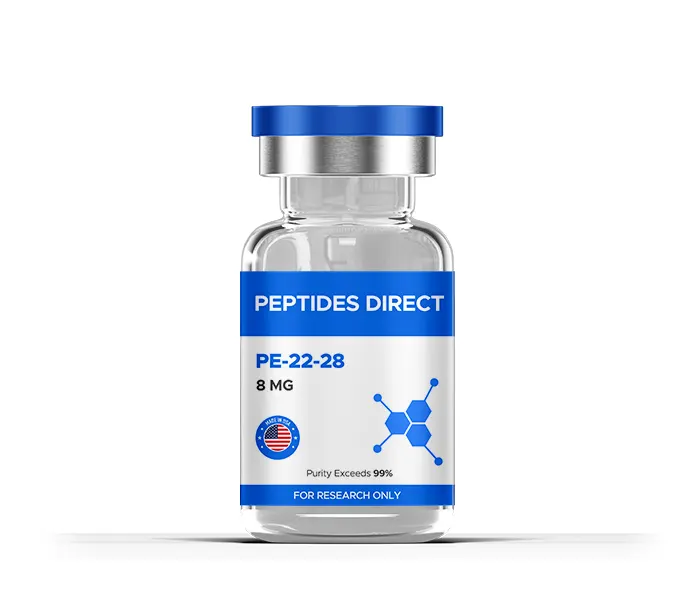


PE-22-28 (8mg)
$55.00
PE-22-28 peptides are Synthesized and Lyophilized in the USA.
PE-22-28 Peptide
PE-22-28 is a synthetic variant of the naturally occurring peptide Spadin. Spadin is a secreted peptide obtained from Sortilin. It appears to act as an antagonist of the TREK-1 (TWIK-related-potassium channel) receptor, a two-pore potassium channel identified as a potential target in the context of depression research and as a possible neurogenic regulator. Studies in mice have suggested that TREK-1 receptor deletion may make them resistant to depressive behavior and corresponding chemical imbalances in the brain.[1] PE-22-28 represents a shorter seven amino acid synthetic Spadin analog with potentially higher efficacy and stability. Research in animal models is ongoing.
Specifications
Other Known Titles: Spadin Analog, PE2228, TREK-1 Antagonist, PE 22 28, Sortilin Derivative, PE 2228
Sequence: GVSWGLR
Molecular Formula: C35H55N11O9
Molecular Weight: 773.8947 g/mol
PE-22-28 Research
PE-22-28 research remains highly limited due to a scarcity of experimental data. Given that PE-22-28 is a shorter variant of spadin with proposed enhanced affinity and stability, the properties of spadin are outlined below, as these may reasonably be expected to apply to PE-22-28 as well.
PE-22-28 and TREK-1 Receptors
TREK-1 is identified as the cognate receptor for spadin and, by extension, researchers suggest it may serve the same role for PE-22-28.[1] It is a two-pore potassium channel regulated by multiple molecular signals and is considered to govern neuronal excitability.[2] TREK-1 appears to be particularly abundant in the prefrontal cortex, amygdala, and hippocampus, where its capacity to reduce neuronal excitability may help protect against excitotoxicity. Researchers suggest that spadin holds potential to alleviate neurogenic depression regulated by the TREK-1 channel, and may potentially reverse hippocampal volume loss by stimulating neurogenesis.[3,4] Given the similarities in proposed potential between spadin and PE-22-28, it is reasonable to posit that a comparable hypothesis may apply to PE-22-28.
PE-22-28 and BDNF
It has been hypothesized that PE-22-28 may interact with BDNF, based on research suggesting such an interaction exists between spadin and BDNF. Brain-Derived Neurotrophic Factor (BDNF) is a protein proposed to support neuronal survival, growth, and maintenance, and is closely involved in synaptic plasticity. Research suggests that spadin may play a role in modulating BDNF levels, potentially contributing to its hypothesized antidepressant properties.[5] Spadin may influence BDNF pathways indirectly — possibly through its effects on serotonin (5-HT) neurotransmission and regulation of TREK-1 channel activity. NTSR3/Sortilin, from which spadin is derived, is also proposed to interact with neurotrophins such as pro-BDNF, considered important for neurotrophic regulation, cell survival, and apoptosis. While available research does not directly measure BDNF levels or associated pathways, it suggests that further investigation into how spadin may influence BDNF at both the mRNA and protein levels could yield valuable insights. PE-22-28 is expected to carry similar or potentially greater effects on BDNF, though research has yet to examine this directly.
PE-22-28 and Neurogenesis
PE-22-28 appears to promote neurogenesis over a relatively short timeframe. Studies in mice suggest the peptide may increase neurogenesis and synaptogenesis within as little as four days of exposure.[6] CREB (cAMP response element-binding protein) is a transcription factor associated with neuronal plasticity, memory formation, and spatial memory development,[7] and appears to be an essential component not only for neuronal growth but also for neuroprotection. Analysis indicates that brief spadin exposure may produce a marked increase in phosphorylated CREB (pCREB) levels — approximately four times higher than those observed in placebo controls — suggesting CREB activation, as confirmed by Western blot results showing the active form of CREB while total CREB levels remained unchanged. A notable colocalization of pCREB with doublecortin (DCX) — a protein associated with neuronal precursor cells — was also observed, implying that CREB activation may be intricately involved in neurogenesis, with particular relevance to neuronal rather than glial cells. It is therefore hypothesized that spadin, potentially via rapid CREB activation, may considerably promote both the magnitude and pace of hippocampal neurogenesis.[5] By extension, PE-22-28 may exert comparable effects on neurogenesis through analogous mechanisms.
Findings additionally suggest that spadin may increase the number of bromodeoxyuridine (BrdU)-positive cells in the hippocampus relative to placebo, potentially indicating enhanced new neuron formation from dividing progenitor cells. BrdU, a thymidine analog incorporated into DNA during the S-phase of the cell cycle, serves as a marker of cell proliferation, and the apparent rapid rise in BrdU-positive cells within four days of spadin exposure suggests an accelerated activation of neurogenic processes. PE-22-28 is postulated to similarly influence neurogenesis through these pathways.
Spadin and analogs such as PE-22-28 may also avoid some of the adverse outcomes observed in models entirely lacking TREK-1 channels. Research in animal models has suggested that complete TREK-1 channel knockout may be significantly detrimental — substantially increasing seizure susceptibility and eliminating the channel’s neuroprotective role against excitotoxicity. Notably, neither spadin nor PE-22-28 appeared to increase seizure activity in experimental settings, with mice exposed to spadin actually reported to show greater resistance to generalized seizure development. Research in animal models is ongoing.
PE-22-28 and Serotonin
Spadin has been proposed to modulate serotonin (5-HT) neurotransmission through its interaction with the TREK-1 potassium channel, raising the question of whether PE-22-28 may carry similar potential. It is hypothesized that spadin’s action may involve TREK-1 inhibition, leading to an increased firing rate of 5-HT neurons in the Dorsal Raphe Nucleus (DRN) — a central hub for serotonin signaling. This potential blockade may reduce the inhibitory feedback normally mediated by 5-HT1A autoreceptors, potentially amplifying serotonin neurotransmission.[5]
Further research suggests that the effects of spadin and serotonin receptor agonists may be additive and independently mediated.[8] When an mGluR2/3 (metabotropic glutamate receptor 2 and 3) antagonist was introduced, it appeared to attenuate spadin’s influence — implying that spadin’s effects may be linked to TREK-1 channels within the medial prefrontal cortex (mPFC) and their interaction with mGluR2/3 receptors.
Immunohistochemical analyses further indicated that spadin, in combination with the selective serotonin agonist RS 67333, may alter Zif268 expression in the DRN — a marker of neuronal activity. Both spadin and RS 67333 alone increased the number of Zif268-positive neurons, though their combination produced a substantially greater increase, suggesting a pronounced depolarizing effect on a subset of DRN neurons. When the mGluR2/3 antagonist LY 341495 was applied, an increased DRN serotonin neuron firing rate was observed — an effect that was absent following electrolytic lesioning of the mPFC, highlighting the potential role of mPFC TREK-1 channels and their interaction with mGluR2/3 receptors in this regulatory process. Fluorescence microscopy using Fura2-AM dye to measure intracellular calcium (Ca2+) levels in cultured cortical neurons revealed that combining spadin with either LY 341495 or RS 67333 elevated intracellular Ca2+ levels more than either compound alone, with the spadin and RS 67333 combination producing the most pronounced increase — an effect appearing to depend on serotonin receptor activation.
It may only be proposed at this stage that PE-22-28, as a potent spadin analog, may exhibit similar interactions with mGluR2/3 receptors and serotonin neurons, potentially mirroring the effects observed with spadin.
PE-22-28 and Muscle Function
Research suggests that TREK-1 may play a role in muscle responsiveness to mechanical stimulation,[9] with scientists noting that “application of negative pressure to cell-attached patches (-20 mmHg) caused a 19-fold increase in the open probability (NPo) of TREK-1 channels.” TREK-1 blockade appears to increase contractility in muscle tissue, while channel activation appears to promote muscle relaxation. While this aspect of TREK-1 function remains in early stages of investigation, it is gaining increasing research interest. A better understanding of the role of molecules such as PE-22-28 in muscle contraction and relaxation may open new research directions for conditions such as myogenic bladder dysfunction, and may also provide new pathways for investigating the physiology of muscle tissue development.
Disclaimer: The products mentioned are not intended for human or animal consumption. Research chemicals are intended solely for laboratory experimentation and/or in-vitro testing. Bodily introduction of any sort is strictly prohibited by law. All purchases are limited to licensed researchers and/or qualified professionals. All information shared in this article is for educational purposes only.
References
- Djillani A, Pietri M, Moreno S, Heurteaux C, Mazella J, Borsotto M. Shortened Spadin Analogs Display Better TREK-1 Inhibition, In Vivo Stability and Antidepressant Activity. Front Pharmacol. 2017 Sep 12;8:643. doi: 10.3389/fphar.2017.00643. PMID: 28955242; PMCID: PMC5601071.
- A. Djillani, J. Mazella, C. Heurteaux, and M. Borsotto, “Role of TREK-1 in Health and Disease, Focus on the Central Nervous System,” Front. Pharmacol., vol. 10, Apr. 2019, doi: 10.3389/fphar.2019.00379.
- R. S. Duman, S. Nakagawa, and J. Malberg, “Regulation of adult neurogenesis by antidepressant treatment,”Neuropsychopharmacol. Off. Publ. Am. Coll. Neuropsychopharmacol., vol. 25, no. 6, pp. 836–844, Dec. 2001, doi: 10.1016/S0893-133X(01)00358-X.
- H. Moha Ou Maati et al., “Spadin as a new antidepressant: absence of TREK-1-related side effects,” Neuropharmacology, vol. 62, no. 1, pp. 278–288, Jan. 2012, doi: 10.1016/j.neuropharm.2011.07.019.
- Mazella J, Pétrault O, Lucas G, Deval E, Béraud-Dufour S, Gandin C, El-Yacoubi M, Widmann C, Guyon A, Chevet E, Taouji S, Conductier G, Corinus A, Coppola T, Gobbi G, Nahon JL, Heurteaux C, Borsotto M. Spadin, a sortilin-derived peptide, targeting rodent TREK-1 channels: a new concept in the antidepressant drug design. PLoS Biol. 2010 Apr 13;8(4):e1000355. doi: 10.1371/journal.pbio.1000355. PMID: 20405001; PMCID: PMC2854129.
- C. Devader et al., “In vitro and in vivo regulation of synaptogenesis by the novel antidepressant spadin,” Br. J. Pharmacol., vol. 172, no. 10, pp. 2604–2617, May 2015, doi: 10.1111/bph.13083.
- A. J. Silva, J. H. Kogan, P. W. Frankland, and S. Kida, “CREB and memory,” Annu. Rev. Neurosci., vol. 21, pp. 127–148,1998, doi: 10.1146/annurev.neuro.21.1.127.
- Moha ou Maati, Hamid et al. “The peptidic antidepressant spadin interacts with prefrontal 5-HT(4) and mGluR(2) receptors in the control of serotonergic function.” Brain structure & function vol. 221,1 (2016): 21-37. doi:10.1007/s00429-014-0890-x
- Q. Lei, X.-Q. Pan, S. Chang, S. B. Malkowicz, T. J. Guzzo, and A. P. Malykhina, “Response of the human detrusor to stretch is regulated by TREK-1, a two-pore-domain (K2P) mechano-gated potassium channel,” J. Physiol., vol. 592, no. 14, pp. 3013–3030, Jul. 2014, doi: 10.1113/jphysiol.2014.271718.
Reviews
There are no reviews yet.