

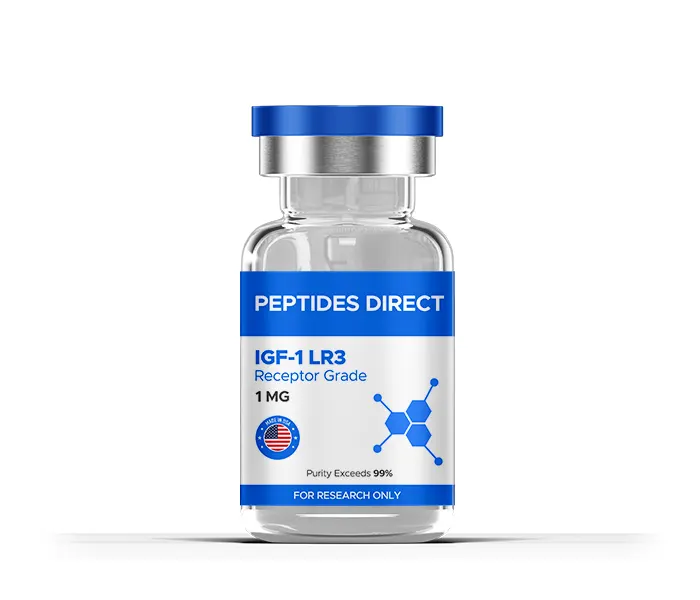
Receptor Grade IGF-1 LR3 (1mg)
$145.00
IGF-1 LR3 peptides are Synthesized and Lyophilized in the USA.
Receptor Grade IGF-1 LR3 Peptide
Receptor Grade IGF-1 LR3 is an altered variant of insulin-like growth factor-1; the complete name of the peptide is insulin-like growth factor-1 long arginine 3. IGF-1 derivatives have played important roles in research studies on cell proliferation, cell division, and cell-to-cell communication. Despite research reporting physiological potential similar to the parent protein, Receptor Grade IGF-1 LR3 does not appear to interact with IGF binding proteins (IGFBPs) as strongly as IGF-1. IGFBPs are a group of proteins that modulate the accessibility of Insulin-like Growth Factors (IGFs) within the bloodstream. This modulation potentially alters how IGFs engage with diverse bodily tissues. A reduction in the binding affinity of Insulin-like Growth Factor 1 Long Arg3 (IGF-1 LR3) for IGFBPs might potentially influence its bioavailability. Furthermore, this reduced binding might also affect the manner in which IGF-1 LR3 interacts with targeted tissues within experimental frameworks. Such alterations may lead to an enhanced potential of IGF-1 LR3, albeit possibly with a diminished duration of its active presence. This scenario suggests that the dynamics between IGF-1 LR3 and IGFBPs might be critical in determining the functional outcomes of IGF-1 LR3 in specific experimental contexts. The structural modifications in IGF-1 LR3 may have also contributed to the increased affinity of the peptide towards the IGF-1 receptors. The peptide is created by the inclusion of 13 amino acids to the N-terminus of native IGF-1 and by replacing the glutamic acid at position 3 with arginine, which ultimately leads to the formation of an 83 amino acid peptide.[1] The designation of Receptor Grade addresses the purity of the reference product, which is considered higher than Media Grade IGF-1 LR3.
Specifications
Molecular Formula: C400H625N111O115S9
Molecular Weight: 9117.5 g/mol
Sequence: MFPAMPLSSL FVNGPRTLCG AELVDALQFV CGDRGFYFNK PTGYGSSSRR APQTGIVDEC CFRSCDLRRL EMYCAPLKPA KSA
Receptor Grade IGF-1 LR3 Research
Receptor Grade IGF-1 LR3 and Cell Division
Similar to IGF-1, research suggests that Receptor Grade IGF-1 LR3 may act as a stimulus for cell division and proliferation, with primary effects observed in connective tissues of muscle and bone, as well as cell division in the liver, kidney, skin, lung, nerve, and blood tissues. IGF-1 is broadly regarded as a maturation hormone given its proposed influence on cell proliferation, differentiation, and functional maturation. The elevated potency of Receptor Grade IGF-1 LR3 at IGF-1 receptors may position it as a preferred molecule for studies involving cell division. Receptor Grade IGF-1 LR3 appears to provide approximately three times the cellular activation compared to standard IGF-1,[2] with researchers noting that analogs including “LR3 IGF-1 were approx. 2.5-fold more potent than IGF-1” in enhancing anabolic activities across various experimental models. These activities encompassed increased body mass, visceral organ growth, and potentially improved feed utilization efficiency under conditions of continuous exposure. This implies that IGF-1 LR3 may demonstrate enhanced efficacy in cellular proliferation studies relative to its unmodified counterpart.
Research employing murine models subjected to catabolic stressors noted a significant reduction in Ntau-methylhistidine excretion — a recognized indicator of muscle protein breakdown — with the reduction observed to be up to threefold greater with IGF-1 LR3 compared to IGF-1. This suggests that under specific experimental conditions, IGF-1 LR3 may exhibit more pronounced anabolic effects, though these were not consistently observed across all measured variables. Given these findings, Receptor Grade IGF-1 LR3 — specifically engineered for enhanced receptor affinity — may demonstrate even greater anabolic activity than standard IGF-1.
Receptor Grade IGF-1 LR3 and Myostatin
Myostatin, also known as growth differentiation factor 8, is a muscle protein considered to suppress the growth and differentiation of muscle cells, and is regarded as essential for protecting against unregulated hypertrophy. However, certain research contexts may call for myostatin inhibition — for example, in Duchenne Muscular Dystrophy (DMD) research or investigations into muscle loss associated with prolonged immobility, where attenuating myostatin activity may slow muscle breakdown. Studies in mouse models of DMD have suggested that Receptor Grade IGF-1 LR3 and other IGF-1 derivatives may counteract the adverse effects of myostatin, helping to protect muscle cells and prevent apoptosis.[3] Researchers noted that “results together suggest that myostatin suppresses both basal and IGF-1-stimulated proliferation of both WAT and BAT preadipocytes, actions that are again similar to those in muscle satellite cells.” Receptor Grade IGF-1 LR3, owing to its proposed stability, may potentially counteract myostatin through activation of MyoD — a muscle protein ordinarily triggered by prolonged physical exertion.
Receptor Grade IGF-1 LR3 and Metabolism
Researchers suggest that Receptor Grade IGF-1 LR3 may indirectly promote fat cell dissolution through interactions with the IGF-1R and insulin receptors, potentially improving glucose uptake from the bloodstream by muscle, nerve, and liver cells. These observed effects may occur through a complex signaling mechanism involving the PI3K (Phosphoinositide 3-kinases) and AMPK (AMP-activated protein kinase) pathways — both considered critical molecular regulators of cellular metabolism and growth.
Specifically, interaction of IGF-1 analogs with their receptors may initiate a series of biochemical reactions via the PI3K pathway, considered essential for cell proliferation and survival. This activation could trigger Protein Kinase B (Akt), which may influence the translocation of glucose transporters to the plasma membrane, potentially increasing cellular glucose uptake. Simultaneously, the AMPK pathway — recognized for its role in maintaining energy homeostasis — may be indirectly influenced by IGF-1 analogs such as IGF-1 LR3, with this influence potentially stimulating cellular glucose uptake and facilitating the movement of GLUT4 (Glucose Transporter Type 4) to the cell surface to promote glucose entry. Overall, these effects may result in reduced blood sugar levels, prompting adipose tissue and the liver to initiate glycogen and triglyceride catabolism — potentially decreasing adipose tissue and promoting net energy expenditure. Given its proposed capacity to regulate blood sugar levels, Receptor Grade IGF-1 LR3 may reduce insulin levels and diminish the requirement for exogenous insulin in diabetes research.[4]
Receptor Grade IGF-1 LR3 and Longevity Research
Studies suggest that Receptor Grade IGF-1 LR3 may support tissue repair and cell survival, potentially making it a protective molecule against cellular damage. Research in bovine and porcine models indicates that Receptor Grade IGF-1 LR3 exposure may help offset effects associated with cell turnover. Ongoing research in mice has examined the potential of Receptor Grade IGF-1 LR3 in possibly attenuating the progression of a range of conditions including muscle atrophy, dementia, and kidney disease.[5]
Disclaimer: The products mentioned are not intended for human or animal consumption. Research chemicals are intended solely for laboratory experimentation and/or in-vitro testing. Bodily introduction of any sort is strictly prohibited by law. All purchases are limited to licensed researchers and/or qualified professionals. All information shared in this article is for educational purposes only.
References
- Assefa B, Mahmoud AM, Pfeiffer AFH, Birkenfeld AL, Spranger J, Arafat AM. Insulin-Like Growth Factor (IGF) Binding Protein-2, Independently of IGF-1, Induces GLUT-4 Translocation and Glucose Uptake in 3T3-L1 Adipocytes. Oxid Med Cell Longev. 2017;2017:3035184. doi: 10.1155/2017/3035184. Epub 2017 Dec 20. PMID: 29422987; PMCID: PMC5750484.
- Tomas FM, Knowles SE, Owens PC, Chandler CS, Francis GL, Read LC, Ballard FJ. Insulin-like growth factor-I (IGF-I) and especially IGF-I variants are anabolic in dexamethasone-treated rats. Biochem J. 1992 Feb 15;282 ( Pt 1)(Pt 1):91-7. doi: 10.1042/bj2820091. PMID: 1371669; PMCID: PMC1130894.
- Li N, Yang Q, Walker RG, Thompson TB, Du M, Rodgers BD. Myostatin Attenuation In Vivo Reduces Adiposity, but Activates Adipogenesis. Endocrinology. 2016 Jan;157(1):282-91. doi: 10.1210/en.2015-1546. Epub 2015 Nov 18. PMID: 26580671; PMCID: PMC4701895.
- Bailes J, Soloviev M. Insulin-Like Growth Factor-1 (IGF-1) and Its Monitoring in Medical Diagnostic and in Sports. Biomolecules. 2021 Feb 4;11(2):217. doi: 10.3390/biom11020217. PMID: 33557137; PMCID: PMC7913862.
- AsghariHanjani N, Vafa M. The role of IGF-1 in obesity, cardiovascular disease, and cancer. Med J Islam Repub Iran. 2019 Jun 17;33:56. doi: 10.34171/mjiri.33.56. PMID: 31456980; PMCID: PMC6708115.
- Philippou A, Barton ER. Optimizing IGF-I for skeletal muscle therapeutics. Growth Horm IGF Res. 2014 Oct;24(5):157-63. doi: 10.1016/j.ghir.2014.06.003. Epub 2014 Jun 19. PMID: 25002025; PMCID: PMC4665094.
Reviews
There are no reviews yet.