

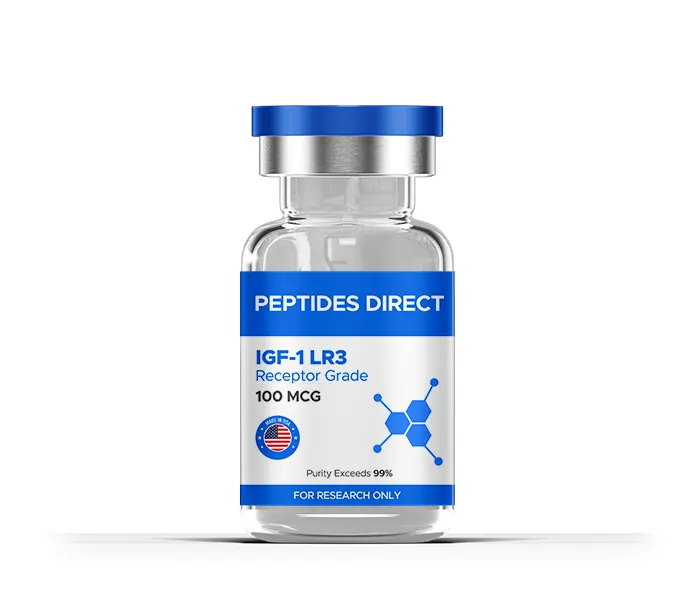
Receptor Grade IGF-1 LR3 (100mcg)
$27.00
Receptor Grade IGF-1 LR3 peptides are Synthesized and Lyophilized in the USA.
Receptor Grade IGF-1 LR3 Peptide
Receptor Grade IGF-1 LR3 peptide is a research reagent examined in studies on cellular growth, IGF receptors, and IGF binding proteins. It contains an extended N-terminal structure of 13 amino acids and a replacement of the glutamic acid at residue 3. Additionally, the addition of arginine in the original sequence of recombinant IGF-1 (rhIGF-1), which ultimately leads to the formation of an 83 amino acid peptide. Hence, it is named IGF-1 Long R3.[1,2] It appears to be potentially more influential on cellular activities than rhIGF-1 due to an apparent significant improvement in its biological activity. This is since it exhibits a stronger affinity for the IGF receptor and lower affinity towards other proteins that may inactivate it. Moreover, the classification of Receptor Grade refers to the purity of the material, which is considered higher than the standard Media Grade IGF-1 LR3. Media grate IGF-1 LR3 is routinely studied in cell cultures and as a research reagent, at an economical cost, for studies where biological potency is not crucial. Receptor Grade IGF-1 LR3 is considered the reagent of choice to achieve optimum results when performing any animal study and cell-based assays. Growth of mammalian cells in the presence of low concentrations of Long R3 IGF-1 appears to result in better productivity than standard concentrations of insulin and/or standard IGF-1.[1] Researchers report that the peptide exhibited “equivalent or better performance using two recombinant CHO cell lines.” IGF-1 LR3 may be more capable of inducing the type 1 IGF receptor, potentially promoting an elevated level of intracellular signaling, cellular proliferation, and apoptosis inhibition.
Specifications
Molecular Formula: C400H625N111O115S9
Molecular Weight: 9117.5 g/mol
Sequence: MFPAMPLSSL FVNGPRTLCG AELVDALQFV CGDRGFYFNK PTGYGSSSRR APQTGIVDEC CFRSCDLRRL EMYCAPLKPA KSA
Receptor Grade IGF-1 LR3 Research
Receptor Grade IGF-1 LR3 and Biological Activity
The peptide appears to produce a more pronounced but comparatively short-lived effect relative to IGF-1, potentially through a degree of resistance to inactivating proteins such as IGF binding proteins (IGFBPs).[2] IGFBPs are a category of proteins that may regulate the availability of insulin-like growth factors (IGFs) within the bloodstream, potentially influencing their interactions with various tissues. A reduction in IGF-1 LR3’s binding affinity for IGFBPs may affect its bioavailability and potentially shorten its duration of action. This weakened binding may additionally alter how IGF-1 LR3 engages with target tissues in experimental settings, potentially enhancing its potency while reducing its active window. The interactions between IGF-1 LR3 and IGFBPs may therefore be a determining factor in the functional outcomes of IGF-1 LR3 across specific experimental contexts, potentially resulting in greater potency but shorter duration of action compared to recombinant insulin-like growth factor 1 (rhIGF-1).
Studies in murine models indicate that IGF-1 LR3 may be cleared from plasma more rapidly and distributed more quickly into various tissue compartments compared to IGF-1.[3] Investigation into the tissue distribution of IGF-1 LR3 suggested it may localize differently from IGF-1, with elevated concentrations observed in specific tissues including the kidneys, ovaries, and adrenal glands in murine models.[1] This distinct localization pattern suggests that organs primarily involved in metabolic and reproductive functions may differ in their capacity to absorb or retain IGF-1 LR3 relative to IGF-1. These differences are speculated to arise from IGF-1 LR3’s reduced tendency to bind IGFBPs, which may alter its bioavailability and tissue interactions in experimental models. It has nonetheless been hypothesized that a peptide bearing similar modifications — specifically the R3 modification present in IGF-1 LR3 — may possess greater anabolic potential than standard IGF-1 despite a shorter duration of activity. Further research is required to fully characterize these mechanisms and their implications.[4]
Receptor Grade IGF-1 LR3 and Insulin-Like Growth Factor Receptor Interactions
Endogenously produced IGF-1 interacts with at least two cell surface receptors — the IGF-1 receptor (IGF-1R) and the insulin receptor.[5] Researchers have noted that “IR and IGF1R act as identical portals to the regulation of gene expression, with differences between insulin and IGF-1 effects due to a modulation of the amplitude of the signal created by the specific ligand-receptor interaction.” IGF-1R is referred to as the physiologic receptor due to its substantially higher affinity for IGF-1 — approximately 100 times greater than that of the insulin receptor. Binding of IGF-1 to IGF-1R is associated with alterations in metabolism, prevention of apoptosis, promotion of cell growth (hypertrophy), support of differentiation and cell division (hyperplasia), normal developmental processes, and potentially malignant growth. IGF-1R has been investigated in the context of various cancer types including prostate, breast, and lung cancer.[6] IGF-1 also appears to activate insulin receptors, thereby promoting cellular glucose uptake from the bloodstream, and has been reported to exert a threefold influence on muscle cells.
Receptor Grade IGF-1 LR3 and Muscle Cells
Preliminary research in murine models suggests that IGF-1 LR3 may possess significant anabolic properties. One study examined its effects in both normal mice and those experiencing catabolic conditions induced by dexamethasone, a synthetic steroid,[7] with IGF-1 LR3 appearing to be approximately 2.5 times more potent than standard IGF-1 in producing anabolic outcomes. Observed effects included weight gain, increased visceral organ weight, and potentially improved feed-to-body-mass conversion efficiency under conditions of continuous IGF-1 LR3 exposure. Direct studies examining IGF-1 LR3’s effects specifically on muscle cells are currently lacking, though given the structural similarities between the two peptides, IGF-1 LR3 is expected to exert comparable effects on muscle tissue as IGF-1.
Based on existing research, IGF-1 is proposed to promote an increase in the number of muscle cells — a process known as hyperplasia.[8] It also appears to influence the lifespan of skeletal muscle satellite cells, which provide nutritional support to muscle cells and contribute to their efficient function, potentially supporting muscle tissue development by prolonging satellite cell viability. Additionally, IGF-1 appears to promote myoblast differentiation[9] — encouraging the commitment of stem cell progeny from non-specific pluripotent stem cells toward dedicated muscle tissue. In summary, IGF-1 may support muscle development by enhancing the rate at which generic stem cells are converted into muscle cells.
Disclaimer: The products mentioned are not intended for human or animal consumption. Research chemicals are intended solely for laboratory experimentation and/or in-vitro testing. Bodily introduction of any sort is strictly prohibited by law. All purchases are limited to licensed researchers and/or qualified professionals. All information shared in this article is for educational purposes only.
References
- Thomas, James N., and Victor Fung. “Comparison of long R3 IGF-1 with insulin in the support of cell growth and recombinant protein expression in CHO cells.” Animal Cell Technology. Butterworth-Heinemann, 1994. 91-95.
- Assefa, Biruhalem, et al. “Insulin-like growth factor (IGF) binding protein-2, independently of IGF-1, induces GLUT-4 translocation and glucose uptake in 3T3-L1 adipocytes.” Oxidative Medicine and Cellular Longevity 2017 (2017).
- Bastian SE, Walton PE, Wallace JC, Ballard FJ. Plasma clearance and tissue distribution of labelled insulin-like growth factor-I (IGF-I) and an analogue LR3IGF-I in pregnant rats. J Endocrinol. 1993 Aug;138(2):327-36. doi: 10.1677/joe.0.1380327. PMID: 7693845.
- Elis S, Wu Y, Courtland HW, Cannata D, Sun H, Beth-On M, Liu C, Jasper H, Domené H, Karabatas L, Guida C, Basta-Pljakic J, Cardoso L, Rosen CJ, Frystyk J, Yakar S. Unbound (bioavailable) IGF1 enhances somatic growth. Dis Model Mech. 2011 Sep;4(5):649-58. doi: 10.1242/dmm.006775. Epub 2011 May 31. PMID: 21628395; PMCID: PMC3180229.
- Boucher J, Tseng YH, Kahn CR. Insulin and insulin-like growth factor-1 receptors act as ligand-specific amplitude modulators of a common pathway regulating gene transcription. J Biol Chem. 2010 May 28;285(22):17235-45. doi: 10.1074/jbc.M110.118620. Epub 2010 Apr 1. PMID: 20360006; PMCID: PMC2878077.
- Shanmugalingam T, Bosco C, Ridley AJ, Van Hemelrijck M. Is there a role for IGF-1 in the development of second primary cancers? Cancer Med. 2016 Nov;5(11):3353-3367. doi: 10.1002/cam4.871. Epub 2016 Oct 13. PMID: 27734632; PMCID: PMC5119990.
- Tomas, F. M., Knowles, S. E., Owens, P. C., Chandler, C. S., Francis, G. L., Read, L. C., & Ballard, F. J. (1992). Insulin-like growth factor-I (IGF-I) and especially IGF-I variants are anabolic in dexamethasone-treated rats. The Biochemical journal, 282 ( Pt 1)(Pt 1), 91–97.
- Yoshida T, Delafontaine P. Mechanisms of IGF-1-Mediated Regulation of Skeletal Muscle Hypertrophy and Atrophy. Cells. 2020 Aug 26;9(9):1970. doi: 10.3390/cells9091970. PMID: 32858949; PMCID: PMC7564605.
- Aboalola D, Han VKM. Different Effects of Insulin-Like Growth Factor-1 and Insulin-Like Growth Factor-2 on Myogenic Differentiation of Human Mesenchymal Stem Cells. Stem Cells Int. 2017;2017:8286248. doi: 10.1155/2017/8286248. Epub 2017 Dec 14. PMID: 29387091; PMCID: PMC5745708.
Reviews
There are no reviews yet.