

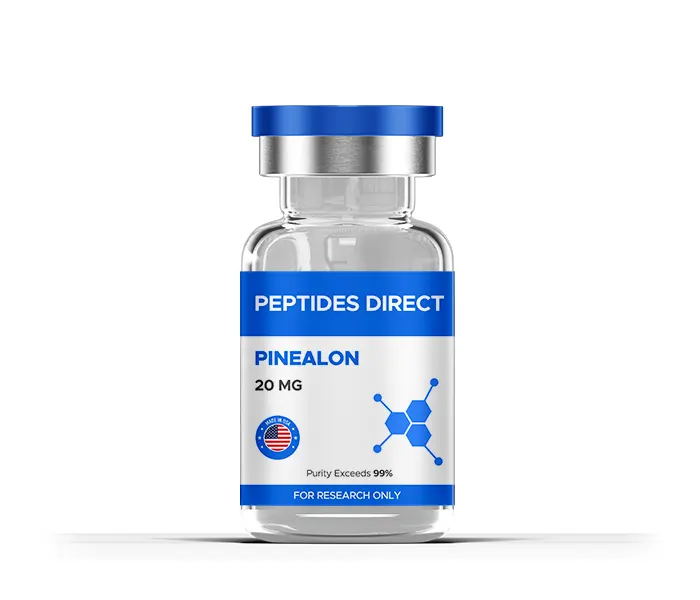
Pinealon (20mg)
$68.00
Pinealon peptides are Synthesized and Lyophilized in the USA.
Pinealon Peptide
Pinealon (also referred to as EDR) is a short peptide comprising only three amino acids (Glu-Asp-Arg). Additionally, it is classified as one of Khavinson’s peptides. EDR is generally extracted from a crude polypeptide extract called Cortexin. Pinealon is considered to be a peptide bioregulator, and it appears to interact directly with DNA. It may contribute to the alteration of gene expression levels. It may potentially exhibit behavior modification and may protect various cell types, including neurons, against hypoxia. Pinealon has been studied for its potential to impact the pineal gland to address issues with metabolism, circadian rhythm disorders, and certain cognitive functions.
Pinealon, unlike most other peptides, does not appear to bind to the cell surface or cytoplasmic receptors. Research studies exploring cell cultures (HeLa cells) have suggested that the peptide penetrates the cell membrane and the nuclear membrane to interact with DNA directly.[1] The researchers conclude that “The site-specific interactions of peptides with DNA [may] control epigenetically the cell genetic functions, and they seem to play an important role in regulation of gene activity even at the earliest stages of… origin and in evolution.” Thus, it is believed that the peptide may function in some ways as a potential regulator of gene expression and mediate myriad cellular actions.
In experiments where the peptide is exposed to research models at high concentrations, it has been observed that Pinealon appears to contribute to modulation of the cell cycle. Researchers have posited that the peptide might interact directly with the cell genome. Pinealon may also have specific actions toward nerve cells, specifically related to protecting them against oxidative stress. Some studies suggest that the peptide may exert its anti-cellular aging and nerve cell protective actions at low concentrations based on its anti-oxidative actions in laboratory settings.[6]
Specifications
Molecular Weight: 418.407 g/mol
Molecular Formula: C15H26N6O8
Sequence: Glu-Asp-Arg
Other Known Titles: Glutamylaspartylarginine, T-33 peptide
Pinealon Research
Pinealon and Cellular Aging
Pinealon may exert anti-aging effects on cells, with particularly notable observations within the central nervous system. It appears to be anabolic in brain tissue and may reduce the rate of cellular aging as assessed through certain bioindicators.[2] These proposed neuroprotective and anti-apoptotic properties are hypothesized to be mediated through influence on the mitogen-activated protein kinase (MAPK) and extracellular signal-regulated kinase (ERK) signaling pathways. The MAPK pathway is considered a critical signaling mechanism transmitting signals from the cell surface to nuclear DNA, with potential implications for gene expression and cellular processes including growth, division, and programmed death.
ERK is recognized as a specific component of the MAPK pathway involved in regulating various cellular activities including proliferation and survival. Researchers propose that by influencing MAPK/ERK signaling, Pinealon may reduce intracellular production of reactive oxygen species (ROS). While ROS are endogenous byproducts of cellular metabolism with recognized roles in cell signaling, excessive levels are understood to induce oxidative stress and potentially damage cellular components. ROS are suggested to act as secondary messengers within the MAPK and ERK signaling pathways, potentially activating these pathways and shaping cellular responses.
Pinealon may attenuate MAPK and ERK pathway activation by contributing to a reduction in ROS levels, potentially resulting in diminished cellular stress and inhibition of apoptosis — the programmed cell death mechanism.[3] The peptide also appears to influence other cell types, including muscle cells, by seemingly altering Irisin expression. Irisin is understood to play a role in protecting muscle cells during physical exertion, influencing metabolic rate, and potentially promoting telomere elongation.[4] The peptide may therefore hold potential for protecting muscle cell telomeres and supporting these cells against the adverse effects of cellular aging and oxidative stress.
Pinealon and Neuron Protection
Research studies indicate that Pinealon may protect neurons against oxidative stress in rats, supporting cognitive function and motor coordination.[5] Researchers noted that these “experiments allowed confirming the neuroprotective properties of pinealon, which is in agreement with the previous data obtained by us in vitro.” The study observed a significant reduction in both reactive oxygen species accumulation and necrotic cell populations in experimental brain models.
The peptide may also protect proliferative pathways and modify the cell cycle as part of its defense against cell death,[6] with this action considered to regulate the damaging potential of ROS under oxidative stress conditions. Such stress may be induced by receptor-dependent processes — for example, homocysteine exposure may activate NMDA receptors, leading to excitotoxicity, in which excessive NMDA receptor stimulation causes neuronal cell damage through elevated calcium influx and subsequent ROS production.
Pinealon also appears to enhance neuronal resistance to hypoxic stress through activation of innate antioxidative enzyme systems and may reduce the excitotoxic potential of N-methyl-D-aspartate (NMDA). Laboratory experiments suggested the peptide may decrease necrotic cell death, as indicated by propidium iodide staining — a protective effect accompanied by delayed activation of ERK 1/2 kinases, components of the MAPK signaling pathway involved in cell survival and proliferation.
Pinealon and Serotonin Signaling
Pinealon may carry neuroprotective and geroprotective potential, with research beginning to examine its possible influence within the context of depression research. The peptide may promote expression of 5-tryptophan hydroxylase (TPH) through epigenetic changes in brain cortex cells — TPH being considered essential for serotonin production and secretion.[7]
The proposed underlying mechanism involves Pinealon’s interaction with DNA within the cell nucleus, with the peptide hypothesized to bind specifically to certain nucleotide sequences in the promoter region of the TPH gene — the segment of DNA controlling the initiation of gene transcription. By potentially engaging this region, Pinealon may enhance TPH gene transcriptional activity, potentially increasing TPH enzyme production and subsequently elevating serotonin synthesis.
To explore this possibility, researchers employed molecular docking simulations, which suggested that Pinealon may exhibit a lower — more negative — binding energy when interacting with DNA compared to other bioregulatory peptides. Lower binding energy may indicate a more stable peptide-DNA interaction, potentially leading to increased TPH enzyme synthesis and higher serotonin production. Preliminary research also suggests that Pinealon may increase serotonin synthesis by approximately 1.9 times in younger cell cultures relative to control groups.
Pinealon and Cell Death
Researchers propose that Pinealon may alter cytokine signaling in ways that influence caspase-3 enzyme levels. Caspase-3 is recognized as a direct initiator of apoptosis through genetic instruction,[8] and by potentially contributing to its regulation, Pinealon may block at least one pathway to cell death and thereby attenuate the impact of oxygen deprivation — as suggested by experiments in stroke research models.
Beyond its proposed role in caspase-3 modulation, Pinealon has been suggested to influence levels of interleukin-6 (IL-6) and tumor necrosis factor-alpha (TNF-alpha) — cytokines commonly associated with inflammation and cellular stress responses. This suggests that Pinealon may help restore these inflammatory markers toward normal levels, potentially attenuating the inflammatory response and apoptosis induced under hypoxic conditions. By possibly supporting an environment conducive to neuronal survival and function during hypoxic stress, some researchers propose that Pinealon may enhance the resilience of nerve cells to oxygen deprivation.
Pinealon may additionally reduce caspase-3 levels in myocardial infarction models, with potential relevance to heart attack research and the management of long-term cardiac remodeling that contributes to post-infarction dysfunction. The peptide also appears to promote cell proliferation in both young and aged animals by inhibiting apoptosis in dermal and epidermal cells, potentially enhancing regenerative processes and offsetting age-related pathology in these cell populations.[9]
Pinealon and Sleep Regulation
Research indicates that Pinealon may help attenuate the adverse effects of certain sleep cycle disruptions. The peptide has been observed to apparently contribute to resetting the pineal gland to baseline following circadian rhythm disturbance — a type of influence over circadian function considered to carry broad downstream biological implications.[10] Disrupted sleep is widely recognized as significantly detrimental to biological function over time, and Pinealon may help reduce the impact of sleep disturbance and thereby offset its cumulative effects. Research in this area is ongo
Disclaimer: The products mentioned are not intended for human or animal consumption. Research chemicals are intended solely for laboratory experimentation and/or in-vitro testing. Bodily introduction of any sort is strictly prohibited by law. All purchases are limited to licensed researchers and/or qualified professionals. All information shared in this article is for educational purposes only.
References
- Fedoreyeva LI, Kireev II, Khavinson VKh, Vanyushin BF. Penetration of short fluorescence-labeled peptides into the nucleus in HeLa cells and in vitro specific interaction of the peptides with deoxyribooligonucleotides and DNA. Biochemistry (Mosc). 2011 Nov;76(11):1210-9. doi: 10.1134/S0006297911110022. PMID: 22117547.
- Meshchaninov VN, Tkachenko EL, Zharkov SV, Gavrilov IV, Katyreva IuE. [EFFECT OF SYNTHETIC PEPTIDES ON AGING OF PATIENTS WITH CHRONIC POLYMORBIDITY AND ORGANIC BRAIN SYNDROME OF THE CENTRAL NERVOUS SYSTEM IN REMISSION]. Adv Gerontol. 2015;28(1):62-7. Russian. PMID: 26390612.
- Khavinson, V., Linkova, N., Kozhevnikova, E., & Trofimova, S. (2020). EDR Peptide: Possible Mechanism of Gene Expression and Protein Synthesis Regulation Involved in the Pathogenesis of Alzheimer’s Disease. Molecules (Basel, Switzerland), 26(1), 159. https://www.ncbi.nlm.nih.gov/pmc/articles/PMC7795577/
- Khavinson VKh, Kuznik BI, Tarnovskaya SI, Lin’kova NS. Short Peptides and Telomere Length Regulator Hormone Irisin. Bull Exp Biol Med. 2016 Jan;160(3):347-9. doi: 10.1007/s10517-016-3167-y. Epub 2016 Jan 8. PMID: 26742748.
- Arutjunyan A, Kozina L, Stvolinskiy S, Bulygina Y, Mashkina A, Khavinson V. Pinealon protects the rat offspring from prenatal hyperhomocysteinemia. Int J Clin Exp Med. 2012;5(2):179-85. Epub 2012 Apr 6. PMID: 22567179; PMCID: PMC3342713.
- Khavinson V, Ribakova Y, Kulebiakin K, Vladychenskaya E, Kozina L, Arutjunyan A, Boldyrev A. Pinealon increases cell viability by suppression of free radical levels and activating proliferative processes. Rejuvenation Res. 2011 Oct;14(5):535-41. doi: 10.1089/rej.2011.1172. Epub 2011 Oct 6. PMID: 21978084.
- Khavinson VKh, Lin’kova NS, Tarnovskaya SI, Umnov RS, Elashkina EV, Durnova AO. Short peptides stimulate serotonin expression in cells of the brain cortex. Bull Exp Biol Med. 2014 May;157(1):77-80. doi: 10.1007/s10517-014-2496-y. Epub 2014 Jun 10. PMID: 24909721.
- Mendzheritskiĭ AM, Karantysh GV, Ryzhak GA, Dem’ianenko SV. [Regulation of content of cytokines in blood serum and of caspase-3 activity in brains of old rats in a model of sharp hypoxic hypoxia with Cortexin and Pinealon]. Adv Gerontol. 2014;27(1):94-7. Russian. PMID: 25051764.
- Voicekhovskaya MA, Chalisova NI, Kontsevaya EA, Ryzhak GA. Effect of bioregulatory tripeptides on the culture of skin cells from young and old rats. Bull Exp Biol Med. 2012 Jan;152(3):357-9. doi: 10.1007/s10517-012-1527-9. PMID: 22803085. https://pubmed.ncbi.nlm.nih.gov/22803085/
- Bashkireva AS, Artamonova VG. [The peptide correction of neurotic disorders among professional truck drivers]. Adv Gerontol. 2012;25(4):718-28. Russian. PMID: 23734521.
Reviews
There are no reviews yet.