

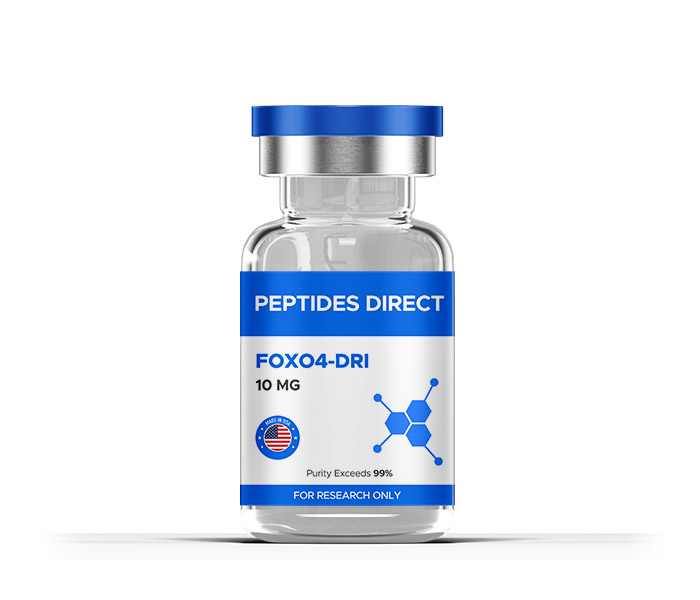
FOXO4-DRI (Proxofim) (10mg)
$270.00
FOXO4-DRI peptides are Synthesized and Lyophilized in the USA.
FOXO4-DRI Peptide
FOXO4-DRI is a synthetic version of FOXO4, containing D amino acids instead of L amino acids. This modification is intended to allow the peptide to retain the functionality of the original protein but with a longer shelf life and lower clearance. Its most prominent function has been suggested to regulate apoptosis in senescent cells.[1] It has been suggested in scientific studies that senescent cells might exhibit resistance to apoptosis, aka programmed cell death. This resistance has been associated with increased binding of FOXO4 with another protein, p53, which should trigger apoptosis but become inactivated.
FOXO4-DRI appears to work by inhibiting FOXO4-p53 binding; thereby, p53 may target pro-apoptotic genes and promote their expression. These proteins, in turn, may induce apoptosis of old cells, thereby reducing the old cell burden in tissues. The accumulation of senescent cells, often referred to as the “old cell burden,” is a concern because these cells can secrete a variety of harmful substances as part of the senescence-associated secretory phenotype (SASP). SASP is characterized by the release of inflammatory and tissue-degrading molecules that can impair tissue function and structure, potentially leading to age-related deterioration. By possibly disrupting the harmful cycle of senescent cell accumulation through the action of FOXO4-DRI, there might be an improvement in tissue function. This restoration of tissue function could also be accompanied by a reduction in the biomarkers associated with cellular aging, suggesting a return toward a more balanced state of cell function.
This may also lead to increases in cellular differentiation and tissue repair. FOXO4 protein is a prominent member of the group of transcription factors classified as exhibiting potential to regulate growth and differentiation. It appears to be endogenously abundant in tissues such as the placenta, ovaries, fat cells, testes, and adrenal glands. Post-translational modifications, especially those in the DNA binding domain of FOXO4 protein, appear to modify its functionality as a transcription factor and regulation of pathways such as apoptosis, cellular senescence, insulin signaling, and senescence.
FOXO4-D-Retro-Inverso is a synthetic and partially altered form of the original FOXO4 protein. The modification was developed to help enhance the half-life of the protein and allow it to obstruct the normal FOXO4 function. FOXO4-DRI has been suggested to prevent normal FOXO4 binding to p53, eliminate senescent cells, enhance organ function, and reduce cell death progression. FOXO4-DRI also appears to influence insulin signaling, cell cycle regulation, and oxidative stress signaling pathways. The peptide appears to be permeable into cells, and researchers have suggested selectively inducing senescent cell apoptosis based on results found in studies.
Specifications
Other Known Titles: Forkhead box protein O4, Proxofim, FOXO4a, AFX, AFX1, MLLT7
Sequence: H-D-Leu-D-Thr-D-Leu-D-Arg-D-Lys-D-Glu-D-Pro-D-Ala-D-Ser-D-Glu-D-Ile-D-Ala-D-Gln-D-Ser-D-Ile-D-Leu-D-Glu-D-Ala-D-Tyr-D-Ser-D-Gln-D-Asn-D-Gly-D-Trp-D-Ala-D-Asn-D-Arg-D-Arg-D-Ser-D-Gly-D-Gly-D-Lys-D-Arg-D-Pro-D-Pro-D-Pro-D-Arg-D-Arg-D-Arg-D-Gln-D-Arg-D-Arg-D-Lys-D-Lys-D-Arg-D-Gly-OH
Molecular Formula: C228H388N86O64
Molecular Weight: 5358.05 g/mol
FOXO4-DRI Research
DRI peptides are synthetic variants of their naturally occurring counterparts, characterized by a reversed amino acid sequence and an altered alpha chirality.[2] While naturally occurring amino acids adopt an L chiral configuration, DRI peptides appear to be composed of D chiral amino acids. This structural distinction may confer resistance to enzymatic degradation, potentially prolonging functional viability. DRI peptides are also considered candidates for peptidomimetics, useful in studying protein-protein, protein-peptide, and peptide-peptide interactions.
FOXO4-DRI and Research in Cell Aging, Senescence
FOXO4 is proposed to contribute to the perpetuation of aged or senescent cells through its apparent binding to p53, which may prevent apoptotic death of these cells.[3] The FOXO4-DRI peptide appears to disrupt this FOXO4-p53 interaction, potentially allowing p53 to activate apoptotic proteins and initiate cellular death. The p53 protein functions as an intrinsic cellular regulator, primarily responsible for overseeing cell cycle progression and initiating cell death where necessary. Recognized for its role as a tumor suppressor, p53 appears to primarily act to halt the division of cells that have sustained DNA damage. When FOXO4 binds to p53, preliminary observations suggest that p53 may be prevented from binding to DNA, thereby inhibiting apoptosis and allowing cells to evade programmed death. This may result in an increased accumulation of senescent cells — defined as cells that cease to divide but fail to undergo natural death — thereby contributing to population-level cellular aging. However, in scenarios where FOXO4 is bound to the DRI peptide, this inhibitory interaction may not occur, potentially allowing p53 to engage with DNA and facilitate progression toward programmed cell death. The interaction involving FOXO4-DRI may therefore hold potential to restore p53’s capacity to initiate the elimination of senescent cells through apoptosis, allowing aged cells to be cleared from tissues and supporting improved tissue regeneration. Studies exposing aging murine models to the DRI peptide reportedly resulted in improved tissue regeneration and extended healthspan — the portion of the lifespan during which the organism remains biologically active. Treated aged mice exhibited greater physical activity and researchers observed a reduction in age-associated conditions such as cardiac disease and musculoskeletal dysfunction.
FOXO4-DRI and Research in Insulin Signal Regulation
FOXO proteins are proposed to regulate the influence of insulin signaling and insulin-like growth factors. Scientific data suggests that the FOXO family of proteins may act downstream of insulin signaling to regulate cellular growth, metabolism, differentiation, and oxidative stress. Mutations in FOXO genes have been associated with hyperglycemia and hyperlipidemia and may increase the risk of carcinogenesis in experimental models. In the context of diabetes models, such mutations may contribute to cardiac events, impaired wound healing, stroke, and kidney damage.[4] The precise mechanism of FOXO4-DRI action remains to be fully characterized.
FOXO4-DRI and Research in Heart Disease
Cellular aging and death represent critical factors in the onset of cardiac disease, a phenomenon partly attributed to the progressive loss of proteasome activity over time. The proteasome is responsible for degrading oxidized, modified, or damaged proteins, thereby maintaining a functional cellular environment. Reduced proteasome activity may lead to the accumulation of toxic proteins detrimental to cardiac tissue.[5] FOXO signaling appears to hold potential for enhancing autophagy and proteasomal activity in the heart, thereby accelerating the clearance of damaged cells. It has been proposed that FOXO4-DRI or a structural variant may promote proteasomal function, supporting the functional integrity of cardiac tissue and potentially reducing the risk of cardiovascular disease.
FOXO4-DRI and Research in Neurodegenerative Diseases
The complex etiology of neurodegenerative diseases remains incompletely understood. Research data indicates that alterations in FOXO proteins may contribute to disease pathology.[6] Diminished proteasomal activity appears to exacerbate the underlying conditions of Huntington’s disease, Alzheimer’s disease, Parkinson’s disease, and prion disease. FOXO-DRI protein or structurally modified alternatives may therefore hold value in researching select neurodegenerative conditions by compensating for the functional absence of native FOXO proteins.
FOXO4-DRI Potential Selectivity
FOXO4-DRI is believed to selectively disrupt the binding of FOXO4 to p53, which may lead to p53 activation and subsequent stimulation of senescent cell clearance.[7] By inhibiting this specific interaction, FOXO4-DRI may enhance the organism’s capacity to eliminate senescent cells without significantly affecting other functions of FOXO4. Notably, this inhibition may not interfere with the antioxidative properties of FOXO4, which is understood to continue playing a vital role in the transcription of genes encoding antioxidant enzymes such as manganese superoxide dismutase (MnSOD), catalase (CAT), and glutathione peroxidase (GPX) — enzymes considered essential for neutralizing harmful free radicals and maintaining cellular integrity. The targeted mechanism of FOXO4-DRI therefore suggests a potential dual research benefit: facilitating the removal of senescent cells to support tissue rejuvenation and improved organ function, while preserving the critical antioxidant defenses mediated by FOXO4. This potentially selective inhibition may theoretically offer a means of reducing cellular senescence with minimal disruption to the cell’s natural protective mechanisms against oxidative stress.
Disclaimer: The products mentioned are not intended for human or animal consumption. Research chemicals are intended solely for laboratory experimentation and/or in-vitro testing. Bodily introduction of any sort is strictly prohibited by law. All purchases are limited to licensed researchers and/or qualified professionals. All information shared in this article is for educational purposes only.
References
- Huang Y, He Y, Makarcyzk MJ, Lin H. Senolytic Peptide FOXO4-DRI Selectively Removes Senescent Cells From in vitro Expanded Human Chondrocytes. Front Bioeng Biotechnol. 2021 Apr 29;9:677576. doi: 10.3389/fbioe.2021.677576. PMID: 33996787; PMCID: PMC8116695.
- Doti N, Mardirossian M, Sandomenico A, Ruvo M, Caporale A. Recent Applications of Retro-Inverso Peptides. Int J Mol Sci. 2021 Aug 12;22(16):8677. doi: 10.3390/ijms22168677. PMID: 34445382; PMCID: PMC8395423.
- Baar MP, Brandt RMC, Putavet DA, Klein JDD, Derks KWJ, Bourgeois BRM, Stryeck S, Rijksen Y, van Willigenburg H, Feijtel DA, van der Pluijm I, Essers J, van Cappellen WA, van IJcken WF, Houtsmuller AB, Pothof J, de Bruin RWF, Madl T, Hoeijmakers JHJ, Campisi J, de Keizer PLJ. Targeted Apoptosis of Senescent Cells Restores Tissue Homeostasis in Response to Chemotoxicity and Aging. Cell. 2017 Mar 23;169(1):132-147.e16. doi: 10.1016/j.cell.2017.02.031. PMID: 28340339; PMCID: PMC5556182.
- Murakami T, Inagaki N, Kondoh H. Cellular Senescence in Diabetes Mellitus: Distinct Senotherapeutic Strategies for Adipose Tissue and Pancreatic β Cells. Front Endocrinol (Lausanne). 2022 Mar 31;13:869414. doi: 10.3389/fendo.2022.869414. PMID: 35432205; PMCID: PMC9009089.
- Zhu M, Zhang QJ, Wang L, Li H, Liu ZP. FoxO4 inhibits atherosclerosis through its function in bone marrow derived cells. Atherosclerosis. 2011 Dec;219(2):492-8. doi: 10.1016/j.atherosclerosis.2011.09.038. Epub 2011 Oct 2. PMID: 22005198; PMCID: PMC3226872.
- Bourgeois B, Madl T. Regulation of cellular senescence via the FOXO4-p53 axis. FEBS Lett. 2018 Jun;592(12):2083-2097. doi: 10.1002/1873-3468.13057. Epub 2018 May 25. PMID: 29683489; PMCID: PMC6033032.
- Lee, S., & Dong, H. H. (2017). FoxO integration of insulin signaling with glucose and lipid metabolism. The Journal of endocrinology, 233(2), R67–R79. https://www.ncbi.nlm.nih.gov/pmc/articles/PMC5480241/
Reviews
There are no reviews yet.