

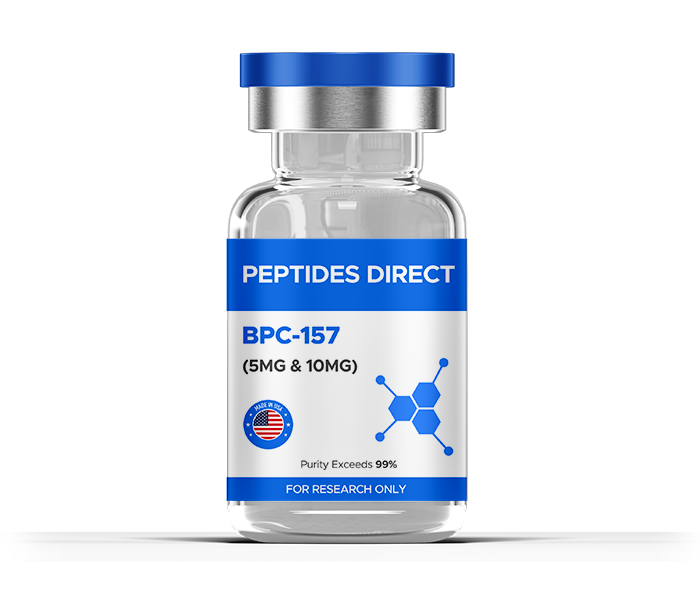
BPC-157 (5mg & 10mg)
$92.00
BPC-157 peptides are Synthesized and Lyophilized in the USA.
BPC-157 Peptide
BPC-157, also referred to as Body Protection Compound-157, is a derivative of the parent protein Body Protection Compound (BPC) — a naturally occurring protein endogenous to the digestive tract.[1] Classified as a penta-decapeptide composed of 15 amino acids, BPC-157 is derived from a segment of endogenous BPC that was identified and isolated from gastric juice. Preclinical animal studies have indicated its potential to support tissue repair mechanisms in muscle, tendon, and torn ligament tissue. The compound may additionally exert protective effects on various organs and may hold potential in preventing the development of gastric ulcers.[2] Sikiric et al. observed “a strong protection, noted following [exposure to] BPC 157.” Beyond its proposed structural repair potential, BPC-157 may also support digestive tract function and could offer a degree of protection against conditions such as irritable bowel syndrome (IBS), gastrointestinal cramps, and Crohn’s disease. The peptide has further been noted for its possible analgesic properties.
Specifications
Molecular Formula: C62H98N16O22
Molecular Weight: 1419.556 g/mol
Sequence: L-Valine,glycyl-L-alpha-glutamyl-L-prolyl-L-prolyl-Lprolylglycyl-L-lysyl-L-prolyl-L-alanyl-L-alpha-aspartyl-L-alpha-aspartyl-L-alanylglycyl-L-leucyl-;glycyl-L-alpha-glutamyl-L-prolyl-L-prolyl-L-prolylglycyllysyl-L-prolyl-L-alanyl-L- alpha-aspartylL-alpha-aspartyl-L-alanylglycyl-L-leucyl-L-valine
BPC-157 Peptide Research
BPC-157 and Wound Healing
The mucosal barrier of the GI tract is understood to shield underlying tissues from the damaging effects of bile, gastric acid, and other compounds integral to the digestion and absorption of nutrients. BPC-157 is thought to help maintain the structural integrity of this mucosal layer, with its role appearing to be partially mediated through the recruitment of fibroblasts — cells recognized for producing extracellular matrix proteins such as fibrin, collagen, elastin, and related compounds. BPC-157 has been proposed to encourage fibroblast proliferation and accelerate their migration in a concentration-dependent fashion.[3] A separate research study hypothesized that BPC-157 may have contributed to expedited wound closure relative to control groups, attributed to improvements in granulation tissue formation, reepithelialization, dermal remodeling, and collagen deposition. The peptide may have promoted the expression of vascular endothelial growth factor (VEGF) in injured skin tissue.[4] Researchers further noted that BPC-157 may have demonstrated potential to enhance umbilical vein endothelial cell proliferation (HUVECs), with wound healing assays indicating a considerable increase in HUVEC migration. BPC-157 possibly contributed to the upregulation of VEGF-a expression and the acceleration of vascular tube formation. It also appeared to regulate the phosphorylation levels of extracellular signal-regulated kinases 1 and 2 (ERK1/2) and their downstream targets — including c-Fos, c-Jun, and Egr-1 — molecules hypothesized to play significant roles in cell growth, migration, and angiogenesis.[4]
BPC-157 and Vascular Growth and Collateralization
The peptide has been identified as a potential angiogenic agent, with studies suggesting it may enhance the growth and proliferation of endothelial cells lining blood vessel walls. Rat-based research has observed that BPC-157 may substantially elevate the rate of collateral blood vessel development in the context of ischemia.[5] While this effect has been most consistently observed in the GI tract, comparable findings have been noted in muscle, neurological, and cardiovascular tissues. Studies utilizing chicken embryos have further proposed that BPC-157 may promote vascular growth through activation of the VEGFR2 pathway — a cell surface receptor involved in nitric oxide signaling, understood to support cellular activity and proliferation. BPC-157 may also promote vascular “running” in cultured cells — the process by which new blood vessels develop toward a site of injury or form around areas of blood clotting to reach distal tissues and preserve cellular function.
BPC-157 and Tendon Healing
Research into BPC-157 has identified potential in connective tissue healing, encompassing ligaments, bone, and tendons. Ligament and tendon injuries are characteristically slow to resolve due to limited blood supply to these tissue types, which restricts fibroblast migration and the arrival of wound-healing cells, thereby impeding the repair process. In rat tendon studies, the peptide demonstrated potential to improve collateralization and fibroblast density at injury sites.[6] More specifically, it was hypothesized that BPC-157 might accelerate the outgrowth of tendon fibroblasts from tendon explants, suggesting a capacity to stimulate new cell growth within injured tendon tissue. Cell survival following BPC-157 application appeared to be significantly enhanced under H₂O₂-induced oxidative stress, indicating a possible protective effect. The peptide may also promote tendon fibroblast migration, as evidenced by transwell filter migration assays, and may accelerate cell spreading on culture dishes — suggesting enhanced cell adhesion and attachment.[6] This experimental work has positioned BPC-157 favorably in comparison to EGF, bFGF, and VGF hormones. Immunostaining assays using FITC-conjugated phalloidin indicated that BPC-157 may enhance F-actin formation in fibroblasts — a structure considered essential for cell integrity, function, and migration. Immunoblotting experiments further noted that BPC-157 appears to increase the phosphorylation of paxillin and FAK proteins, both considered crucial for cellular migration. Specifically, BPC-157 may activate the FAK-paxillin pathway, with phosphorylation levels of both proteins appearing to rise while total protein quantities remain unchanged — suggesting activation rather than upregulation, potentially facilitating tendon fibroblast migration and cell adhesion.[6]
BPC-157 and Antioxidant Characteristics
Rat model studies have proposed that BPC-157 may exhibit antioxidant properties, potentially neutralizing oxidative stress molecules including nitric oxide, malondialdehyde (MDA), and reactive oxygen species within the GI tract.[7] Research has further hypothesized that modified Lactococcus lactis bacteria may augment peptide concentrations in cell culture and could potentially serve as a delivery vehicle to the GI tract. A separate study evaluated early functional recovery and inflammatory responses in tendon cells following BPC-157 application,[8] utilizing the Achilles functional index (AFI), myeloperoxidase activity, histological inflammatory cell influx, and vascular index as markers. Findings suggest BPC-157 may have improved functional recovery — evidenced by elevated AFI values across all timepoints — an outcome hypothesized to stem from its proposed anti-inflammatory properties, including a reduction in myeloperoxidase (MPO) activity and histological inflammatory cell influx. BPC-157 also potentially promoted new blood vessel formation, as inferred from an increased vascular index. By contrast, methylprednisolone similarly appeared to reduce MPO activity and inflammatory cell influx, yet was associated with decreased vascular formation and limited impact on early functional recovery.[8] An additional study assessed BPC-157’s proposed action on inflammation and bone resorption in experimental periodontitis, using Evans blue plasma extravasation and histological analysis. Results indicated that periodontitis induction led to elevated Evans blue extravasation, histological signs of inflammation, and alveolar bone destruction — while BPC-157 exposure appeared to significantly attenuate plasma extravasation, inflammation-related histological changes, and alveolar bone resorption.[9]
BPC-157 and the Central Nervous System
The potential of BPC-157 has been examined in a murine model of traumatic brain injury (TBI), yielding encouraging preliminary outcomes. The peptide appeared to significantly attenuate TBI-induced damage and support improved early recovery markers. During the 24-hour post-injury window, mortality appeared minimal. The severity of traumatic lesions — including subarachnoid and intraventricular hemorrhage, brain laceration, and hemorrhagic laceration — was less pronounced in the BPC-157 group, and a notable reduction in cerebral edema was observed. Hypothetically, administration prior to TBI may have improved the conscious/unconscious/death ratio, and immediate pre-injury introduction appeared to also reduce damage in murine models subjected to force impulse.[10]
BPC-157 and Bees
Colony collapse disorder (CCD) is a syndrome responsible for the rapid and complete decline of entire bee colonies, potentially linked to Nosema ceranae fungal infection in the GI tract of bees. The inclusion of BPC-157 in bee feed was associated with notable improvement in bee GI tract health and hive survival rates. In this experimental research, the peptide appeared effective under natural field conditions in reducing the impact of CCD — a finding of relevance given the critical role bees play as pollinators of numerous crop species.
References
- Jelovac, N., Sikirić, P., Rucman, R., Petek, M., Perović, D., Konjevoda, P., Marović, A., Seiwerth, S., Grabarević, Z., Sumajstorcić, J., Dodig, G., & Perić, J. (1998). A novel pentadecapeptide, BPC 157, blocks the stereotypy produced acutely by amphetamine and the development of haloperidol-induced supersensitivity to amphetamine. Biological psychiatry, 43(7), 511–519. https://doi.org/10.1016/s0006-3223(97)00277-1
- Sikirić, P., Mazul, B., Seiwerth, S., Grabarević, Z., Rucman, R., Petek, M., Jagić, V., Turković, B., Rotkvić, I., Mise, S., Zoricić, I., Jurina, L., Konjevoda, P., Hanzevacki, M., Gjurasin, M., Separović, J., Ljubanović, D., Artuković, B., Bratulić, M., Tisljar, M., … Sumajstorcić, J. (1997). Pentadecapeptide BPC 157 interactions with adrenergic and dopaminergic systems in mucosal protection in stress. Digestive diseases and sciences, 42(3), 661–671. https://doi.org/10.1023/a:1018880000644
- Tkalcević, V. I., Cuzić, S., Brajsa, K., Mildner, B., Bokulić, A., Situm, K., Perović, D., Glojnarić, I., & Parnham, M. J. (2007). Enhancement by PL 14736 of granulation and collagen organization in healing wounds and the potential role of egr-1 expression. European journal of pharmacology, 570(1-3), 212–221. https://doi.org/10.1016/j.ejphar.2007.05.072
- Huang, T., Zhang, K., Sun, L., Xue, X., Zhang, C., Shu, Z., Mu, N., Gu, J., Zhang, W., Wang, Y., Zhang, Y., & Zhang, W. (2015). Body protective compound-157 enhances alkali-burn wound healing in vivo and promotes proliferation, migration, and angiogenesis in vitro. Drug design, development and therapy, 9, 2485–2499. https://doi.org/10.2147/DDDT.S82030
- Hsieh, M. J., Liu, H. T., Wang, C. N., Huang, H. Y., Lin, Y., Ko, Y. S., Wang, J. S., Chang, V. H., & Pang, J. S. (2017). Therapeutic potential of pro-angiogenic BPC157 is associated with VEGFR2 activation and up-regulation. Journal of molecular medicine (Berlin, Germany), 95(3), 323–333. https://doi.org/10.1007/s00109-016-1488-y
- Chang, C. H., Tsai, W. C., Lin, M. S., Hsu, Y. H., & Pang, J. H. (2011). The promoting effect of pentadecapeptide BPC 157 on tendon healing involves tendon outgrowth, cell survival, and cell migration. Journal of applied physiology (Bethesda, Md. : 1985), 110(3), 774–780. https://doi.org/10.1152/japplphysiol.00945.2010
- Škrlec, K., Ručman, R., Jarc, E., Sikirić, P., Švajger, U., Petan, T., Perišić Nanut, M., Štrukelj, B., & Berlec, A. (2018). Engineering recombinant Lactococcus lactis as a delivery vehicle for BPC-157 peptide with antioxidant activities. Applied microbiology and biotechnology, 102(23), 10103–10117. https://doi.org/10.1007/s00253-018-9333-6
- Krivic, A., Majerovic, M., Jelic, I., Seiwerth, S., & Sikiric, P. (2008). Modulation of early functional recovery of Achilles tendon to bone unit after transection by BPC 157 and methylprednisolone. Inflammation research : official journal of the European Histamine Research Society … [et al.], 57(5), 205–210. https://doi.org/10.1007/s00011-007-7056-8
- Keremi, B., Lohinai, Z., Komora, P., Duhaj, S., Borsi, K., Jobbagy-Ovari, G., Kallo, K., Szekely, A. D., Fazekas, A., Dobo-Nagy, C., Sikiric, P., & Varga, G. (2009). Antiinflammatory effect of BPC 157 on experimental periodontitis in rats. Journal of physiology and pharmacology : an official journal of the Polish Physiological Society, 60 Suppl 7, 115–122.
- Tudor, M., Jandric, I., Marovic, A., Gjurasin, M., Perovic, D., Radic, B., Blagaic, A. B., Kolenc, D., Brcic, L., Zarkovic, K., Seiwerth, S., & Sikiric, P. (2010). Traumatic brain injury in mice and pentadecapeptide BPC 157 effect. Regulatory peptides, 160(1-3), 26–32. https://doi.org/10.1016/j.regpep.2009.11.012
Reviews
There are no reviews yet.