

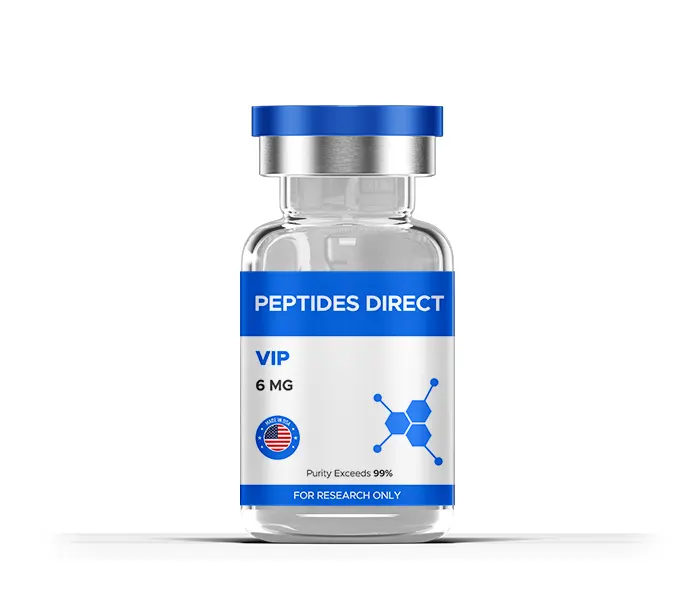
VIP (6mg)
$71.00
VIP peptides are Synthesized and Lyophilized in the USA. For research use only.
Vasoactive Intestinal Peptide (VIP)
Vasoactive Intestinal Peptide (VIP), also known as vasoactive intestinal polypeptide or PHM27, is a short peptide hormone endogenously produced in the gastrointestinal tract, pancreas, and brain of most vertebrate animals. Researchers have suggested that VIP may exhibit potential to influence inflammation across multiple systems, including neurodegenerative disease, pulmonary fibrosis, inflammatory bowel disease, and cardiac fibrosis. It has been classified by scientists as an anti-inflammatory peptide and immune system regulator, with active scientific interest in its proposed ability to support cognitive function in neurodegenerative settings. VIP is hypothesized to bind to class II G protein-coupled receptors.
Specifications
Other Known Titles: PHM27, Vasoactive intestinal polypeptide
Sequence: HSDAVFTDNYXRLRKQMAVKKYLNSXLN
Molecular Formula: C147H237N43O43S
Molecular Weight: 3326.8 g/mol
VIP Research
Vasoactive Intestinal Peptide (VIP) and Receptor Signaling
VIP is hypothesized to interact with three distinct types of G protein-coupled receptors (GPCRs): VPAC1, VPAC2, and PAC1.[1] This interaction may potentially activate adenylate cyclase — a regulatory enzyme — leading to subsequent biological activity, though this has not been definitively established. The primary distinction among these receptors appears to be their distribution within the organism. VPAC1 receptors are predominantly found in the brain and peripheral tissues including the liver, lungs, intestine, and immune cells. VPAC2 receptors are primarily located within the central nervous system and various peripheral tissues including the pancreas, heart, kidneys, skeletal muscles, gastrointestinal tract, and reproductive organs. PAC1 receptors are mainly present in the brain and adrenal glands. Given the extensive distribution of these receptors, VIP binding is speculated to potentially influence a range of targets across both the central and peripheral nervous systems — suggesting a complex and diverse spectrum of potential biological effects, though the precise nature and extent of these effects remain to be fully characterized.
Vasoactive Intestinal Peptide (VIP) and Bowel Inflammation
VIP is synthesized from immune nerve fibers in blood vessels of the central and peripheral nervous systems and immune cells. Research into inflammatory bowel diseases such as Crohn’s disease and ulcerative colitis suggests it may reduce inflammation by suppressing interleukin-10 production and improving intestinal barrier function.[2] Researchers have noted that “VIP and its analogs have been proposed as promising alternative candidates to existing [research] for acute and chronic inflammatory and autoimmune diseases.” Compromised barrier function leads to increased antigenic material in the intercellular space, which interacts with immune cells to trigger inflammatory responses. Further studies have proposed that VIP may reduce antigen presentation to immune cells by improving the barrier function of tight junctions in bowel inflammation models.
Murine models of necrotizing enterocolitis (NEC) were exposed to VIP based on the hypothesis that the peptide might potentially attenuate disruptions in intestinal barrier integrity. VIP was speculated to help maintain tight junction integrity — considered essential for intestinal barrier function — with claudin-3 expression, a protein vital for tight junction functionality, appearing elevated in the NEC + VIP group relative to the NEC group without VIP exposure. This suggests a possible mechanism through which VIP may support barrier function during inflammatory episodes. Additionally, VIP appeared to reduce levels of proinflammatory cytokines including interleukin-6 (IL-6) and tumor necrosis factor-alpha (TNFalpha) in the NEC + VIP group relative to NEC alone, implying a modulatory role in inflammatory responses in this context.[3]
Vasoactive Intestinal Peptide (VIP) and Lung Function
VIP appears to influence lung function through two primary pathways. The first involves alteration of pulmonary vascular remodeling in response to inflammation through suppression of NFAT — a peptide proposed to activate T cells and promote inflammatory activity.[4] Scientists noted that “VIP would emerge as an endogenous modulator of pulmonary vascular remodeling and inflammation, through its suppression of NFAT activation.” NFAT suppression may play a particularly important role in preventing pulmonary fibrosis — the end stage of diverse inflammatory conditions including COPD and sarcoidosis. Smooth muscle cell proliferation, a recognized long-term consequence of chronic lung inflammation and a challenge in uncontrolled bronchial asthma, represents a second area of proposed VIP activity — with the peptide suggested to inhibit this proliferation. Preliminary research also suggests VIP may lower pulmonary arterial blood pressure, leading to increased cardiac output and improved venous oxygen saturation.[5]
Vasoactive Intestinal Peptide (VIP) and Transplants
Immune rejection remains one of the primary challenges in organ transplantation, currently addressed in research through broad-spectrum anti-inflammatory compounds — which may carry risks including susceptibility to infection and secondary effects such as scarring and organ fibrosis. Researchers suggest VIP may influence dendritic cells (DCs). VIP exposure of immature DCs may potentially upregulate CD86 expression, enhancing CD4+ T cell proliferation, with these VIP-exposed DC-activated CD4+ T cells potentially exhibiting a Th2 phenotype — linked to VIP’s proposed tendency to bias immune responses toward Th2, contributing to its anti-inflammatory potential. Conversely, when DCs are stimulated with LPS, VIP appears to reduce expression of both CD86 and CD80 without affecting CD40 or MHC class II expression, potentially inhibiting DC-induced T cell proliferation.
VIP-exposed DCs in early differentiation stages may develop a tolerogenic phenotype characterized by low costimulatory molecule expression (CD40, CD80, CD86), reduced proinflammatory cytokine production, increased IL-10 secretion, and capacity to induce suppressive regulatory T cells (Tregs). This action on the DC-Treg axis may represent an additional mechanism through which VIP exerts anti-inflammatory properties — particularly relevant in autoimmunity and transplantation research. VIP-generated tolerogenic DCs may produce CD4+ and CD8+ Treg cells displaying high IL-10 and TGF-beta with minimal IFN-gamma and IL-2. These DCs may not prime T cell responses but may suppress already primed immune activity, contributing to immune tolerance.
The mechanisms behind VIP-generated Tregs may involve the characteristic DC phenotype of high MHC levels with poor costimulatory molecule expression, delivering stimulatory but not costimulatory signals to promote tolerance. IL-10 secretion by these DCs may further stabilize their tolerogenic state by inhibiting costimulatory molecule expression and promoting IL-10-producing T cell generation. VIP-induced suppression may involve both soluble factors including IL-10 and TGF-beta and direct cellular contact, with CTLA4 expression on these cells supporting this hypothesis. Through DC regulation, VIP may help selectively suppress immune responses implicated in autoimmune reaction models.[6]
Vasoactive Intestinal Peptide (VIP) and Neuroprotection
Researchers propose that VIP may hold a threefold role in the central nervous system — as a neurotransmitter, neurotrophic and neurogenic agent, and anti-inflammatory and neuroprotective molecule. In neuroprotection research, the peptide may help maintain the critical function of the blood-brain barrier (BBB), compromise of which has been implicated in multiple sclerosis, encephalomyelitis, and stroke. VIP appears to offer possible neuroprotective functions in neurodegeneration and may act as a neuroprotectant in the developing brain by mitigating excitotoxic white matter damage and supporting neuronal fatty acid myelination.[7] Research suggests that VIP processing is impaired in neurodegeneration, with peptide and amino acid byproduct levels reduced in affected brain regions, with actions in such models appearing mediated through VPAC1 and VPAC2 receptors.
The neuroprotective potential of VIP may be mediated through its actions on microglial cells — potentially inhibiting pro-inflammatory cytokine secretion and enhancing amyloid-beta phagocytosis through PKA pathway activation and NF-kB pathway inhibition, considered important in reducing neuroinflammation and supporting neuronal survival. VIP stimulation may additionally result in increased secretion of neurotrophic factors including ADNP and BDNF, which may help protect synapses and astrocytes in experimental models.[8] VIP’s role in promoting regulatory T cells (Tregs) may also be significant in attenuating neuroinflammation and providing neuroprotection. In murine Parkinson’s disease models, VIP appears to increase Treg activity without expanding their numbers — an effect proposed to reduce microglial activation and enhance dopaminergic neuron survival. VIP analogs were speculated to restore Treg activity and reduce inflammatory microglial activity, suggesting that VIPR2 activation may represent a viable strategy for attenuating neuroinflammation and protecting dopaminergic neurons. VIP’s neuroprotective mechanisms may additionally involve inhibition of inflammatory cytokine release and rebalancing of T cell polarization toward a neuroprotective phenotype, with VIP and its agonists proposed to enhance Treg suppressive function — considered important for maintaining central nervous system homeostasis.[9]
Vasoactive Intestinal Peptide (VIP) and Cardiac Fibrosis
As in lung disease, fibrosis represents the end stage of numerous cardiac conditions, leading to serious complications including valve dysfunction, reduced contractility, and altered cardiac filling — ultimately necessitating transplantation in severe cases. Scientists have observed that as fibrosis advances, VIP levels become undetectable, suggesting a potential role for the peptide in cardiac fibrosis development and progression. Research in rat models suggests VIP may not only slow fibrosis progression but may also reverse established scarring — an effect apparently mediated in part through substantial reductions in the expression of angiotensinogen (Agt) and angiotensin receptor type 1a (AT1a).
This selective influence on Agt and AT1a suggests a potential mechanism by which VIP may inhibit fibrosis through downregulation of the intra-myocardial renin-angiotensin system. Reduced Agt and AT1a expression implies suppression of Angiotensin II (Ang II) activity — hypothesized to contribute to fibrosis progression. This mechanism appears plausible given that angiotensin receptor blockers and ACE inhibitors have long been investigated for their potential to slow cardiac remodeling and fibrosis, with researchers suggesting they represent a primary preventive approach for fibrosis management.[10]
Disclaimer: The products mentioned are not intended for human or animal consumption. Research chemicals are intended solely for laboratory experimentation and/or in-vitro testing. Bodily introduction of any sort is strictly prohibited by law. All purchases are limited to licensed researchers and/or qualified professionals. All information shared in this article is for educational purposes only.
References
- Vosko, A. M., Schroeder, A., Loh, D. H., & Colwell, C. S. (2007). Vasoactive intestinal peptide and the mammalian circadian system. General and comparative endocrinology, 152(2-3), 165–175.
- Gonzalez-Rey E, Delgado M. Role of vasoactive intestinal peptide in inflammation and autoimmunity. Curr Opin Investig Drugs. 2005 Nov;6(11):1116-23. PMID: 16312132.
- Seo S, Miyake H, Alganabi M, Janssen Lok M, O’Connell JS, Lee C, Li B, Pierro A. Vasoactive intestinal peptide decreases inflammation and tight junction disruption in experimental necrotizing enterocolitis. J Pediatr Surg. 2019 Dec;54(12):2520-2523. doi: 10.1016/j.jpedsurg.2019.08.038. Epub 2019 Aug 30. PMID: 31668399.
- Said SI. The vasoactive intestinal peptide gene is a key modulator of pulmonary vascular remodeling and inflammation. Ann N Y Acad Sci. 2008 Nov;1144:148-53. doi: 10.1196/annals.1418.014. PMID: 19076374.
- Petkov V, Mosgoeller W, Ziesche R, Raderer M, Stiebellehner L, Vonbank K, Funk GC, Hamilton G, Novotny C, Burian B, Block LH. Vasoactive intestinal peptide as a new drug for treatment of primary pulmonary hypertension. J Clin Invest. 2003 May;111(9):1339-46. doi: 10.1172/JCI17500. PMID: 12727925; PMCID: PMC154449.
- Chorny A, Gonzalez-Rey E, Delgado M. Regulation of dendritic cell differentiation by vasoactive intestinal peptide: therapeutic applications on autoimmunity and transplantation. Ann N Y Acad Sci. 2006 Nov;1088:187-94. doi: 10.1196/annals.1366.004. PMID: 17192565.
- de Souza FRO, Ribeiro FM, Lima PMD. Implications of VIP and PACAP in Parkinson’s Disease: What do we Know So Far? Curr Med Chem. 2021;28(9):1703-1715. doi: 10.2174/0929867327666200320162436. PMID: 32196442.
- Solés-Tarrés I, Cabezas-Llobet N, Vaudry D, Xifró X. Protective Effects of Pituitary Adenylate Cyclase-Activating Polypeptide and Vasoactive Intestinal Peptide Against Cognitive Decline in Neurodegenerative Diseases. Front Cell Neurosci. 2020 Jul 17;14:221. doi: 10.3389/fncel.2020.00221. PMID: 32765225; PMCID: PMC7380167.
- Mosley RL, Lu Y, Olson KE, Machhi J, Yan W, Namminga KL, Smith JR, Shandler SJ, Gendelman HE. A Synthetic Agonist to Vasoactive Intestinal Peptide Receptor-2 Induces Regulatory T Cell Neuroprotective Activities in Models of Parkinson’s Disease. Front Cell Neurosci. 2019 Sep 18;13:421. doi: 10.3389/fncel.2019.00421. PMID: 31619964; PMCID: PMC6759633.
- Duggan KA, Hodge G, Chen J, Hunter T. Vasoactive intestinal peptide infusion reverses existing myocardial fibrosis in the rat. Eur J Pharmacol. 2019 Nov 5;862:172629. doi: 10.1016/j.ejphar.2019.172629. Epub 2019 Aug 23. PMID: 31449808.
Reviews
There are no reviews yet.