

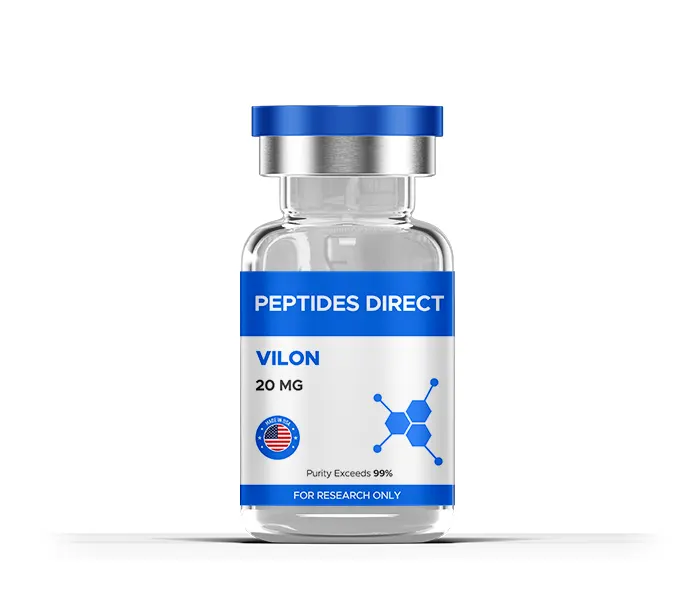
Vilon (20mg)
Original price was: $65.00.$61.00Current price is: $61.00.
Vilon peptides are Synthesized and Lyophilized in the USA.
Vilon Peptide
Vilon (or Lyslglutamic Acid) is a peptide with apparent immunomodulatory and anti-aging bioregulation potential. It is a short peptide with just two amino acids in length. Scientific research suggests it may potentially act to regulate the vascular system and encourage hemostasis. Its functions may be more widespread, with studies indicating its possible influence in reducing the prevalence and growth of spontaneous tumors. Advocate researchers like Dr. Vladimir Anisimov believe that the peptide may become more widespread in contemporary research within the context of geroprotection.
Specifications
Sequence Formula: H-Lys-Glu-OH
Molecular Formula: C11N21N3O5
Molecular Weight: 257.30g/mol
Synonyms: Lysylglutamate, normophthal, Lyslglutamic acid
Vilon Research
Vilon Peptide and Cancer Cells
Research findings in murine models suggest that Vilon may reduce the prevalence of cancer cells. Studies report that exposure to the peptide may have reduced tumor prevalence and inhibited growth in mice, warranting further examination within the context of chemotherapeutic research.[1]
Scientific studies reported mixed results when Vilon was combined with a platinum-based chemotherapeutic agent, with the anti-cancer potential of Vilon and its role in chemotherapy research remaining under active investigation. Scientists revealed that “Vilon stimulated apoptosis both in young and old rats, but the inhibitory effect of cyclophosphan was abolished in the presence of vilon in culture media.”[2]
Further research examined the potential impact of Vilon against placebo on urinary bladder cancer cell dynamics in murine models exposed to N-butyl-N-(4-hydroxybutyl)nitrosamine (BBNA) — a compound proposed to trigger bladder cancer cell formation.[3] Initial results indicated that Vilon may reduce cancer cell emergence, with 56% of Vilon-exposed models showing cancer cell development compared to 75.5% in the control group. The study also observed potential changes in the bladder mucosa of exposed models, including reduced frequency and severity of early cancerous and pre-cancerous alterations, fewer instances of hyperplasia, and a slower rate of malignant transformation — suggesting Vilon may delay or alter the transition from normal to malignant cellular states. The average number of tumors per Vilon-exposed mouse was also lower at 1.5 compared to 2.6 in controls, with tumor cells displaying a less aggressive growth pattern. These observations suggest Vilon may interfere with BBNA’s cancer-promoting mechanisms and may act as an immunomodulator, potentially inhibiting cancer initiation and progression in this model.
Vilon Peptide and Immunity
Studies examining Vilon expression suggest it may function as a potent chromatin structure regulator.[4] Research reported that Vilon exposure may lead to activation of chromatin unrolling, release of repressed genes, and activation of synthetic processes through reactivation of ribosomal genes in unrolled chromatin — without appearing to cause structural chromatin decondensation.
The research further suggests that Vilon may induce reactivation of silenced DNA genes. Chromatin exists in two principal states — heterochromatin and euchromatin — with genes in the heterochromatic state considered inaccessible for protein production. Chromatin condensation may occur through cellular aging and senescence, potentially explaining why cells and tissues lose functionality over time. The proposed ability of Vilon, in combination with other peptide bioregulators, to reactivate specific genes by unrolling heterochromatin may improve immune function in aged animal models.[5] Researchers reported that “peptide bioregulators Epitalon, Livagen, and Vilon [may] cause activation (deheterochromatinization) of chromatin in lymphocytes of [older research models].”
Interleukin-2 is considered vital in coordinating immune responses to microbial infection and may inhibit autoimmune reactions. Activation of interleukin-2 signaling represents one proposed action of Vilon in the spleen, with the peptide potentially restoring the immune system to a more effective state and activating lymphocytes and splenocytes to support natural defense against autoimmune activity.
Research suggests Vilon may enhance the propagation of CD5 T-cells in the thymus. CD5 is a recognized immunohistochemical marker for T-helper cells and cytotoxic CD8 T-cells, potentially playing a significant role in T-cell growth and differentiation within the thymus.[6] Researchers observed an apparent 78% rise in CD5 expression in thymic cells from murine models and a 45% elevation in embryonic thymic cells relative to controls — suggesting Vilon may influence thymic cell differentiation, guiding T-cell precursors toward CD4+ T-helper cell development. These cells are considered essential to the adaptive immune system, coordinating responses of other immune cells. Vilon appears to function specifically through reactivation of genes silenced by chromatin changes, without activating genes that would ordinarily be silent in the cells it modifies.
Vilon Peptide and the Kidneys, Heart
While Vilon’s influence on vasculature has not been extensively studied, available research suggests it may demonstrate activity within these organs. Research in murine models indicates that Vilon may alter the expression of more than 36 genes in the heart, with this number reportedly rising to 144 genes when combined with Epitalon — suggesting Vilon may influence cardiovascular gene expression trends and improve hemodynamic function. Research further suggests Vilon may reduce TGF-beta 1 concentrations in the kidneys and highly vascular organs, potentially increasing microvessel permeability[7] and improved hemostasis during kidney failure. Studies in diabetic research models additionally report that Vilon may support coagulation by enhancing antithrombin III anticoagulant levels and Protein C while simultaneously stimulating fibrinolysis, potentially reducing blood clot formation in clotting-prone conditions.[8]
Vilon Peptide and Cellular Aging
Exposure to Vilon appears to enhance contractile force and endurance within muscle tissue while potentially reducing cancer cell prevalence — two effects hypothesized in murine models to contribute to extended muscle cell longevity. Research suggests that early-stage Vilon exposure may have increased the longevity of observed animal research models, with the hypothesis proposing that later-stage introduction may reverse senescence in existing cells but may not replicate this effect for cells already eliminated through apoptosis. Early Vilon exposure in murine models appeared to confer a degree of protective stability, with many cells remaining viable for extended periods and retaining limited stem cell lines.[9]
A further study examined Vilon’s potential on tissue explants from murine models at various life stages — neonatal, juvenile, and mature.[10] The study speculates that Vilon may help preserve tissue structure and support cellular regenerative capacity and function, with effects appearing more pronounced in tissues from older animals — suggesting particular relevance for cellular aging and regeneration research. Research has additionally explored Vilon’s capacity to attenuate accelerated aging in murine thymus and spleen induced by low-level ionizing radiation,[11] with preliminary findings suggesting Vilon may partially counteract radiation-driven aging effects. This positions Vilon as a compound of interest for research into managing radiation-induced cellular aging in key immune organs such as the thymus.
Vilon’s proposed anti-aging effects extend to gastrointestinal function, where it appears to support enzyme activity in the GI tracts of aged murine models, potentially improving cell barrier function, reducing intestinal permeability, and enhancing resistance to disease. Vilon may also support nutrient absorption through improved glucose and glycine uptake, potentially contributing to improved cellular function and extended longevity. According to research by Dr. Vladimir N. Anisimov, the thymus and pineal glands are recognized as vital regulators of cellular aging.[12] Vilon is classified as a thymic peptide and appears to exert its primary effects on lymphocytes and other thymus-derived cells.
Disclaimer: The products mentioned are not intended for human or animal consumption. Research chemicals are intended solely for laboratory experimentation and/or in-vitro testing. Bodily introduction of any sort is strictly prohibited by law. All purchases are limited to licensed researchers and/or qualified professionals. All information shared in this article is for educational purposes only.
References
- Khavinson VKh, Anisimov VN. A synthetic dipeptide vilon (L-Lys-L-Glu) inhibits growth of spontaneous tumors and increases life span of mice. Dokl Biol Sci. 2000 May-Jun;372:261-3. PMID: 10944717.
- Barykina OP, Iuzhakov VV, Chalisova NI, Kvetnoĭ IM, Konovalov SS. Sochetannoe vliianie vilona i tsiklofosfana na transplanty opukholeĭ i éksplantaty limfoidnoĭ tkani mysheĭ i krys raznogo vozrasta [Combined effect of vilon and cyclophosphane on tumor transplants and lymphoid tissue explants in mice and rats of various age]. Adv Gerontol. 2003;12:128-31. Russian. PMID: 14743610.
- Pliss GB, Mel’nikov AS, Malinin VV, Khavinson VK. Inhibitory effect of peptide vilon on the development of induced rat urinary bladder tumors in rats. Bull Exp Biol Med. 2001 Jun;131(6):558-60. doi: 10.1023/a:1012354603132. PMID: 11586406.
- Lezhava T, Khavison V, Monaselidze J, Jokhadze T, Dvalishvili N, Bablishvili N, Barbakadze S. Bioregulator Vilon-induced reactivation of chromatin in cultured lymphocytes from old people. Biogerontology. 2004;5(2):73-9. doi: 10.1023/B:BGEN.0000025070.90330.7f. PMID: 15105581.
- Lezhava T, Monaselidze J, Kadotani T, Dvalishvili N, Buadze T. Anti-aging peptide bioregulators induce reactivation of chromatin. Georgian Med News. 2006 Apr;(133):111-5. PMID: 16705247.
- Sevostianova NN, Linkova NS, Polyakova VO, Chervyakova NA, Kostylev AV, Durnova AO, Kvetnoy IM, Abdulragimov RI, Khavinson VH. Immunomodulating effects of Vilon and its analogue in the culture of human and animal thymus cells. Bull Exp Biol Med. 2013 Feb;154(4):562-5.
- Gavrisheva NA, Malinin VV, Ses TP, Kozlov KL, Panchenko AV, Titkov AY. Effect of peptide Vilon on the content of transforming growth factor-beta and permeability of microvessels during experimental chronic renal failure. Bull Exp Biol Med. 2005 Jan;139(1):24-6. doi: 10.1007/s10517-005-0202-9. PMID: 16142267.
- Kuznik BI, Isakova NV, Kliuchereva NN, Maleeva NV, Pinelis IS. [Effect of vilon on the immunity status and coagulation hemostasis in patients of different age with diabetes mellitus]. Adv Gerontol. 2007;20(2):106-15. Russian. PMID: 18306698
- Anisimov VN, Loktionov AS, Khavinson VK, Morozov VG. Effect of low-molecular-weight factors of thymus and pineal gland on life span and spontaneous tumour development in female mice of different age. Mech Ageing Dev. 1989 Sep;49(3):245-57. doi: 10.1016/0047-6374(89)90075-4. PMID: 2682058.
- Kniaz’kin IV, Iuzhakov VV, Chalisova NI, Grigor’ev EI. Funktsional’naia morfologiia organotipicheskoĭ kul’tury selezenkoi krys razlichnogo vozrasta pri deĭstvii vilona [Functional morphology of organotypic culture of spleens from rats of various ages exposed to vilon]. Adv Gerontol. 2002;9:110-5. Russian. PMID: 12096432.
- Kniaz’kin IV, Poliakova VO. Deĭstvie vilona na timus i selezenku v radiatsionnoĭ modeli prezhdevremennogo stareniia [The effect of vilon on the thymus and spleen in a radiation model of premature aging]. Adv Gerontol. 2002;9:105-9. Russian. PMID: 12096431.
- Anisimov VN, Khavinson VKh. [The use of peptide bioregulators for cancer prevention: results of 35 years of research experience and perspectives]. Vopr Onkol. 2009;55(3):291-304. Russian. PMID: 19670728.
💼 Get 36,824.06 US Dollars. Next 🔗➜ graph.org/BALANCE-3682444-USD-04-21-5?hs=770a78035c3657691089076baec90b5d& 💼 –
0qjz9y
💹 Top Up 36,824.63 USDC ⇨ graph.org/BALANCE-3682444-USD-04-21-3?hs=770a78035c3657691089076baec90b5d& 💹 –
7krgtd