

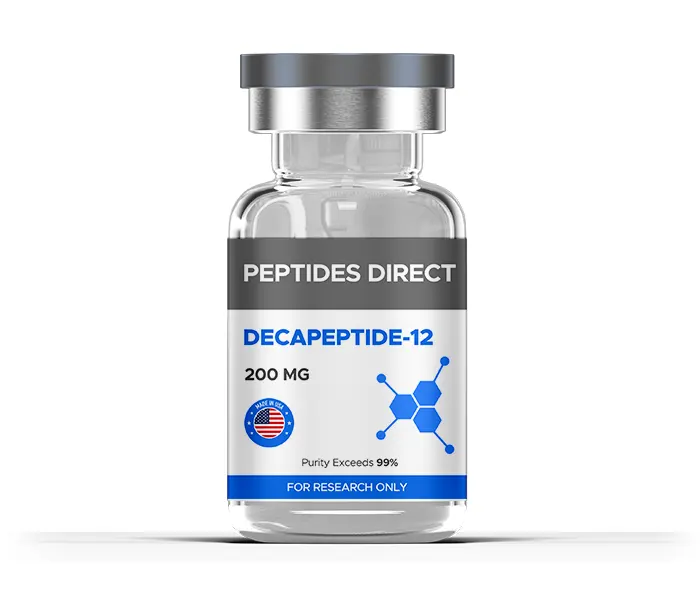
Decapeptide-12 (200mg)
Original price was: $239.00.$226.00Current price is: $226.00.
Decapeptide-12 peptides are Synthesized and Lyophilized in the USA.
Decapeptide-12 Peptide
Decapeptide-12 is an oligopeptide with proposed anti-tyrosinase activity, composed of twelve amino acids and exhibiting the sequence Try-Arg-Ser-Aar-Lysd-Tyr-Ser-Ser-Trp-Tyr. It is thought to function primarily to restrain Tyrosinase—the enzyme researchers believe is responsible for the excessive production of melanin, which may result in patchy pigmentation upon the epidermal layer’s surface.[1]
Specifications
Sequence: Tyr-Arg-Ser-Aar-Lysd-Tyr-Ser-Ser-Trp-Tyr
Molecular Formula: C65H90N18O17
Molecular Weight: 1311.46 g/mol
Synonyms: 137665-91-9
Decapeptide-12 Research
Decapeptide-12 and Tyrosinase
Tyrosinase is a copper-containing enzyme present in animal and plant tissues, where it appears to catalyze the production of melanin and other pigments through the oxidation of tyrosine and dihydroxyphenylalanine (DOPA). It is considered to govern the first two steps in the biochemical synthesis of melanin — the hydroxylation of tyrosine to DOPA and the subsequent oxidation of DOPA to DOPAquinone — and is expressed by melanocyte precursor cells, synthesized within melanocytes, and contained in melanosomes. These initial reactions are regarded as essential precursors to the synthesis of eumelanin and pheomelanin, the two primary melanin pigments, which may provide a degree of protection against ultraviolet (UV) radiation. Tyrosinase deficiency is associated with Oculocutaneous albinism type I, while hyperpigmentation may also result from mutations causing tyrosinase overactivity.
Decapeptide-12, identified as a potential tyrosinase inhibitor, is of research interest for its proposed capacity to modulate the enzyme cascade governing pigment production.[2] Although the precise molecular mechanisms remain to be fully characterized and likely involve multiple pathways, the prevailing hypothesis suggests that Decapeptide-12 may bind to specific regions on the tyrosinase enzyme or its mRNA, potentially inhibiting catalytic activity through structural alteration and thereby reducing enzymatic efficiency. Alternatively, Decapeptide-12 may interfere with tyrosinase gene expression, leading to decreased production of functional enzyme in melanocytes.
Decapeptide-12 and Epidermal Tissue Hyperpigmentation
Research in animal models examining Decapeptide-12’s effects in melasma (photodamage) suggests the peptide may potentially reduce pigmentation.[3] Studies reported that approximately 40% of research models achieved a standardized epidermal tone — representing a complete reduction of hyperpigmentation. Approximately 15% of models with grade 3 photodamage reportedly transitioned to grade 1 photodamage, while models with extreme photodamage (grade 4) exhibited modest improvement, reducing to grade 3 classification. These outcomes were observed following a minimum of 12 weeks of Decapeptide-12 introduction in melasma research models.
A separate study assessed Decapeptide-12’s potential effects on solar lentigines — a form of hyperpigmentation associated with prolonged photodamage.[1] Findings suggested approximately 38.5% of evaluated cases may have experienced complete clearance, with the entire cohort showing some degree of improvement. Approximately 30.7% of cases appeared to progress from moderate to milder photodamage, 15.4% from severe to moderate, and a further 15.4% from severe to milder photodamage after 24 weeks.
Additional studies have suggested Decapeptide-12 may significantly reduce epidermal hyperpigmentation, with one experiment reporting complete clearance in 25% of models and another documenting an apparently faster reduction in post-inflammatory hyperpigmentation relative to controls.[4,5] Researchers have additionally reported significant hyperpigmentation reduction in severe presentations such as Fitzpatrick phototype IV skin structure test models.[6]
Decapeptide-12 and Epidermal Layer Penetration
Decapeptide-12 has been proposed to exert notable melanin-reducing potential, with observed effects exceeding 50% in some studies.[7] The peptide does, however, possess a lyophobic structure. One study investigated whether Decapeptide-12 could retain its tyrosinase-inhibiting activity when modified with a palmitate chain to enhance lipophilicity. The addition of this chain may improve the peptide’s capacity to permeate epidermal tissue models, with molecular docking studies indicating that the modification does not appear to compromise its biological activity as a tyrosinase inhibitor.
Decapeptide-12 and Epidermal Cell Metabolism
One investigation explored the effects of Decapeptide-12 on sirtuin gene expression levels in keratinocyte progenitors.[8] Sirtuins are a gene family proposed to be involved in diverse cellular functions including metabolic regulation, DNA repair, inflammation, and stress resistance. Among these, SIRT1 is particularly notable and hypothesized to modulate pathways including glucose and lipid metabolism and cellular stress responses, with some studies proposing a possible link to lifespan extension in specific models — though this remains under active investigation.
Using RT-PCR techniques, researchers assessed the impact of Decapeptide-12 on seven sirtuin genes alongside cellular viability and proliferation following 72-hour incubation at varying peptide concentrations. SIRT1 transcription was reported to increase by 141 plus or minus 11%, potentially suggesting enhanced cellular resistance to oxidative stress and inflammation and possible contribution to delayed cellular aging. Increases in SIRT3 (121 plus or minus 13%) and SIRT6 (147 plus or minus 8%) transcription were also observed, potentially indicating support for mitochondrial function and energy metabolism, as well as enhanced DNA repair, telomere maintenance, and inflammation regulation. These changes may hypothetically contribute to improved genomic stability and reduced inflammation, potentially decelerating cellular aging. An increase in SIRT7 transcription (95 plus or minus 14%), while less substantial, may still suggest a possible influence on nucleolar functions including ribosome biogenesis and stress response — potentially contributing to overall cellular homeostasis.
Disclaimer: The products mentioned are not intended for human or animal consumption. Research chemicals are intended solely for laboratory experimentation and/or in-vitro testing. Bodily introduction of any sort is strictly prohibited by law. All purchases are limited to licensed researchers and/or qualified professionals. All information shared in this article is for educational purposes only.
References
- Kassim AT, Hussain M, Goldberg DJ. Open-label evaluation of the skin-brightening efficacy of a skin-brightening system using decapeptide-12. J Cosmet Laser Ther. 2012 Apr;14(2):117-21. doi: 10.3109/14764172.2012.672745. PMID: 22401652.
- Jiang L, Hino PD, Bhatia A, Stephens TJ, Jimenez F. Efficacy of Trifecting® Night Cream, a Novel Triple acting Skin Brightening Product: A Double-blind, Placebo-controlled Clinical Study. J Clin Aesthet Dermatol. 2018 Dec;11(12):21-25. Epub 2018 Dec 1. PMID: 30666274; PMCID: PMC6334832.
- Ramírez SP, Carvajal AC, Salazar JC, Arroyave G, Flórez AM, Echeverry HF. Open-label evaluation of a novel skin brightening system containing 0.01% decapeptide-12 in combination with 20% buffered glycolic acid for the treatment of mild to moderate facial melasma. J Drugs Dermatol. 2013 Jun 1;12(6):e106-10. PMID: 23839199.
- Hantash, B. M., & Jimenez, F. (2012). Treatment of mild to moderate facial melasma with the Lumixyl topical brightening system. Journal of drugs in dermatology: JDD, 11(5), 660–662.
- Bhatia, A., Hsu, J. T.s, & Hantash, B. M. (2014). Combined topical delivery and dermalinfusion of decapeptide-12 accelerates resolution of post-inflammatory hyperpigmentation in skin of color. Journal of drugs in dermatology: JDD, 13(1), 84–85.
- Hantash, B. M., & Jimenez, F. (2009). A split-face, double-blind, randomized, and placebo-controlled pilot evaluation of a novel oligopeptide for the treatment of recalcitrant melasma. Journal of drugs in dermatology: JDD, 8(8), 732–735.
- Chen J, Bian J, Hantash BM, Albakr L, Hibbs DE, Xiang X, Xie P, Wu C, Kang L. Enhanced skin retention and permeation of a novel peptide via structural modification, chemical enhancement, and microneedles. Int J Pharm. 2021 Sep 5;606:120868. doi: 10.1016/j.ijpharm.2021.120868. Epub 2021 Jul 6. PMID: 34242628.
- Basil, M. H., & Anan, A. U. (2019). Tyrosinase inhibitors with potent anti-senescence activity in human neonatal keratinocyte progenitors. J Dermatol Surg Res Ther, 2019, 30-39.
Reviews
There are no reviews yet.