

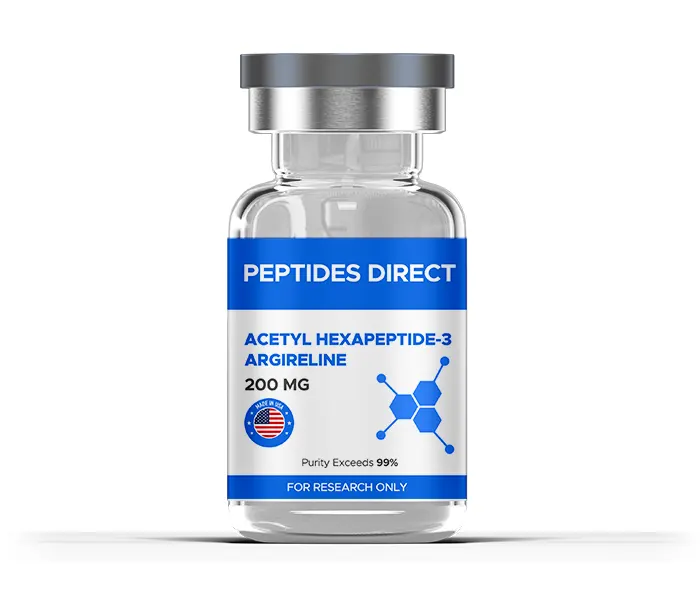
Acetyl Hexapeptide-3 (Argireline) (200mg)
$210.00
Acetyl Hexapeptide-3 (Argireline) peptides are Synthesized and Lyophilized in the USA.
Acetyl Hexapeptide-3 (Argireline) Peptide
Acetyl Hexapeptide-3 (Argireline) is a peptide chain of amino acids with the following sequence: Ac-Glu-Glu-Met-Gln-Arg-Arg-NH2. It is a fragment of the SNAP-25 (synaptosome-associated protein 25 kDa).[1] SNAP-25 is a key component of the SNARE (Soluble N-ethylmaleimide-sensitive factor Attachment protein Receptor)-Synaptotagmin-1 complex. This is a protein assembly that facilitates the release of neurotransmitters, such as acetylcholine, into the synaptic cleft between nerve cells and muscle cells. SNAP-25 is considered to be critical in this process because it appears to be in the assembly of the SNARE complex. This may also lead to the release of acetylcholine, thus triggering muscle contraction. Acetyl Hexapeptide-3 resembles the SNAP-25 protein, particularly the portion that is believed essential for SNARE complex formation.
By inhibiting its formation, the peptide may also prevent neurotransmitter release and muscle contraction. Researchers have investigated Acetyl Hexapeptide-3 (Argireline) for its potential to support skin cell structure and reduce wrinkling along the stratum corneum. Continuous muscle movements result in wrinkling, and the devitalization of muscle contractions may possibly inhibit the development of new lines and decrease the depth of existing skin tissue creases and wrinkles. Acetyl Hexapeptide-3 (Argireline) may prevent muscles from moving or contracting. Researchers also posit that the peptide may support endogenous collagen production to preserve the skin’s extracellular matrix.
Specifications
Sequence: Ac-Glu-Glu-Met-Gln-Arg-Arg-NH2
Molecular Formula: C34H60N14O12S
Molecular Weight: 888.99 g/mol
Synonyms: Acetyl hexapeptide, Argireline, Argireline Acetate
Acetyl Hexapeptide-3 (Argireline) Research
Acetyl Hexapeptide-3 (Argireline) and Wrinkles
Acetyl Hexapeptide-3 (Argireline) appears to hold potential for inhibiting the production of neurotransmitters that influence and regulate the contractile force of certain muscle groups. The peptide may interfere with the protein complex governing muscle movement and limit muscle contractions by attenuating the activity of nerves responsible for initiating those contractions. Research suggests the peptide may potentially reduce the depth of wrinkles and surface lines in skin tissue through supporting the endogenous synthesis of extracellular matrix proteins including collagen.[2]
Researchers noted that introducing the peptide alongside functional symbiotic compounds may improve wrinkle depth and breadth, with scientific evidence suggesting it may serve as a meaningful adjunct for reducing existing skin creases while simultaneously supporting collagen production.
Research findings on Acetyl Hexapeptide-3 range from modest to more pronounced effects on wrinkle reduction.[3,4] Studies report that a cream containing a 10% concentration of Acetyl Hexapeptide-3 reduced wrinkle formations in a targeted area by 30% after one month of exposure. A separate investigation examining twice-daily serum application over one month observed a 27% reduction in periorbital wrinkle depth. In vitro findings further suggest that Acetyl Hexapeptide-3 may potentially inhibit neurotransmitter release. Blanes-Mira et al. noted that “taken together, these findings indicate that Argireline is a non-toxic, anti-wrinkle peptide that emulates the action of currently used BoNTs” — suggesting a reduction in wrinkle formation attributable to limited muscle contraction.[5]
Acetyl Hexapeptide-3 (Argireline) and Skin Hydration
Experimental data suggests that Acetyl Hexapeptide-3 may influence the properties of skin tissue models and potentially enhance water retention in test model skin tissue. One study proposed a decrease in transepidermal water loss (TEWL) following Acetyl Hexapeptide-3 exposure compared to placebo.[6]
Acetyl Hexapeptide-3 (Argireline) and Muscle Twitching
A study investigated Acetyl Hexapeptide-3 for its potential to address muscle twitching models.[7] Researchers suggested the peptide may interact with the mechanisms underlying certain neurotoxins typically employed in such models, potentially enhancing and prolonging their effects. Study data indicated that models exposed to both Acetyl Hexapeptide-3 and a neurotoxin experienced a delayed return to baseline twitching compared to the neurotoxin-only group — with an average time to baseline of 3.7 months in the Acetyl Hexapeptide-3 group versus 3.0 months in controls. While this difference did not reach statistical significance, it suggests a trend toward extended neurotoxin activity. Additionally, in one-third of models in the active group, the interval between required neurotoxin exposures was notably extended — ranging from 3.3 to 7.1 months — suggesting Acetyl Hexapeptide-3 may contribute to prolonged reduction in muscle twitching by potentially stabilizing neurotoxin-mediated suppression of neurotransmitter release.
Acetyl Hexapeptide-3 (Argireline) and Modifications with Palmitic Acid
Researchers have modified Acetyl Hexapeptide-3 with palmitic acid to produce Palmitoyl Hexapeptide-3, with modified potential particularly in nociception research. In murine models of chronic inflammatory and neuropathic pain, the palmitoylated variant appeared linked to notable reductions in thermal hyperalgesia and mechanical allodynia.[8] The study suggests this palmitoylation may also be associated with a prolonged antinociceptive effect, potentially attributable to the peptide’s stabilization within the neuronal membrane — extending its presence at the target site. Researchers further proposed that the peptide may block exocytotic recruitment of TRPV1 channels to the plasma membrane. TRPV1 channels are recognized for their role in pain signal transmission — particularly in inflammatory contexts — and by potentially preventing these channels from being incorporated into the membrane, the peptide may reduce overall nociceptor excitability.
Disclaimer: The products mentioned are not intended for human or animal consumption. Research chemicals are intended solely for laboratory experimentation and/or in-vitro testing. Bodily introduction of any sort is strictly prohibited by law. All purchases are limited to licensed researchers and/or qualified professionals. All information shared in this article is for educational purposes only.
References
- Wang Y, Wang M, Xiao XS, Huo J, Zhang WD. The anti-wrinkle efficacy of Argireline. J Cosmet Laser Ther. 2013 Aug;15(4):237-41. doi: 10.3109/14764172.2013.769273. Epub 2013 Mar 6. PMID: 23464592.
- An JH, Lee HJ, Yoon MS, Kim DH. Anti-Wrinkle Efficacy of Cross-Linked Hyaluronic Acid-Based Microneedle Patch with Acetyl Hexapeptide-8 and Epidermal Growth Factor on Korean Skin. Ann Dermatol. 2019 Jun;31(3):263-271. doi: 10.5021/ad.2019.31.3.263. Epub 2019 May 1. PMID: 33911590; PMCID: PMC7992733.
- Wang Y, Wang M, Xiao S, Pan P, Li P, Huo J. The anti-wrinkle efficacy of argireline, a synthetic hexapeptide, in Chinese subjects: a randomized, placebo-controlled study. Am J Clin Dermatol. 2013 Apr;14(2):147-53. doi: 10.1007/s40257-013-0009-9. PMID: 23417317.
- Blanes-Mira C, Clemente J, Jodas G, Gil A, Fernández-Ballester G, Ponsati B, Gutierrez L, Pérez-Payá E, Ferrer-Montiel A. A synthetic hexapeptide (Argireline) with antiwrinkle activity. Int J Cosmet Sci. 2002 Oct;24(5):303-10. doi: 10.1046/j.1467-2494.2002.00153.x. PMID: 18498523
- Lim SH, Sun Y, Thiruvallur Madanagopal T, Rosa V, Kang L. Enhanced Skin Permeation of Anti-wrinkle Peptides via Molecular Modification. Sci Rep. 2018 Jan 25;8(1):1596. doi: 10.1038/s41598-017-18454-z. Erratum in: Sci Rep. 2018 Apr 20;8(1):6500. PMID: 29371611; PMCID: PMC5785486.
- Raikou, V., Varvaresou, A., Panderi, I., & Papageorgiou, E. (2017). The efficacy study of the combination of tripeptide-10-citrulline and acetyl hexapeptide-3. A prospective, randomized controlled study. Journal of cosmetic dermatology, 16(2), 271–278. https://doi.org/10.1111/jocd.12314
- Lungu, C., Considine, E., Zahir, S., Ponsati, B., Arrastia, S., & Hallett, M. (2013). Pilot study of topical acetyl hexapeptide-8 in the treatment for blepharospasm in patients receiving botulinum toxin therapy. European journal of neurology, 20(3), 515–518. https://doi.org/10.1111/ene.12009
- Ponsati, B., Carreño, C., Curto-Reyes, V., Valenzuela, B., Duart, M. J., Van den Nest, W., Cauli, O., Beltran, B., Fernandez, J., Borsini, F., Caprioli, A., Di Serio, S., Veretchy, M., Baamonde, A., Menendez, L., Barros, F., de la Pena, P., Borges, R., Felipo, V., Planells-Cases, R., … Ferrer-Montiel, A. (2012). An inhibitor of neuronal exocytosis (DD04107) displays long-lasting in vivo activity against chronic inflammatory and neuropathic pain. The Journal of pharmacology and experimental therapeutics, 341(3), 634–645. https://doi.org/10.1124/jpet.111.190678
Reviews
There are no reviews yet.