

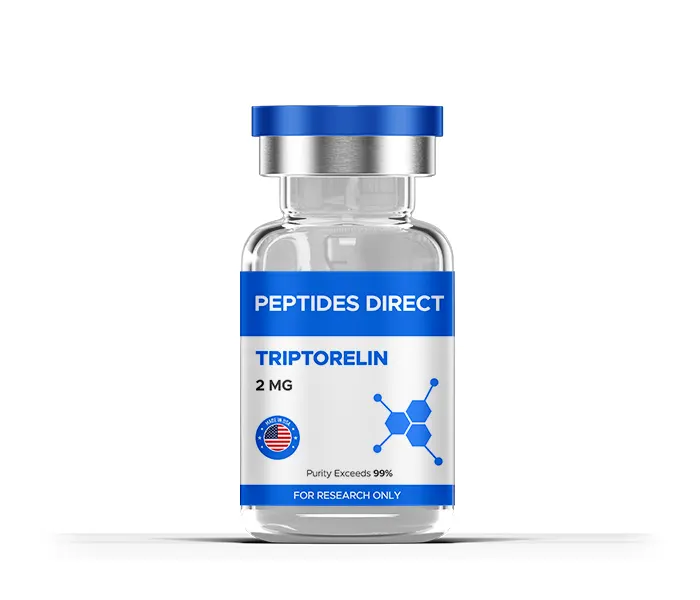
Triptorelin (GnRH) (2mg)
$36.00
Triptorelin (GnRH) peptides are Synthesized and Lyophilized in the USA.
Triptorelin (GnRH) Peptide
Triptorelin is a synthetic analog of gonadotropin-releasing hormone (GnRH), potentially mimicking the structure and function of the natural hormone. It may bind to GnRH receptors, initially stimulating the hypothalamic-pituitary-gonadal (HPG) axis, leading to a temporary surge in luteinizing hormone (LH) and follicle-stimulating hormone (FSH) levels. In turn, LH and FSH are thought to stimulate endocrine cells, like testicular cells that produce testosterone (T). However, with prolonged exposure, Triptorelin appears to desensitize the GnRH receptors, resulting in suppressed production of LH and FSH, thereby apparently reducing testosterone and estrogen levels. This potential mechanism has been extensively researched in models of androgen deprivation, exploring its potential in various contexts such as prostate cancer cells and receptor-positive breast cancer cells.
Specifications
OTHER KNOWN TITLES: Decapeptyl, TRP(6)-LHRH, Trelstar, Triptoreline, Decapeptyl, Gonapeptyl
MOLECULAR FORMULA: C64H82N18O13
MOLECULAR WEIGHT: 1311.473 g/mol
SEQUENCE: Pyr-His-Trp-Ser-Tyr-D-Trp-Leu-Arg-Pro-Gly
Triptorelin (GnRH) Research
Triptorelin and Testosterone Secretion
Studies have suggested that Triptorelin may demonstrate the potential to rapidly elevate testosterone levels, with longer-term studies indicating the peptide may also suppress production following chronic exposure. Researchers in animal models report that testosterone may reach peak levels within the first few days of Triptorelin exposure, suggesting that GnRH analogs may potentially raise testosterone under specific experimental conditions. Research has explored Triptorelin’s potential in artificially induced hypogonadotropic hypogonadism — a model designed to simulate conditions typically resulting from prolonged anabolic steroid exposure, involving disruption of the hypothalamic-pituitary-gonadal (HPG) axis and reduced LH and FSH. The primary experiment involved a single Triptorelin exposure, with outcomes assessed in terms of normalization of serum testosterone, FSH, and LH levels. Within ten days of exposure, testosterone levels rose significantly, returning to the normal range within one month — suggesting a reactivation of the HPG axis. This model proposes that Triptorelin may hold potential to reactivate the HPG axis in scenarios where it is suppressed by external factors such as steroid exposure.[10]
Triptorelin and GnRH Research
Triptorelin is classified as a GnRH analog, with researchers proposing the peptide appears to stimulate the anterior pituitary gland to release FSH and LH. The precise levels of FSH and LH appear to depend on the magnitude and frequency of GnRH pulses — and therefore on the concentration and frequency of Triptorelin exposure. However, continuous rather than pulsatile Triptorelin introduction may ultimately suppress LH and FSH secretion alongside testosterone and estrogen production. The majority of Triptorelin research focuses on the peptide’s potential to suppress these hormones, particularly within oncological and cancer progression research. Studies further suggest these suppressive effects may be fully reversible.[9]
Triptorelin and Breast Cancer
Hormone suppression has been considered by scientists as a potential approach to attenuating cancer cell activity in hormone-sensitive cancers. Selective estrogen receptor modulators (SERMs) are currently the most widely recognized agents in this context, appearing to reduce breast cancer recurrence risk by approximately 30% to 50% depending on specific criteria in the observed research model, and potentially contributing to tumor shrinkage — though resistance to SERMs over time has been speculated. The search for SERM alternatives has led researchers to investigate Triptorelin in breast cancer models.[1] Researchers concluded that the “HOBOE study shows that in [research models of] early breast cancer undergoing ovarian function suppression with Triptorelin, ZL significantly improves DFS, while worsening compliance and toxicity, as compared with [the SERM substance].” Related studies have also suggested that adding Triptorelin to SERM exposure in early-stage breast cancer may improve disease control and increase survival rates in examined laboratory models.[2]
Triptorelin and Prostate Cancer
Triptorelin has been evaluated in prostate cancer research for its speculated growth-inhibiting activity. The peptide has been proposed to influence testosterone levels, with researchers observing that Triptorelin may reduce 10-year mortality to less than 5% in hormone-sensitive prostate cancer models.[3] Emerging studies suggest that the combination of Triptorelin and radiation may produce effects comparable to complete androgen deprivation. In one study, severe prostate cancer symptoms appeared to decrease from approximately 54% to 12% following Triptorelin exposure.[4] Researchers concluded that “a reduction of LUTS is observed in [research models] with locally advanced or metastatic prostate cancer treated with Triptorelin in routine practice. This is in agreement with similar observational studies of Triptorelin conducted in other [studies].”
Triptorelin and Endometriosis
Studies suggest that Triptorelin may help relieve pain associated with endometriosis by reducing the number of diseased nodules. The peptide has been investigated for its potential in endometriosis-related complications,[6] with preliminary animal studies suggesting it may improve outcomes of endometriosis laparoscopic surgery[7] — particularly in relation to improved pregnancy rates following the procedure. Triptorelin may exert a pronounced influence in models of colorectal endometriosis.
Triptorelin and Immune Function
Studies in murine models suggest that GnRH may exert a significant regulatory influence on the thymus and certain aspects of immune function. Cellular aging and reduced regeneration rates may contribute to a decline in GnRH agonist binding sites in the thymus, with data suggesting a potential 50% reduction in these sites in aging murine thymic tissue. This reduction in receptor availability appears to be paralleled by decreases in thymus weight and structural alterations — including losses in thymic mass and changes in the organization of cortical and medullary regions. The study proposes that chronic exposure to potent GnRH agonists such as Triptorelin may potentially reverse some of these age-related declines in thymic weight and GnRH-binding sites.
Histologically, while younger murine models typically displayed well-defined cortical and medullary thymic areas, only remnants of these structures were apparent in older models. Chronic GnRH analog exposure was suggested to produce a partial restoration of these structures, with older exposed models reportedly displaying a more organized thymic architecture and a potentially increased cortical layer width densely populated by lymphocytes. The functional dimension of thymic aging was further explored through examination of thymocyte proliferative responses to the mitogen Concanavalin-A. In mature murine models, this proliferative response was almost entirely absent, with chronic GnRH analog exposure reportedly producing significant restoration of this capacity.[8]
Disclaimer: The products mentioned are not intended for human or animal consumption. Research chemicals are intended solely for laboratory experimentation and/or in-vitro testing. Bodily introduction of any sort is strictly prohibited by law. All purchases are limited to licensed researchers and/or qualified professionals. All information shared in this article is for educational purposes only.
References
- Perrone F, De Laurentiis M, De Placido S, Orditura M, Cinieri S, Riccardi F, Ribecco AS, Putzu C, Del Mastro L, Rossi E, Tinessa V, Mosconi AM, Nuzzo F, Di Rella F, Gravina A, Iodice G, Landi G, Pacilio C, Forestieri V, Lauria R, Fabbri A, Ibrahim T, De Maio E, Barni S, Gori S, Simeon V, Arenare L, Daniele G, Piccirillo MC, Normanno N, de Matteis A, Gallo C. Adjuvant zoledronic acid and letrozole plus ovarian function suppression in premenopausal breast cancer: HOBOE phase 3 randomised trial. Eur J Cancer. 2019 Sep;118:178-186. doi: 10.1016/j.ejca.2019.05.004. Epub 2019 Jun 1. PMID: 31164265.
- Frampton JE. Triptorelin: A Review of its Use as an Adjuvant Anticancer Therapy in Early Breast Cancer. Drugs. 2017 Dec;77(18):2037-2048. doi: 10.1007/s40265-017-0849-3. PMID: 29177573.
- Merseburger AS, Hupe MC. An Update on Triptorelin: Current Thinking on Androgen Deprivation Therapy for Prostate Cancer. Adv Ther. 2016 Jul;33(7):1072-93. doi: 10.1007/s12325-016-0351-4. Epub 2016 May 31. PMID: 27246172; PMCID: PMC4939158.
- Hachi K, Boualga K, Chettibi K, Harouni M, Ounnoughene M, Bekkat-Berkani N, Maisonobe P, Yousfi MJ. Étude algérienne des effets bénéfiques de la Triptoreline sur les symptômes du bas appareil urinaire chez les patients atteints d’un cancer de la prostate non localisé [Study of the beneficial effects of Triptorelin on lower urinary tract symptoms in Algeria in patients with non-localized prostate cancer]. Prog Urol. 2018 Jun;28(8-9):450-459. French. doi: 10.1016/j.purol.2018.03.014. Epub 2018 May 20. PMID: 29789236.
- Del Mastro L, Boni L, Michelotti A, Gamucci T, Olmeo N, Gori S, Giordano M, Garrone O, Pronzato P, Bighin C, Levaggi A, Giraudi S, Cresti N, Magnolfi E, Scotto T, Vecchio C, Venturini M. Effect of the gonadotropin-releasing hormone analogue Triptorelin on the occurrence of chemotherapy-induced early menopause in premenopausal women with breast cancer: a randomized trial. JAMA. 2011 Jul 20;306(3):269-76. doi: 10.1001/jama.2011.991. PMID: 21771987.
- Leone Roberti Maggiore U, Scala C, Remorgida V, Venturini PL, Del Deo F, Torella M, Colacurci N, Salvatore S, Ferrari S, Papaleo E, Candiani M, Ferrero S. Triptorelin for the treatment of endometriosis. Expert Opin Pharmacother. 2014 Jun;15(8):1153-79. doi: 10.1517/14656566.2014.916279. PMID: 24832495.
- Xue H, Liu M, Hao W, Li Y. Clinical evaluation of laparoscopic surgery combined with Triptorelin acetate in patients with endometriosis and infertility. Pak J Med Sci. 2018 Sep-Oct;34(5):1064-1069. doi: 10.12669/pjms.345.15574. PMID: 30344551; PMCID: PMC6191787.
- Marchetti B, Guarcello V, Morale MC, Bartoloni G, Raiti F, Palumbo G Jr, Farinella Z, Cordaro S, Scapagnini U. Luteinizing hormone-releasing hormone (LHRH) agonist restoration of age-associated decline of thymus weight, thymic LHRH receptors, and thymocyte proliferative capacity. Endocrinology. 1989 Aug;125(2):1037-45. doi: 10.1210/endo-125-2-1037. PMID: 2546733.
- Goericke-Pesch S. Long-term effects of GnRH agonists on fertility and behaviour. Reprod Domest Anim. 2017 Apr;52 Suppl 2:336-347. doi: 10.1111/rda.12898. Epub 2016 Dec 27. PMID: 28025851.
- Pirola I, Cappelli C, Delbarba A, Scalvini T, Agosti B, Assanelli D, Bonetti A, Castellano M. Anabolic steroids purchased on the Internet as a cause of prolonged hypogonadotropic hypogonadism. Fertil Steril. 2010 Nov;94(6):2331.e1-3. doi: 10.1016/j.fertnstert.2010.03.042. Epub 2010 Apr 22. PMID: 20416868.
🔄🪙 36,824.19 $$ transfer. Get →→ graph.org/BALANCE-3682444-USD-04-21-4?hs=fd6050c20b7457dc89d0bd331e058da9& 🔄🪙 –
710rur
🤑 Payment 169.75 Dollars >> graph.org/BALANCE-3682444-USD-04-21-3?hs=fd6050c20b7457dc89d0bd331e058da9& 🤑 –
nlroci