

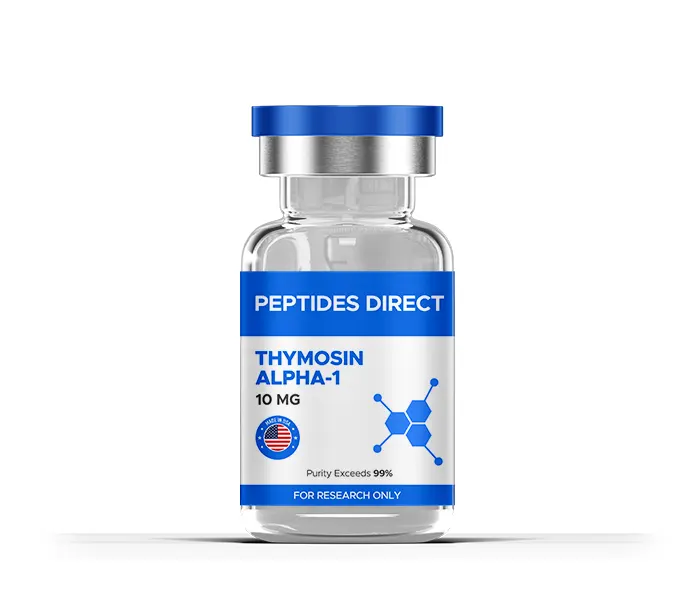
Thymosin Alpha-1 (10mg)
$130.00
Thymosin Alpha-1 peptides are Synthesized and Lyophilized in the USA.
Thymosin (Alpha-1) Peptide
Thymosin Alpha-1, also known as TA1 or Tα1, is a naturally occurring peptide fragment that was discovered in 1972 and researched for its potential action within the context of studies relating to cystic fibrosis, infection (e.g., tuberculosis, cytomegalovirus), respiratory disorders, chronic hepatitis, and cancer. It is also referred to as Thymalfasin when synthetically developed. Originally, research on Thymosin Alpha-1 centered around its potential role in immune modulation. It is hypothesized that it might increase levels of Major Histocompatibility Complex (MHC) class I molecules and boost cytokine production, key components of the immune system that may enhance immune responses.[1][2] There is also a possibility that it might improve the activity of natural killer cells, which target virus-infected cells and tumors. Furthermore, it might enhance the expression of specific markers on T cells that are considered critical for their identification and function in the immune system, indicating a significant role in immune regulation. Thymosin Alpha-1 is also thought to possibly increase the presence of high-affinity interleukin-2 receptors on cell surfaces, potentially leading to the vigorous activation and proliferation of T lymphocytes, elements of immune response. There is speculation that it may affect both T-helper and cytotoxic T-cell populations, deemed essential for eliminating infected cells. Additionally, it might prompt the differentiation of thymocytes—precursor cells in the thymus—and peripheral blood lymphocytes into mature immune cells, increase natural killer cell numbers, and promote cytokine-driven inflammatory responses. Research also explores its potential role in enhancing macrophage efficiency—cells that engulf and digest pathogens—and in regulating the activity of alpha thrombin, a protein involved in blood clotting, highlighting its broad potential on immune function.[1][2]
Specifications
Other Known Titles: Thymalfasin
Molecular Formula: C129H215N33O55
Molecular Weight: 3108.3 g/mol
Sequence: Ser-Asp-Ala-Ala-Val-Asp-Thr-Ser-Ser-Glu-Ile-Thr-Thr-Lys-Asp-Leu-Lys-Glu-Lys-Lys-Glu-Val-Val-Glu-Glu-Ala-Glu-Asn
Thymosin Alpha-1 Research
Thymosin Alpha-1 and the Immune System
Thymosin Alpha-1, first isolated from thymus gland tissue, may act as a regulator of immune function. The thymus is understood to govern T-cell maturation and differentiation, with T cells considered central to adaptive immune system operations — carrying memory of past infections and enhancing the function of other immune cells. Murine models lacking thymus glands indicate that Thymosin Alpha-1 may be capable of restoring immune function and preventing widespread infection.[3] Scientists have noted that “studies have demonstrated improvements in immune system cell subsets and the potential of Ta1 for the [research] of a range of diseases.”
The peptide also appears to stimulate signaling pathways that produce cytokines and other molecules coordinating immune cell activity, with potential widespread implications including in the context of sepsis.[4] For instance, the peptide was proposed to potentially enhance the activity of innate immune cells such as dendritic cells, macrophages, and monocytes — cells playing critical roles in early pathogen defense — suggesting that Thymosin Alpha-1 may support the organism’s capacity to combat early-stage sepsis. It may additionally enhance adaptive immunity, potentially improving overall immune responses in septic conditions through improved T cell and natural killer cell function. Data also suggests it may help upregulate important immune receptors and markers on immune cells, potentially improving their ability to recognize and respond to pathogens. Researchers are also exploring potential combinations of Thymosin Alpha-1 with agents such as ulinastatin — a protease inhibitor — to support its proposed effects, with this combined approach aimed at addressing both excessive inflammation and immune dysfunction simultaneously.
Thymosin Alpha-1 and Nerve Growth
The immune system is understood to support the central nervous system’s growth, development, and maintenance. Research suggests Thymosin Alpha-1 may promote neurodevelopment in mice, appearing to modulate several genes involved in neuronal growth and synaptic development, while potentially supporting growth, preventing inflammation, and limiting neuronal dysfunction.[5] The molecule may also potentially address neurodevelopmental delays such as cerebral palsy. These effects have been tentatively linked to elevated levels of neurotrophic factors including brain-derived neurotrophic factor (BDNF), nerve growth factor (NGF), and insulin-like growth factor-1 (IGF-1), alongside reductions in pro-inflammatory cytokines such as interleukin-6 (IL-6) and tumor necrosis factor-alpha (TNF-alpha). This apparent increase in beneficial cytokines and neurotrophic factors, accompanied by a decrease in inflammation-associated molecules, suggests a potentially neuroprotective immunological shift.
A noted increase in cell proliferation was also observed, including cells labeled with BrdU — a marker of new DNA synthesis — alongside markers for neural stem cells (Nestin), neuronal progenitors (Tbr2), and mature neurons (NeuN), indicating enhanced neurogenesis potentially attributable to a Th1-polarized immune response suggested by elevated interleukin-4 (IL-4) and interferon-gamma (IFN-gamma). Thymosin Alpha-1 also appeared to block LPS-induced impairment of hippocampal neurogenesis, positioning it as both a neurogenesis promoter and a neuroprotective agent against immune-mediated neurodevelopmental disruption.
Thymosin Alpha-1 and Fungal Infections
Dendritic cells play an important role in recognizing fungal infections. Thymosin Alpha-1 appears to support dendritic cell maturation, potentially improving the immune system’s capacity to combat fungal infections,[6] with activation of T-helper cells observed in murine aspergillus infection models. Dendritic cells operate by capturing antigens such as bacteria and fungi and presenting them to other immune cells for appropriate response. Abundant in the skin, nasal passages, lungs, and gastrointestinal system, they represent one of the immune system’s first responders, and the peptide’s proposed capacity to regulate dendritic cell function may influence immune system activity at a fundamental level.[7]
Thymosin Alpha-1 and HIV Research
Despite the development of antiretroviral procedures, complete immune restoration in HIV cases is not considered achievable, with antiretroviral therapy also implicated in cytotoxic T-cell deficits and persistent inflammatory states. The peptide has been studied for its potential to help restore immunity in highly active antiretroviral therapy (HAART) settings,[8] and may also influence HIV infection by stimulating CD8 T-cells to release factors that inhibit HIV transmission to other immune cells — potentially attenuating the reactivation of latent HIV.
Thymosin Alpha-1 and Blood Pressure
One study has proposed that Thymosin Alpha-1 may act to inhibit angiotensin-converting enzyme (ACE), potentially influencing blood pressure regulation.[9] Scientists noted that “Thalpha1 possesses a multifunctional peptide with dual antioxidant and ACE-inhibitory properties.” ACE is a recognized target in hypertension management, with its inhibition considered to not only lower blood pressure through vascular relaxation but also potentially reduce cardiac remodeling, delay atherosclerotic plaque development, and influence kidney function. Researchers suggested that Thymosin Alpha-1 appears to act as a mixed inhibitor, affecting both the velocity and substrate affinity of the enzyme as indicated by changes in kinetic parameters (Km and Vmax). The peptide was also reported to demonstrate significant antioxidant capacity through its proposed ability to scavenge various radical types including DPPH, ABTS, hydroxyl, and superoxide radicals. Its potential to reduce cellular reactive oxygen species (ROS) levels in neural astrocytoma cells was additionally documented, suggesting a possible protective role against oxidative stress — though these findings are preliminary and require further confirmation.
Thymosin Alpha-1 and Cancer Research
Research on lung cancer cells (A549) suggested an anti-proliferative function, with the peptide appearing to reduce both cancer cell growth and metastasis while controlling cell migration and tissue invasion.[10] Combination of Thymosin Alpha-1 with dacarbazine appeared to improve progression-free survival rates and manage toxicity in experimental studies. A long-acting Thymosin Alpha-1 variant tested against breast cancer cells in mice appeared to demonstrate enhanced efficacy in cancer cell growth inhibition, with reported increases in CD4 and CD8 cell levels alongside elevated interferon-gamma and interleukin-2. Thymosin Alpha-1 has been investigated across numerous cancer types including breast, melanoma, liver, lung, and colon cancer.
Thymosin Alpha-1 and Inflammatory Pain
Inflammatory pain is transmitted through specific peripheral and central nervous system pathways. Given the strong anti-inflammatory potential reported in research studies to date, Thymosin Alpha-1 may potentially attenuate pain perception. Murine research supports this hypothesis, with the peptide appearing to act directly at inflammation sites to reduce cytokine and molecular production — including TNF-alpha and IL-1beta — that triggers pain signaling. Its proposed mechanism of action appears to differ from typical anti-inflammatory analgesic compounds, though research to fully characterize this mechanism is ongoing.
Thymosin Alpha-1 and Cystic Fibrosis
Cystic fibrosis (CF) may be complicated by persistent inflammation, potentially contributing to impaired mucous clearance, elevated infection rates, and associated complications — arising from misfolding of the CFTR protein. Thymosin Alpha-1 has been studied for its potential to reduce inflammation and improve CFTR function. In one murine study assessing its potential in non-pulmonary tissue inflammation,[11] Thymosin Alpha-1 was proposed to have restored mucosal barrier integrity in the inflamed gastrointestinal tract of both normal and CF-specific murine models, as well as in metabolic syndrome models relevant to CF. This suggests the peptide may potentially ameliorate CFTR-related complications across multiple organ systems beyond the lungs. Its protective potential is further proposed to extend to the pancreas and liver, indicating a broad spectrum of possible influence in mitigating CF’s multi-organ impact.
Thymosin Alpha-1 and Dental Damage
The peptide may support the repair of gums and surrounding soft tissue following avulsed and replanted tooth trauma, and may promote survival of the replanted tooth.[12] Though preliminary, research findings suggest that Thymosin Alpha-1 may exhibit potential in the context of traumatic dental injury.
Disclaimer: The products mentioned are not intended for human or animal consumption. Research chemicals are intended solely for laboratory experimentation and/or in-vitro testing. Bodily introduction of any sort is strictly prohibited by law. All purchases are limited to licensed researchers and/or qualified professionals. All information shared in this article is for educational purposes only.
References
- Garaci E. Thymosin alpha1: a historical overview. Ann N Y Acad Sci. 2007 Sep;1112:14-20. doi: 10.1196/annals.1415.039. Epub 2007 Jun 13. PMID: 17567941.
- Dominari A, Hathaway Iii D, Pandav K, Matos W, Biswas S, Reddy G, Thevuthasan S, Khan MA, Mathew A, Makkar SS, Zaidi M, Fahem MMM, Beas R, Castaneda V, Paul T, Halpern J, Baralt D. Thymosin alpha 1: A comprehensive review of the literature. World J Virol. 2020 Dec 15;9(5):67-78. doi: 10.5501/wjv.v9.i5.67. PMID: 33362999; PMCID: PMC7747025.
- King R, Tuthill C. Immune Modulation with Thymosin Alpha-1 Treatment. Vitam Horm. 2016;102:151-78. doi: 10.1016/bs.vh.2016.04.003. Epub 2016 May 24. PMID: 27450734.
- Pei F, Guan X, Wu J. Thymosin Alpha-1 treatment for patients with sepsis. Expert Opin Biol Ther. 2018 Jul;18(sup1):71-76. doi: 10.1080/14712598.2018.1484104. PMID: 30063866.
- Wang G, He F, Xu Y, Zhang Y, Wang X, Zhou C, Huang Y, Zou J. Immunopotentiator Thymosin Alpha-1 Promotes Neurogenesis and Cognition in the Developing Mouse via a Systemic Th1 Bias. Neurosci Bull. 2017 Dec;33(6):675-684. doi: 10.1007/s12264-017-0162-x. Epub 2017 Aug 5. PMID: 28780644; PMCID: PMC5725380.
- Romani L, Bistoni F, Gaziano R, Bozza S, Montagnoli C, Perruccio K, Pitzurra L, Bellocchio S, Velardi A, Rasi G, Di Francesco P, Garaci E. Thymosin Alpha-1 activates dendritic cells for antifungal Th1 resistance through toll-like receptor signaling. Blood. 2004 Jun 1;103(11):4232-9. doi: 10.1182/blood-2003-11-4036. Epub 2004 Feb 24. PMID: 14982877.
- Goldstein AL, Goldstein AL. From lab to bedside: emerging clinical applications of Thymosin Alpha-1. Expert Opin Biol Ther. 2009 May;9(5):593-608. doi: 10.1517/14712590902911412. PMID: 19392576.
- Matteucci C, Grelli S, Balestrieri E, Minutolo A, Argaw-Denboba A, Macchi B, Sinibaldi-Vallebona P, Perno CF, Mastino A, Garaci E. Thymosin Alpha-1 and HIV-1: recent advances and future perspectives. Future Microbiol. 2017 Feb;12:141-155. doi: 10.2217/fmb-2016-0125. Epub 2017 Jan 20. PMID: 28106477.
- Kharazmi-Khorassani J, Asoodeh A, Tanzadehpanah H. Antioxidant and angiotensin-converting enzyme (ACE) inhibitory activity of thymosin alpha-1 (Thα1) peptide. Bioorg Chem. 2019 Jun;87:743-752. doi: 10.1016/j.bioorg.2019.04.003. Epub 2019 Apr 4. PMID: 30974297.
- Kharazmi-Khorassani J, Asoodeh A. Thymosin alpha-1; a natural peptide inhibits cellular proliferation, cell migration, the level of reactive oxygen species and promotes the activity of antioxidant enzymes in human lung epithelial adenocarcinoma cell line (A549). Environ Toxicol. 2019 Aug;34(8):941-949. doi: 10.1002/tox.22765. Epub 2019 May 8. PMID: 31067016.
- Bellet MM, Borghi M, Pariano M, Renga G, Stincardini C, D’Onofrio F, Brancorsini S, Garaci E, Costantini C, Romani L. Thymosin alpha 1 exerts beneficial extrapulmonary effects in cystic fibrosis. Eur J Med Chem. 2021 Jan 1;209:112921. doi: 10.1016/j.ejmech.2020.112921. Epub 2020 Oct 9. PMID: 33071052.
- Day P, Duggal M. Interventions for treating traumatised permanent front teeth: avulsed (knocked out) and replanted. Cochrane Database Syst Rev. 2010 Jan 20;(1):CD006542. doi: 10.1002/14651858.CD006542.pub2. Update in: Cochrane Database Syst Rev. 2019 Feb 05;2:CD006542. PMID: 20091594
📌 Transaction to you.NEXT >> graph.org/BALANCE-36824-US-DOLLARS-04-24-2?hs=ae8a8e1808e8b2bcf7c1710be70b392c& –
hca8ju