

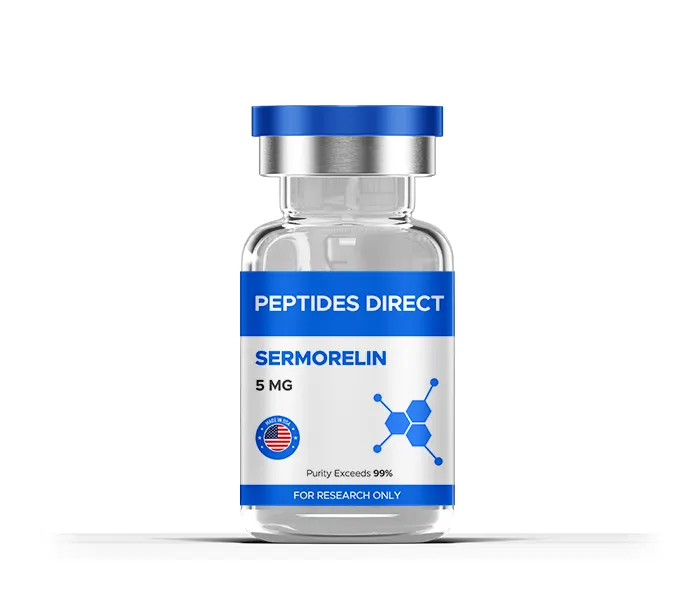
Sermorelin (5mg)
$43.00
Sermorelin peptides are Synthesized and Lyophilized in the USA.
Sermorelin Peptide
Sermorelin is among the growth hormone-releasing hormone (GHRH) analogs. It is classified as a GHRH as researchers have suggested that the peptide acts to induce the endogenous production and release of growth hormone (hGH). Growth hormone has been associated with numerous physiological activities, making Sermorelin and other GHRH analogs, potentially relevant in growth hormone-related research. Examples of studies employing GHRH analogs include research in the context of tissue scarring following cardiac dysfunction, as well as those examining bone density, renal function, dementia and seizure activity.
Specifications
Molecular Formula: C149H246N44O42S
Molecular Weight: 3357.9 g/mol
Sequence: Tyr-Ala-Asp-Ala-lle-Phe-DL-Thr-Asn-Ser-Tyr-Arg-Lys-Val-Leu-Gly-Gln-Leu-Ser-Ala-Arg-Lys-Leu-Leu-Gln-Asp-Ile-Met-Ser-Arg-NH2
Sermorelin Research
Sermorelin and Mechanisms of Action
Sermorelin may represent the shortest sequence proposed to potentially activate the biological mechanisms associated with GHRH receptors.[1] The peptide comprises the initial 29 amino acids of the typical 44-amino acid sequence found in GHRH. It is suggested that Sermorelin may interact with GHRH receptors on the pituitary gland, potentially triggering growth hormone release in a manner that mimics the primary actions of GHRH — potentially activating receptors within the somatotroph cells of the anterior pituitary gland and leading to intermittent growth hormone emissions despite Sermorelin’s truncated structure.[2]
Upon receptor engagement, Sermorelin is theorized to initiate various intracellular signaling events. One proposed pathway involves the adenylyl cyclase pathway, which may facilitate the conversion of ATP (adenosine triphosphate) to cAMP (cyclic adenosine monophosphate).[3] Elevated cAMP levels may activate protein kinase A (PKA), which may in turn phosphorylate several proteins including voltage-dependent calcium channels in the cell membrane. Phosphorylation and potential subsequent opening of these channels may allow calcium ions to enter somatotroph cells, with the resulting rise in intracellular calcium considered critical for the subsequent steps in growth hormone release. Elevated intracellular calcium is further hypothesized to stimulate secretory vesicles within somatotroph cells, potentially leading to growth hormone secretion into the bloodstream.
A notable theoretical feature of Sermorelin is its apparent specificity for GHRH receptors, which may prevent significant alterations in other endocrine markers such as prolactin, insulin, cortisol, glucose, or thyroid hormones. This selective increase in growth hormone production is understood to potentially elevate levels of insulin-like growth factor-1 (IGF-1), which plays a recognized role in the anabolic actions of growth hormone. The approximate half-life of Sermorelin is estimated at between 11 and 12 minutes, suggesting a relatively rapid turnover in the organism.[4]
Sermorelin and Cardiac Function
Heart attacks may precipitate secondary cardiac failure, conduction abnormalities (arrhythmias), and diminished cardiac capacity — risks commonly associated with cardiac remodeling resulting from damaged myocytes and potential effects on surrounding tissues. A 2016 study in pigs observed that Sermorelin exposure appeared to reduce instances of cardiac remodeling following cardiac events. Researchers proposed that the peptide may have acted to decrease cardiomyocyte cell death while improving production of extracellular matrix components and promoting angiogenesis in damaged tissue. The peptide has also been studied for its potential to support diastolic function, reduce scar size, and enhance capillary growth.[5,6] Researchers noted that “[exposure to] GHRH agonists appears to reduce the inflammatory responses post-MI and may consequently improve mechanisms of healing and cardiac remodeling by regulating pathways involved in fibrosis, apoptosis and cardiac repair.” Sermorelin is being explored in the context of various cardiac conditions including cardiac failure and valve disorders.
Sermorelin and Epilepsy
Gamma-aminobutyric acid (GABA) is a central nervous system signaling molecule considered to reduce electrical activity in the spinal cord and diminish overall excitability in the central nervous system. Many anti-seizure compounds function either by enhancing CNS GABA levels or by binding to and mimicking GABA. In one murine epilepsy study, Sermorelin was introduced to examine its influence on seizure activity, with GHRH analogs observed to activate GABA receptors and inhibit seizures.[7]
Sermorelin and Sleep
Orexin is recognized as a potent neurochemical secreted in the brain, hypothesized by neurological researchers to regulate sleep cycles. Growth hormone secretion is similarly understood to reach its maximum during sleep. Studies have suggested that a functional GHRH axis may be required for orexin production and activity, and that exposure to Sermorelin and other GHRH agonists appears to enhance orexin secretion.[8] Sermorelin is currently being investigated in the context of sleep disorders.
Sermorelin and Growth Hormone
Sermorelin is a growth hormone-releasing hormone derivative developed to modulate growth hormone activity with limited secondary effects. It has been studied for its potential to elevate hormone levels while appearing to be regulated through physiological feedback mechanisms that may prevent certain secondary effects associated with excess growth hormone — including edema, joint pain, and physiological dysregulation.[9] Researchers have proposed that Sermorelin may not be subject to tachyphylaxis — the process by which an organism becomes acclimatized to a compound, diminishing its effect.[10] Scientists noted that “the short time course of resensitisation following acute octreotide withdrawal is suggestive of an effect(s) on receptor function or on the receptor signal transduction cascade at sites further downstream, rather than an immune-mediated phenomenon.” Studies have also suggested peptide-induced upregulation of GHRH receptors rather than their downregulation — an action that may help prevent tachyphylaxis onset.
Initial results from an ongoing study suggest that Sermorelin may potentially increase average growth hormone levels by approximately 82%.[11] A 16-week investigation explored Sermorelin’s potential influence on growth hormone and IGF-1 production, skin cell proliferation, and muscle tissue growth. The study proposed that Sermorelin may cause a considerable though variable increase in growth hormone release — ranging from 70% to 107% — over a 12-hour period from anterior pituitary somatotroph cells. IGF-1 levels were additionally observed to potentially rise by approximately 28%, suggesting enhanced functionality of the growth hormone-IGF-1 axis and improvements in how these hormones interact and influence the organism.[12]
Sermorelin and Lean Mass
The aforementioned 16-week study proposed that Sermorelin may enhance lean mass by approximately 2.78 pounds (1.26 kilograms), with no concurrent changes in fat mass observed — suggesting the increase may be attributable to gains in muscle tissue and water retention. This effect was hypothesized to arise from Sermorelin’s proposed capacity to elevate growth hormone levels, which may in turn stimulate IGF-1 — considered the primary anabolic mediator of growth hormone’s muscle-building actions. Researchers additionally observed a significant increase in skin thickness, suggesting potential dermal modifications linked to these hormonal effects.[12]
Sermorelin and Potential Synergism with Other Peptides
Sermorelin is a GHRH analog that may exert synergistic potential when combined with ghrelin mimetics — also referred to as growth hormone secretagogues (GHSs) — which are proposed to stimulate growth hormone release through activation of ghrelin receptors rather than GHRH receptors of the anterior pituitary gland. By engaging distinct receptor populations, Sermorelin and GHSs may produce synergistic effects. Studies combining Sermorelin with GHSs such as GHRP-6 have reported greater IGF-1 elevation than either peptide alone — IGF-1 being recognized as the primary anabolic mediator of hGH and considered to correlate with mean growth hormone levels. One study, for instance, reported an apparent increase in IGF-1 levels of over 65% following the combined introduction of GHRP-6 and the unmodified version of Mod GRF 1-29.[13]
Disclaimer: The products mentioned are not intended for human or animal consumption. Research chemicals are intended solely for laboratory experimentation and/or in-vitro testing. Bodily introduction of any sort is strictly prohibited by law. All purchases are limited to licensed researchers and/or qualified professionals. All information shared in this article is for educational purposes only.
References
- Prakash, A, and K L Goa. “Sermorelin: a review of its use in the diagnosis and treatment of children with idiopathic growth hormone deficiency.” BioDrugs : clinical immunotherapeutics, biopharmaceuticals and gene therapy vol. 12,2 (1999): 139-57. https://pubmed.ncbi.nlm.nih.gov/18031173/
- Clark, R G, and I C Robinson. “Growth induced by pulsatile infusion of an amidated fragment of human growth hormone releasing factor in normal and GHRF-deficient rats.” Nature vol. 314,6008 (1985): 281-3. https://pubmed.ncbi.nlm.nih.gov/2858818/
- Sinha DK, Balasubramanian A, Tatem AJ, Rivera-Mirabal J, Yu J, Kovac J, Pastuszak AW, Lipshultz LI. Beyond the androgen receptor: the role of growth hormone secretagogues in the modern management of body composition in hypogonadal males. Transl Androl Urol. 2020 Mar;9(Suppl 2):S149-S159. doi: 10.21037/tau.2019.11.30. PMID: 32257855; PMCID: PMC7108996.
- Ishida, J., Saitoh, M., Ebner, N., Springer, J., Anker, S. D., & von Haehling, S. (2020). Growth hormone secretagogues: history, mechanism of action, and clinical development. JCSM Rapid Communications, 3(1), 25-37.
- Bagno LL, Kanashiro-Takeuchi RM, Suncion VY, et al. Growth hormone-releasing hormone agonists reduce myocardial infarct scar in swine with subacute ischemic cardiomyopathy. J Am Heart Assoc. 2015;4(4):e001464. Published 2015 Mar 31. doi:10.1161/JAHA.114.001464.
- Kanashiro-Takeuchi RM, Szalontay L, Schally AV, et al. New therapeutic approach to heart failure due to myocardial infarction based on targeting growth hormone-releasing hormone receptor. Oncotarget. 2015;6(12):9728-9739. doi:10.18632/oncotarget.3303.
- Tang S, Luo Z, Qiu X, et al. Interactions between GHRH and GABAARs in the brains of patients with epilepsy and in animal models of epilepsy. Sci Rep. 2017;7(1):18110. Published 2017 Dec 22. doi:10.1038/s41598-017-18416-5.
- Shepherd BS, Johnson JK, Silverstein JT, et al. Endocrine and orexigenic actions of growth hormone secretagogues in rainbow trout (Oncorhynchus mykiss). Comp Biochem Physiol A Mol Integr Physiol. 2007;146(3):390-399. doi:10.1016/j.cbpa.2006.11.004.
- Walker RF. Sermorelin: a better approach to management of adult-onset growth hormone insufficiency?. Clin Interv Aging. 2006;1(4):307-308. doi:10.2147/ciia.2006.1.4.307.
- Wahid ST, Marbach P, Stolz B, Miller M, James RA, Ball SG. Partial tachyphylaxis to somatostatin (SST) analogues in a patient with acromegaly: the role of SST receptor desensitisation and circulating antibodies to SST analogues. Eur J Endocrinol. 2002;146(3):295-302. doi:10.1530/eje.0.1460295.
- Vittone, J., Blackman, M. R., Busby-Whitehead, J., Tsiao, C., Stewart, K. J., Tobin, J., Stevens, T., Bellantoni, M. F., Rogers, M. A., Baumann, G., Roth, J., Harman, S. M., & Spencer, R. G. (1997). Effects of single nightly injections of growth hormone-releasing hormone (GHRH 1-29) in healthy elderly men. Metabolism: clinical and experimental, 46(1), 89–96. https://doi.org/10.1016/s0026-0495(97)90174-8
- Khorram, O., Laughlin, G. A., & Yen, S. S. (1997). Endocrine and metabolic effects of long-term administration of [Nle27]growth hormone-releasing hormone-(1-29)-NH2 in age-advanced men and women. The Journal of clinical endocrinology and metabolism, 82(5), 1472–1479. https://doi.org/10.1210/jcem.82.5.3943
- Sigalos, J. T., Pastuszak, A. W., Allison, A., Ohlander, S. J., Herati, A., Lindgren, M. C., & Lipshultz, L. I. (2017). Growth Hormone Secretagogue Treatment in Hypogonadal Men Raises Serum Insulin-Like Growth Factor-1 Levels. American journal of men’s health, 11(6), 1752–1757. https://doi.org/10.1177/1557988317718662.
Reviews
There are no reviews yet.