

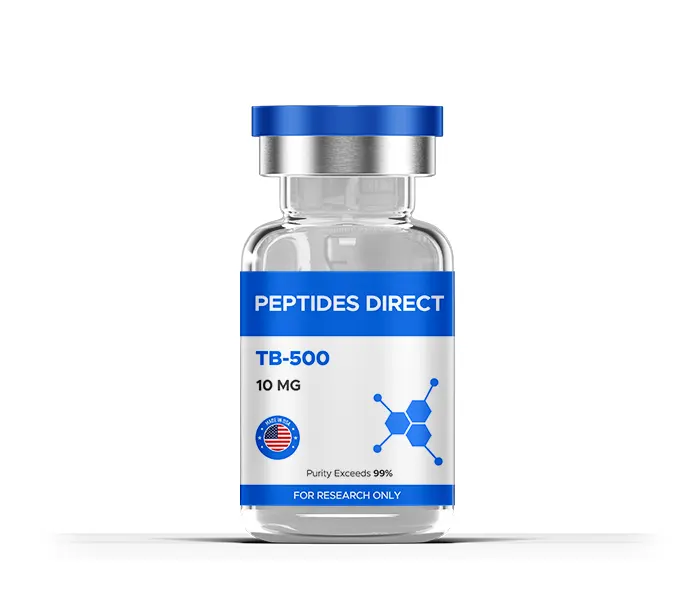
TB-500 (Thymosin Beta-4) (10mg)
$124.00
TB-500 peptides are Synthesized and Lyophilized in the USA.
TB-500 (Thymosin Beta-4) Peptide
TB-500, or synthetic Thymosin Beta-4, also known as synthetic Tβ4, is a synthetic analog of the endogenous Thymosin Beta-4 protein, which is considered to be ubiquitously present in cells. The peptide belongs to a widespread family of 16 related molecules observed to exhibit a high degree of sequence conservation and localization in most tissues and circulating cells. TB-500 was developed to sequester and block actin polymerization in eukaryotic cells.
Specifications
Other Known Titles: Thymosin Beta-4
Molecular Formula: C212H350N56O78S
Molecular Weight: 4963 g/mol
Sequence: Ac-Ser-Asp-Lys-Pro-Asp-Met-Ala-Glu-lle-GluLys-Phe-Asp-Lys-Ser-Lys-Leu-Lys-LysThr-Glu-Thr-Gin-Glu-Lys-Asn-Pro-Leu-Pro-Ser-Lys-GluThy-lleGlu-Gin-Glu-Lys-Gin-Ala-Gly-Glu-Ser
TB-500 (Thymosin Beta-4) Research
TB-500 and Intracellular Mechanism of Action
TB-500 is thought to contain a specific peptide sequence, LKKTETQ, located between the 16th and 24th amino acids, hypothesized to play a role in mediating actin binding. Actins are proteins considered integral to the cellular cytoskeleton, responsible for maintaining cell structure and recognized as critically involved in primary cellular functions such as motility.
TB-500’s interaction with actin is proposed to occur through binding to globular actin (G-actin) — the monomeric form of actin — prior to its polymerization into filamentous actin (F-actin). This hypothesized interaction between thymosin beta-4 and G-actin is understood to inhibit the polymerization process through actin sequestration, likely resulting in increased G-actin availability. The potential suppression of F-actin polymerization by thymosin beta-4 may theoretically alter cellular cytoskeletal architecture, with possible implications for the cell’s capacity for movement and morphological transformation.[1]
TB-500 and Extracellular Mechanism of Action
Initial research indicates that TB-500 may also exert effects outside the cell that influence various cellular functions, potentially including cell motility and angiogenesis — the process through which new blood vessels form.[2,3] It is hypothesized that thymosin beta-4, the naturally occurring counterpart of TB-500, may facilitate these actions through its influence on ATP synthase enzymes found on cell surfaces, which appear to play an essential role in generating the energy required for cellular activity. This hypothesis suggests a potential dual role for thymosin beta-4 in both cellular structural maintenance and energy production.
TB-500 and Vascular Tissues
TB-500 or thymosin beta-4 expression appears to increase fourfold to sixfold during early angiogenesis. Research suggests it may support the development of new blood vessels from existing ones, potentially mediating accelerated tissue repair.[4] Researchers have noted that “delineating the molecular pathways impacted by Tbeta4 to promote vascular growth and remodeling may reveal novel targets for prevention of vascular disease.” The actin-binding domain — a short central amino acid sequence — appears to be involved in TB-500-mediated regulation of blood cell division, tissue repair processes, migration of endothelial cells and keratinocytes, and potentially enhanced production of extracellular matrix-degrading enzymes.
TB-500 and Inflammation
TB-500 research suggests the peptide may carry potential anti-inflammatory properties.[5] Researchers have noted that “it acts by increasing angiogenesis and cell migration and is currently [studied in] wound repair.” Unlike many naturally produced growth factors, TB-500 may support endothelial and keratinocyte migration while appearing not to bind to the extracellular matrix. Researchers suggest its comparatively low molecular weight may facilitate relatively long-distance travel through tissues, with study findings generally proposing that the peptide’s primary action involves regulation of actin polymerization and function.
Further research suggests TB-500 may enhance expression of microRNA-146a (miR-146a), which may function as an inhibitory regulator of certain cellular communication networks — particularly those associated with inflammation-related cytokines including interleukin-1 receptor-associated kinase 1 (IRAK1) and tumor necrosis factor receptor-associated factor 6 (TRAF6). Investigators hypothesized this as a potential anti-inflammatory mechanism, with inhibition of miR-146a observed to reverse the suppression of IRAK1 and TRAF6 by Tbeta4.[6]
TB-500 and Tissue Wound Models
TB-500 has been suggested to potentially influence cytokine production, possibly accelerating recovery in wound models.[7] Preliminary data indicates that following injury, TB-500 may enhance expression of interleukin-1beta (IL-1beta) and interleukin-6 (IL-6) mRNA in mouse corneal tissue. Following alkali injury, TB-500 exposure is proposed to potentially reduce levels of chemoattractants including macrophage inflammatory protein-2 (MIP-2) and keratinocyte chemoattractant (KC), potentially diminishing polymorphonuclear neutrophil (PMN) infiltration. TB-500 may also influence nuclear factor kappa-light-chain-enhancer of activated B cells (NFkB) signaling pathways in the cornea, potentially producing anti-inflammatory effects.
Additionally, TB-500 is thought to exhibit anti-apoptotic properties, with cellular models demonstrating that overexpression of TB-500 appears to increase growth rates, reduce basal apoptosis, and enhance resistance to cell death stimuli. TB-500 may inhibit apoptosis in corneal epithelial cells by blocking caspase activity and limiting mitochondrial release of the pro-apoptotic protein bcl-2. The proposed anti-apoptotic mechanism may involve attenuation of early cell death signals and activation of the survival kinase Akt through interactions with particularly interesting new cysteine-histidine-rich protein (PINCH) and integrin-linked kinase. Collectively, these potential mechanisms may contribute to TB-500 supporting accelerated recovery across various tissue wound models.
TB-500 and Cell Repair
Initial studies tentatively suggest that TB-500 may enhance cardiac cell restoration in experimental models. Cardiac fibroblasts — connective tissue cells within the heart — may appear to undergo transformation into cells resembling cardiomyocytes, the muscle cells responsible for cardiac contractions.[8] Laboratory research has further hypothesized that TB-500, combined with cardiac reprogramming techniques, may cooperatively reduce cardiac cell damage and support recovery by stimulating endogenous cells within the heart region.
Further exploratory studies in murine models involving coronary artery ligation have suggested that TB-500 may elevate levels of integrin-linked kinase (ILK) and protein kinase B (Akt) — both recognized as critical enzymes in cellular signaling pathways with proposed roles in the early survival and repair of cardiomyocytes — potentially enhancing the cardiac tissue regeneration process.[9]
Disclaimer: The products mentioned are not intended for human or animal consumption. Research chemicals are intended solely for laboratory experimentation and/or in-vitro testing. Bodily introduction of any sort is strictly prohibited by law. All purchases are limited to licensed researchers and/or qualified professionals. All information shared in this article is for educational purposes only.
References
- Gurtner GC, Werner S, Barrandon Y, Longaker MT. Wound repair and regeneration. Nature. 2008 May 15;453(7193):314-21. doi: 10.1038/nature07039. PMID: 18480812.
- Huff, T., Müller, C. S., Otto, A. M., Netzker, R., & Hannappel, E. (2001). beta-Thymosins, small acidic peptides with multiple functions. The international journal of biochemistry & cell biology, 33(3), 205–220. https://doi.org/10.1016/s1357-2725(00)00087-x
- Freeman, K. W., Bowman, B. R., & Zetter, B. R. (2011). Regenerative protein thymosin beta-4 is a novel regulator of purinergic signaling. FASEB journal : official publication of the Federation of American Societies for Experimental Biology, 25(3), 907–915. https://doi.org/10.1096/fj.10-169417
- Dubé, K. N., & Smart, N. (2018). Thymosin β4 and the vasculature: multiple roles in development, repair and protection against disease. Expert opinion on biological therapy, 18(sup1), 131–139. doi:10.1080/14712598.2018.1459558
- Philp, D., Goldstein, A. L., & Kleinman, H. K. (2004). Thymosin beta4 promotes angiogenesis, wound healing, and hair follicle development. Mechanisms of ageing and development, 125(2), 113–115. doi:10.1016/j.mad.2003.11.005
- Santra, M., Zhang, Z. G., Yang, J., Santra, S., Santra, S., Chopp, M., & Morris, D. C. (2014). Thymosin β4 up-regulation of microRNA-146a promotes oligodendrocyte differentiation and suppression of the Toll-like proinflammatory pathway. The Journal of biological chemistry, 289(28), 19508–19518. https://doi.org/10.1074/jbc.M113.529966
- Sosne, G., Qiu, P., & Kurpakus-Wheater, M. (2007). Thymosin beta 4: A novel corneal wound healing and anti-inflammatory agent. Clinical ophthalmology (Auckland, N.Z.), 1(3), 201–207.
- Srivastava, D., Ieda, M., Fu, J., & Qian, L. (2012). Cardiac repair with thymosin β4 and cardiac reprogramming factors. Annals of the New York Academy of Sciences, 1270, 66–72. https://doi.org/10.1111/j.1749-6632.2012.06696.x
- Bock-Marquette, I., Saxena, A., White, M. D., Dimaio, J. M., & Srivastava, D. (2004). Thymosin beta4 activates integrin-linked kinase and promotes cardiac cell migration, survival and cardiac repair. Nature, 432(7016), 466–472. target=”_blank” rel=”noopener”https://doi.org/10.1038/nature03000
Reviews
There are no reviews yet.