

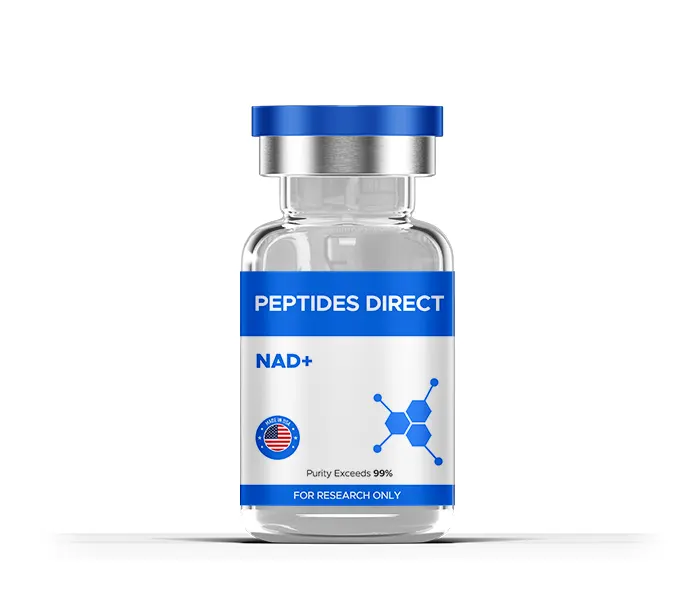
NAD+ (100mg & 250mg & 500mg)
$179.00
NAD+ peptides are Synthesized and Lyophilized in the USA.
Nicotinamide Adenine Dinucleotide (NAD+) Peptide
Nicotinamide Adenine Dinucleotide (NAD+) is an oxidized form of NADH (Nicotinamide Adenine Dinucleotide Hydroxide). NAD+ is a component of the Electron Transport Chain (ETC), which researchers have suggested to act in carrying electrons and thus energy within cells. The peptide has also been posited to potentially act as a mediator for various physiological processes, such as post-translational modification of the proteins and activation/deactivation of some enzymes. It is believed to be a critical component in maintaining cell-to-cell communication.
Specifications
MOLECULAR WEIGHT: 663.43 g/mol
MOLECULAR FORMULA: C21H27N7O14P2
SYNONYMS: Nicotinamide Adenine Dinucleotide, Beta-NAD, NAD, Endopride
NAD+ Research
NAD+ and Cellular Aging
Mitochondria serve as a central platform for primary metabolic functions including intracellular signaling and regulation of innate immunity — processes that appear directly affected by mitochondrial senescence, ultimately altering cellular metabolism, inflammation, and stem cell activity.[1] Together, these changes may reduce the pace of tissue repair following damage, illustrating the extent to which mitochondrial function is implicated in age-related decline of tissue and organ integrity. Researchers consider that through manipulation of mitochondrial activity, it may be possible to slow, halt, or potentially reverse aspects of the cellular aging process.
A deficiency of NAD+ within the cell appears to induce a pseudo-hypoxic state that disrupts nuclear signaling.[2] Scientists have noted that “raising NAD+ levels in old mice restores mitochondrial function to that of a young mouse in a SIRT1-dependent manner.” The mechanism underlying this property appears to involve activation of SIRT1 function, wherein a gene encodes the enzyme Sirtuin-1 (NAD+-dependent Deacetylase Sirtuin-1), which may in turn regulate mediators involved in metabolism, inflammation, and cellular longevity.[3]
Sirtuin-1 belongs to a class of proteins called sirtuins, proposed to require NAD+ as a cofactor to carry out enzymatic activity. These proteins are potentially involved in various cellular processes including DNA repair, gene expression, and metabolic regulation, and have been associated with cellular longevity and lifespan extension.[4]
NAD+ and Muscle Cell Function
The endogenous decline in muscle cell function is associated with mitochondrial senescence and is considered to occur in two stages. The first — partially reversible — involves reduced expression of mitochondrial genes responsible for oxidative phosphorylation, the process by which mitochondria generate energy. The second stage, considered irreversible, involves decline in the nuclear genes governing oxidative phosphorylation.
Experiments in murine models have reported an apparent reversal of stage one following supplemental NAD+ exposure, provided it occurs before the cell progresses to stage two.[5] The mechanism underlying this intervention in mitochondrial aging may involve stabilization of Peroxisome Proliferator-activated Receptor Gamma Co-activator 1-alpha (PGC-1-alpha) activity. Studies have suggested that the mitochondrial effects produced through this action may be comparable to those induced by physical exercise on skeletal muscle mitochondria.[6]
NAD+ and Neurodegeneration
NAD+ functions as a cofactor that may exert potential neuroprotective effects,[7] proposed to be mediated through support of mitochondrial function and reduction in reactive oxygen species (ROS) production. ROS is associated with the inflammatory changes linked to injury and the degenerative changes characteristic of cellular aging — providing a mechanistic basis for certain neurodegenerative conditions including Alzheimer’s, Huntington’s, and Parkinson’s disease.
Research in mouse models suggested the potential of NAD+ to protect against progressive motor deficits and the loss of dopamine-producing cells in the substantia nigra.[8] Researchers stated that “these results add credence to the beneficial role of NAD against parkinsonian neurodegeneration in mouse models of PD, provide evidence for the potential of NAD for the prevention of PD, and suggest that NAD prevents pathological changes in PD via decreasing mitochondrial dysfunctions.” These findings implied that while NAD+ may not alleviate established symptoms, it may slow — and potentially prevent — the development of Parkinson’s disease pathology.
NAD+ and Inflammation
NAMPT is an enzyme associated with inflammatory activity and appears to be overexpressed in certain cancer cell types. Elevated NAMPT levels appear to correlate positively with NAD+ concentrations and vice versa.[9] NAMPT-associated inflammation has been observed in cancer cells and in research models of obesity, type 2 diabetes, and nonalcoholic fatty liver disease. NAMPT may function as a potent activator of inflammation, while cellular inflammation levels may decline substantially following NAD+ introduction. Modulation of NAD+ concentrations may therefore influence intracellular inflammatory pathways, suggesting a potential means of regulating inflammatory responses at the cellular level.
NAD+ and DNA Integrity
Research has examined how NAD+ may help preserve DNA integrity through its association with poly(ADP-ribose) polymerase (PARP) enzymes.[10] NAD+ is understood to serve as a substrate for PARP enzymes, which may participate in DNA repair mechanisms by attaching ADP-ribose (ADPr) units to specific proteins. PARP-1, the first identified member of the PARP family, is believed to become activated upon DNA damage by adding poly(ADP-ribose) (pADPr) chains to proteins.
These pADPr chains may function as scaffolds, potentially recruiting DNA repair proteins to sites of damage and facilitating chromatin relaxation to support repair processes. Research additionally proposes that pADPr may serve roles within the cell nucleus under normal conditions — including influencing gene transcription, modifying chromatin architecture, and maintaining telomeres, the protective chromosome termini. These functions are presumably mediated by PARP enzymes utilizing NAD+ to generate ADPr modifications on proteins. Different PARP enzymes may act cooperatively, with some initiating mono(ADP-ribosyl)ation and others extending these into longer pADPr chains — a sequential modification process potentially supporting the specificity and efficiency of DNA repair.
This research also highlights the potential contribution of other NAD+-consuming enzymes such as sirtuins to DNA integrity maintenance. Sirtuins — exemplified by the yeast protein Sir2p — are associated with gene silencing, chromosomal stability, and cellular aging. The sirtuin SIRT6, in particular, is reported to add a single ADP-ribose unit to PARP-1 in response to DNA damage, potentially stimulating further pADPr chain addition — suggesting a cooperative interaction between NAD+-dependent signaling pathways in preserving genomic stability.
NAD+ and Cell Survival
As a critical coenzyme involved in cellular energy metabolism, NAD+ may participate in various signaling pathways that influence cell survival. Under conditions of oxidative stress, researchers suggest that oxidative DNA damage may accumulate,[11] driven by increased ROS-mediated attacks on DNA and a potential reduction in the cell’s DNA repair capacity. Accumulation of DNA lesions may activate PARP-1, leading to NAD+ depletion and potentially culminating in cell death.
In experiments using neuronal cell cultures subjected to oxygen-glucose deprivation (OGD) — a laboratory model simulating ischemic injury through reduced oxygen and glucose availability — direct NAD+ supplementation either before or after OGD appeared to reduce cell death and decrease DNA damage.[11] This protective effect appeared to be concentration- and timing-dependent. It is hypothesized that NAD+ supplementation may restore nuclear DNA repair activity by mitigating phosphorylation of serine residues on key enzymes involved in base-excision repair (BER), including apurinic/apyrimidinic endonuclease 1 (APE1) and DNA polymerase beta (betapol). Reactivation of these repair mechanisms may represent a central factor mediating the neuroprotective actions of NAD+, with further observations suggesting that NAD+ replenishment may attenuate the typical decline in BER activity following OGD.
The loss of BER function in OGD-exposed neurons is understood to stem from phosphorylation of serine and threonine residues on the rate-limiting enzymes APE1 and betapol. NAD+ may help restore the activity of these enzymes by potentially inhibiting protein kinases or activating phosphatases that regulate their phosphorylation states. Experiments involving APE1 knockdown indicated that this significantly diminished the prosurvival benefit of NAD+ supplementation, implying that functional BER pathway integrity may be critical for the observed neuroprotection. However, since APE1 knockdown did not fully eliminate the prosurvival effect, NAD+ may also activate additional survival mechanisms — including supporting substrate delivery to mitochondria under conditions of active NAD+ consumption, thereby sustaining energy production, or engaging NAD+-dependent processes such as sirtuin deacetylase activity. Sirtuins may in turn influence cell survival through chromatin remodeling and suppression of proteins involved in apoptosis.
Disclaimer: The products mentioned are not intended for human or animal consumption. Research chemicals are intended solely for laboratory experimentation and/or in-vitro testing. Bodily introduction of any sort is strictly prohibited by law. All purchases are limited to licensed researchers and/or qualified professionals. All information shared in this article is for educational purposes only.
References
- Sun N, Youle RJ, Finkel T. The Mitochondrial Basis of Aging. Mol Cell. 2016 Mar 3;61(5):654-666. doi: 10.1016/j.molcel.2016.01.028. PMID: 26942670; PMCID: PMC4779179.
- Gomes AP, Price NL, Ling AJ, Moslehi JJ, Montgomery MK, Rajman L, White JP, Teodoro JS, Wrann CD, Hubbard BP, Mercken EM, Palmeira CM, de Cabo R, Rolo AP, Turner N, Bell EL, Sinclair DA. Declining NAD(+) induces a pseudohypoxic state disrupting nuclear-mitochondrial communication during aging. Cell. 2013 Dec 19;155(7):1624-38. doi: 10.1016/j.cell.2013.11.037. PMID: 24360282; PMCID: PMC4076149.
- Imai S, Guarente L. NAD+ and sirtuins in aging and disease. Trends Cell Biol. 2014 Aug;24(8):464-71. doi: 10.1016/j.tcb.2014.04.002. Epub 2014 Apr 29. PMID: 24786309; PMCID: PMC4112140.
- Wątroba, M., Dudek, I., Skoda, M., Stangret, A., Rzodkiewicz, P., & Szukiewicz, D. (2017). Sirtuins, epigenetics and longevity. Ageing research reviews, 40, 11–19. https://doi.org/10.1016/j.arr.2017.08.001
- Mendelsohn AR, Larrick JW. Partial reversal of skeletal muscle aging by restoration of normal NAD⁺ levels. Rejuvenation Res. 2014 Feb;17(1):62-9. doi: 10.1089/rej.2014.1546. PMID: 24410488.
- Kang C, Chung E, Diffee G, Ji LL. Exercise training attenuates aging-associated mitochondrial dysfunction in rat skeletal muscle: role of PGC-1α. Exp Gerontol. 2013 Nov;48(11):1343-50. doi: 10.1016/j.exger.2013.08.004. Epub 2013 Aug 30. PMID: 23994518.
- Matthews RT, Yang L, Browne S, Baik M, Beal MF. Coenzyme Q10 administration increases brain mitochondrial concentrations and exerts neuroprotective effects. Proc Natl Acad Sci U S A. 1998 Jul 21;95(15):8892-7. doi: 10.1073/pnas.95.15.8892. PMID: 9671775; PMCID: PMC21173.
- Shan C, Gong YL, Zhuang QQ, Hou YF, Wang SM, Zhu Q, Huang GR, Tao B, Sun LH, Zhao HY, Li ST, Liu JM. Protective effects of β- nicotinamide adenine dinucleotide against motor deficits and dopaminergic neuronal damage in a mouse model of Parkinson’s disease. Prog Neuropsychopharmacol Biol Psychiatry. 2019 Aug 30;94:109670. doi: 10.1016/j.pnpbp.2019.109670. Epub 2019 Jun 17. PMID: 31220519.
- Garten A, Schuster S, Penke M, Gorski T, de Giorgis T, Kiess W. Physiological and pathophysiological roles of NAMPT and NAD metabolism. Nat Rev Endocrinol. 2015 Sep;11(9):535-46. doi: 10.1038/nrendo.2015.117. Epub 2015 Jul 28. PMID: 26215259.
- Leung A, Todorova T, Ando Y, Chang P. Poly(ADP-ribose) regulates post-transcriptional gene regulation in the cytoplasm. RNA Biol. 2012 May;9(5):542-8. doi: 10.4161/rna.19899. Epub 2012 May 1. PMID: 22531498; PMCID: PMC3495734.
- Wang S, Xing Z, Vosler PS, Yin H, Li W, Zhang F, Signore AP, Stetler RA, Gao Y, Chen J. Cellular NAD replenishment confers marked neuroprotection against ischemic cell death: role of enhanced DNA repair. Stroke. 2008 Sep;39(9):2587-95. doi: 10.1161/STROKEAHA.107.509158. Epub 2008 Jul 10. PMID: 18617666; PMCID: PMC2743302.
Reviews
There are no reviews yet.