

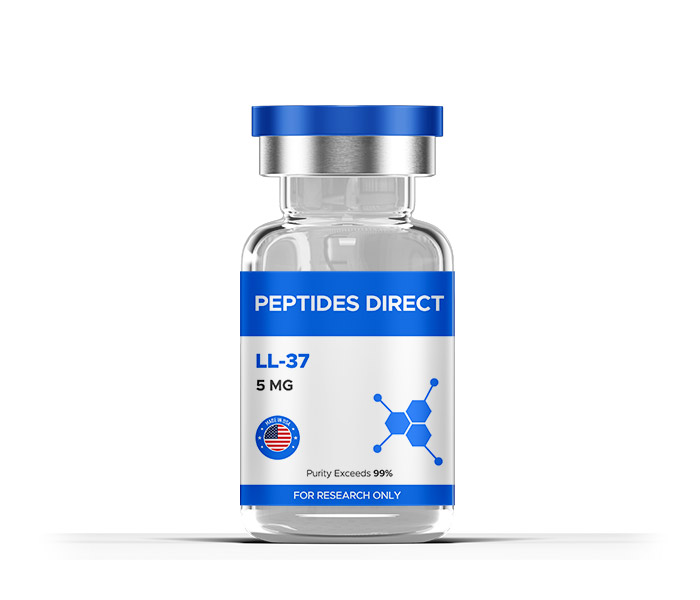
LL-37 (5mg)
$86.00
LL-37 peptides are Synthesized and Lyophilized in the USA.
LL-37 Peptide
LL-37 is a Cathelicidin, a protein family of unique and diverse functions. These peptides, produced by macrophages and polymorphonuclear leukocytes (both types of white blood cells), have been suggested to exhibit bactericidal action. The entire group is classified as antimicrobial peptides (AMPs). The peptide, in particular, has been researched in relation to autoimmune disease, cancer, and wound recovery.[1] For example, researchers note that “Corneal and conjunctival epithelia express LL-37 as part of mucosal innate immunity to protect against bacterial and viral ocular infections.”
Specifications
Other Known Titles: CAP-18
Molecular Formula: C205H340N50O53
Molecular Weight: 4493.34 g/mol
Sequence: Leu-Leu-Gly-Asp-Phe-Phe-Arg-Lys-Ser-Lys-GluLys-Ile-Gly-Lys-Glu-Phe-Lys-Arg-Ile-Val-Gln-Arg-Ile-Lys-Asp-Phe-Leu-Arg-Asn-Leu-Val-Pro-ArgThr-Glu-Ser
LL-37 Peptide Research
LL-37 and Inflammatory Disease Models
LL-37, while primarily investigated as an antimicrobial peptide, has also been examined in research related to various inflammatory conditions including lupus, rheumatoid arthritis, psoriasis, and atherosclerosis. Researchers suggest the peptide exhibits diverse immune-modulating behaviors dependent on the cell types involved and the local inflammatory environment. It has been proposed to reduce apoptotic death of keratinocytes, enhance IFN-alpha synthesis, suppress signaling through toll-like receptor 4 (TLR4), modify neutrophil and eosinophil chemotaxis,[2] stimulate IL-18 production, and potentially reduce atherosclerotic plaque levels. Notably, LL-37 — also known as CAP-18 — appears to engage the immune system differently depending on the triggering stimulus. Cell culture studies have highlighted the significance of the inflammatory environment in shaping the immune response to LL-37, with T cells appearing to amplify inflammatory activity via LL-37 when in an inactivated state, while minimizing this activity upon activation.
The peptide appears to mediate immunological homeostasis, helping to prevent hyperactivation during infection. A strong correlation appears to exist between peptide levels and disease severity. While CAP-18 was initially hypothesized to promote autoimmune disorders, more recent findings suggest it may help attenuate associated damage.[3] Researchers outlined that the peptide plays a role “in the modulation of immune and inflammatory pathways and their effects on autoimmune and inflammatory diseases,” with elevated peptide levels potentially helping to limit further inflammatory escalation.
LL-37 and Antimicrobial Characteristics
LL-37 appears to be an important biomolecule of innate immunity and among the first proteins to be activated upon infection. Research in skin infection models suggests that while the peptide is present in limited quantities in resting skin cells, it accumulates rapidly in the presence of invading pathogens.[4] It may cooperate with other proteins such as beta-defensin 2 to combat infection. The peptide appears to bind to bacterial lipopolysaccharide (LPS) found in the outer membrane of gram-negative bacteria — a component considered critical for membrane integrity — with this binding potentially rendering it toxic to certain bacterial strains. Research on staph infections and other serious bacterial pathogens suggests LL-37 may also act against gram-positive organisms, with evidence indicating it may enhance lysozyme activity against gram-positive bacteria such as Staphylococcus aureus.
LL-37 levels may also be elevated in gastrointestinal ulcer models, where increased peptide expression appears to exert antimicrobial activity against nearby potential threats.[5] This heightened production is likely influenced by activation of Toll-like receptor 3 (TLR-3) — a receptor involved in immune response — which may be activated by its ligand polyinosinic-polycytidylic acid (poly(I)), a synthetic analog of double-stranded RNA. Interaction with poly(I) may trigger a cascade of intracellular signaling events involving proteins such as Toll/IL-1 receptor (TIR) domain-containing adaptor-inducing interferon (TRIF), tumor necrosis factor receptor-associated factor 6 (TRAF6), and transforming growth factor beta-activated kinase 1 (TAK1) — each recognized for their roles in immune signaling pathways potentially leading to enhanced LL-37 expression. The peptide’s role in the gastrointestinal tract may extend to attenuating microbial damage to the GI mucosa through interactions with LPS, while also potentially reducing secretion of pro-inflammatory cytokines such as interleukin-6 (IL-6) and IL-8 in colonic subepithelial myofibroblasts (SEMFs) — cells involved in wound recovery and fibrosis — thereby contributing to the preservation of GI tract lining integrity.
LL-37 and Lung Disease Models
LPS is present in various organisms and may become airborne in environments contaminated by mold or fungi. Normal lung tissue responds to LPS inhalation by producing mucus, though this response is often insufficient to address toxic dust syndrome and respiratory conditions such as asthma and COPD. LL-37 has been investigated in research on toxic dust syndrome,[6] with the peptide appearing to support epithelial cell proliferation and wound closure in lung disease contexts. It may attract airway epithelial cells to sites of injury and facilitate vascularization, wound recovery, and nutritional supply to newly formed tissue.
LL-37 Peptide and Arthritis Models
Research in murine models observed elevated LL-37 levels in the joints of rat models of rheumatoid arthritis, though whether the peptide exerts beneficial or detrimental effects in such models remains to be determined. Several findings nonetheless indicate the peptide’s potential relevance to inflammation. LL-37 deficiency does not appear to alter disease outcomes in animal models of arthritis or lupus,[7] with animals expressing the peptide appearing to exhibit similar disease progression to those lacking it — suggesting that physiological responses associated with elevated cathelicidin levels in arthritis may be incidental.
Peptides derived from LL-37 may reduce collagen damage occurring in inflammatory arthritis, with direct joint exposure in rat models observed to reduce both disease severity and serum levels of antibodies against type II collagen. Direct interleukin-32 (IL-32) involvement in inflammatory arthritis severity has been reported, with LL-37 and its derivatives potentially capable of modulating IL-32 response levels. Researchers consider it reasonable to propose a protective role for the peptide in this disease context. Synovial fluid fibroblasts are understood to upregulate toll-like receptor 3 levels, which scientists consider a contributor to worsening arthritic conditions through increased inflammatory cytokine expression. LL-37 may interact with TLR4, producing either pro-inflammatory or anti-inflammatory outcomes.[8] Whether LL-37 and CAP-18 mediate the same actions against a backdrop of elevated TLR3 has yet to be confirmed. The peptide has been examined in experimental studies for its capacity to selectively reduce pro-inflammatory macrophage responses, with researchers suggesting its inflammatory regulation to be selective in nature.
LL-37 and Intestinal Cancer
Cell culture research has suggested multifaceted functions of LL-37 within the intestine. The peptide appears to enhance the migration of cells necessary for maintaining the intestinal epithelial barrier, and may reduce apoptosis during intestinal inflammation, helping to attenuate both the causes and associated pathogenesis of inflammation. Studies suggest LL-37 may work in concert with beta-defensin 2 to support wound recovery, with both peptides proposed to simultaneously repair and maintain the intestinal epithelium while reducing TNF-related cell death.[9] Despite TNF-alpha inhibitors being among the primary compounds investigated in inflammatory bowel conditions, they have been associated with adverse secondary effects. LL-37 exposure may potentially reduce dependence on such inhibitors. Research examining LL-37’s actions on cancer cells has yielded mixed findings.
LL-37 and Blood Vessel Growth
LL-37 appears to stimulate the production of prostaglandin E2 (PGE2) in endothelial cells — the cells lining the interior surface of blood vessels.[10] Within endothelial cells, PGE2 supports blood vessel development through the process of angiogenesis, regulation of which is considered critical given its influence on cancer development, stroke outcomes, cardiac disease, and wound recovery. LL-37 may support the study of angiogenesis with the aim of promoting it in cardiac disease contexts while limiting it within cancer microenvironments. Further research suggests the peptide may support several key endothelial cell functions,[11] including cell proliferation, cell migration, and the formation of tube-like structures resembling small capillaries. Research in mouse models with induced catabolism, employing both synthetic and natural recombinant forms of LL-37, tentatively indicated that exposure to the peptide may promote new blood vessel development and epithelial tissue recovery. These preliminary findings support the hypothesis that LL-37 may play a meaningful role in enhancing wound recovery through its potential influence on vascularization.
LL-37 and Immune Cells
Studies suggest that LL-37 may enhance the immune system’s capacity to respond to cellular damage.[12] This may occur through modulation of the immune system’s recognition mechanisms for self-nucleic acids including DNA and RNA, potentially facilitated by LL-37’s interaction with specific cellular receptors — notably scavenger receptors (SRs). These receptors are considered key participants in clathrin-dependent endocytosis, believed to be critical for activating inflammatory pathways within cells. LL-37 is further thought to facilitate the association of double-stranded RNA (dsRNA) with scavenger receptors, potentially initiating a cascade of signaling events culminating in cytokine expression — important mediators of immune response. The specific interactions between LL-37 and scavenger receptors such as SR-A6 and SR-B1 may be particularly significant. Research additionally explores the possibility that LL-37 may influence the immune system by modifying intracellular signaling pathways including Toll-like receptors (TLRs) and interferon regulatory factors (IRFs), commonly activated in response to foreign nucleic acids. Through clathrin-mediated endocytosis, LL-37 may facilitate the cellular entry of immune-modulating molecules — an essential step in initiating an immune response — suggesting a sophisticated mechanism by which LL-37 may regulate immune reactions at the cellular level.
Disclaimer: The products mentioned are not intended for human or animal consumption. Research chemicals are intended solely for laboratory experimentation and/or in-vitro testing. Bodily introduction of any sort is strictly prohibited by law. All purchases are limited to licensed researchers and/or qualified professionals. All information shared in this article is for educational purposes only.
References
- Gordon YJ, Huang LC, Romanowski EG, Yates KA, Proske RJ, McDermott AM. Human cathelicidin (LL-37), a multifunctional peptide, is expressed by ocular surface epithelia and has potent antibacterial and antiviral activity. Curr Eye Res. 2005 May;30(5):385-94. doi: 10.1080/02713680590934111. PMID: 16020269; PMCID: PMC1497871.
- Alalwani SM, Sierigk J, Herr C, Pinkenburg O, Gallo R, Vogelmeier C, Bals R. The antimicrobial peptide LL-37 modulates the inflammatory and host defense response of human neutrophils. Eur J Immunol. 2010 Apr;40(4):1118-26. doi: 10.1002/eji.200939275. PMID: 20140902; PMCID: PMC2908514.
- Kahlenberg JM, Kaplan MJ. Little peptide, big effects: the role of LL-37 in inflammation and autoimmune disease. J Immunol. 2013 Nov 15;191(10):4895-901. doi: 10.4049/jimmunol.1302005. PMID: 24185823; PMCID: PMC3836506.
- Reinholz M, Ruzicka T, Schauber J. Cathelicidin LL-37: an antimicrobial peptide with a role in inflammatory skin disease. Ann Dermatol. 2012 May;24(2):126-35. doi: 10.5021/ad.2012.24.2.126. Epub 2012 Apr 26. PMID: 22577261; PMCID: PMC3346901.
- Kusaka; et al. Expression of human cathelicidin peptide LL-37 in inflammatory bowel disease. Clin Exp Immunol. 2018 Jan;19(11). Epub 2017 Sep 28. https://pubmed.ncbi.nlm.nih.gov/28872665/
- Golec M. Cathelicidin LL-37: LPS-neutralizing, pleiotropic peptide. Ann Agric Environ Med. 2007;14(1):1-4. PMID: 17655171.
- Moreno-Angarita A, Aragón CC, Tobón GJ. Cathelicidin LL-37: A new important molecule in the pathophysiology of systemic lupus erythematosus. J Transl Autoimmun. 2019 Dec 17;3:100029. doi: 10.1016/j.jtauto.2019.100029. PMID: 32743514; PMCID: PMC7388365.
- Singh D, Vaughan R, Kao CC. LL-37 peptide enhancement of signal transduction by Toll-like receptor 3 is regulated by pH: identification of a peptide antagonist of LL-37. J Biol Chem. 2014 Oct 3;289(40):27614-24. doi: 10.1074/jbc.M114.582973. Epub 2014 Aug 4. PMID: 25092290; PMCID: PMC4183800.
- Piktel E, Niemirowicz K, Wnorowska U, Wątek M, Wollny T, Głuszek K, Góźdź S, Levental I, Bucki R. The Role of Cathelicidin LL-37 in Cancer Development. Arch Immunol Ther Exp (Warsz). 2016 Feb;64(1):33-46. doi: 10.1007/s00005-015-0359-5. Epub 2015 Sep 22. PMID: 26395996; PMCID: PMC4713713.
- Salvado MD, Di Gennaro A, Lindbom L, Agerberth B, Haeggström JZ. Cathelicidin LL-37 induces angiogenesis via PGE2-EP3 signaling in endothelial cells, in vivo inhibition by aspirin. Arterioscler Thromb Vasc Biol. 2013 Aug;33(8):1965-72. doi: 10.1161/ATVBAHA.113.301851. Epub 2013 Jun 13. PMID: 23766266.
- Ramos R, Silva JP, Rodrigues AC, Costa R, Guardão L, Schmitt F, Soares R, Vilanova M, Domingues L, Gama M. Wound healing activity of the human antimicrobial peptide LL37. Peptides. 2011 Jul;32(7):1469-76. doi: 10.1016/j.peptides.2011.06.005. Epub 2011 Jun 13. https://pubmed.ncbi.nlm.nih.gov/21693141/
- Takahashi, T., Kulkarni, N.N., Lee, E.Y. et al. Cathelicidin promotes inflammation by enabling binding of self-RNA to cell surface scavenger receptors. Sci Rep 8, 4032 (2018). https://doi.org/10.1038/s41598-018-22409-3
Reviews
There are no reviews yet.