

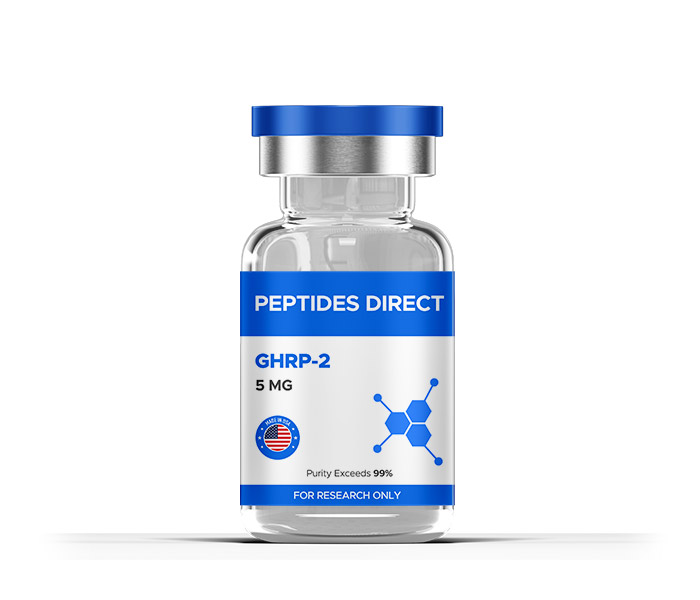
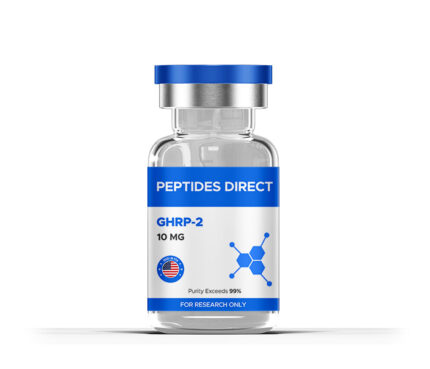
GHRP-2 (5mg)
$20.00
GHRP-2 peptides are Synthesized and Lyophilized in the USA.
GHRP-2 Peptide
GHRP-2, also known as Pralmorelin (also available in 10mg) is a synthetic growth hormone secretagogue that researchers consider may interact with the ghrelin/growth hormone secretagogue receptor found on pituitary cells. It is a pentapeptide consisting of five amino acids and bears a resemblance to the endogenous neurotransmitter, met-enkephalin. It is proposed, albeit with uncertainty, that GHRP-2 may not function as a typical neurotransmitter. Rather, it is hypothesized to engage with ghrelin receptors. Ghrelin, identified as a hormone that regulates appetite, may be affected by interactions with GHRP-2. There is a conjecture that GHRP-2 might induce the secretion of growth hormone (GH) through potential interactions with ghrelin receptors on the pituitary gland, specifically the growth hormone secretagogue receptors (GHS-Rs). Yet, the nature of this interaction is still under investigation and not conclusively established. Extensive research has also been performed to evaluate its role in regulating various physiological processes, including muscle development, appetite, immune functions, and sleep cycles.[1]
Specifications
Other Known Titles: Pralmorelin
Molecular Formula: C45H55N9O6
Molecular Weight: 817.9 g/mol
Sequence: H-D-Ala-D-2-Nal-Ala-Trp-D-Phe-Lys-NH2
GHRP-2 Research
GHRP-2 and Muscle Structure
Research conducted in yaks indicated that GHRP-2 appeared to stimulate muscle growth through two distinct mechanisms — enhanced protein synthesis and accumulation, alongside reduced protein degradation.[3] The study suggested that GHRP-2 may help overcome natural growth limitations in yaks arising from food deprivation, adverse environmental conditions, and disease. Researchers noted that “GHRP-2 enhanced muscle protein deposition mainly by up-regulating the protein synthesis pathways.” A particularly notable observation was the potential of GHRP-2 to reduce muscle atrophy through suppression of atrogin-1 and MuRF1 proteins, both recognized as regulators of muscle degradation pathways.
GHRP-2 and the Heart
Studies conducted in fetal heart cell culture lines proposed that GHRP-2 and its analogs — GHRP-1 and GHRP-6 — may help protect cardiac cells by reducing apoptosis, or programmed cell death.[4] The peptide appears to offer protection to cardiac muscle from diminished blood and nutrient supply, which may in certain circumstances contribute to cardiac arrest. Research into Hexarelin, a GHRP-2 analog, has proposed that these peptides interact with a specific receptor, with CD36 hypothesized to play a significant role in binding oxidized low-density lipoprotein (OxLDL). A possible interaction between GHRP-2 and CD36 may reduce cellular absorption of OxLDL, a compound implicated in the onset of atherosclerosis and associated reductions in blood and nutrient flow. Preliminary findings suggest that GHRP-2 may lower interferon-gamma levels by approximately 66% in cultured aortic smooth muscle cells — a model commonly used to study atherosclerotic mechanisms. While GHRP-2 did not appear to significantly alter the degree of atherosclerotic plaque formation, the peptide may have reduced superoxide generation within vascular tissues. GHRP-2 was further reported to decrease gene expression of 12/15-lipoxygenase by nearly 92%, alongside reductions in both interferon-gamma and macrophage migration inhibitory factor levels. Experimental observations in cultured aortic smooth muscle cells suggest that GHRP-2 may inhibit OxLDL-induced peroxide production, attenuate downregulation of the IGF-I receptor, and potentially prevent apoptosis. In macrophages loaded with OxLDL, GHRP-2 was observed to reduce lipid accumulation, further highlighting its proposed antioxidative and protective properties in the context of compromised blood and nutrient supply.[4]
GHRP-2 and the Immune System
Researchers suggest that GHRP-2 may support the functional capacity of the thymus — an organ recognized for its role in protecting and maturing immune cells, particularly T lymphocytes.[5] T lymphocytes are considered essential for adaptive immunity and the organism’s ability to combat complex infections. Thymic efficacy is understood to decline over time, potentially contributing to tissue deterioration and diminished immune function. In such contexts, GHRP-2 appears to hold potential for thymic rejuvenation, possibly promoting the number and diversity of T cells and supporting broader immune competence.
GHRP-2 and Pain Perception
Researchers initially proposed that GHRP-2 may alleviate pain associated with osteoarthritis in animal models through stimulation of growth hormone production and facilitation of damaged tissue repair. Subsequent research has suggested that GHRP-2 may produce analgesic effects prior to tissue repair, potentially through an action on opioid receptors — four of which are currently recognized.[6] Compounds studied for their effects on opioid receptors typically mediate a non-selective action across all four receptor subtypes, an approach that may present challenges given the distinct and diverse functions of each receptor. GHRP-2 appears to function as a selective opioid receptor agonist, binding specifically to receptors implicated in pain perception, reward system activation, and sedation.
GHRP-2 and Sleep Cycles
GHRP-2 has been proposed to exert an influence on sleep cycles. Researchers have reported that the peptide may extend the duration of sleep stages 3 and 4 by up to 50%, and may potentially improve REM sleep duration by approximately 20%.[7] It may further reduce deviation from established normal sleep patterns. Research in this area is ongoing.
GHRP-2 and Pituitary Cells
The primary mechanism through which GHRP-2 appears to operate involves binding to Growth Hormone Secretagogue Receptors (GHS-Rs), understood to be activated by ghrelin. These receptors are distributed across various regions of the nervous system and other tissues, particularly the hypothalamus and pituitary gland. GHRP-2 binding to GHS-Rs is hypothesized to provoke a structural alteration in the receptor, potentially initiating a chain of intracellular signaling events commonly mediated by G-proteins. This interaction may facilitate the release of Gaq/11, a G-protein component, potentially triggering further downstream signaling activity. Phospholipase C (PLC) may cleave phosphatidylinositol 4,5-bisphosphate (PIP2) into the secondary messengers IP3 and DAG (diacylglycerol) — with IP3 stimulating calcium ion release and DAG potentially activating Protein Kinase C (PKC), thereby amplifying the signaling pathway and contributing to growth hormone secretion from pituitary cells. This process may also involve activation of cyclic AMP (cAMP), considered essential for cellular signaling, with elevated cAMP levels potentially enhancing the signaling cascade and supporting growth hormone production in the somatotroph cells of the anterior pituitary gland. It has been postulated, however, that GHRP-2 exposure may rapidly induce receptor desensitization, potentially reducing responsiveness for up to four hours before this effect reverses.[8]
GHRP-2 Peptide and Growth Factors
GHRP-2 has been proposed to induce a more substantial increase in GH levels in somatotroph cells than the natural increase triggered by growth hormone-releasing hormone (GHRH). Preliminary data also suggests the peptide may elevate ACTH and cortisol levels, both of which are produced by pituitary cells. Additional research indicates that GHRP-2 exposure may significantly enhance peak GH levels and mean pulsatile GH secretion from anterior pituitary cells, and may augment the activity of mediators involved in the anabolic actions of GH — including insulin-like growth factor-1 (IGF-1). In one study, GHRP-2 was implicated in inducing up to a 181-fold increase in GH production from anterior pituitary cells relative to baseline.[9] IGF-1 levels were also reported to rise from an average of 100 mcg/l at baseline to approximately 180 mcg/l in a separate study, with researchers observing that the peptide appeared to “stimulate pulsatile, rhythmic, and entropic GH secretion by more than threefold” compared to GHRH.[10]
GHRP-2 and Hunger Regulation
GHRP-2 activation of GHS-Rs across various regions of the nervous system is suggested to initiate a series of cellular processes that may support the production of hunger-stimulating neuropeptides — notably Neuropeptide Y (NPY) and Agouti-related peptide (AgRP) — both recognized as important regulators of energy balance and appetite. Concurrently, GHRP-2 may suppress the release of melanocyte-stimulating hormone (alpha-MSH), an appetite-suppressing hormone, potentially contributing to increased hunger and greater food consumption. The peptide may also influence the mesolimbic reward system — a key brain pathway regulating food cravings — possibly through activation of GHSR-1a receptors, theoretically heightening appetite via cyclic adenosine monophosphate (cAMP) pathway activation and further implicating GHRP-2 in the modulation of feeding behavior and reward-driven eating. Research suggested that models exposed to GHRP-2 consumed approximately 36% more food than control models, with energy intake per kilogram of body weight recorded at 136.0 plus or minus 13.0 kJ/kg in the GHRP-2 group compared to 101.3 plus or minus 10.5 kJ/kg in controls. GH levels were also elevated in GHRP-2 models relative to saline controls, with hormone levels expressed as area under the curve (AUC) reaching up to 5550 plus or minus 1090 ug/L/240 min versus 412 plus or minus 161 ug/L/240 min.[11]
Disclaimer: The products mentioned are not intended for human or animal consumption. Research chemicals are intended solely for laboratory experimentation and/or in-vitro testing. Bodily introduction of any sort is strictly prohibited by law. All purchases are limited to licensed researchers and/or qualified professionals. All information shared in this article is for educational purposes only.
References
- Phung LT, Inoue H, Nou V, Lee HG, Vega RA, Matsunaga N, Hidaka S, Kuwayama H, Hidari H. The effects of growth hormone-releasing peptide-2 (GHRP-2) on the release of growth hormone and growth performance in swine. Domest Anim Endocrinol. 2000 Apr;18(3):279-91. doi: 10.1016/s0739-7240(00)00050-3. PMID: 10793268.
- Laferrère B, Abraham C, Russell CD, Bowers CY. Growth hormone releasing peptide-2 (GHRP-2), like ghrelin, increases food intake in healthy men. J Clin Endocrinol Metab. 2005 Feb;90(2):611-4. doi: 10.1210/jc.2004-1719. PMID: 15699539; PMCID: PMC2824650.
- Hu R, Wang Z, Peng Q, Zou H, Wang H, Yu X, Jing X, Wang Y, Cao B, Bao S, Zhang W, Zhao S, Ji H, Kong X, Niu Q. Effects of GHRP-2 and Cysteamine Administration on Growth Performance, Somatotropic Axis Hormone and Muscle Protein Deposition in Yaks (Bos grunniens) with Growth Retardation. PLoS One. 2016 Feb 19;11(2):e0149461. doi: 10.1371/journal.pone.0149461. PMID: 26894743; PMCID: PMC4760683.
- Titterington JS, Sukhanov S, Higashi Y, Vaughn C, Bowers C, Delafontaine P. Growth hormone-releasing peptide-2 suppresses vascular oxidative stress in ApoE-/- mice but does not reduce atherosclerosis. Endocrinology. 2009 Dec;150(12):5478-87. doi: 10.1210/en.2009-0283. Epub 2009 Oct 9. PMID: 19819949; PMCID: PMC2795722.]
- Chao YN, Sun D, Peng YC, Wu YL. Growth Hormone Releasing Peptide-2 Attenuation of Protein Kinase C-Induced Inflammation in Human Ovarian Granulosa Cells. Int J Mol Sci. 2016 Aug 19;17(8):1359. doi: 10.3390/ijms17081359. PMID: 27548147; PMCID: PMC5000754.
- Zeng P, Li S, Zheng YH, Liu FY, Wang JL, Zhang DL, Wei J. Ghrelin receptor agonist, GHRP-2, produces antinociceptive effects at the supraspinal level via the opioid receptor in mice. Peptides. 2014 May;55:103-9. doi: 10.1016/j.peptides.2014.02.013. Epub 2014 Mar 4. PMID: 24607724.
- Sigalos JT, Pastuszak AW. The Safety and Efficacy of Growth Hormone Secretagogues. Sex Med Rev. 2018 Jan;6(1):45-53. doi: 10.1016/j.sxmr.2017.02.004. Epub 2017 Apr 8. PMID: 28400207; PMCID: PMC5632578.
- Sinha, D. K., Balasubramanian, A., Tatem, A. J., Rivera-Mirabal, J., Yu, J., Kovac, J., Pastuszak, A. W., & Lipshultz, L. I. (2020). Beyond the androgen receptor: the role of growth hormone secretagogues in the modern management of body composition in hypogonadal males. Translational andrology and urology, 9(Suppl 2), S149–S159. https://doi.org/10.21037/tau.2019.11.30
- Veldhuis, J. D., Keenan, D. M., Bailey, J. N., Adeniji, A. M., Miles, J. M., & Bowers, C. Y. (2009). Novel relationships of age, visceral adiposity, insulin-like growth factor (IGF)-I and IGF binding protein concentrations to growth hormone (GH) releasing-hormone and GH releasing-peptide efficacies in men during experimental hypogonadal clamp. The Journal of clinical endocrinology and metabolism, 94(6), 2137–2143. https://doi.org/10.1210/jc.2009-0136
- Bowers, C. Y., Granda, R., Mohan, S., Kuipers, J., Baylink, D., & Veldhuis, J. D. (2004). Sustained elevation of pulsatile growth hormone (GH) secretion and insulin-like growth factor I (IGF-I), IGF-binding protein-3 (IGFBP-3), and IGFBP-5 concentrations during 30-day continuous subcutaneous infusion of GH-releasing peptide-2 in older men and women. The Journal of clinical endocrinology and metabolism, 89(5), 2290–2300. https://doi.org/10.1210/jc.2003-031799
- Laferrère, Blandine et al. “Growth hormone releasing peptide-2 (GHRP-2), like ghrelin, increases food intake in healthy men.” The Journal of clinical endocrinology and metabolism vol. 90,2 (2005): 611-4. https://www.ncbi.nlm.nih.gov/pmc/articles/PMC2824650/
Reviews
There are no reviews yet.