

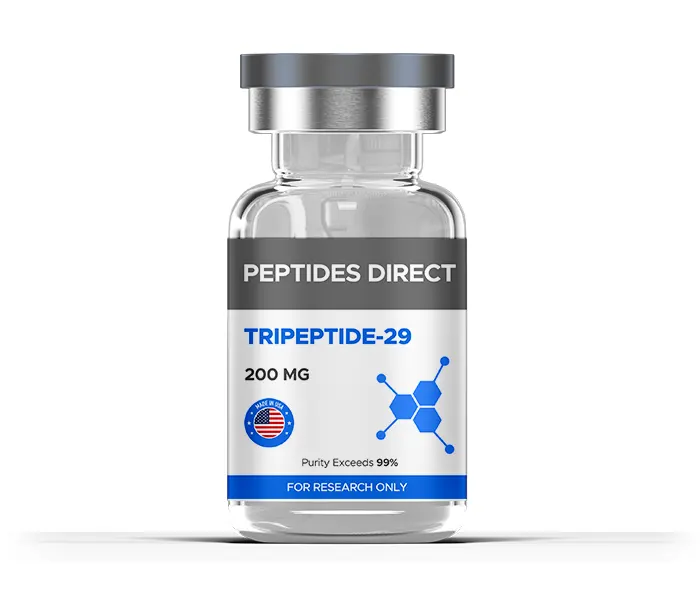
Tripeptide-29 (200mg)
$189.00
Tripeptide-29 peptides are Synthesized and Lyophilized in the USA.
Tripeptide-29
Tripeptide-29 is a peptide representing one of the fundamental monomers of collagen — a long-chain polymer composed of short three-amino acid monomers that combine to form secondary structures, which may in turn develop into tertiary and quaternary arrangements. These complex structures may carry a range of emergent properties, with most collagen molecules understood to contribute to the structural integrity and elasticity of cellular complexes in tissues such as the stratum corneum, tendons, and bones.
Collagen subunits most commonly follow the pattern of Gly-Pro-X, Gly-Xo-X, or Gly-X-Hyp, with Tripeptide-29 representing a Gly-Pro-Hyp peptide — a complete synthetic analog of common collagen building blocks. Beyond its proposed involvement in collagen synthesis, researchers speculate that Tripeptide-29 may carry additional biological implications. Preliminary studies suggest it may function as an antioxidant, potentially helping to protect cells against oxidative stress — the imbalance between free radicals and antioxidants that may contribute to cellular damage.
Tripeptide-29 is additionally hypothesized to potentially exhibit anti-inflammatory properties, possibly attenuating inflammatory responses, anti-fibrotic actions that may help limit excessive fibrous connective tissue formation, and anti-melanogenic characteristics that may influence melanin production and affect pigmentation processes in the dermal and epidermal layers.
Specifications
MOLECULAR FORMULA: C12H19N3O5
MOLECULAR WEIGHT: 285.3 g/mol
SEQUENCE: Gly-Pro-Hyp
Tripeptide-29 Research
Tripeptide-29 and Coagulation Models
In vitro studies on Tripeptide-29 propose that the unpolymerized form of the peptide may function as a partial agonist of the collagen receptor GPVI, which appears to be expressed on the platelet surface.[1] Platelets are cell-like structures recognized for their involvement in early blood clot formation, with GPVI receptors playing an important role in collagen-induced platelet aggregation in vascular tissue — representing a foundational step in blood clot formation and tissue repair. Collagen fibers are therefore generally considered to be thrombus-forming, and dysregulation of this process may contribute to aberrant thrombus development.
In this specific trial, Tripeptide-29 motifs containing collagen-like sequences appeared to induce tyrosine phosphorylation of tyrosine kinase Syk and phospholipase C gamma2 (PLCgamma2) in platelets, ultimately stimulating platelet aggregation. Researchers suggested that “the monomeric peptides are partial agonists of the collagen receptor GPVI,” with cross-linking of Tripeptide-29 appearing to promote GPVI activation. These observations may help researchers better understand how this peptide establishes an accurate coagulation environment in research models affected by bleeding and clotting disorders.
Tripeptide-29 and Collagen Stability
Benchtop studies examining the role of short peptides such as Tripeptide-29 have suggested they may exert regulatory influence on collagen stability. Research has helped scientists understand that the final structure of collagen appears to be primarily determined by the terminal amino acid of the tripeptide monomer, with the amino acid at position C demonstrating the greatest influence on collagen stability for ABC monomers.[2]
The presence of Hyp as the third amino acid in Tripeptide-29 may support collagen stability relative to other tripeptide monomers — potentially through the contribution of the -OH (hydroxy) group of Hyp to favorable interatomic interactions.[3] Researchers additionally propose that the presence of Tripeptide-29 monomers within the collagen sequence may significantly reduce the molecule’s susceptibility to UV-related damage and lower its degradation rate, further contributing to collagen stability under specific conditions.[4]
Tripeptide-29 and Skin Cell Aging
Free radical damage is a primary contributor to cellular and tissue aging, with the efficacy of certain endogenous defenses understood to diminish over time. Studies have suggested that collagen hydrolysates composed of monomers such as Tripeptide-29 may function as potent radical scavengers.[5] Further research indicates that such hydrolysate — primarily constituted of Tripeptide-29 — may potentially reduce the accumulation of advanced glycation end products (AGEs).[6] AGEs are considered detrimental compounds formed when sugar molecules bind to proteins or lipids through a process called glycation, which may alter the mechanical properties and stability of dermal cells and potentially accelerate cellular aging.
By potentially attenuating denatured collagen formation and reducing reactive oxygen species (ROS) levels, Tripeptide-29 may contribute to maintaining stratum corneum function. Researchers have accordingly proposed that Tripeptide-29 “might support cell aging phenotypes via the inhibition of glycation and oxidative stress, leading to a delay in cellular aging.” Laboratory experiments suggested Tripeptide-29 may reduce AGE and denatured collagen production while inhibiting matrix metalloproteinase (MMP) activity — enzymes that may degrade extracellular matrix components such as collagen. Additionally, Tripeptide-29 may support Type I collagen levels in dermal fibroblasts — the epidermal cells responsible for producing and maintaining the extracellular matrix — with its small molecular size potentially supporting dermal layer penetration and bioavailability.
Tripeptide-29 and Tissue Fibrosis
In vitro studies of pigskin, bovine skin, fish scales, and chicken feet observed that Tripeptide-29 may act as an inhibitor of dipeptidyl peptidase IV (DPP4) activity.[7] DPP4 is primarily found in immune cells and is considered an integral membrane component that indiscriminately degrades growth factors, chemokines, neuropeptides, and vasoactive peptides, while also playing a significant role in glucose metabolism through the breakdown of incretin hormones that stimulate insulin synthesis.
Experimental research has suggested that DPP4 may contribute to fibrosis induction across various cell cultures, with enzyme inhibition considered a potential means of attenuating organ-associated scarring.[8] Tripeptide-29 is of particular interest in this context, as its potential capacity to stimulate glucose uptake and reduce fibrosis through DPP4 inhibition opens promising avenues for laboratory investigation.
Tripeptide-29 and Dermal Cells
Scientific interest has grown in the role of Tripeptide-29 and related tripeptides in protecting the dermal layer from cellular aging and cell death. Experimental models suggest that tripeptide exposure may potentially reduce visible markers by supporting skin contours, reducing dermal cell deformity, and promoting hydration. Studies further indicate that tripeptides may reduce inconsistencies in the texture of the dermal barrier and may diminish the appearance of brown and red spots. In one particular study, 90% of research models were reported to exhibit increased hydration and flexibility attributable to improved elasticity compared to controls.[9,10]
Disclaimer: The products mentioned are not intended for human or animal consumption. Research chemicals are intended solely for laboratory experimentation and/or in-vitro testing. Bodily introduction of any sort is strictly prohibited by law. All purchases are limited to licensed researchers and/or qualified professionals. All information shared in this article is for educational purposes only.
References
- Asselin J, Knight CG, Farndale RW, Barnes MJ, Watson SP. Monomeric (glycine-proline-hydroxyproline)10 repeat sequence is a partial agonist of the platelet collagen receptor glycoprotein VI. Biochem J. 1999 Apr 15;339 ( Pt 2)(Pt 2):413-8. PMID: 10191274; PMCID: PMC1220172.
- K. Mizuno, D. H. Peyton, T. Hayashi, J. Engel, and H. P. Bächinger, “Effect of the -Gly-3(S)-hydroxyprolyl-4(R)-hydroxyprolyl- tripeptide unit on the stability of collagen model peptides,” FEBS J., vol. 275, no. 23, pp. 5830–5840, Dec. 2008
- Némethy, G., & Scheraga, H. A. (1986). Stabilization of collagen fibrils by hydroxyproline. Biochemistry, 25(11), 3184–3188. https://doi.org/10.1021/bi00359a016
- Jariashvili, K., Madhan, B., Brodsky, B., Kuchava, A., Namicheishvili, L., & Metreveli, N. (2012). UV damage of collagen: insights from model collagen peptides. Biopolymers, 97(3), 189–198. https://doi.org/10.1002/bip.21725
- Abedin MZ, Karim AA, Latiff AA, Gan CY, Ghazali FC, Barzideh Z, Ferdosh S, Akanda MJ, Zzaman W, Karim MR, Sarker MZ. Biochemical and radical-scavenging properties of sea cucumber (Stichopus vastus) collagen hydrolysates. Nat Prod Res. 2014;28(16):1302-5. doi: 10.1080/14786419.2014.900617. Epub 2014 Mar 27. PMID: 24670209.
- Lee, Y. I., Lee, S. G., Jung, I., Suk, J., Lee, M. H., Kim, D. U., & Lee, J. H. (2022). Effect of a Collagen Tripeptide on Antiaging and Inhibition of Glycation of the Skin: A Pilot Study. International journal of molecular sciences, 23(3), 1101. https://doi.org/10.3390/ijms23031101
- Hatanaka T, Kawakami K, Uraji M. Inhibitory effect of collagen-derived tripeptides on dipeptidylpeptidase-IV activity. J Enzyme Inhib Med Chem. 2014 Dec;29(6):823-8. doi: 10.3109/14756366.2013.858143. Epub 2014 Mar 20. PMID: 24650211.
- Min HS, Kim JE, Lee MH, Song HK, Kang YS, Lee MJ, Lee JE, Kim HW, Cha JJ, Chung YY, Hyun YY, Han JY, Cha DR. Dipeptidyl peptidase IV inhibitor protects against renal interstitial fibrosis in a mouse model of ureteral obstruction. Lab Invest. 2014 Jun;94(6):598-607. doi: 10.1038/labinvest.2014.50. Epub 2014 Mar 31. PMID: 24687121.
- Garre A, Martinez-Masana G, Piquero-Casals J, Granger C. Redefining face contour with a novel anti-aging cosmetic product: an open-label, prospective clinical study. Clin Cosmet Investig Dermatol. 2017 Nov 13;10:473-482. doi: 10.2147/CCID.S148597. PMID: 29180884; PMCID: PMC5691901.
- Reivitis A, Karimi K, Griffiths C, Banayan A. A single-center, pilot study evaluating a novel TriHex peptide- and botanical-containing eye treatment compared to baseline. J Cosmet Dermatol. 2018 Jun;17(3):467-470. doi: 10.1111/jocd.12542. Epub 2018 Apr 16. PMID: 29663676.
Reviews
There are no reviews yet.