

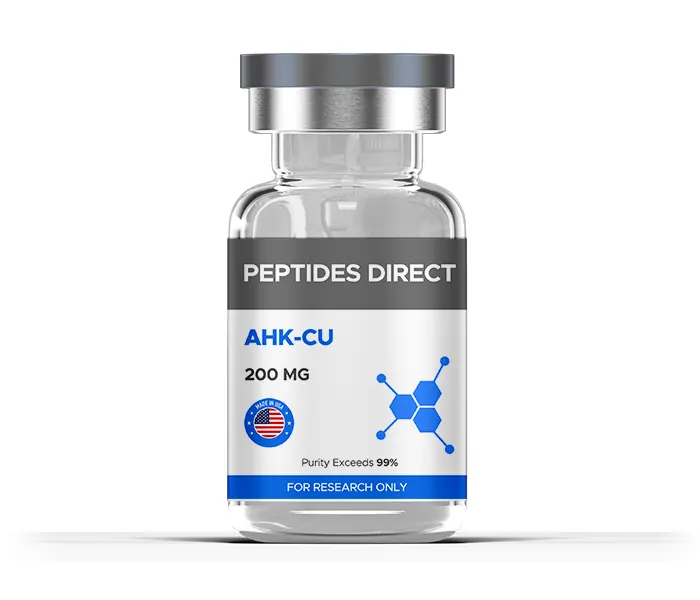
AHK-Cu (200mg)
$192.00
AHK-Cu peptides are Synthesized and Lyophilized in the USA.
AHK-Cu Peptide
AHK-Cu is a tripeptide containing a copper atom. It is a short peptide in which the copper atom is attached between the histidine and alanine residues of the alanine-histidine-lysine tripeptide. The copper atom is linked to three nitrogen atoms in this molecule. It is a naturally occurring compound that has been suggested to add support in cell growth and regulation, and cell death, particularly in the case of vascular endothelial cells (the innermost layer of blood vessels). AHK-Cu has also been studied extensively in animal models under laboratory conditions for its suggested impact on collagen synthesis. Researchers posit that the peptide appears to regulate various cellular processes primarily by controlling the production of two compounds: Vascular Endothelial Growth Factor (VEGF) and Transforming Growth Factor beta (TGF-B).[1] According to the researchers “TGF-beta1 induction of angiogenesis requires a rapid and transient apoptotic effect mediated by VEGF/VEGFR2.” AHK-Cu, by enhancing levels of the Vascular Endothelial Growth Factor, may possibly activate fibroblasts and endothelial cells. Fibroblasts are considered to lead to the production of two complex compounds; elastin and collagen. Endothelial cells are considered responsible for the growth and function of blood vessels that supply nutrition to hair follicles and skin cells. The activation of endothelial cells in association with the fibroblasts may lead to a strengthened skin barrier and increased skin elasticity, as well as potential acceleration in tissue repair. Some laboratory studies done on dermal cells indicate an increase in collagen type 1 production to the extent of as much as 300%.
Specifications
MOLECULAR FORMULA: C15H25CuN6O4
MOLECULAR WEIGHT: 416.9 g/mol
SEQUENCE: Ala-His-Lys-Cu
AHK-Cu is a tripeptide incorporating a copper atom attached between the histidine and alanine residues of the alanine-histidine-lysine tripeptide, with the copper atom linked to three nitrogen atoms within the molecule. It is a naturally occurring compound proposed to support cell growth and regulation, as well as cell death processes — particularly in vascular endothelial cells, which form the innermost layer of blood vessels. AHK-Cu has also been extensively studied in animal models under laboratory conditions for its proposed influence on collagen synthesis. Researchers suggest the peptide may regulate various cellular processes primarily through controlling the production of two compounds: Vascular Endothelial Growth Factor (VEGF) and Transforming Growth Factor beta (TGF-beta).[1] According to researchers, “TGF-beta1 induction of angiogenesis requires a rapid and transient apoptotic effect mediated by VEGF/VEGFR2.” By potentially elevating VEGF levels, AHK-Cu may activate fibroblasts — considered responsible for producing elastin and collagen — and endothelial cells, which support the growth and function of blood vessels supplying nutrition to hair follicles and skin cells. This combined activation may contribute to a strengthened skin barrier, increased skin elasticity, and potential acceleration of tissue repair. Select laboratory studies on dermal cells have indicated increases in collagen type I production of up to 300%.
AHK-Cu Research
AHK-Cu studies have primarily examined the peptide’s potential in hair follicle and skin cell research, with the peptide demonstrating primary activity within fibroblasts — cells recognized for maintaining and developing the extracellular matrix (ECM) surrounding cells. Fibroblasts secrete various biological substances including VEGF, a signaling protein involved in angiogenesis — the formation of new blood vessels from existing vasculature. This process appears to initiate when VEGF, secreted by oxygen-deprived cells during a hypoxic response, binds to VEGF receptors on endothelial cell surfaces. While several receptor types exist — including VEGFR-1, VEGFR-2, and VEGFR-3 — VEGFR-2 appears to be the primary mediator of angiogenic response. This proposed VEGF/VEGFR interaction may activate a complex intracellular signaling cascade involving proteins such as phospholipase C, protein kinase C, and mitogen-activated protein kinases, potentially leading to endothelial cell proliferation, survival, migration, and differentiation — considered the foundational processes for new blood vessel formation. VEGF may additionally increase blood vessel permeability, potentially enabling plasma protein extravasation and contributing to a primitive vascular scaffold that supports angiogenesis. AHK-Cu may therefore also carry potential action on blood vessel growth, further supporting fibroblast function.
AHK-Cu and Skin Cells
Copper and its peptide derivatives are frequently the subject of research into collagen synthesis and production in skin cells. Collagen levels naturally decline over time, with reduced new collagen production and diminishing structural integrity of existing collagen. Collagen also demonstrates an affinity for water, appearing to hydrate skin cells and the extracellular matrix upon penetrating the skin barrier[2] — properties that may reduce the appearance of surface creases and wrinkles.
Research studies have investigated AHK-Cu’s potential in skin conditioning and collagen production. Researchers examined the potential of AHK-Cu copper peptide complexes on collagen formation by assessing collagen type I output from fibroblasts in cell culture. Normal dermal fibroblasts were seeded into a 96-well plate and cultured to confluence in high glucose media supplemented with 10% fetal calf serum over approximately three days, before transfer to low glucose media with 2% serum and varying AHK-Cu concentrations. Culture media was subsequently analyzed for collagen type I content using a sandwich ELISA assay with a purified collagen type I antibody. Findings suggested that AHK-Cu may have stimulated dermal fibroblast proliferation and potentially enhanced their viability, with collagen type I formation hypothesized to increase by approximately 300% relative to controls.[2]
AHK-Cu and Hair Follicles
AHK-Cu may potentially influence follicle stimulation through two proposed mechanisms. The first involves stimulation and secretion of VEGF, supporting the growth of blood vessels in the vicinity of hair follicles — vessels that supply essential nutrients to follicles and may promote growth. Reduced nutrient supply, conversely, may contribute to follicle deterioration and loss. Studies suggest AHK-Cu may also support the formation of new hair follicles by promoting neovascularization and improving blood supply to existing follicles. The second proposed mechanism involves downregulation of Transforming Growth Factor beta, potentially reducing the influence of dihydrotestosterone (DHT) on hair loss.[3]
One study examined the potential role of the tripeptide in dermal papilla cells (DPCs) — specialized fibroblast variants proposed to play a pivotal role in hair follicle development and growth, though this has not been definitively confirmed. AHK-Cu introduction was associated with increased hair follicle elongation, potentially suggesting a positive effect, alongside apparent DPC proliferation — though this result was not fully conclusive. Annexin V-fluorescein isothiocyanate/propidium iodide labeling and flow cytometric analysis suggested AHK-Cu may have reduced apoptotic DPC numbers, though this decrease was not statistically significant. The Bcl-2/Bax ratio — proteins associated with cell death regulation — appeared elevated, suggesting a possible protective role. This was potentially supported by apparent reductions in cleaved caspase-3 and PARP levels following AHK-Cu introduction. Researchers concluded that “the present study proposed that AHK-Cu promotes the growth of hair follicles, and this stimulatory effect may occur due to stimulation of the proliferation and the preclusion of the apoptosis of DPCs.”
Dihydrotestosterone is considered a primary contributor to progressive hair loss, with researchers proposing that attenuating its impact may reduce overall loss and protect follicles from adverse stress. By supporting blood supply to existing follicles, AHK-Cu may potentially increase follicle thickness and size. Studies additionally suggest AHK-Cu may help extend the growth phase of the hair cycle — comprising the Anagen, Telogen, and Catagen phases — with research proposing that AHK-Cu may both extend and trigger the Anagen growth phase, with effects in certain studies reported across periods of up to 3 to 5 years.
Disclaimer: The products mentioned are not intended for human or animal consumption. Research chemicals are intended solely for laboratory experimentation and/or in-vitro testing. Bodily introduction of any sort is strictly prohibited by law. All purchases are limited to licensed researchers and/or qualified professionals. All information shared in this article is for educational purposes only.
References
- Ferrari G, Cook BD, Terushkin V, Pintucci G, Mignatti P. Transforming growth factor-beta 1 (TGF-beta1) induces angiogenesis through vascular endothelial growth factor (VEGF)-mediated apoptosis. J Cell Physiol. 2009 May;219(2):449-58. doi: 10.1002/jcp.21706. PMID: 19180561; PMCID: PMC2749291.
- Patt, Leonard M., and A. Procyte. “Neova® DNA Repair Factor Nourishing Lotion Stimulates Collagen and Speeds Natural Repair Process.” skin 1 (2009): 2.
- Pyo HK, Yoo HG, Won CH, Lee SH, Kang YJ, Eun HC, Cho KH, Kim KH. The effect of tripeptide-copper complex on human hair growth in vitro. Arch Pharm Res. 2007 Jul;30(7):834-9. doi: 10.1007/BF02978833. PMID: 17703734.
Reviews
There are no reviews yet.