

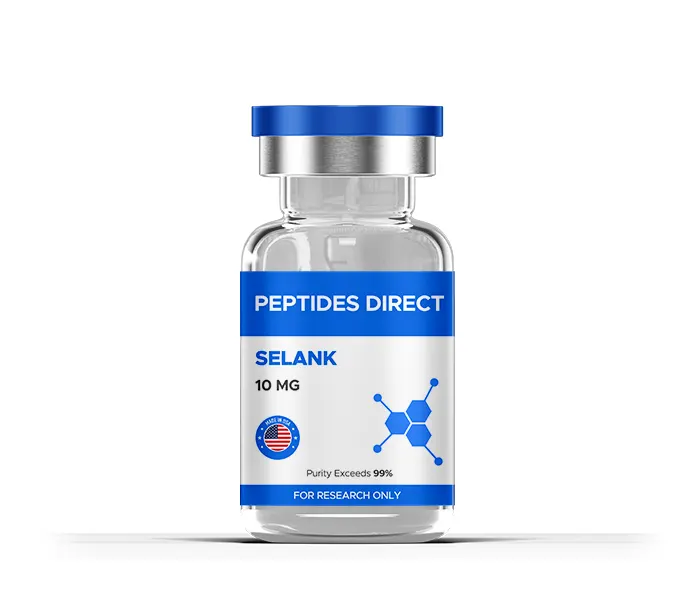
Selank (10mg)
$46.00
Selank peptides are Synthesized and Lyophilized in the USA.
Selank Peptide
Selank is a small peptide studied for its potential nootropic and behavior-modifying functions in experimental models. It is a synthetic analog of naturally occurring Tuftsin. This immunomodulatory peptide is a short fragment from the immunoglobulin G (IgG), a natural tetrapeptide involved in certain functions that may regulate the immune system. Selank is also posited to possess additional potential for regulating immune cells, IL-6, a wide range of neurotransmitter systems, and brain-derived neurotrophic factor (BDNF).
Selank differs in structure from the endogenous Tuftsin by an additional three amino acids in its chain, which have been supposed to enhance the metabolic stability and half-life of the synthetic peptide. Specifically, that is the Pro-Gly-Pro segment at the C-terminus of Selank, which might enhance its ability to move through various models, including the blood-brain barrier (BBB). The BBB is a highly selective and semi-permeable barrier that separates circulating blood from the tissues and extracellular fluid of the central nervous system, playing a vital role in regulating substance passage.
The inclusion of Pro-Gly-Pro may possibly increase BBB permeability by affecting the peptide’s hydrophilicity or lipophilicity, which may enhance its affinity for the BBB’s lipid-rich environment. Furthermore, the Pro-Gly-Pro sequence might interact with specific transport mechanisms or receptors at the BBB, possibly initiating facilitated transport or receptor-mediated endocytosis. These processes may enable Selank to circumvent the tight junctions that are said to typically restrict larger molecules.
Specifications
Molecular Formula: C33H57N11O9
Molecular Weight: 751.88 g/mol
Sequence: Thr-Lys-Pro-Arg-Pro-Gly-Pro
Selank Research
Selank and GABA Neurotransmission
As noted by Dr. Anastasiya Volkova of the Institute of Molecular Genetics in Russia, “numerous clinical studies have [suggested] that Selank [may exhibit] strong antianxiety and neuroprotective effects in the [context] of anxiety. Selank and classical antianxiety [compounds] such as benzodiazepine have a similar mode of action. Selank allosterically modulates GABAA receptors and increases the inhibitory action of GABA.”
Researchers including Dr. Volkova have proposed that peptide activity may result in reduced stress hormone levels. Studies examining small concentrations of Selank have observed a sedating effect broadly comparable to that of benzodiazepines. It has been suggested that the peptide may influence the expression of 7 genes and moderately affect an additional 45 targets, drawn from a set of approximately 84 genes associated with GABA signaling.[1] Researchers reported that their “results [posited] that Selank caused a number of alterations in the expression of genes involved in neurotransmission,” suggesting the peptide may stimulate neuronal gene expression and influence the affinity of GABA receptors for GABA. Synergism between Selank and benzodiazepines or other GABA receptor agonists appears to be mediated through alterations in receptor affinity.
Research in rats indicates that Selank and benzodiazepines administered independently appear to produce similar effects on stress hormones, particularly in models of generalized anxiety, though the synergistic potential of these compounds has not been fully investigated.[2] Selank’s influence on enkephalin degradation appears to modulate its effects on GABA receptors to a degree. Studies have suggested that enkephalins with reduced blood stability may be present in models of anxiety and phobic disorders, potentially attributable to elevated enkephalinase activity in the blood. Murine anxiety studies propose that the peptide may inhibit enkephalinase, stabilize enkephalins, reset the enzymatic pathway, and thereby help preserve endogenous anxiolytic peptides.[3]
Selank and the Immune System
Selank has been investigated for its potential to inhibit the gene governing production of the inflammatory cytokine IL-6 in research models of depression, though not in control models.[4] Researchers additionally noted that “the adaptogenic properties of Selank may be beneficial [in the cases of exposure] to environmental stressors for the prevention of infectious diseases.” Research suggests that relative to standard anxiolytic compounds such as benzodiazepines, Selank may improve asthenic symptoms including fatigue and pain,[5] potentially attributable to its apparent stabilization of enkephalins and proposed capacity to modify IL-6 expression. The peptide appears to influence the expression of approximately 34 genes within inflammatory pathways, potentially including those affecting chemokines, cytokines, and receptors. It has been specifically examined in relation to Bcl6 expression, considered to support immune development.
Such research not only explores the peptide’s complex potential but may also deepen understanding of immune system function more broadly. Selank and its truncated variants may mediate transient gene expression for C3, Casp1, Il2rf, and Xcr1 in the mouse spleen, suggesting a capacity to shift immune system balance and thereby modulate inflammatory activity.[6]
Selank and Metabolic Actions on Lipid Metabolism
Selank has been investigated in comparison to placebo for its potential influence on lipid metabolism in murine obesity models.[7] Analysis suggested that Selank-exposed groups exhibited reductions in cholesterol and fat levels ranging approximately between 25% and 58%, implying the peptide may potentially reduce specific lipid fractions including low-density lipoprotein (LDL), very-low-density lipoprotein (VLDL) cholesterol, and triglycerides. These observations suggest Selank may exert a direct or indirect influence on lipid metabolism mechanisms, potentially exhibiting hypocholesterolemic and hypolipidemic properties.
Research additionally reported notable improvements in hemostasis-related parameters including increased total fibrinolytic activity and reduced platelet aggregation — changes that may suggest potential benefits in conditions predisposing to clot formation. A modulatory effect on glucose homeostasis was also indicated, suggesting Selank may help maintain stable blood glucose levels. The study further reported an enhancement in fat metabolism rate in the Selank group, which progressively aligned with rates observed in control models. Weight measurements indicated an average gain of 40g in control research models during the study period, while the Selank group maintained weight throughout, with a gradual reduction observed with continued peptide exposure.
Selank and Nootropic Actions
Studies in research models have demonstrated a strong inverse association between anxiety and learning and memory performance. Selank appears to potentially attenuate anxiety’s impact on cognitive function, with research suggesting the peptide may improve memory traceability and recall in rats.[8] This improvement appeared independent of anxiety levels and appears to be mediated through hippocampal expression of 36 different genes, the majority of which encode membrane-associated proteins regulating ion movement across cell membranes. Ion-dependent processes underlying learning and memory therefore appear to be enhanced by the molecule. Researchers have proposed Selank’s potential to support memory formation and retrieval, and it may also help restore memory and cognitive capacity following injury in rats exposed to neurotoxins — an effect attributed to apparent inhibition of catecholamines in the brain.[9]
A further study examined the nootropic potential of Selank in murine models with both normal and impaired learning capacity. In normal models, Selank appeared to enhance the learning process, with improvements particularly notable by the third day of repeated exposure — evidenced by increased correct avoidance responses and fewer errors, with this effect persisting and suggesting improved memory retention. Selank’s influence appeared to begin during the consolidation phase of learning. In models with initially reduced learning ability, effects emerged more rapidly — from the first day of experimentation — with a progressive increase in correct responses and reduction in errors observed across the training period. These findings suggest Selank may play a role in optimizing learning and memory processes by potentially enhancing the formation and consolidation of conditioned reflexes.[10]
Selank and Serotonin Neurotransmission
Research suggests that Selank may interact with serotonin signaling pathways,[12] which are recognized as important regulators of mood and anxiety. Studies in murine models with inhibited serotonin synthesis suggest Selank may contribute to the modulation of serotonin levels when serotonergic function is impaired. It is hypothesized that the peptide may enhance serotonin metabolism in the brainstem, potentially producing a relatively rapid effect on the serotonin system and increasing serotonergic metabolic activity in brain regions associated with mood and anxiety regulation. The study further proposes that Selank’s capacity to support serotonin metabolism may provide a mechanistic basis for addressing disturbances associated with diminished serotonin function.
Selank and Neurotrophic Factors
Selank may influence the expression of brain-derived neurotrophic factor (BDNF) — a protein considered essential for neuronal survival and growth.[13] Some studies suggest Selank may potentially elevate BDNF mRNA levels in the hippocampus, a brain region associated with memory formation and emotional regulation. The peptide’s proposed capacity to enhance BDNF expression — particularly in scenarios where stress and glucocorticoids may suppress BDNF levels — highlights its potential relevance in research exploring neuroplasticity.
Selank and Nociception
Enkephalins are endogenous peptides understood to attenuate nociception through interaction with opioid receptors. Research suggests that Selank may potentially inhibit enkephalin-degrading enzymes responsible for enkephalin breakdown,[11] with enkephalins recognized as naturally occurring opioid receptor ligands involved in regulating pain, mood, and stress responses. By possibly inhibiting these enzymes, Selank may slow enkephalin degradation, potentially increasing their availability and enhancing their functional effects. Research data also indicated that Selank exposure may increase the half-life (tau(1/2)) of leu-enkephalin — a specific enkephalin subtype — particularly in anxiety models, implying that Selank may prolong leu-enkephalin presence in the system and thereby contribute to its anxiolytic properties. These findings nonetheless require further investigation, and the precise mechanisms and full extent of Selank’s influence remain to be characterized.
Disclaimer: The products mentioned are not intended for human or animal consumption. Research chemicals are intended solely for laboratory experimentation and/or in-vitro testing. Bodily introduction of any sort is strictly prohibited by law. All purchases are limited to licensed researchers and/or qualified professionals. All information shared in this article is for educational purposes only.
References
- Volkova A, Shadrina M, Kolomin T, Andreeva L, Limborska S, Myasoedov N, Slominsky P. Selank Administration Affects the Expression of Some Genes Involved in GABAergic Neurotransmission. Front Pharmacol. 2016 Feb 18;7:31. doi: 10.3389/fphar.2016.00031. PMID: 26924987; PMCID: PMC4757669.
- Kasian A, Kolomin T, Andreeva L, Bondarenko E, Myasoedov N, Slominsky P, Shadrina M. Peptide Selank Enhances the Effect of Diazepam in Reducing Anxiety in Unpredictable Chronic Mild Stress Conditions in Rats. Behav Neurol. 2017;2017:5091027. doi: 10.1155/2017/5091027. Epub 2017 Feb 9. PMID: 28280289; PMCID: PMC5322660.
- Sokolov OY, Meshavkin VK, Kost NV, Zozulya AA. Effects of Selank on behavioral reactions and activities of plasma enkephalin-degrading enzymes in mice with different phenotypes of emotional and stress reactions. Bull Exp Biol Med. 2002 Feb;133(2):133-5. doi: 10.1023/a:1015582302311. PMID: 12432865.
- Uchakina ON, Uchakin PN, Miasoedov NF, Andreeva LA, Shcherbenko VE, Mezentseva MV, Gabaeva MV, Sokolov OIu, Zozulia AA, Ershov FI. [Immunomodulatory effects of selank in patients with anxiety-asthenic disorders]. Zh Nevrol Psikhiatr Im S S Korsakova. 2008;108(5):71-5. Russian. PMID: 18577961.
- Zozulia AA, Neznamov GG, Siuniakov TS, Kost NV, Gabaeva MV, Sokolov OIu, Serebriakova EV, Siranchieva OA, Andriushenko AV, Telesheva ES, Siuniakov SA, Smulevich AB, Miasoedov NF, Seredenin SB. [Efficacy and possible mechanisms of action of a new peptide anxiolytic selank in the therapy of generalized anxiety disorders and neurasthenia]. Zh Nevrol Psikhiatr Im S S Korsakova. 2008;108(4):38-48. Russian. PMID: 18454096.
- Agapova TIu, Agniullin IaV, Silachev DN, Shadrina MI, Slominskiĭ PA, Shram SI, Limborskaia SA, Miasoedov NF. [Effect of semax on the temporary dynamics of brain-derived neurotrophic factor and nerve growth factor gene expression in the rat hippocampus and frontal cortex]. Mol Gen Mikrobiol Virusol. 2008;(3):28-32. Russian. PMID: 18756821.
- N.F. Mjasoedov et al, The Influence of Selank on the Parameters of the Hemostasis System, Lipid Profile, and Blood Sugar Level in the Course of Experimental Metabolic Syndrome. April 14, 2014.
- Semenova TP, Kozlovskiĭ II, Zakharova NM, Kozlovskaia MM. [Experimental optimization of learning and memory processes by selank]. Eksp Klin Farmakol. 2010 Aug;73(8):2-5. Russian. PMID: 20919548.
- Semenova TP, Kozlovskaya MM, Zakharova NM, Kozlovskii II, Zuikov AV. Effect of selank on cognitive processes after damage inflicted to the cerebral catecholamine system during early ontogeny. Bull Exp Biol Med. 2007 Nov;144(5):689-91. doi: 10.1007/s10517-007-0406-2. PMID: 18683497.
- Kozlovskii II, Danchev ND. The optimizing action of the synthetic peptide Selank on a conditioned active avoidance reflex in rats. Neurosci Behav Physiol. 2003 Sep;33(7):639-43.
- Kost, N. V., Sokolov, O. I.u, Gabaeva, M. V., Grivennikov, I. A., Andreeva, L. A., Miasoedov, N. F., & Zozulia, A. A. (2001). Ingibiruiushchee deĭstvie semaksa i selanka na énkefalindegradiruiushchie fermenty syvorotki krovi cheloveka [Semax and selank inhibit the enkephalin-degrading enzymes from human serum]]. Bioorganicheskaia khimiia, 27(3), 180–183. https://doi.org/10.1023/a:1011373002885
- Semenova TP, kozlovskiĭ II, Zakharova NM, Kozlovskaia MM. [Comparison of the effects of selank and tuftsin on the metabolism of serotonin in the brain of rats pretreated with PCPA]. Eksp Klin Farmakol. 2009 Jul-Aug;72(4):6-8. Russian. PMID: 19803361.
- Inozemtseva, L. S., Karpenko, E. A., Dolotov, O. V., Levitskaya, N. G., Kamensky, A. A., Andreeva, L. A., & Grivennikov, I. A. (2008). Intranasal administration of the peptide Selank regulates BDNF expression in the rat hippocampus in vivo. Doklady biological sciences : proceedings of the Academy of Sciences of the USSR, Biological sciences sections, 421, 241–243. https://doi.org/10.1134/s0012496608040066
Reviews
There are no reviews yet.