

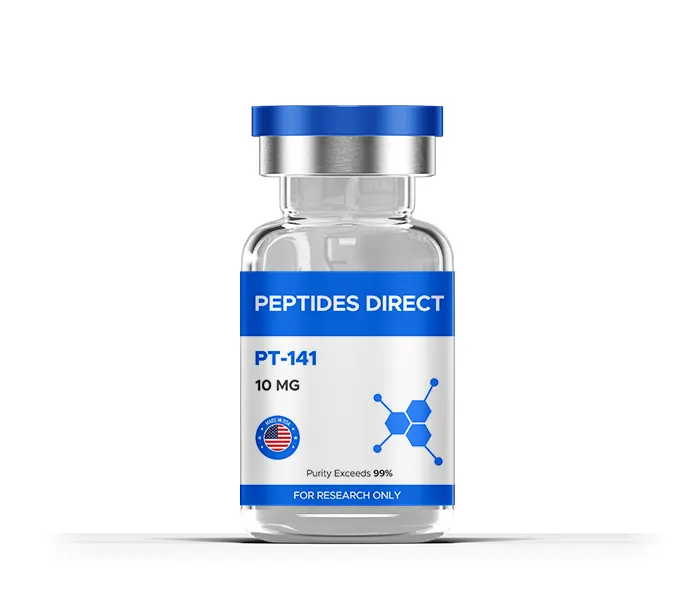
PT-141 (Bremelanotide) (10mg)
$45.00
PT-141 peptides are Synthesized and Lyophilized in the USA.
PT-141 (Bremelanotide) Peptide
PT-141, also known as Bremelanotide, was derived from a synthetic melanocortin analog known as Melanotan 2 (MT-2). A melanocortin analog, such as PT-141 and MT-2, is considered to be any synthetic compound designed to mimic or influence the functions of natural melanocortin peptides. These peptides, such as the alpha-melanocyte stimulating hormone (α-MSH), may be involved in a range of physiological processes including appetite regulation, energy homeostasis, immune responses, and skin cell pigmentation. PT-141 is a melanocortin analog that was developed to interact with Melanocortin-4 Receptor (MC-4R). It has been studied for a variety of potential characteristics and bioactivities through its interaction with this receptor. Apart from MC-4R, there are other melanocortin receptors like MC-1R, MC-2R, MC-3R, and MC-5R, each associated with different potential functions. For instance, MC-1R may be primarily involved in skin cell and hair follicle pigmentation, MC-2R appears to play a crucial role in the adrenal axis and stress response, MC-3R is implicated in the regulation of energy homeostasis, and MC-5R has been linked to exocrine function and thus impacts processes such as sweating and sebum production.
Specifications
Other Known Titles: Bremelanotide
Molecular Formula: C50H68N14O10
Molecular Weight: 1025.18 g/mol
Sequence: Ac-Nle-Asp(1)-His-D-Phe-Arg-Trp-Lys(1)-OH
PT-141 Peptide Research
PT-141 Peptide (Bremelanotide) and the Melanocortin-4 Receptors
PT-141 appears to uniquely stimulate the MC-4R, potentially triggering cascades within the central nervous system that influence the brain regions governing reproductive and copulatory behavior.[1] Researchers have noted that “the erectogenic potential of PT-141, its tolerability profile and its [potential] to cause significant erections in [cases that otherwise] do not have an adequate response to a PDE5 inhibitor suggest that PT-141 may provide an alternative [avenue for ED research].” Studies in mice examining agonist binding to MC-4R reported sexual arousal and increased copulatory activity in both male and female subjects.[2] The mechanism of PT-141 appears to differ from compounds that primarily manage genital blood flow.[3][4] Researchers suggest that MC-4R agonism, potentially in conjunction with existing research modalities, may promote both physiological and psychological alterations.
In a carefully designed randomized, double-blinded, placebo-controlled, crossover clinical trial, researchers explored the potential stimulation of the Melanocortin-4 receptor on neural pathways involved in sexual processing. Initial findings suggested that PT-141 as an agonist may potentially enhance sexual desire for a duration of up to 24 hours relative to placebo. During the functional neuroimaging component of the study, an apparent increase in activity was observed in the cerebellar and supplementary motor areas — regions considered important for motor control and planning. Conversely, a possible reduction in activation was noted within the secondary somatosensory cortex, an area involved in processing sensory information, specifically in response to visual stimuli — a pattern differing from placebo responses. It was additionally theorized that MC-4R agonists such as PT-141 may enhance functional connectivity between the amygdala — a region central to emotion regulation — and the insula, involved in perception and emotional processing, during stimulus exposure. This was in contrast to effects observed with placebo. These preliminary observations led researchers to propose that MC-4R agonists may potentially enhance the neural processing associated with sexual arousal and behavior.
PT-141 Peptide (Bremelanotide) and Cavernous Tissues
Despite suggestions that PT-141’s mechanism differs from compounds managing genital blood flow, some researchers propose that melanocortin agonists such as PT-141 may exhibit properties conducive to promoting erections by influencing vasodilator concentrations within specific tissues.[5] Research has examined the possible involvement of the nitric oxide (NO)-cyclic guanosine monophosphate (cyclic GMP) pathway in the action of melanocortin agonists on erectile function — a pathway considered pivotal in numerous processes including the regulation of vascular tone and blood flow within cavernosal tissues. One study investigated this by bilaterally transecting the pudendal nerves, considered vital for erectile function, and blocking nitric oxide synthase — the enzyme responsible for NO production — using the inhibitor L-NAME.[5] Findings suggested that disruption of pudendal nerve integrity or inhibition of nitric oxide synthesis may diminish melanocortin agonist-induced increases in cavernosal tissue pressure in anesthetized mouse models. These tissues are regarded as key structures in achieving erection due to their role in retaining blood within the cavernosa. The data therefore cautiously suggest that activation of central melanocortin receptors by agonists such as PT-141 may enhance cavernosal pressure, presumably through augmented neuronal NO release — though this mechanism remains speculative and requires further confirmation.
PT-141 Peptide (Bremelanotide) and Cell Survival
The MC-1R receptor may represent an important activator of DNA repair pathways and is considered relevant to cell survival.[6] Scientists reported that “MC1R signalling activates antioxidant, DNA repair and survival pathways.” PT-141 retains some degree of MC-1R activity despite its primary bias toward MC-3R and MC-4R receptor subtypes.
Disclaimer: The products mentioned are not intended for human or animal consumption. Research chemicals are intended solely for laboratory experimentation and/or in-vitro testing. Bodily introduction of any sort is strictly prohibited by law. All purchases are limited to licensed researchers and/or qualified professionals. All information shared in this article is for educational purposes only.
References
- Rosen RC, Diamond LE, Earle DC, Shadiack AM, Molinoff PB. Evaluation of the safety, pharmacokinetics and pharmacodynamic effects of subcutaneously administered PT-141, a melanocortin receptor agonist, in healthy male subjects and in patients with an inadequate response to Viagra. Int J Impot Res. 2004 Apr;16(2):135-42. doi: 10.1038/sj.ijir.3901200</>. PMID: 14999221.
- Rössler AS, Pfaus JG, Kia HK, Bernabé J, Alexandre L, Giuliano F. The melanocortin agonist, melanotan II, enhances proceptive sexual behaviors in the female rat. Pharmacol Biochem Behav. 2006 Nov;85(3):514-21. doi: 10.1016/j.pbb.2006.09.023. Epub 2006 Nov 20. PMID: 17113634.
- Clayton AH, Althof SE, Kingsberg S, DeRogatis LR, Kroll R, Goldstein I, Kaminetsky J, Spana C, Lucas J, Jordan R, Portman DJ. Bremelanotide for female sexual dysfunctions in premenopausal women: a randomized, placebo-controlled dose-finding trial. Womens Health (Lond). 2016 Jun;12(3):325-37. doi: 10.2217/whe-2016-0018. Epub 2016 May 16. PMID: 27181790; PMCID: PMC5384512.
- Miller MK, Smith JR, Norman JJ, Clayton AH. Expert opinion on existing and developing drugs to treat female sexual dysfunction. Expert Opin Emerg Drugs. 2018 Sep;23(3):223-230. doi: 10.1080/14728214.2018.1527901. Epub 2018 Oct 11. PMID: 30251897.
- Pfaus, J. G., Shadiack, A., Van Soest, T., Tse, M., & Molinoff, P. (2004). Selective facilitation of sexual solicitation in the female rat by a melanocortin receptor agonist. Proceedings of the National Academy of Sciences of the United States of America, 101(27), 10201–10204. https://doi.org/10.1073/pnas.0400491101
- Maresca V, Flori E, Picardo M. Skin phototype: a new perspective. Pigment Cell Melanoma Res. 2015 Jul;28(4):378-89. doi: 10.1111/pcmr.12365. Epub 2015 Apr 11. PMID: 25786343.
Reviews
There are no reviews yet.