

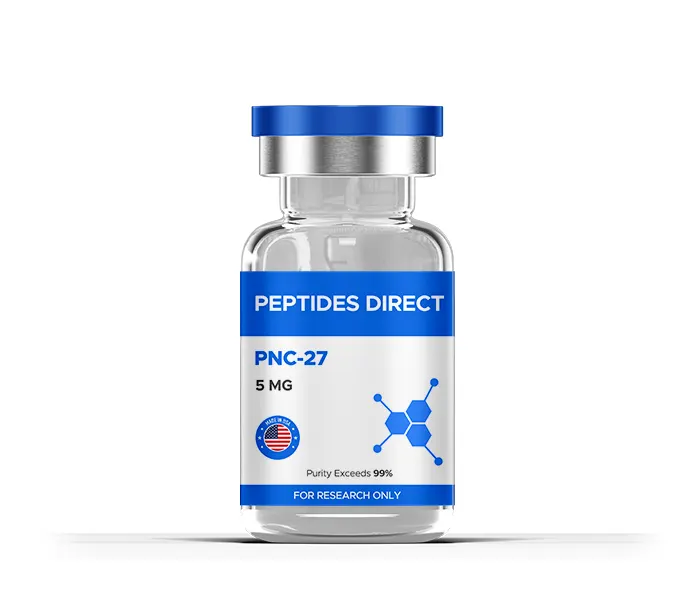
PNC-27 (5mg)
$142.00
PNC-27 peptides are Synthesized and Lyophilized in the USA.
PNC-27 Peptide
PNC-27 is a synthetic peptide originally developed for its proposed inhibitory action on cancer cell proliferation. It belongs to the PNC family of probe proteins and is designed to attach to malformed cancer cells and induce cell necrosis while bypassing normal functioning cells. The PNC-27 peptide contains the HDM2 binding domain and a transmembrane domain corresponding to residue 1226 on p53. Researchers suggest it may hold potential to bind to and destroy cancer cells through membrane lysis — the disruption of the cell membrane. Research studies have proposed that PNC-27 may exhibit selectivity in targeting specific cancer cell types, prompting further investigation in the context of pancreatic cancer, breast cancer, leukemia, melanoma, and other cancer variants.
The PNC protein was first developed in 2000. PNC-27 appears to be a non-toxic compound that attaches to and perforates the membranes of individual cancer cells. This may result in rapid cellular implosion, leading to immediate cell death attributable to differences in osmotic pressure across the tumor cell membrane. PNC-27 appears to achieve this through its affinity for binding to a protein called HDM2, which cancer cells characteristically display on their cell membranes. Researchers have noted that “PNC-27 targets HDM-2 in the membranes of cancer cells, allowing it to induce membranolysis of these cells selectively.” Studies have observed that following exposure, the peptide appears to rapidly localize to HDM2, with binding generating pores or perforations in the cell membrane and initiating membrane lysis — a process that may ultimately lead to cancer cell destruction. Research in this area is ongoing.
Specifications
Molecular Formula: C188H293N53O44S
Molecular Weight: 4031.7 g/mol
Sequence: H-Pro-Pro-Leu-Ser-Gln-Glu-Thr-Phe-Ser-Asp-Leu-Trp-Lys-Leu-Leu-Lys-Lys-Trp-Lys-Met-Arg-Arg-Asn-Gln-Phe-Trp-Val-Lys-Val-Gln-Arg-Gly-OH
Synonyms: membrane residency peptide (MRP)
PNC-27 Peptide Research
PNC-27 and HDM2 Binding
In a paper published by the American Association for Cancer Research, Dr. Ehsan Sarafraz Yazdi et al. examined in detail the mechanism through which the PNC-27 peptide appeared to exert its effects and what its novel mode of action might mean for cancer research.[3] The authors reported that PNC-27’s mechanism of action may involve the formation of oligomeric pores in the plasma membrane of tumor cells. Notably, such pores do not appear to form in untransformed or non-tumor cells exposed to PNC-27, underscoring the peptide’s potentially selective cytotoxicity toward cancer cells. Researchers further noted that HDM2 as a target molecule appears to contribute to PNC-27’s selectivity for cancer cells due to its mislocalization to the plasma membrane of malignant cells. The research proposes that the formation of a 1:1 complex between PNC-27 — a peptide with proposed anticancer properties — and HDM2, a regulator of the p53 tumor suppressor, may represent a critical step in potentially triggering transmembrane pore formation.
The study employed a combination of theoretical modeling and experimental methods to examine the interactions and structural foundations involved in this pore formation process. Conformational energy analysis suggested that PNC-27 may form relatively stable complexes with HDM2, potentially allowing the leader sequence to align in a manner that minimizes interference with the core binding interaction — though its role in the overall pore structure could not be definitively confirmed. Immuno-electron microscopy provided visual evidence of these complexes on the surface of cancer cells, where ring-like formations were observed at proposed pore locations.
A 2009 study reported that the three-dimensional structure of the p53 residue of PNC-27 may be directly superimposed on the equivalent residue bound to HDM2,[5] potentially enabling PNC-27 to target HDM2 within the membranes of cancer cells. Cancer cells appear to display significant HDM2 levels at their membranes, whereas non-transformed cells do not appear to carry comparable concentrations — a distinction that may allow the peptide to target malignant cells without substantially damaging surrounding healthy tissue.
In further experiments, transplantation of HDM2 carrying a membrane localization signal into non-transformed cells — which are ordinarily less susceptible to PNC-27 — appeared to increase their sensitivity to the peptide. This finding provides additional support for the hypothesis that PNC-27 may selectively engage HDM2 at the cancer cell membrane, inducing cell destruction through membrane lysis while leaving intact non-cancerous cells unaffected.
PNC-27 and Specific Cancer Cell Lines
PNC-27 may selectively target certain leukemia cell types and induce necrosis, particularly in those displaying elevated HDM2 levels at their membranes. One research publication focused on three acute myelogenous leukemia (AML) cell lines — U937, OCI-AML3, and HL60 — which are genetically and phenotypically distinct.[6] These cell lines were confirmed to express elevated levels of membrane-bound HDM2, hypothesized to be a critical determinant of PNC-27’s potential cytotoxic activity. The study suggested that PNC-27’s interaction with membrane-bound HDM2 may be essential for its cytotoxic effects, as inferred from confocal microscopy observations of PNC-27 and HDM2 colocalization.
In vitro experiments indicated that PNC-27 reduced the viability of the tested leukemia cell lines, suggesting its cytotoxic activity may be selective for malignant cells — normal rat mononuclear cells did not demonstrate comparable susceptibility. The observed mode of cell death was necrosis, as indicated by lactate dehydrogenase (LDH) release from exposed leukemia cells, while apoptotic markers such as annexin V and caspase-3 activity were not elevated. This suggests that PNC-27 likely induces necrosis through plasma membrane pore formation rather than through activation of apoptotic pathways. Some variability in PNC-27’s effects across different leukemia cell lines was nonetheless observed, potentially attributable to differences in HDM2 isoform expression or other cellular factors yet to be fully characterized — suggesting that while the peptide may demonstrate meaningful influence, its efficacy may not be uniform across all leukemia cell types.
A separate study examined PNC-27’s effects on freshly isolated primary ovarian cancer cells harvested from two ovarian cancer subtypes — mucinous cystadenocarcinoma and high-grade papillary serous carcinoma.[7] PNC-27 appeared to exert an inhibitory effect on the proliferation of these primary cancer cells alongside a direct cytotoxic action, with cytotoxicity inferred from LDH release — a biochemical marker of cell membrane disruption — suggesting that the peptide may compromise cellular integrity and induce cell death in these cancer cell populations.
Disclaimer: The products mentioned are not intended for human or animal consumption. Research chemicals are intended solely for laboratory experimentation and/or in-vitro testing. Bodily introduction of any sort is strictly prohibited by law. All purchases are limited to licensed researchers and/or qualified professionals. All information shared in this article is for educational purposes only.
References
- Davitt K, Babcock BD, Fenelus M, Poon CK, Sarkar A, Trivigno V, Zolkind PA, Matthew SM, Grin’kina N, Orynbayeva Z, Shaikh MF, Adler V, Michl J, Sarafraz-Yazdi E, Pincus MR, Bowne WB. The anti-cancer peptide, PNC-27, induces tumor cell necrosis of a poorly differentiated non-solid tissue human leukemia cell line that depends on expression of HDM-2 in the plasma membrane of these cells. Ann Clin Lab Sci. 2014 Summer;44(3):241-8. PMID: 25117093.
- Sarafraz-Yazdi E, Bowne WB, Adler V, Sookraj KA, Wu V, Shteyler V, Patel H, Oxbury W, Brandt-Rauf P, Zenilman ME, Michl J, Pincus MR. Anticancer peptide PNC-27 adopts an HDM-2-binding conformation and kills cancer cells by binding to HDM-2 in their membranes. Proc Natl Acad Sci U S A. 2010 Feb 2;107(5):1918-23. doi: 10.1073/pnas.0909364107. Epub 2010 Jan 11. PMID: 20080680; PMCID: PMC2836618.
- Sarafraz-Yazdi, Ehsan, et al. “MDM2 protein variants expression in the plasma membrane of cancer cells: A target for anticancer peptide PNC-27.” Cancer Research 70.8_Supplement (2010): 5770-5770.
- Aguon, Paul Muna, et al. “Experimental PNC-27 Therapy and Massive GI Hemorrhage: A Complication or Coincidence?: 1879.” Official journal of the American College of Gastroenterology| ACG 112 (2017): S1035-S1036.
- Sarafraz-Yazdi, E., Adler, V., Bowne, W., Sookraj, K., North, A., Niharny, P., … & Michl, J. (2009). Abstract# 884: Mechanism of action of PNC-27/-28 anti-cancer peptides. Cancer Research, 69(9_Supplement), 884-884
- Anusha Thadi et al, Targeting Membrane HDM-2 by PNC-27 Induces Necrosis in Leukemia Cells But Not in Normal Hematopoietic Cells, Anticancer Research 40 (9):4857-4867, September 2020
- Sarafraz-Yazdi E, Gorelick C, Wagreich AR, Salame G, Angert M, Gartman CH, Gupta V, Bowne WB, Lee YC, Abulafia O, Pincus MR, Michl J. Ex vivo Efficacy of Anti-Cancer Drug PNC-27 in the Treatment of Patient-Derived Epithelial Ovarian Cancer. Ann Clin Lab Sci. 2015 Fall;45(6):650-8. PMID: 26663795.
Reviews
There are no reviews yet.