

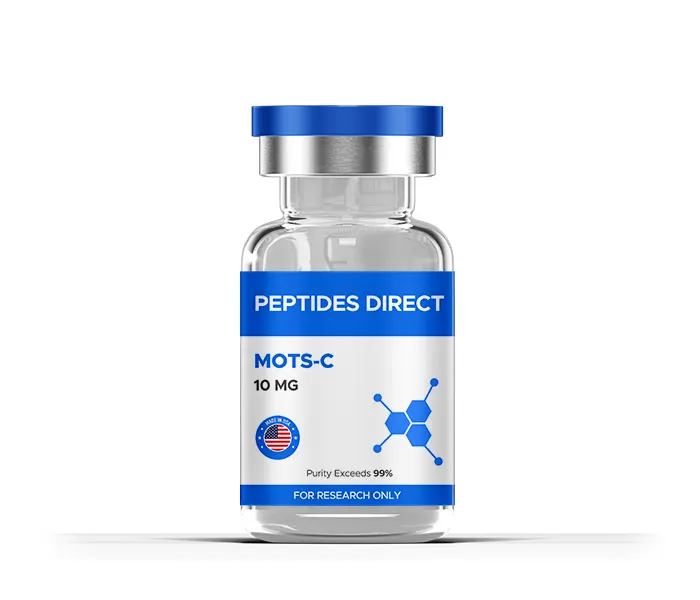


MOTS-c (10mg)
$99.00
MOTS-c peptides are Synthesized and Lyophilized in the USA.
MOTS-c Peptide
MOTS-c (mitochondrial open-reading-frame of the 12S rRNA-c) is a 16 amino acid peptide classified as a Mitochondrial-Derived Peptide (MDP), aka “mitochondrial hormone” or “mitokine.” Recent research indicates that MOTS-c is a bioactive peptide closely associated with mitochondrial communication and energy regulation. Initially, researchers hypothesized that it might be most active in the mitochondria, however recent studies suggest otherwise, that MOTS-c may operate via the bloodstream, exhibiting a potentially systemic action.
It is important to note that MOTS-c is a newly identified MDP. Its primary roles are under investigation, but studies include MOTS-c peptide’s influence in cell function and longevity, muscle contractile force, metabolic function and weight regulation.
Specifications
Sequence Formula: Met-Arg-Trp-Gln-Glu-Met-Gly-Tyr-Ile-Phe-Tyr-Pro-Arg-Lys-Leu-Arg
Molecular Formula: C101H152N28O22S2
Molecular Weight: 2174.64g/mol
Synonyms: 12S rRNA-c, MT-RNR1
MOTS-c Research
MOTS-c and Fat Metabolism
Estrogen research in mouse models suggests that reduced hormone availability may increase fat mass and impair normal adipose tissue function. Introduction of MOTS-c in these models appeared to increase the prevalence of brown adipose tissue and reduce overall fat accumulation. The peptide may partially counteract the adipose dysfunction and inflammation that accompanies insulin resistance.[1]
Researchers propose that a portion of MOTS-c’s potential influence on fat metabolism is mediated through activation of the AMP-activated protein kinase (AMPK) pathway — a pathway engaged when cellular energy levels are low, stimulating glucose and fatty acid uptake for metabolic use. MOTS-c may act directly on the methionine folate cycle, elevating AICAR levels and promoting AMPK activation. Studies in mouse models of obesity indicate that the peptide may serve as a potentially significant regulator of monoacylglycerol, dicarboxylate, and sphingolipid metabolism. By attenuating the activity of these pathways and enhancing beta-oxidation, the peptide may help curb fat accumulation — with the majority of these effects appearing to originate from the peptide’s activity in the nucleus.[2] Dysregulation of mitochondrial fat metabolism may impair fat oxidation, resulting in elevated circulating lipid levels as insulin concentrations rise in an attempt to clear lipids from the bloodstream, accompanied by increased fat deposition and disrupted homeostasis.[3] Researchers noted that “the implications of plasma MOTS-c for metabolic homeostasis deserve future examination.”
MOTS-c and Muscle Metabolism
Research suggests that MOTS-c may function by targeting skeletal muscle, where it may inhibit the folate cycle and the associated de novo purine biosynthesis pathway, leading to AMPK activation. Specifically, MOTS-c may activate AMPK independently of changes in AMP/ATP ratios — a pathway potentially critical for modulating glucose metabolism, fatty acid oxidation, and overall energy expenditure in muscle tissue.
This effect may be facilitated through enhanced skeletal muscle responsiveness to AMPK activation, which appears to sequentially increase glucose transporter expression. Notably, this activation does not appear to depend on the insulin pathway, potentially offering an alternative mechanism for improving muscle cell glucose uptake when insulin function is impaired. Research in mice suggests that MOTS-c may accordingly improve age-related insulin-resistant muscle function, enhancing glucose uptake in muscle cells.[4] Such outcomes may support muscle cell growth and function while reducing insulin resistance. Researchers concluded that “MOTS-c has implications in the regulation of obesity, diabetes, and longevity, representing an entirely novel mitochondrial signaling mechanism to regulate metabolism within and between cells.” The peptide’s influence on muscle tissue may further affect systemic energy balance, as reflected by its observed reduction of diet-induced obesity and improvement of glucose tolerance in murine models — suggesting MOTS-c may be an important modulator of metabolic responses to nutrient intake, potentially enabling mitochondria to play a more active role in energy homeostasis beyond their established bioenergetic functions.[5]
MOTS-c and Osteoporosis
MOTS-c appears to be involved in type I collagen synthesis by osteoblasts in bone tissue. Studies examining osteoblast cells suggest it may influence the TGF-beta/SMAD pathway, which governs osteoblast function and survival — supporting osteoblast viability and consequently improving type I collagen synthesis, strength, and structural integrity.[6]
Specifically, MOTS-c appeared to influence key genes involved in collagen synthesis including COL1A1 and COL1A2. Research suggests MOTS-c may attenuate osteoporosis through potential bone marrow enhancement and stem cell differentiation mediated by the TGF-beta/SMAD pathway. Activation of this pathway following MOTS-c exposure was evidenced by upregulation of TGF-beta1, TGF-beta2, and Smad7 genes, while knockdown of TGF-beta1 significantly inhibited the osteogenic effects of MOTS-c — suggesting the TGF-beta/Smad pathway may be essential to MOTS-c’s proposed osteogenic activity.
These findings collectively suggest enhanced osteogenesis, including improved osteoblast survival and stem cell development,[7] supported by observed increases in osteogenesis-related gene expression including ALP, Bglap, and Runx2 — recognized markers of osteogenic differentiation indicating that MOTS-c may stimulate the osteoblast differentiation process.
MOTS-c and Cardiovascular Function
Elevated risk of endothelial cell dysfunction was reported in research models of coronary angiography. Endothelial cells, which line the inner walls of blood vessels, are considered essential for regulating blood clotting, blood pressure, and plaque dynamics. Research indicates that the peptide does not appear to directly alter vascular responsiveness but may instead enhance endothelial cell sensitivity to the signaling actions of other molecules such as acetylcholine.[8] Peptide introduction in mice appeared to improve endothelial, microvascular, and epicardial blood vessel function. Research further indicates that mitochondria-derived peptides (MDPs) alongside MOTS-c may help protect cardiomyocytes from inflammation and cellular stress, with MDP downregulation hypothesized to increase cardiovascular disease risk. MOTS-c may play a meaningful role in reperfusion injury and endothelial function, with proposed mechanisms potentially involving AMPK activation — theoretically enhancing endothelial nitric oxide synthase (eNOS) activity, considered essential for endothelium-dependent vasodilation. MOTS-c may additionally modulate inflammatory pathways, potentially reducing endothelial inflammation — a hallmark of endothelial dysfunction.
MOTS-c and Cell Lifespan
A substitution of glutamate for lysine at position 14 of the MOTS-c protein appears to result from changes in the MOTS-c gene, though how this may influence the peptide’s functional properties has yet to be determined. Nonetheless, structural and functional alterations in the MOTS-c gene have been hypothesized to potentially confer remarkable cellular longevity. Research by Dr. Changhan David Lee at the USC Leonard Davis School of Gerontology underscores the significance of mitochondrial biology in prolonging cell lifespan and healthspan,[4,5,9] with dietary restriction proposed as one of the few established means of modifying mitochondrial function and longevity.
It has further been proposed that MOTS-c may influence the cellular aging process by interacting with pathways that regulate nicotinamide adenine dinucleotide (NAD+) levels — a coenzyme considered central to cellular metabolism and closely associated with cellular aging. By potentially elevating NAD+ levels and engaging the folate/methionine cycle, MOTS-c may contribute to delaying age-related metabolic decline and possibly extending cellular healthspan in experimental models.[10]
MOTS-c and Physical Capacity
Studies in murine models have reported that MOTS-c may potentially improve physical performance across different age groups.[11] Data indicates that the peptide may enhance endurance and motor coordination, as reflected by improved performance in treadmill running and rotarod tests — assessing physical endurance and balance respectively. Notably, these observed benefits do not appear to be directly linked to changes in body weight, suggesting that MOTS-c may influence physical capacity through mechanisms independent of weight reduction. These mechanisms are hypothesized to involve optimization of energy metabolism — the process by which cells convert nutrients into usable energy — and enhancement of metabolic flexibility, referring to the cell’s capacity to adapt fuel utilization in response to availability and demand.
MOTS-c may also play a role in regulating the expression of nuclear genes considered critical for metabolism and proteostasis — the maintenance of protein homeostasis. This regulation may involve modulation of skeletal muscle metabolism, considered essential for muscle contraction and energy production, along with improved cellular adaptation to metabolic stress experienced during fluctuations in energy availability. The peptide may further influence the expression of genes related to heat shock responses — proteins that help protect cells under stressful conditions — and broader metabolic processes in controlled laboratory settings.
Available data suggests this gene regulation may be at least partly mediated by the transcription factor HSF1 (Heat Shock Factor 1), understood to support cellular stress adaptation and proteostasis maintenance. The potential relationship between MOTS-c and HSF1 raises the possibility that MOTS-c may enhance cellular resilience to metabolic stress — potentially significant for preserving muscle function and overall physical performance as cells age. Further research is nonetheless needed to confirm these mechanisms and fully characterize how MOTS-c may contribute to these effects.
Disclaimer: The products mentioned are not intended for human or animal consumption. Research chemicals are intended solely for laboratory experimentation and/or in-vitro testing. Bodily introduction of any sort is strictly prohibited by law. All purchases are limited to licensed researchers and/or qualified professionals. All information shared in this article is for educational purposes only.
References
- Lu H, Wei M, Zhai Y, Li Q, Ye Z, Wang L, Luo W, Chen J, Lu Z. MOTS-c peptide regulates adipose homeostasis to prevent ovariectomy-induced metabolic dysfunction. J Mol Med (Berl). 2019 Apr;97(4):473-485. doi: 10.1007/s00109-018-01738-w. Epub 2019 Feb 6. PMID: 30725119.
- Kim KH, Son JM, Benayoun BA, Lee C. The Mitochondrial-Encoded Peptide MOTS-c Translocates to the Nucleus to Regulate Nuclear Gene Expression in Response to Metabolic Stress. Cell Metab. 2018 Sep 4;28(3):516-524.e7. doi: 10.1016/j.cmet.2018.06.008. Epub 2018 Jul 5. PMID: 29983246; PMCID: PMC6185997.
- Cataldo LR, Fernández-Verdejo R, Santos JL, Galgani JE. Plasma MOTS-c levels are associated with insulin sensitivity in lean but not in obese individuals. J Investig Med. 2018 Aug;66(6):10 19-1022. doi: 10.1136/jim-2017-000681. Epub 2018 Mar 27. PMID: 29593067.
- Lee C, Kim KH, Cohen P. MOTS-c: A novel mitochondrial-derived peptide regulating muscle and fat metabolism. Free Radic Biol Med. 2016 Nov;100:182-187. doi: 10.1016/j.freeradbiomed.2016.05.015. Epub 2016 May 20. PMID: 27216708; PMCID: PMC5116416.
- Lee C, Zeng J, Drew BG, Sallam T, Martin-Montalvo A, Wan J, Kim SJ, Mehta H, Hevener AL, de Cabo R, Cohen P. The mitochondrial-derived peptide MOTS-c promotes metabolic homeostasis and reduces obesity and insulin resistance. Cell Metab. 2015 Mar 3;21(3):443-54. doi: 10.1016/j.cmet.2015.02.009. PMID: 25738459; PMCID: PMC4350682.
- Che N, Qiu W, Wang JK, Sun XX, Xu LX, Liu R, Gu L. MOTS-c improves osteoporosis by promoting the synthesis of type I collagen in osteoblasts via TGF-β/SMAD signaling pathway. Eur Rev Med Pharmacol Sci. 2019 Apr;23(8):3183-3189. doi: 10.26355/eurrev_201904_17676. PMID: 31081069.
- Hu BT, Chen WZ. MOTS-c improves osteoporosis by promoting osteogenic differentiation of bone marrow mesenchymal stem cells via TGF-β/Smad pathway. Eur Rev Med Pharmacol Sci. 2018 Nov;22(21):7156-7163. doi: 10.26355/eurrev_201811_16247. PMID: 30468456.
- Qin Q, Delrio S, Wan J, Jay Widmer R, Cohen P, Lerman LO, Lerman A. Downregulation of circulating MOTS-c levels in patients with coronary endothelial dysfunction. Int J Cardiol. 2018 Mar 1;254:23-27. doi: 10.1016/j.ijcard.2017.12.001. Epub 2017 Dec 6. PMID: 29242099.
- Fuku N, Pareja-Galeano H, Zempo H, Alis R, Arai Y, Lucia A, Hirose N. The mitochondrial-derived peptide MOTS-c: a player in exceptional longevity? Aging Cell. 2015 Dec;14(6):921-3. doi: 10.1111/acel.12389. Epub 2015 Aug 20. PMID: 26289118; PMCID: PMC4693465.
- Mohtashami Z, Singh MK, Salimiaghdam N, Ozgul M, Kenney MC. MOTS-c, the Most Recent Mitochondrial Derived Peptide in Human Aging and Age-Related Diseases. Int J Mol Sci. 2022 Oct 9;23(19):11991. doi: 10.3390/ijms231911991. PMID: 36233287; PMCID: PMC9570330.
- Reynolds JC, Lai RW, Woodhead JST, Joly JH, Mitchell CJ, Cameron-Smith D, Lu R, Cohen P, Graham NA, Benayoun BA, Merry TL, Lee C. MOTS-c is an exercise-induced mitochondrial-encoded regulator of age-dependent physical decline and muscle homeostasis. Nat Commun. 2021 Jan 20;12(1):470. doi: 10.1038/s41467-020-20790-0. PMID: 33473109; PMCID: PMC7817689.


Reviews
There are no reviews yet.