

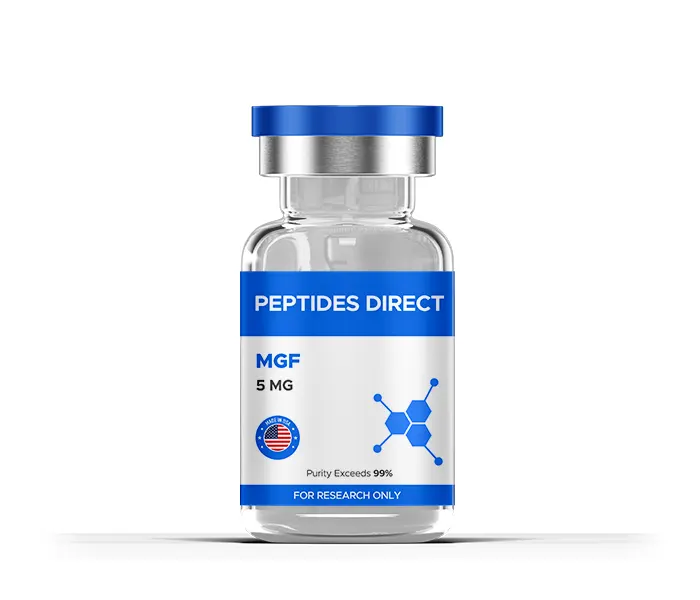


MGF (Mechano-Growth Factor) (5mg)
$59.00
MGF (Mechano-Growth Factor) peptides are Synthesized and Lyophilized in the USA.
MGF Peptide
Mechano-Growth Factor (MGF) is an alternative name for the Insulin-like Growth Factor-1Eb (IGF-1Eb), an isoform of IGF-1. It has been studied for its potential in remodeling muscles, cellular survival, and cellular proliferation.[1] New studies on this specific isoform highlight its potential for activating satellite cells in skeletal muscle, suggesting that this particular isoform may also activate satellite cells in skeletal muscle, protect neurons, and help overcome muscle mass loss.[2] The principal function of MGF is its possible efficacy in reparating severe muscle wear and tear. Further, its concentration appears to correspond with skeletal muscle growth and differentiation found in rodent models.
Specifications
Other Known Titles: Mechano-Growth Factor
Molecular Formula: C124H204N42O41S1
Molecular Weight: 2971.99 g/mol
Sequence: yr-Gln-Pro-Pro-Ser-Thr-Asn-Lys-Asn-Thr-Lys-Ser-Gln-Arg-Arg-Lys-Gly-Ser-Thr-Phe-Glu-Glu-Arg-Lys-Cys
Mechano-Growth Factor (MGF) Research
Mechano-Growth Factor (MGF) and Inflammation
Inflammatory cells such as macrophages and specific signaling molecules are understood to drive muscle cell regeneration upon release. Macrophages have been proposed to produce MGF in the context of muscle inflammation. IGF-1Ea (MGF) not only appears to exhibit anti-inflammatory characteristics but may also potentially extend macrophage lifespan. The precise relevance of this activity remains to be fully characterized, though it has been speculated that MGF may improve the rate of muscle cell recovery through macrophage modulation.[3]
Mechano-Growth Factor (MGF) and Cell Aging
IGF-1 exists in multiple variants, with the synthesis of these isoforms considered to be influenced by a range of factors including developmental conditions, hormones such as growth and steroid hormones, cellular death and regeneration, and cellular aging. Cell age is regarded as a significant regulatory factor in IGF-1 splicing, with class 1 and class 2 variants appearing predominant in control models, while older models with less effective cell cycle regulation tend to show a prevalence of class 1Ea. This shift in the predominant splice variant represents a meaningful starting point for understanding the biology of cellular aging. It has been suggested that MGF may help reduce the loss of function and proliferative capacity of muscle cells over time, though comprehensive study in this area remains necessary.
Mechano-Growth Factor (MGF) and Cardiac Cells
The peptide was reported by researchers to potentially protect cardiac muscle from ischemia in sheep models of myocardial infarction. Findings indicated a 35% reduction in cardiomyocyte compromise following MGF introduction after cardiac arrest,[4] with researchers concluding that “the E domain of MGF protects the myocardium against ischemia, thus improving cardiac function post-MI.” A separate study examined whether MGF might influence cardiac muscle cells under hypoxic conditions — a scenario analogous to ischemia, characterized by insufficient oxygen supply.[5] Mouse models subjected to hypoxia maintained at 1% oxygen experienced cellular apoptosis, and subsequent MGF exposure appeared to suggest the peptide may facilitate stem cell migration toward cardiac tissue, potentially impeding the apoptotic process. Specifically, MGF appears to encourage the movement of mesenchymal stem cells — cells capable of differentiating into various cell types including cardiac cells — with this migratory activity appearing to exhibit a chemotactic character, potentially useful for directing stem cells to regions compromised by injury or disease. This hypothesis is supported by preliminary data indicating elevated levels of the Bcl-2 gene, implicated in the promotion of cell survival.
Mechano-Growth Factor (MGF) and Muscle Cell Growth
MGF appears to promote muscle hypertrophy and repair through stimulation of muscle stem cells, known as satellite cells. Research in murine models observed a 25% increase in mean muscle fiber size following three weeks of MGF exposure.[6] Researchers noted that “the discovery of MGF and muscle IGF-1 provides a link between physical activity and gene expression, underlining the need for [aged models to maintain activity] as the locally produced growth factors supplement the circulating IGF-1 levels.” The peptide is speculated to improve muscle conditions in degenerative diseases and to amplify the positive adaptive effects of physical exertion on muscle — a hypothesis rooted in the recognized significance of muscle mass in supporting baseline metabolism. Duchenne Muscular Dystrophy (DMD), a severe degenerative muscular condition, is commonly addressed through transplantation of myogenic precursor cells to support dystrophin production and improve disease outcomes, though low transplant survival rates remain a persistent challenge. Mouse studies have suggested that MGF may support precursor cell survival, potentially improving transplantation outcomes.[7]
Mechano-Growth Factor (MGF) and Brain Development
Studies on developing mouse brains identified the presence of MGF as early as 2010, shedding light on the peptide’s potential neuroprotective properties.[8] Researchers suggest that MGF appears to be overexpressed in the hypoxic brains of rats within regions undergoing neuronal regeneration. The influence of the peptide on neuronal function was further suggested in a murine model of ALS (Lou Gehrig’s Disease) — a condition characterized by progressive motor neuron loss and generalized weakness — with MGF exposure appearing to improve both outcomes. Research in this area is ongoing.
Mechano-Growth Factor (MGF) and Cartilage
Cartilage — a critical connective tissue — is not typically associated with rapid regeneration, owing to limited blood supply and a relative scarcity of stem cells required for significant tissue repair. Research has suggested that MGF may be capable of supporting cartilage regeneration. Through its proposed role in promoting chondrocyte survival following mechanical stimuli — in the context of physical stress and cartilage tissue damage — MGF may enhance chondrocyte survival and migration rates to injury sites via YAP signaling and related pathways.[9] Overloading of chondrocytes may induce apoptosis, contributing to spinal disc degeneration under sustained mechanical stress. MGF may help inhibit this apoptotic process, potentially attenuating disc degeneration in the spine.
Mechano-Growth Factor (MGF) and Muscle Fibrosis
Researchers have examined the role of MGF in muscle fibrosis — a recovery process that may impair muscle function.[10] A study utilizing murine models with induced muscle contusions and macrophage depletion produced preliminary findings suggesting MGF may promote functional and structural recovery in damaged tissues by reducing fibrosis rates and lowering inflammatory cytokines, chemokines, and stress-related factors. MGF is speculated to inhibit fibrosis through suppression of type I and III collagen expression — key components of the fibrotic extracellular matrix. Observations also indicated a potential reduction in oxidative stress markers and matrix metalloproteinases (MMPs), suggesting a role for MGF in attenuating inflammatory responses to muscle injury. A possible decrease in contused muscle prevalence was also noted, potentially facilitating tissue repair. MGF’s influence on satellite cells and immune cell dynamics following injury — processes considered vital for muscle regeneration — appeared minimal, supported by stable MyoD and myogenin levels, recognized markers of satellite cell activity. Additionally, MGF may modulate the inflammatory environment in injured muscle, evidenced by reduced expression of pro-inflammatory cytokines including tumor necrosis factor-alpha (TNF-alpha), interferon-gamma (IFN-gamma), interleukin-1 beta (IL-1beta), and transforming growth factor-beta (TGF-beta), as well as chemokines CCL2, CCL5, and CXCR4, and a potential reduction in gp91phox expression — a key mediator of oxidative stress.
Mechano-Growth Factor (MGF) and Muscle Cell Aging
One study aimed to evaluate MGF’s potential influence on muscle cells across varying age-related cell populations.[11] Cultures ranging from the neonatal to the aged phase were exposed to MGF, with the peptide appearing to delay cellular senescence — particularly in younger cells — suggesting a potential capacity to sustain muscle functionality and regenerative ability over time. In younger muscle cells specifically, an apparent increase in cell proliferation rate was detected following MGF exposure, an effect not observed in older cells. In older cohorts, a notable enhancement in muscle hypertrophy was instead observed — referring to the enlargement of muscle cells typically seen as an adaptive response to stress and stimuli. The study simultaneously noted a reduction in the reserve cell population — generally inactive and undifferentiated cells considered important as a potential source for future differentiation. Furthermore, myotube formation — a critical step in muscle development involving the fusion of muscle precursor cells — appeared to be stimulated by MGF across all age groups, potentially contributing to improved muscle function through an increased presence of contractile proteins, considered essential components enabling muscle contraction and influencing overall muscle performance.
Mechano-Growth Factor (MGF) and Bone Cells
One experiment investigated the potential of MGF in bone cell regeneration using 27 experimental models, each with a surgically created 5-millimeter defect in their bone structure.[12] Models were exposed to either MGF or a control compound over five days, with subsequent histological analysis tentatively indicating that bone tissue exposed to MGF exhibited apparently improved recovery processes compared to both control and IGF-1-exposed groups — suggesting possible unique cellular interactions. Preliminary data hinted that MGF may influence the cell division process and potentially activate the Mitogen-Activated Protein Kinase-Extracellular Signal-Regulated Kinase 1/2 (MAPK-Erk1/2) signaling pathway. These observations propose that MGF’s mechanism may involve complex strategies to foster cellular growth and tissue repair, supporting the hypothesis that MGF may play a meaningful role in enhancing bone repair — though further investigation is required to confirm these findings.
Disclaimer: The products mentioned are not intended for human or animal consumption. Research chemicals are intended solely for laboratory experimentation and/or in-vitro testing. Bodily introduction of any sort is strictly prohibited by law. All purchases are limited to licensed researchers and/or qualified professionals. All information shared in this article is for educational purposes only.
References
- Yang SY & Goldspink G (2002). Different roles of the IGF-IEc peptide (MGF) and mature IGF-I in myoblast proliferation and differentiation. FEBS Lett 522, 156-160.
- Hill M & Goldspink G (2003). Expression and splicing of the insulinlike growth factor gene in rodent muscle is associated with muscle satellite (stem) cell activation following local tissue damage. J Physiol 549, 409-418.
- Sun KT, Cheung KK, Au SWN, Yeung SS, Yeung EW. Overexpression of Mechano-Growth Factor Modulates Inflammatory Cytokine Expression and Macrophage Resolution in Skeletal Muscle Injury. Front Physiol. 2018 Jul 26;9:999. doi: 10.3389/fphys.2018.00999. PMID: 30140235; PMCID: PMC6094977.
- Carpenter V, Matthews K, Devlin G, Stuart S, Jensen J, Conaglen J, Jeanplong F, Goldspink P, Yang SY, Goldspink G, Bass J, McMahon C. Mechano-growth factor reduces loss of cardiac function in acute myocardial infarction. Heart Lung Circ. 2008 Feb;17(1):33-9. doi: 10.1016/j.hlc.2007.04.013. Epub 2007 Jun 19. PMID: 17581790.
- Doroudian G, Pinney J, Ayala P, Los T, Desai TA, Russell B. Sustained delivery of MGF peptide from microrods attracts stem cells and reduces apoptosis of myocytes. Biomed Microdevices. 2014 Oct;16(5):705-15. https://pubmed.ncbi.nlm.nih.gov/24908137/
- Goldspink G, Yang SY. Effects of activity on growth factor expression. Int J Sport Nutr Exerc Metab. 2001 Dec;11 Suppl:S21-7. doi: 10.1123/ijsnem.11.s1.s21. PMID: 11915923.
- Goldspink G, Yang SY, Skarli M & Vrbova G (1996). Local growth regulation is associated with an isoform of IGF-I that is expressed in normal muscles but not in dystrophic muscles. J Physiol 495, 162.
- Zabłocka B, Goldspink PH, Goldspink G, Górecki DC. Mechano-Growth Factor: an important cog or a loose screw in the repair machinery? Front Endocrinol (Lausanne). 2012 Nov 1;3:131. doi: 10.3389/fendo.2012.00131. PMID: 23125840; PMCID: PMC3485521.
- Song Y, Xu K, Yu C, Dong L, Chen P, Lv Y, Chiang MYM, Li L, Liu W, Yang L. The use of mechano growth factor to prevent cartilage degeneration in knee osteoarthritis. J Tissue Eng Regen Med. 2018 Mar;12(3):738-749. doi: 10.1002/term.2493. Epub 2017 Oct 6. PMID: 28599103.
- Liu X, Zeng Z, Zhao L, Chen P, Xiao W. Impaired Skeletal Muscle Regeneration Induced by Macrophage Depletion Could Be Partly Ameliorated by MGF Injection. Front Physiol. 2019 May 17;10:601. https://pubmed.ncbi.nlm.nih.gov/31164836/
- Kandalla PK, Goldspink G, Butler-Browne G, Mouly V. Mechano Growth Factor E peptide (MGF-E), derived from an isoform of IGF-1, activates human muscle progenitor cells and induces an increase in their fusion potential at different ages. Mech Ageing Dev. 2011 Apr. https://pubmed.ncbi.nlm.nih.gov/21354439/





Reviews
There are no reviews yet.