

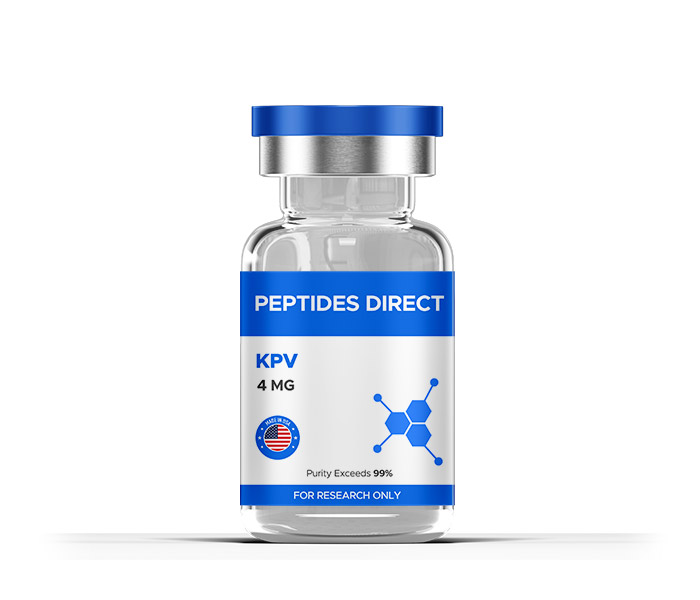
KPV (4mg)
$39.00
KPV peptides are Synthesized and Lyophilized in the USA.
KPV Peptide
KPV is the C-terminal peptide stretch of alpha-melanocyte-stimulating hormone (alpha-MSH). The peptide consists of the last three amino acids of the alpha-MSH hormone. It has been explored for its potential anti-inflammatory properties at the cellular level. Comprising the amino acids L-Lys-L-Pro-L-Val, KPV represents the minimal sequence that may mitigate inflammation in experimental models. However, the precise mechanisms of its action still need to be further studied in order to be more fully understood.
This peptide’s various mechanisms may potentially differentiate from that of alpha-MSH, which researchers believe interacts with the melanocortin-1 receptors by theoretically activating the cAMP pathway. Instead, studies suggest a rapid and acute increase in intracellular calcium when KPV is introduced alongside N6-(L-2-phenyl isopropyl) adenosine (PIA), an adenosine agonist that inhibits the cAMP pathway.
Further data-gathering investigations using cells transfected with melanocortin-1 receptors have indicated that KPV may, in theory, elevate intracellular calcium levels. This may imply an additional type of interaction with this receptor. This calcium signaling is thought to contribute to the inhibition of the activation of nuclear factor kappa-light-chain-enhancer of activated B cells (NF-κB), a transcription factor involved in inflammatory responses. By potentially inhibiting NF-κB activation, KPV might modulate inflammatory processes within cells.[1]
Specifications
Molecular Weight: 342.43 g/mol
Molecular Formula: C16H30N4O4
Sequence: Lys-Pro-Val
Other Known Titles: MSH(11-13), ACTH(11-13), alpha-MSH(11-13)
KPV Peptide Research
KPV Peptide and Intestinal Inflammation
The primary focus of KPV research to date has centered on the peptide’s potential for reducing intestinal inflammation. In murine models of inflammatory bowel disease (IBD), KPV appeared to reduce inflammatory infiltrates, myeloperoxidase (MPO) activity — a recognized marker of inflammation in gut tissue — and overall histological indicators of inflammation. The peptide appeared to support faster recovery and weight regain in murine models. Delivery of KPV using nanoparticles functionalized with hyaluronic acid appeared to help direct anti-inflammatory activity to targeted intestinal locations.[2]
Suppression of TNF-alpha is thought to potentially reduce inflammation and promote mucosal cell recovery. Researchers noted that “these results collectively [indicate] that our HA-KPV-NP/hydrogel system [may] release HA-KPV-NPs in the colonic lumen and that these NPs subsequently penetrate into colitis tissues and enable KPV to be internalized into target cells, thereby alleviating [models of] ulcerative colitis.” Studies have additionally suggested that the peptide may reduce NF-kappaB and mitogen-activated protein kinase (MAPK) activity.[3]
The combined inhibition of TNF-alpha, NF-kappaB, and MAPK may collectively exert meaningful potential to modulate inflammatory activity in intestinal cells. Murine models exposed to KPV appeared to exhibit reduced colonic infiltration and altered average colon lengths relative to controls. In cellular studies, KPV appeared to attenuate activation of these pathways in intestinal epithelial cells and activated T cells,[4] with this inhibition associated with a reduction in the secretion of pro-inflammatory cytokines such as interleukin-8 (IL-8). The mechanism through which KPV exerts this action appears to involve the peptide transporter PepT1 — a di/tripeptide transporter typically expressed in the small intestine and potentially upregulated in the colon during inflammatory conditions.
Researchers have proposed that KPV is transported into cells via PepT1, leading to intracellular accumulation and subsequent inhibition of inflammatory signaling pathways. This hypothesis is supported by observations that KPV’s anti-inflammatory effects were diminished in the presence of other substrates blocking the PepT1 pathway, suggesting that PepT1-mediated uptake is critical for its activity. KPV did not appear to act through melanocortin receptors, as it did not increase intracellular cyclic adenosine monophosphate (cAMP) levels — a response that would be expected with melanocortin receptor activation. Researchers concluded that “this study indicates that KPV is transported into cells by PepT1 and might be a new [research] agent for IBD.”[4]
KPV Peptide and Wound Healing
Research suggests that the majority of cells involved in wound healing express a Melanocortin 1 receptor capable of binding alpha-melanocyte-stimulating hormone and its analogs, including KPV. Researchers propose that KPV appears to reduce inflammatory activity during healing without inducing the pigmentation typically associated with endogenous scar formation. The actions of KPV in attenuating inflammation and supporting healing in research models may be mediated through nitric oxide (NO) signaling pathways.
One study involved mechanical abrasion designed to expose the entire corneal epithelium, followed by KPV introduction to experimental models.[5] Researchers measured corneal epithelial defect area before and at regular intervals following peptide exposure. The mean percentage of epithelial defect remaining at each time point appeared smaller in KPV-exposed samples relative to controls, suggesting a potential acceleration of the healing process. To investigate the role of NO, sodium nitroprusside (SNP) — an NO donor — was examined, and KPV’s potential was evaluated following pre-exposure with the nitric oxide synthase inhibitor L-NAME. Pre-exposure with L-NAME inhibited KPV’s facilitative effect on corneal epithelial wound healing, suggesting that NO may play a role in the peptide’s mechanism of action. In vitro, corneal epithelial cells exposed to KPV in medium containing 15% fetal bovine serum demonstrated enhanced cell viability at certain concentrations, suggesting a potential direct action on epithelial cells. KPV may therefore facilitate corneal epithelial wound healing through mechanisms involving NO disposition.
KPV Peptide and Scar Formation
KPV is proposed to potentially reduce chronic inflammation, which appears to contribute to hypertrophic scarring such as keloid formation.[6] Hypertrophic scarring is understood to be driven by widespread macrophage infiltration, TNF immunoreactivity, and neutrophil abundance. It has been hypothesized that the involvement of alpha-MSH in this context may result in comparatively reduced scarring and a less pronounced inflammatory response.
Relative to molecules with similar properties, alpha-MSH appears to exhibit greater impact than KPV in certain respects. However, researchers note that alpha-MSH may carry a notable potential disadvantage compared to KPV — specifically the risk of increased melanin production and surface pigmentation along the epidermal layer. The proposed anti-inflammatory actions of KPV appear to be mediated through a pathway distinct from that of alpha-MSH. While alpha-MSH binds to specific melanocortin receptors, KPV does not appear to engage these receptors, suggesting a mechanistically independent route of action.
Disclaimer: The products mentioned are not intended for human or animal consumption. Research chemicals are intended solely for laboratory experimentation and/or in-vitro testing. Bodily introduction of any sort is strictly prohibited by law. All purchases are limited to licensed researchers and/or qualified professionals. All information shared in this article is for educational purposes only.
References
- Elliott RJ, Szabo M, Wagner MJ, Kemp EH, MacNeil S, Haycock JW. alpha-Melanocyte-stimulating hormone, MSH 11-13 KPV and adrenocorticotropic hormone signalling in human keratinocyte cells. J Invest Dermatol. 2004 Apr;122(4):1010-9. doi: 10.1111/j.0022-202X.2004.22404.x. PMID: 15102092.
- Xiao B, Xu Z, Viennois E, Zhang Y, Zhang Z, Zhang M, Han MK, Kang Y, Merlin D. Orally Targeted Delivery of Tripeptide KPV via Hyaluronic Acid-Functionalized Nanoparticles Efficiently Alleviates Ulcerative Colitis. Mol Ther. 2017 Jul 5;25(7):1628-1640. doi: 10.1016/j.ymthe.2016.11.020. Epub 2017 Jan 28. PMID: 28143741; PMCID: PMC5498804.
- Zhu W, Ren L, Zhang L, Qiao Q, Farooq MZ, Xu Q. The Potential of Food Protein-Derived Bioactive Peptides against Chronic Intestinal Inflammation. Mediators Inflamm. 2020 Sep 9;2020:6817156. doi: 10.1155/2020/6817156. PMID: 32963495; PMCID: PMC7499337.
- Dalmasso G, Charrier-Hisamuddin L, Nguyen HT, Yan Y, Sitaraman S, Merlin D. PepT1-mediated tripeptide KPV uptake reduces intestinal inflammation. Gastroenterology. 2008 Jan;134(1):166-78. doi: 10.1053/j.gastro.2007.10.026. Epub 2007 Oct 17. PMID: 18061177; PMCID: PMC2431115.
- Bonfiglio V, Camillieri G, Avitabile T, Leggio GM, Drago F. Effects of the COOH-terminal tripeptide alpha-MSH(11-13) on corneal epithelial wound healing: role of nitric oxide. Exp Eye Res. 2006 Dec;83(6):1366-72. doi: 10.1016/j.exer.2006.07.014. Epub 2006 Sep 11. PMID: 16965771.
- Song J, Li X, Li J. Emerging evidence for the roles of peptide in hypertrophic scar. Life Sci. 2020 Jan 15;241:117174. doi: 10.1016/j.lfs.2019.117174. Epub 2019 Dec 13. PMID: 31843531.
Reviews
There are no reviews yet.