

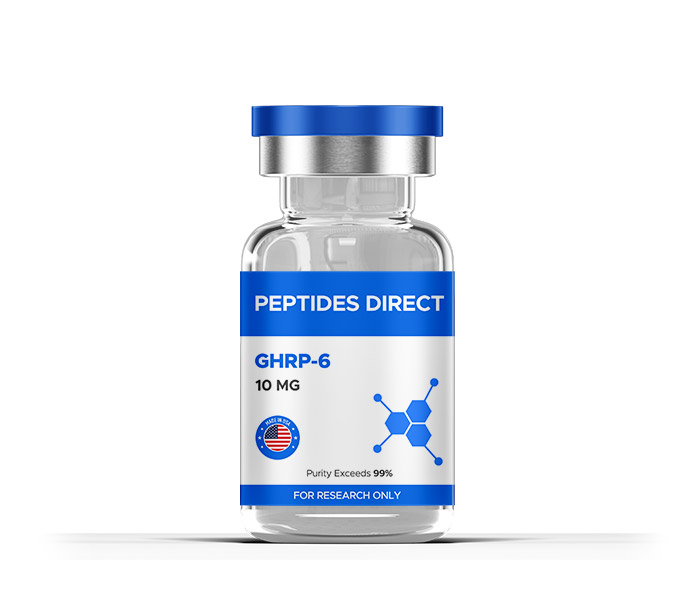
GHRP-6 (10mg)
$39.00
GHRP-6 peptides are Synthesized and Lyophilized in the USA.
GHRP-6 Peptide
GHRP-6 (Growth hormone-releasing peptide-6) has been studied for its potential as a stimulant to release endogenously produced growth hormone (hGH) from the anterior pituitary gland cells. It appears to achieve that by acting as a ghrelin receptor agonist. Ghrelin, also known as the hunger hormone, is naturally produced by the stomach when empty. This ghrelin receptor is also known as growth hormone secretagogue (GHS) receptor 1a (aka GHS-R1a) and is classified amongst the group of growth hormone secretagogues. It has been suggested to positively influence cardiac muscle cells, scar formation, and memory processing, though it has been involved in research in other areas.
Specifications
Molecular Formula: C46H56N12O6
Molecular Weight: 873.032 g/mol
Sequence: His-D-Trp-Ala-Trp-D-Phe-Lys
GHRP-6 Research
GHRP-6 and Growth Hormone Synthesis
Experimental findings suggest that GHRP-6 may actively engage with GHS receptors in the anterior pituitary gland cells, stimulating them to produce growth hormone (hGH). Researchers have compared the peptide’s potential to the natural trigger of hGH synthesis — growth hormone-releasing hormone (GHRH) — which appears to stimulate hGH synthesis via a distinct pathway by activating GHRH receptors on anterior pituitary cells. Scientists reported a mean hGH peak of 15.7 ng/ml, with a total mean amount of hGH released during the first 90 minutes of the experiment estimated at 674 ng/ml — values considerably higher than the hGH peak of 6.8 ng/ml and total hGH release of 412 ng/ml observed following GHRH.[1] A separate experiment comparing GHRP-6 to placebo further suggested the peptide was associated with hGH release of 15.4 ng/ml, compared to 5.5 ng/ml in the control group.[2]
GHRP-6 and Memory
Studies in rodent models have highlighted the potential of GHRP-6 to support the consolidation of newly formed memories and facilitate the transition of short-term memories into long-term storage. Further scientific observations have proposed a role for ghrelin and GHRP-6 in spatial learning tasks. Growth hormone secretagogues such as ghrelin may produce activity-induced cognitive improvements, suggesting that the role of growth hormone itself may be indirect and potentially secondary to the actions of these peptides.
GHRP-6 and Brain Tissue
GHRP-6 has been tentatively linked in scientific investigations to the protection and recovery of brain tissue. Studies using animal models have explored the potential of GHRP-6 in the context of stroke recovery, with timely peptide exposure appearing to protect brain tissue from reduced blood supply following a stroke and potentially supporting recovery from associated memory impairment.[3] At a molecular level, the peptide and its analogs may prevent apoptosis of central nervous system neurons, potentially inhibiting genetic reprogramming and inflammation. A further study examined the influence of GHRP-6 on brain tissue through its capacity to upregulate hGH synthesis and elevate local insulin-like growth factor-1 (IGF-1) levels.[4] IGF-1 — a protein structurally resembling insulin — is understood to play a critical role in growth and development. Preliminary results indicated that GHRP-6 may increase messenger RNA (mRNA) levels of IGF-1 in select brain regions including the hypothalamus, cerebellum, and hippocampus, though this increase was not observed in the cerebral cortex — implying that GHRP-6 may promote IGF-1 synthesis in a region-specific manner. The study also assessed expression of the IGF-1 receptor and insulin-like growth factor-binding protein 2 (IGFBP-2), responsible for regulating IGF-1 availability through binding. No significant changes in their activity were detected following peptide exposure. However, notable phosphorylation of protein kinase B (Akt) and the Bcl-2-associated death promoter (BAD) was observed in regions showing elevated IGF-1 levels, suggesting that hGH and GHRP-6 may activate cell survival pathways in response to growth factors. BAD is a member of the Bcl-2 family involved in regulating cell death, while Akt participates in diverse cellular functions including metabolism, apoptosis, growth, transcription, and cell migration. Elevated levels of Bcl-2, an antiapoptotic protein, were also observed in areas of increased IGF-1, while levels of the proapoptotic protein Bax remained unchanged — suggesting a potential shift toward cellular preservation over programmed cell death.
GHRP-6 Peptide and Parkinson’s Disease
A 2018 study highlighted the presence of ghrelin receptors in the substantia nigra — a brain region considered to be adversely affected in Parkinson’s disease.[5] Organisms genetically predisposed to the condition exhibited a significant apparent reduction in ghrelin receptors in this region. Genetically modified rats also appeared to develop Parkinson’s-like symptoms upon introduction of a receptor antagonist. Researchers concluded that “down-regulation of GHSRs in SNc-DA neurons induced the initial dysfunction of DA neurons, leading to extrapyramidal disorder under PD.” Scientists hypothesize that peptides interacting with receptors present in the substantia nigra may reduce neuronal apoptosis.
GHRP-6 Peptide and Cardiac Issues
GHRP-6 has been suggested to inhibit free radical-mediated cytotoxicity in cardiac cells in porcine models.[6] The peptide may be of interest in ongoing research into the recovery of viable cardiac tissue following cardiac arrest, though investigation in this area remains at a preliminary stage.
GHRP-6 and Sexual Behavior
Studies in male rats have proposed a role for ghrelin receptors in the central nervous system in modulating sexual behavior and motivation, with elevated ghrelin levels suggested to stimulate sexual impulses. Research into GHRP-6 and its modified counterpart — which may antagonize the ghrelin receptor — has indicated that ghrelin receptors in specific brain regions may influence sexual and reward-seeking behavior. Data also suggests that ghrelin may exert an influence on mood. The peptide and its analogs appear to support brain functions associated with mood elevation, reduced secretion of stress hormones, and attenuation of depressive behavior in murine models.[7]
GHRP-6 and CD36 Receptors
Researchers hypothesize that GHRP-6 may interact with receptor sites beyond those associated with ghrelin (GHS-R1a receptors), with speculation that these additional sites may include CD36 receptors — implicated in a range of biological functions.[8] CD36 receptors are understood to potentially facilitate lipid metabolism by functioning as scavenger receptors that assist in lipid uptake and transport. They may also contribute to modulating immune responses — particularly in processes such as phagocytosis and inflammation — and may be involved in the regulation of angiogenesis, the formation of new blood vessels.
In a preclinical murine study, GHRP-6 exposure suggested that activation of CD36 receptors may improve wound healing processes and reduce the development of hypertrophic scars.[9] This effect is thought to arise through a reduction in inflammation and decreased expression of fibrotic cytokines, collectively pointing to potential benefits in wound appearance and recovery.
A further study investigated the effects of ghrelin receptor stimulation in murine models subjected to combined radiation and burn injuries.[10] Preliminary findings indicated improvements in wound healing, potentially attributable to reduced levels of pro-inflammatory markers such as TNF-alpha and modifications in signaling pathways governing inflammation and tissue regeneration.
Additionally, data from an experiment in which rodents were exposed to GHRP-6 over a 60-day period suggested a potential reduction in liver fibrosis.[11] Observations included decreased expression of fibrogenic factors such as transforming growth factor-beta (TGF-beta) and connective tissue growth factor (CTGF), with the extent of fibrotic areas and nodularity reduced significantly by approximately 75% and over 60% respectively — suggesting that GHRP-6 may attenuate fibrosis and support recovery in experimental models.
GHRP-6 and Scarring
Researchers hypothesize that GHRP-6 may support the survival of various cell types by reducing programmed cell death. The peptide has been associated with the CD36 receptor and may help promote blood vessel growth, particularly in wound environments. Experiments in rat models further suggest it may hold potential for accelerating wound closure. GHRP-6 appears to support rapid wound healing and the formation of extracellular matrix proteins such as collagen, promoting appropriate tissue organization around the wound site and potentially reducing the appearance of scar tissue. Hypertrophic scars, such as keloids, are considered to arise from irregular deposition of matrix proteins, and researchers suggest GHRP-6 may help inhibit this aberrant wound-healing process.[12]
GHRP-6 and Muscle Tissue
Emerging research tentatively proposes that GHRP-6 may exhibit anabolic potential, likely through stimulation of growth hormone and IGF-1 secretion — both considered critical components of muscle development and repair. In laboratory experiments utilizing cultured myoblast cells — precursors to muscle cells — GHRP-6 appeared to contribute to increased levels of myogenic marker proteins, indicators of muscle cell differentiation and development.[13] The peptide was also associated with elevated production of IGF-1 and collagen type I — a primary structural protein essential to connective tissue and skeletal muscle integrity — alongside enhanced metabolic activity within the myoblasts. Based on these observations, it has been hypothesized that GHRP-6 may support improvement of muscle tissue by promoting synthesis of collagen type I and other proteins considered essential for muscle function and structure.
Disclaimer: The products mentioned are not intended for human or animal consumption. Research chemicals are intended solely for laboratory experimentation and/or in-vitro testing. Bodily introduction of any sort is strictly prohibited by law. All purchases are limited to licensed researchers and/or qualified professionals. All information shared in this article is for educational purposes only.
References
- Cordido F, Peñalva A, Dieguez C, Casanueva FF. Massive growth hormone (GH) discharge in obese subjects after the combined administration of GH-releasing hormone and GHRP-6: evidence for a marked somatotroph secretory capability in obesity. J Clin Endocrinol Metab. 1993 Apr;76(4):819-23. doi: 10.1210/jcem.76.4.8473389. PMID: 8473389.
- Frieboes RM, Murck H, Maier P, Schier T, Holsboer F, Steiger A. Growth hormone-releasing peptide-6 stimulates sleep, growth hormone, ACTH and cortisol release in normal man. Neuroendocrinology. 1995 May;61(5):584-9. doi: 10.1159/000126883. PMID: 7617137.
- Subirós N, Pérez-Saad HM, Berlanga JA, Aldana L, García-Illera G, Gibson CL, García-Del-Barco D. Assessment of dose-effect and therapeutic time window in preclinical studies of rhEGF and GHRP-6 coadministration for stroke therapy. Neurol Res. 2016 Mar;38(3):187-95. doi: 10.1179/1743132815Y.0000000089. Epub 2016 Apr 19. PMID: 26311576.
- Frago LM, Pañeda C, Dickson SL, Hewson AK, Argente J, Chowen JA. Growth hormone (GH) and GH-releasing peptide-6 increase brain insulin-like growth factor-I expression and activate intracellular signaling pathways involved in neuroprotection. Endocrinology. 2002 Oct;143(10):4113-22. doi: 10.1210/en.2002-220261. PMID: 12239123.
- Suda Y, Kuzumaki N, Sone T, Narita M, Tanaka K, Hamada Y, Iwasawa C, Shibasaki M, Maekawa A, Matsuo M, Akamatsu W, Hattori N, Okano H, Narita M. Down-regulation of ghrelin receptors on dopaminergic neurons in the substantia nigra contributes to Parkinson’s disease-like motor dysfunction. Mol Brain. 2018 Feb 20;11(1):6. doi: 10.1186/s13041-018-0349-8. PMID: 29458391; PMCID: PMC5819262.
- Berlanga J, Cibrian D, Guevara L, Dominguez H, Alba JS, Seralena A, Guillén G, López-Mola E, López-Saura P, Rodriguez A, Perez B, Garcia D, Vispo NS. Growth-hormone-releasing peptide 6 (GHRP6) prevents oxidant cytotoxicity and reduces myocardial necrosis in a model of acute myocardial infarction. Clin Sci (Lond). 2007 Feb;112(4):241-50. doi: 10.1042/CS20060103. PMID: 16989643.
- Huang HJ, Zhu XC, Han QQ, Wang YL, Yue N, Wang J, Yu R, Li B, Wu GC, Liu Q, Yu J. Ghrelin alleviates anxiety- and depression-like behaviors induced by chronic unpredictable mild stress in rodents. Behav Brain Res. 2017 May 30;326:33-43. doi: 10.1016/j.bbr.2017.02.040. Epub 2017 Feb 27. PMID: 28245976.
- Demers, A., McNicoll, N., Febbraio, M., Servant, M., Marleau, S., Silverstein, R., & Ong, H. (2004). Identification of the growth hormone-releasing peptide binding site in CD36: a photoaffinity cross-linking study. The Biochemical journal, 382(Pt 2), 417–424. https://doi.org/10.1042/BJ20040036
- Mendoza Marí, Y., Fernández Mayola, M., Aguilera Barreto, A., García Ojalvo, A., Bermúdez Alvarez, Y., Mir Benítez, A. J., & Berlanga Acosta, J. (2016). Growth Hormone-Releasing Peptide 6 Enhances the Healing Process and Improves the Esthetic Outcome of the Wounds. Plastic surgery international, 2016, 4361702. https://doi.org/10.1155/2016/4361702
- Liu, C., Huang, J., Li, H., Yang, Z., Zeng, Y., Liu, J., Hao, Y., & Li, R. (2016). Ghrelin accelerates wound healing through GHS-R1a-mediated MAPK-NF-κB/GR signaling pathways in combined radiation and burn injury in rats. Scientific reports, 6, 27499. https://doi.org/10.1038/srep27499
- Berlanga-Acosta, J., Vázquez-Blomquist, D., Cibrián, D., Mendoza, Y., Ochagavía, M. E., Miranda, J., … & Guillén-Nieto, G. E. (2012). Growth Hormone Releasing Peptide 6 (GHRP6) reduces liver fibrosis in CCl4 chronically intoxicated rats. Biotecnología Aplicada, 29(2), 60-72.
- Berlanga-Acosta J, Abreu-Cruz A, Herrera DGB, Mendoza-Marí Y, Rodríguez-Ulloa A, García-Ojalvo A, Falcón-Cama V, Hernández-Bernal F, Beichen Q, Guillén-Nieto G. Synthetic Growth Hormone-Releasing Peptides (GHRPs): A Historical Appraisal of the Evidences Supporting Their Cytoprotective Effects. Clin Med Insights Cardiol. 2017 Mar 2;11:1179546817694558. doi: 10.1177/1179546817694558. PMID: 28469491; PMCID: PMC5392015.
- Lim, C. J., Jeon, J. E., Jeong, S. K., Yoon, S. J., Kwon, S. D., Lim, J., Park, K., Kim, D. Y., Ahn, J. K., & Kim, B. W. (2015). Growth hormone-releasing peptide-biotin conjugate stimulates myocytes differentiation through insulin-like growth factor-1 and collagen type I. BMB reports, 48(9), 501–506. https://doi.org/10.5483/bmbrep.2015.48.9.258
Reviews
There are no reviews yet.