

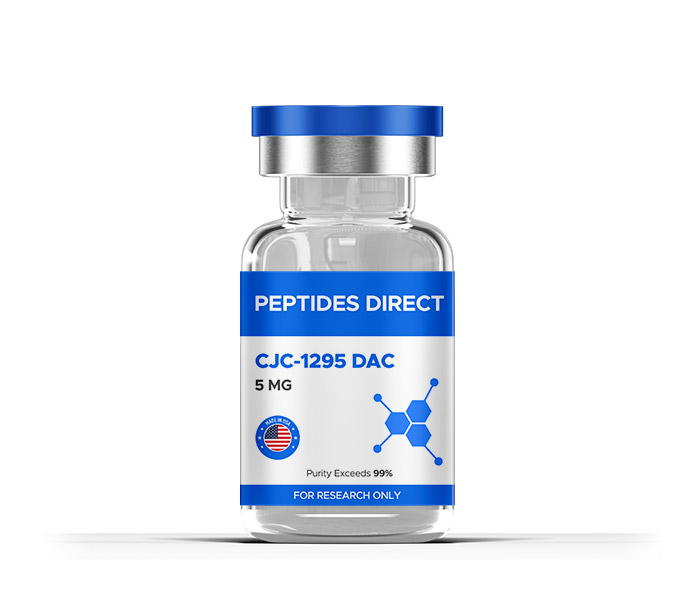
CJC-1295 DAC (5mg)
$52.00
CJC-1295 DAC peptides are Synthesized and Lyophilized in the USA.
CJC-1295 DAC Peptide
CJC-1295 DAC is a synthetic analog of growth hormone-releasing hormone (GHRH) that has the potential to enhance plasma levels of growth hormone (GH) and insulin-like growth factor 1 (IGF-1).[1] Drug affinity complex (DAC) is an additive component that is considered to prolong the half-life of CJC-1295. Researchers have created several synthetic modifications of growth hormone-releasing hormone (GHRH), which appear to retain certain selective traits of the hormone while eliminating others. CJC-1295 is one such synthetic analog, comprising the first 29 amino acids of GHRH. This is believed to lend secretagogue characteristics with greater solubility, which may be easier to synthesize in larger volumes.
CJC-1295 DAC shares similarities with other GHRH analogs like Sermorelin, as both are derivatives of the first 29 amino acids of GHRH. CJC-1295 is structurally identical to Modified GRF (1-29). In particular, CJC-1295 DAC and Mod GRF (1-29) exhibit four alterations within their 29 amino acid sequence, specifically at the 2nd, 8th, 15th, and 27th positions. These modifications are hypothesized to enhance the peptides’ resistance to enzymatic breakdown, particularly by dipeptidyl peptidase-4 (DPP-4). For instance, the replacement of L-alanine with D-alanine at the 2nd position may contribute to increased resistance to molecular degradation. Substituting asparagine with glutamine at the 8th position may conceivably reduce the likelihood of asparagine rearrangement and amide hydrolysis. The substitution of glycine with alanine at the 15th position is suggested to enhance bioactivity. Finally, the alteration from methionine to leucine at the 27th position is thought to aid in mitigating the risk of methionine oxidation. The primary differential between the two peptides, CJC-1295 DAC and Mod GRF (1-29), is the addition of DAC to the CJC-1295 molecule. DAC is attached to CJC-1295 through a lysine linker to extend the peptide’s pharmacokinetics. DAC appears to facilitate the association of peptides with blood proteins such as albumin. This appears to enhance their half-life, as compared to similar peptides such as GRF (1-29).[2] This occurrence may be attributed to the purported ability of DAC to interact with plasma proteins. Specifically, it seems that the DAC element involves the association of a lysine derivative, N-epsilon-3-maleimidopropionamide, with the C-terminus of CJC-1295 DAC. The incorporation of this altered amino acid sequence into the DAC configuration may plausibly improve the pharmacokinetics of CJC-1295 DAC, potentially prolonging its half-life to around eight days.
Specifications
Other Known Titles: CJC-1295 with DAC
Molecular Formula: C152H252N44O42
Molecular Weight: 3367.954 g/mol
Sequence: H-Tyr-D-Ala-Asp-Ala-Ile-Phe-Thr-Gln-Ser-Tyr-Arg-Lys-Val-Leu-Ala-Gln-Leu-Ser-Ala-Arg-Lys-Leu-Leu-Gln-Asp-Ile-Leu-Ser-Arg-Lys(Mal)-NH2
CJC-1295 DAC Research
CJC-1295 DAC and Pituitary Cell Receptors
Studies indicate that the peptide may enhance peak growth hormone levels by up to seven and a half times in the models examined.[3] CJC-1295 DAC may interact with specific binding sites on the growth hormone-releasing hormone (GHRH) receptor, with such interactions potentially altering the receptor’s configuration and initiating a cascade of molecular events. This binding is thought to activate particular intracellular signaling proteins commonly referred to as G-proteins.[4] Upon activation, these proteins may facilitate the production of secondary messengers such as cyclic adenosine monophosphate (cAMP) or inositol trisphosphate (IP3), both considered to play essential roles in cellular signaling pathways.[5] These secondary messengers are understood to activate protein kinases — enzymes that modify specific proteins — which may in turn alter cellular functions by phosphorylating transcription regulators, the proteins responsible for controlling gene expression. Upon phosphorylation, these transcription regulators are hypothesized to translocate into the nucleus of somatotroph cells, potentially influencing the genes governing growth hormone production. This sequence of molecular interactions underscores the proposed capacity of CJC-1295 DAC to modulate growth hormone levels through a detailed intracellular signaling network.
CJC-1295 DAC and Growth Hormone Release
CJC-1295 DAC was initially developed to stimulate growth hormone release and is a synthetic analog of the naturally occurring GHRH. Murine model experiments have reported that a single exposure to the peptide may induce growth hormone production approximately 2 to 10 times greater than that observed in control models.[6] GH expression appears to peak approximately 2 hours following peptide introduction, with effects appearing to persist for up to six days. Unlike other secretagogues, the peptide appears to preserve the natural physiological pattern of growth hormone expression — potentially functioning as a physiological GHRH analog that maintains the natural oscillatory high and low expression cycle of growth hormone levels while simultaneously enhancing its release into circulation. CJC-1295 DAC has been studied in relation to the physiological regulation of growth hormone across processes including protein synthesis, fat metabolism, blood sugar regulation, hypertrophy, bone density, hyperplasia, and myocardial function. Growth hormone production may interact with receptors on liver cells, potentially initiating intracellular signaling events through the Janus kinase-signal transducer and activator of transcription (JAK-STAT) pathway. Following activation, STAT proteins may translocate to the nucleus and bind to specific DNA sequences known as response elements, potentially facilitating transcription of the IGF-I gene. CJC-1295 DAC has been proposed to produce increases in average IGF-I levels ranging from 1.5 to 3-fold over approximately 9 to 11 days, with indications that these elevated levels may persist for at least two weeks under experimental conditions. Following repeated exposure, average IGF-I levels appear to remain elevated above initial baseline values for up to 28 days, with data suggesting a cumulative effect with successive administrations.[6]
CJC-1295 DAC and Infertility
Research from the early 1990s suggests that CJC-1295 DAC and other GRF analogs may exert a stimulatory influence in studies of female infertility. Murine models of superovulation indicated that growth hormone and IGF-1 levels rise in circulation around the time of ovulation.[7] Accordingly, exposure to CJC-1295 DAC and GRF analogs may promote ovulation in female animals, potentially through the IGF-1 and growth hormone expression cycle. Growth hormone secretagogues such as CJC-1295 DAC may alone be sufficient to promote ovulatory activity. Researchers have further suggested these analogs may improve sperm production, though findings in this area remain inconclusive.
CJC-1295 DAC and Growth
Research has proposed that CJC-1295 may restore the physiological release of growth hormone in murine models deficient in normal growth hormone physiology.[8] Jette et al. noted that “CJC-1295 showed a 4-fold increase in GH area under the curve over a 2-hour period.” The peptide may be of interest in the context of growth anomalies across various mammalian species. Preservation of the circadian cycle of growth hormone release appears critical for the downstream production of hormones such as insulin-like growth factor-1 (IGF-1). Further investigations have indicated that CJC-1295 DAC exposure in murine models may potentially stabilize growth patterns and influence body composition — possibly by promoting muscle hypertrophy without increasing, and perhaps even reducing, fat tissue levels. Models examined carried a genetic deletion of the GHRH gene (designated GHRHKO), with findings suggesting CJC-1295 DAC may enhance growth hormone production and yield favorable changes in body composition. In GHRHKO murine models, CJC-1295 DAC exposure appeared to maintain standard levels of lean mass, in contrast to unexposed models which displayed below-optimal lean mass. Subcutaneous fat mass in peptide-exposed models remained comparable to control group levels, while GHRHKO models without CJC-1295 DAC exposure showed indications of increased fat accumulation. This suggests the peptide may beneficially influence muscle and bone structure without contributing to fat gain. The study also observed a potential elevation in pituitary RNA and GH mRNA levels following CJC-1295 DAC exposure, suggesting a probable increase in the somatotroph cell population — cells understood to synthesize growth hormone within the pituitary gland. The researchers concluded that “CJC-1295 caused an increase in total pituitary RNA and GH mRNA, suggesting that proliferation of somatotroph cells had occurred, as confirmed by immunohistochemistry images.”[1]
Disclaimer: The products mentioned are not intended for human or animal consumption. Research chemicals are intended solely for laboratory experimentation and/or in-vitro testing. Bodily introduction of any sort is strictly prohibited by law. All purchases are limited to licensed researchers and/or qualified professionals. All information shared in this article is for educational purposes only.
References
- Alba M, Fintini D, Sagazio A, Lawrence B, Castaigne JP, Frohman LA, Salvatori R. Once-daily administration of CJC-1295, a long-acting growth hormone-releasing hormone (GHRH) analog, normalizes growth in the GHRH knockout mouse. Am J Physiol Endocrinol Metab. 2006 Dec;291(6):E1290-4. doi: 10.1152/ajpendo.00201.2006. Epub 2006 Jul 5. PMID: 16822960.
- Gautam D, Jeon J, Starost MF, Han SJ, Hamdan FF, Cui Y, Parlow AF, Gavrilova O, Szalayova I, Mezey E, Wess J. Neuronal M3 muscarinic acetylcholine receptors are essential for somatotroph proliferation and normal somatic growth. Proc Natl Acad Sci U S A. 2009 Apr 14;106(15):6398-403. doi: 10.1073/pnas.0900977106. Epub 2009 Mar 30. PMID: 19332789; PMCID: PMC2662962.
- Ionescu M, Frohman LA. Pulsatile secretion of growth hormone (GH) persists during continuous stimulation by CJC-1295, a long-acting GH-releasing hormone analog. J Clin Endocrinol Metab. 2006 Dec;91(12):4792-7. doi: 10.1210/jc.2006-1702. Epub 2006 Oct 3. PMID: 17018654.
- Martin, B., Lopez de Maturana, R., Brenneman, R., Walent, T., Mattson, M. P., & Maudsley, S. (2005). Class II G protein-coupled receptors and their ligands in neuronal function and protection. Neuromolecular medicine, 7(1-2), 3–36. https://doi.org/10.1385/nmm:7:1-2:003
- Newton, A. C., Bootman, M. D., & Scott, J. D. (2016). Second Messengers. Cold Spring Harbor perspectives in biology, 8(8), a005926. https://doi.org/10.1101/cshperspect.a005926
- Teichman SL, Neale A, Lawrence B, Gagnon C, Castaigne JP, Frohman LA. Prolonged stimulation of growth hormone (GH) and insulin-like growth factor I secretion by CJC-1295, a long-acting analog of GH-releasing hormone, in healthy adults. J Clin Endocrinol Metab. 2006 Mar;91(3):799-805. doi: 10.1210/jc.2005-1536. Epub 2005 Dec 13. PMID: 16352683.
- Guo S, Li Z, Yan L, Sun Y, Feng Y. GnRH agonist improves pregnancy outcome in mice with induced adenomyosis by restoring endometrial receptivity. Drug Des Devel Ther. 2018 Jun 7;12:1621-1631. doi: 10.2147/DDDT.S162541. PMID: 29922037; PMCID: PMC5995291.
- Jetté L, Léger R, Thibaudeau K, Benquet C, Robitaille M, Pellerin I, Paradis V, van Wyk P, Pham K, Bridon DP. Human growth hormone-releasing factor (hGRF)1-29-albumin bioconjugates activate the GRF receptor on the anterior pituitary in rats: identification of CJC-1295 as a long-lasting GRF analog. Endocrinology. 2005 Jul;146(7):3052-8. doi: 10.1210/en.2004-1286. Epub 2005 Apr 7. PMID: 15817669.
Reviews
There are no reviews yet.