

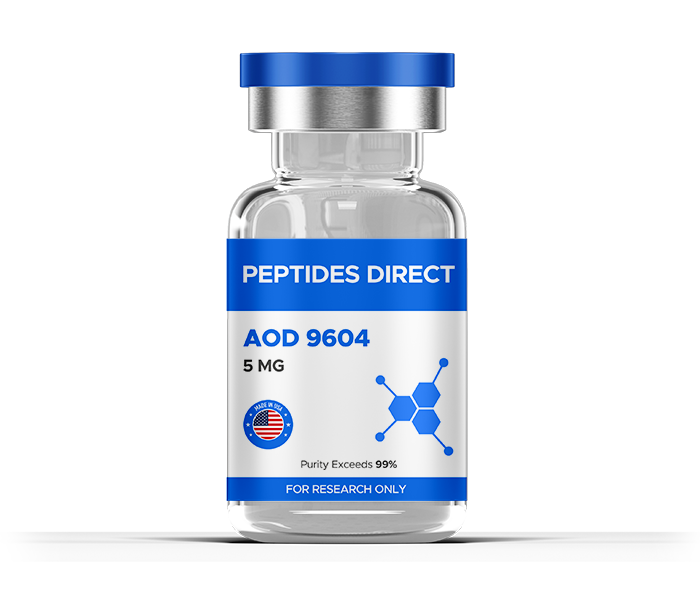
AOD-9604 (5mg)
$44.00
AOD 9604 peptides are Synthesized and Lyophilized in the USA.
AOD 9604 Peptide
AOD 9604 is a modified peptide that was originally developed as a derivative in obesity-related research. It is based on the Fragment 176–191 of the human growth hormone (hGH), with the addition of a tyrosine residue at the N-terminus. Researchers have suggested that the primary mechanism of AOD 9604 may be limited to promoting lipolysis, linking the synthetic compound to studies of fat metabolism.[1]
Current findings indicate that the peptide does not significantly influence insulin or IGF-1 levels. As such, it has not been shown to induce diabetes or cause glucose intolerance in experimental models, although further investigation is required to confirm these observations.[2]
Specifications
Other Known Titles: AOD-9604
Molecular Formula: C78H123N23O23S2
Molecular Weight: 1815.1 g/mol
Sequence: Tyr-Leu-Arg-Ile-Val-Gln-Cys-Arg-Ser-Val-Glu-Gly-Ser-Cys-Gly-Phe
AOD 9604 Research
AOD 9604 Structure
Scientists have proposed that different regions of the hGH molecule may exhibit distinct biological properties and effects in experimental models.[3] It has been suggested that the fat-related activity of the hormone may be associated primarily with the final 15 amino acids.
This fragment was initially identified as hGH 177–191 and was later modified through the addition of a tyrosine residue, forming AOD 9401, likely to enhance stability. This modification resulted in the development of a 16-amino acid peptide known as AOD 9604.[4]
Notably, researchers have indicated that AOD 9604 does not directly interact with the hGH receptor. This adjustment may also contribute to improved stability compared to similar peptide fragments.
AOD 9604 Mechanism of Action
AOD 9604 has primarily been examined in murine models, often involving relatively high dosages.[5] Some studies have reported notable reductions in body weight in these models. However, it is important to emphasize that this fragment does not appear to replicate the broader biological effects of hGH, such as increasing IGF-1 levels, promoting insulin resistance, or stimulating cell proliferation.
As a result, the compound is not believed to provide the muscle-preserving or anabolic effects typically associated with growth hormones. Instead, AOD 9604 may contribute to weight reduction through mechanisms similar to hGH, potentially activating cellular pathways that support the release of fatty acids from adipose tissue.
In addition, researchers have suggested that the peptide may influence lipase activity, a group of enzymes involved in fat metabolism and regulation of fat storage.[6] It is also worth noting that AOD 9604 does not appear to affect natural hGH production and does not function as a growth hormone secretagogue. Furthermore, it does not seem to significantly impact appetite-related hormone signaling.
Comparative studies in animal models have demonstrated differing effects depending on body composition.[4] In lean models, hGH was associated with increased lean body mass, whereas AOD 9604 and placebo did not show similar outcomes. This has led to the suggestion that AOD 9604 may not play a significant role in muscle hypertrophy.
In contrast, in obese models, both hGH and AOD 9604 were associated with weight reduction. Observations indicated approximately a 40% decrease in adipose tissue in the hGH group compared to around 28% in the AOD 9604 group.
Overall, findings suggest that AOD 9604 may have a lower potential than hGH in stimulating fat release from adipose cells.[7] Researchers have also noted that the lipolytic effects of both compounds may not be directly mediated through β3-adrenergic receptors, although both appear to increase β3-AR expression, which may enhance lipolytic responsiveness.
Unlike hGH, AOD 9604 does not appear to increase insulin resistance. Some preliminary and anecdotal observations suggest possible modest effects on cholesterol levels and insulin sensitivity, though these findings require further confirmation in controlled studies.
AOD 9604 and Obesity
AOD 9604 has been investigated in clinical studies aimed at addressing obesity. In a Phase 2b trial conducted in Australia with approximately 300 participants, the peptide was associated with consistent weight reduction over a 12-week period when administered daily.[8]
The rate of weight loss was compared with a placebo group and appeared to remain steady throughout the study. These findings suggest that the peptide may not lead to rapid tolerance, although further research is ongoing to better understand its long-term effects.
Additional studies using animal models have explored potential mechanisms of action. One hypothesis suggests that AOD 9604 may interact with β-3-adrenergic receptors located on white adipose tissue, potentially activating signaling pathways that promote fat mobilization and metabolic activity.
AOD 9604 and Cardiac Disease
AOD 9604 may have indirect implications for cardiac health through its potential role in reducing fat mass and addressing obesity-related risk factors. Some research groups have proposed additional pathways through which the peptide may support cardiovascular function, independent of β-3-adrenergic receptor activity.[9]
AOD 9604 and Joints
Research indicates that AOD 9604 may have potential effects on joint health. Animal studies have suggested improvements in pain response and mobility in models of arthritis.[10]
It has also been hypothesized that the peptide may support cartilage tissue development, although this area has not yet been fully explored. Microscopic analysis of joint structures in experimental models has shown encouraging preliminary outcomes in osteoarthritis-related research.
Disclaimer
The products referenced are not intended for human or animal consumption. Research chemicals are designated strictly for laboratory research and/or in vitro experimentation. Any form of bodily administration is strictly prohibited by law. Purchases are restricted to licensed researchers and qualified professionals. All information provided in this article is for educational and informational purposes only.
References
- Ng, F. M., Sun, J., Sharma, L., Libinaka, R., Jiang, W. J., & Gianello, R. (2000). Metabolic studies of a synthetic lipolytic domain (AOD 9604) of human growth hormone. Hormone research, 53(6), 274–278. https://doi.org/10.1159/000053183
- Cox, H. D., Smeal, S. J., Hughes, C. M., Cox, J. E., & Eichner, D. (2015). Detection and in vitro metabolism of AOD 9604. Drug testing and analysis, 7(1), 31–38. https://doi.org/10.1002/dta.1715
- Ng, F. M., Jiang, W. J., Gianello, R., Pitt, S., & Roupas, P. (2000). Molecular and cellular actions of a structural domain of human growth hormone (AOD9401) on lipid metabolism in Zucker fatty rats. Journal of molecular endocrinology, 25(3), 287-298.
- Heffernan, M. A., Thorburn, A. W., Fam, B., Summers, R., Conway-Campbell, B., Waters, M. J., & Ng, F. M. (2001). Increase of fat oxidation and weight loss in obese mice caused by chronic treatment with human growth hormone or a modified C-terminal fragment. International journal of obesity and related metabolic disorders : journal of the International Association for the Study of Obesity, 25(10), 1442–1449. https://doi.org/10.1038/sj.ijo.0801740
- Ng, F. M., Sun, J., Sharma, L., Libinaka, R., Jiang, W. J., & Gianello, R. (2000). Metabolic studies of a synthetic lipolytic domain (AOD9604) of human growth hormone. Hormone research, 53(6), 274–278. https://doi.org/10.1159/000053183
- Kopchick, J. J., Berryman, D. E., Puri, V., Lee, K. Y., & Jorgensen, J. O. (2020). The effects of growth hormone on adipose tissue: old observations, new mechanisms. Nature Reviews Endocrinology, 16(3), 135-146.
- Heffernan, M., Summers, R. J., Thorburn, A., Ogru, E., Gianello, R., Jiang, W. J., & Ng, F. M. (2001). The Effects of Human GH and Its Lipolytic Fragment (AOD9604) on Lipid Metabolism Following Chronic Treatment in Obese Mice andβ 3-AR Knock-Out Mice. Endocrinology, 142(12), 5182-5189.
- Bray, G. A., & Greenway, F. L. (2007). Pharmacological treatment of the overweight patient. Pharmacological reviews, 59(2), 151–184. https://doi.org/10.1124/pr.59.2.2
- Heffernan, M., Summers, R. J., Thorburn, A., Ogru, E., Gianello, R., Jiang, W. J., & Ng, F. M. (2001). The effects of human GH and its lipolytic fragment (AOD 9604) on lipid metabolism following chronic treatment in obese mice and beta(3)-AR knock-out mice. Endocrinology, 142(12), 5182–5189. https://doi.org/10.1210/endo.142.12.8522
- Kwon, D. R., & Park, G. Y. (2015). Effect of Intra-articular Injection of AOD 9604 with or without Hyaluronic Acid in Rabbit Osteoarthritis Model. Annals of clinical and laboratory science, 45(4), 426–432.
Reviews
There are no reviews yet.