

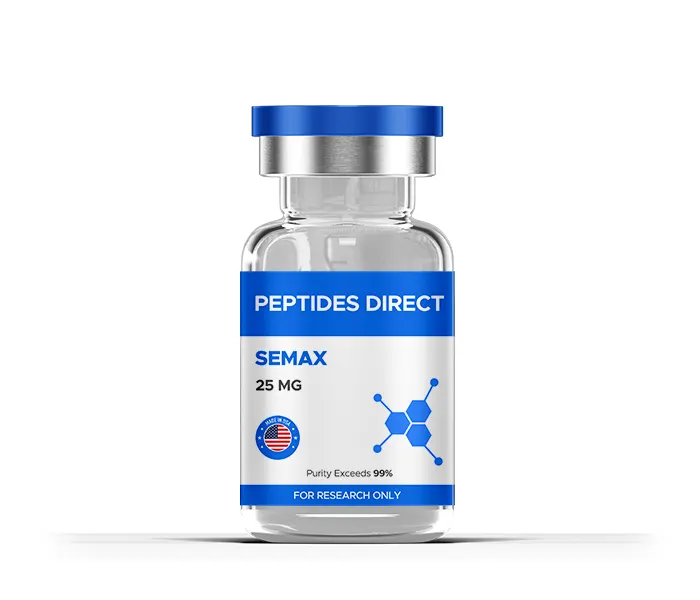

Semax (25mg)
$53.00
Semax peptides are Synthesized and Lyophilized in the USA.
Semax Peptide
Semax is a synthetic analog of adrenocorticotropic hormone (ACTH) comprising the amino acids 4 through 10 of ACTH. Semax has primarily been implicated in research on cognitive impairment and stroke. The peptide has also been studied closely within the context of dementia and certain inflammations of the optic nerve. Researchers posit that the peptide may exert neurotrophic action, suggesting that the peptide may act to increase the production of brain-derived neurotrophic factor (BDNF) in the central nervous system, with potential consequences in serotonin and dopamine release. Some researchers also suggest that Semax may interact with serotonin and enkephalin levels in the central nervous system.
Specifications
Molecular Formula: C39H54N10O10S
Molecular Weight: 854.99 g/mol
Sequence: Ac-Ser-Asp-Lys-Pro-Asp-Met-Ala-Glu-lle-GluLys-Phe-Asp-Lys-Ser-Lys-Leu-Lys-LysThr-Glu-Thr-Gin-Glu-Lys-Asn-Pro-Leu-Pro-Ser-Lys-GluThy-lleGlu-Gin-Glu-Lys-Gin-Ala-Gly-Glu-Ser
Semax Research
Semax and the Blood-Brain Barrier
Semax is a synthetic heptapeptide comprising the amino acid sequence Met-Glu-His-Phe — a partial sequence derived from the naturally occurring adrenocorticotropic hormone (ACTH) — further augmented by a Pro-Gly-Pro (PGP) tripeptide appended at the C-terminal end. This modification is hypothesized to potentially increase the molecule’s lipophilicity, which may in turn enhance its capacity for passive diffusion or uptake through the brain’s protective blood-brain barrier (BBB). Such facilitation may occur through lipid raft-mediated endocytosis mechanisms, potentially enabling the peptide to bypass the tight junctions that ordinarily restrict substance entry into the brain. The incorporation of the PGP sequence at the C-terminus is additionally proposed to influence the peptide’s interaction with specific transporters or receptors on the BBB, potentially promoting brain entry through receptor-mediated transcytosis. Furthermore, acetylation of Semax may confer increased molecular stability, potentially rendering the peptide more resistant to enzymatic degradation and extending its half-life within biological systems, thereby allowing a prolonged period of activity before breakdown occurs.
Semax and Stroke
Semax has been investigated in Russia in the context of acute cerebral hypoxia resulting from stroke or traumatic brain injury. Studies in murine models suggest that Semax may promote the expression of 24 genes in the brain and spinal cord through various molecular mechanisms, with these genes understood to modulate functions ranging from smooth muscle cell migration to red blood cell formation and angiogenesis. The peptide has been proposed to support neuronal survival and potentially stabilize mitochondria.[1] Scientists reported that “the immunomodulating effect of the peptide discovered in our research and its impact on the vascular system during ischemia is likely to be the key mechanisms underlying the neuroprotective effects of the peptide.”[2] Gusev et al. observed that “early rehabilitation and [introduction] of Semax increased BDNF plasma levels, speed functional recovery, and improve motor performance.” BDNF is a naturally occurring brain peptide proposed by some researchers to support cognitive development, with evidence suggesting BDNF stimulation may also promote neuroplasticity.
Semax and Brain Structure
Functional magnetic resonance imaging studies have suggested that Semax may activate what is known as the default mode network — a set of brain regions that remain more active during rest than during conscious task engagement.[3] This network is considered a general-purpose system for monitoring the organism’s environment without directing attention to specific elements, and is regarded as important for the organism’s attentional capacity — supporting the transition from a resting state to alertness.[4] Researchers propose that increased activity in the default mode network may correspond to enhanced neural connectivity, with potential positive implications for cognitive processes. Through ongoing Semax research, scientists speculate the peptide may support global brain function through a cascading effect on interconnected cognitive systems.
Semax and Gene Expression
Semax appears to mediate changes in gene expression within the brain. Study findings indicate that peptide introduction may trigger differential gene regulation in the frontal cortex and hippocampus of rats — regions recognized for their roles in information processing and organization, and in memory and learning, respectively. In both regions, gene expression appeared to spike within 20 minutes of Semax exposure, with particular influence observed on nerve growth factor (NGF) and BDNF.[5] Researchers concluded that “Semax results in rapid, long-term, and specific activation of Bdnf and Ngf expression changes in different rat brain departments.”
Semax and Cognitive Function
ACTH — the natural precursor protein of Semax — appears to preserve memory function and support learning in murine epilepsy models, as suggested by studies published in Canada, China, and the United States, and has been speculated to hold potential in epileptic disorder research. According to Dr. Scantlebury, Semax is a potentially potent ACTH derivative that may offer additional actions not present in the natural peptide.[6] Preliminary findings suggest that even low ACTH concentrations may help mitigate the risk of dysfunction following a seizure, with this research indicating that both ACTH and Semax may possess nootropic characteristics. Investigation in this area is ongoing.
Semax and Serotonin Signaling
Semax may potentially interact with and elevate serotonin levels, contributing to improved mood and reduced anxiety. The peptide’s proposed influence on neurotransmitter systems includes the possibility of restoring or stabilizing neural pathways, potentially balancing excitatory and inhibitory brain signaling and fostering conditions more conducive to anxiety reduction. This implies that the peptide’s influence on anxiety-related neural circuits may be sustained, suggesting a lasting impact on these pathways.[7]
The sustained effects of Semax further suggest it may play a role in protecting or correcting neural circuits over an extended period beyond initial exposure. In a series of murine experiments, Semax exposure was associated with altered levels of 5-hydroxyindoleacetic acid (5-HIAA) — a principal serotonin metabolite — indicating enhanced serotonergic activity considered important for mood and cognitive function. A progressive increase in 5-HIAA levels was observed following Semax exposure, rising to approximately 180% over four hours.[8] Additionally, Semax administration 20 minutes prior to D-amphetamine exposure produced higher 5-HIAA levels compared to Semax alone, suggesting the peptide may modulate serotonin metabolism and potentially influence serotonin-dependent pathways involved in mood regulation, cognitive processes, and overall brain function.
Semax and Enkephalin Signaling
Recent studies propose that specific enzymes involved in enkephalin breakdown may be inhibited by Semax, potentially producing distinct outcomes under laboratory conditions.[9] Enkephalins are brain-produced neurotransmitter substances proposed to play key roles in regulating various biological processes, with significant proposed influence on nociception — the neuronal process of pain perception — and stress responses. Elevated enkephalin levels may potentially influence the functioning of other neurotransmitter systems given the complex interrelationships within the opioid system — which encompasses enkephalins — and related systems involving dopamine and serotonin. These interactions may manifest as changes in neurotransmitter release, alterations in receptor activity, or modifications to signal transduction pathways.
Disclaimer: The products mentioned are not intended for human or animal consumption. Research chemicals are intended solely for laboratory experimentation and/or in-vitro testing. Bodily introduction of any sort is strictly prohibited by law. All purchases are limited to licensed researchers and/or qualified professionals. All information shared in this article is for educational purposes only.
References
- Medvedeva EV, Dmitrieva VG, Povarova OV, et al. The peptide semax affects the expression of genes related to the immune and vascular systems in rat brain focal ischemia: genome-wide transcriptional analysis. BMC Genomics. 2014;15:228. Published 2014 Mar 24. doi:10.1186/1471-2164-15-228.
- Gusev EI, Martynov MY, Kostenko EV, Petrova LV, Bobyreva SN. Éffektivnost’ semaksa pri lechenii bol’nykh na raznykh stadiiakh ishemicheskogo insul’ta [The efficacy of semax in the treatment of patients at different stages of ischemic stroke]. Zh Nevrol Psikhiatr Im S S Korsakova. 2018;118(3. Vyp. 2):61-68. doi:10.17116/jnevro20181183261-68.
- Lebedeva IS, Panikratova YR, Sokolov OY, et al. Effects of Semax on the Default Mode Network of the Brain. Bull Exp Biol Med. 2018;165(5):653-656. doi:10.1007/s10517-018-4234-3.
- Mars RB, Neubert FX, Noonan MP, Sallet J, Toni I, Rushworth MF. On the relationship between the “default mode network” and the “social brain”. Front Hum Neurosci. 2012;6:189. Published 2012 Jun 21. doi:10.3389/fnhum.2012.00189.
- Agapova TIu, Agniullin IaV, Silachev DN, et al. Mol Gen Mikrobiol Virusol. 2008;(3):28-32.
- Scantlebury MH, Chun KC, Ma SC, Rho JM, Kim DY. Adrenocorticotropic hormone protects learning and memory function in epileptic Kcna1-null mice. Neurosci Lett. 2017;645:14-18. doi:10.1016/j.neulet.2017.02.069
- Nataliya Yu. Glazova, Daria M. Manchenko, Maria A. Volodina, Svetlana A. Merchieva, Ludmila A. Andreeva, Vladimir S. Kudrin, Nikolai F. Myasoedov, Natalia G. Levitskaya, Semax, synthetic ACTH(4–10) analogue, attenuates behavioural and neurochemical alterations following early-life fluvoxamine exposure in white rats, Neuropeptides, Volume 86, 2021, 102114, ISSN 0143-4179. https://doi.org/10.1016/j.npep.2020.102114
- Eremin KO, Kudrin VS, Saransaari P, Oja SS, Grivennikov IA, Myasoedov NF, Rayevsky KS. Semax, an ACTH(4-10) analogue with nootropic properties, activates dopaminergic and serotoninergic brain systems in rodents. Neurochem Res. 2005 Dec;30(12):1493-500. doi: 10.1007/s11064-005-8826-8. PMID: 16362768.
- Kost NV, Sokolov OIu, Gabaeva MV, Grivennikov IA, Andreeva LA, Miasoedov NF, Zozulia AA. Ingibiruiushchee deĭstvie semaksa i selanka na énkefalindegradiruiushchie fermenty syvorotki krovi cheloveka [Semax and selank inhibit the enkephalin-degrading enzymes from human serum]]. Bioorg Khim. 2001 May-Jun;27(3):180-3. Russian. doi: 10.1023/a:1011373002885. PMID: 11443939. https://pubmed.ncbi.nlm.nih.gov/11443939/
Reviews
There are no reviews yet.