

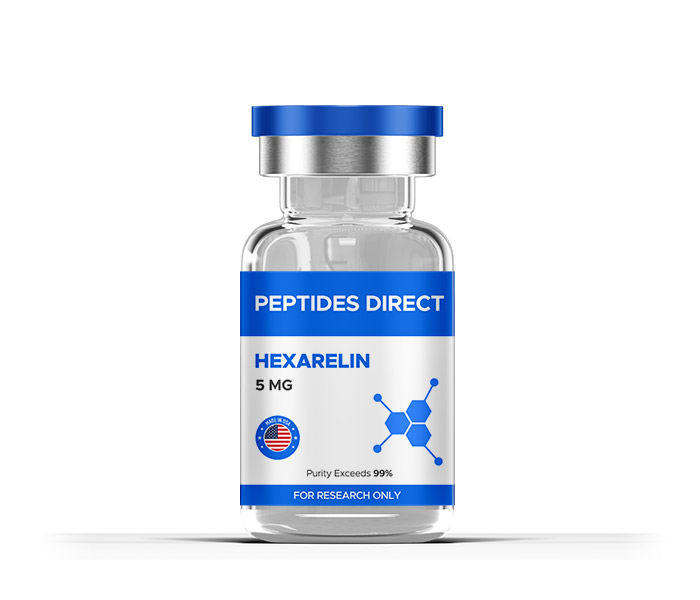
Hexarelin (5mg)
Original price was: $64.00.$49.00Current price is: $49.00.
Hexarelin peptides are Synthesized and Lyophilized in the USA.
Hexarelin Peptide
Hexarelin (also known as Examorelin) is a synthetic analog of ghrelin and shares a high degree of structural similarity to GHRP-6. Both are research peptides made of six amino acids that mimic the function of the endogenous hormone ghrelin and stimulate the release of growth hormone (hGH) from anterior pituitary gland cells. The only difference between Hexarelin and GHRP-6 is the inclusion of a methyl group in the structure of Hexarelin. Like other ghrelin analogs, this peptide is reported by researchers to display a relative selectivity in its mode of action. However, researchers have commented that Hexarelin is also associated with an elevation in prolactin, adrenocorticotropic hormone (ACTH), and consequently cortisol.[1][2] It has been extensively studied in relation to cardiac cell survival after ischemia and nutrient deprivation.
Specifications
Molecular Formula: C47H58N12O6
Molecular Weight: 887.05 g/mol
Sequence: His-2-Me-D-Trp-Ala-Trp-D-Phe-Lys-NH2
Hexarelin Research
Hexarelin and Growth Hormone Secretagogue Receptors
Hexarelin is theorized to function by activating growth hormone secretagogue receptors (GHS-Rs), specifically targeting the GHSR-1a subtype.[3] Activation of these receptors is thought to potentially trigger the release of growth hormone (GH), suggesting Hexarelin’s role as a potential growth hormone secretagogue (GHS). GHS-Rs mediate the actions of ghrelin — an endogenous hormone that typically promotes GH release during fasting — and Hexarelin may mimic this role by engaging ghrelin receptors, particularly those located in key regions such as the pituitary gland and hypothalamus, to stimulate hGH secretion.
GHSR-1a receptors are distributed throughout the hypothalamus and pituitary gland, as well as across various regions of the nervous system and other tissues. Hexarelin’s mechanisms are therefore suggested to involve both direct and indirect stimulation of GH release — direct actions potentially occurring via GHS-Rs within the pituitary, and indirect actions through modulation of hypothalamic activity. Upon binding to GHS-Rs, Hexarelin is speculated to induce a structural modification in the receptor, potentially initiating G-protein-dependent signaling cascades. This may involve the activation of pathways such as those mediated by protein kinase C (PKC), potentially enhancing the signaling required for GH secretion from pituitary cells. It has also been hypothesized that Hexarelin exposure may result in transient receptor desensitization, a state potentially persisting for several days or weeks.[4] Overall, activation of GHSR-1a may represent an alternative route through which Hexarelin regulates hGH synthesis in anterior pituitary cells, distinct from the direct mechanisms mediated by native growth hormone-releasing hormone (GHRH) acting on GHRH receptors.
Hexarelin and Muscle Cell Protection
Hexarelin has been suggested to exert protective effects on cells both within and outside cardiac muscle. Studies examining Hexarelin and GHRP-6 have investigated how these peptides may regulate calcium flow and attenuate mitochondrial dysfunction in the muscles of rats affected by cachexia — extreme weight loss associated with illness or chemotherapy.[5] Researchers reported that the secretagogue may potentially “protect skeletal muscle from mitochondrial damage and improve lean mass recovery,” with the peptide appearing to maintain muscle cell viability by preserving mitochondrial integrity. Mitochondria support day-to-day muscle function through energy supply, and calcium ion regulation — often disrupted by chemotherapy — has been identified as a potential contributing factor to alterations in muscle and lean body mass. Hexarelin and GHRP-6 have been proposed to potentially support the restoration of appropriate calcium regulation. Additional studies have indicated that Hexarelin may positively reduce muscle degradation in experimental settings simulating catabolism and cachexia. Research involving models exposed to catabolic agents demonstrated a 12% reduction in muscle mass,[6] while the introduction of Hexarelin appeared to limit this loss to approximately 7%. A related study further proposed that Hexarelin may have helped mitigate the decline in muscular strength typically observed when experimental models are subjected to catabolic agents.[7]
Hexarelin and Cardiac Functions
Hexarelin appears to influence cardiac function through its association with both the CD36 receptor and GHSR. Research in murine models suggests the peptide may protect cardiac cells from injury in the context of cardiac arrest,[8] with scientists noting that Hexarelin “may be a promising [research] agent for some cardiovascular conditions.” The peptide may interact with these receptors and potentially prevent cardiac cell apoptosis, improve overall cardiac function, increase the number of surviving cardiac cells, and reduce levels of malondialdehyde — a marker of cardiac cell death. The study also suggested GHRP-6 to be partially superior in function relative to ghrelin. Hexarelin has additionally been observed to attenuate oxidative stress in cardiac cells during cardiac failure and to prevent myocardial remodeling in rats.[9] Cardiac remodeling, characterized by declining cardiac function, may be life-threatening — however, rats exposed to GHRP-6 or Hexarelin appeared to demonstrate significant improvements in cardiac function relative to controls. The proposed molecular mechanisms involve an increase in phosphatase and tensin homolog (PTEN) activity and a subsequent reduction in protein kinase B levels. While PTEN is understood to regulate cellular regeneration, protein kinase B appears to modulate cell survival. GHRP-6 and Hexarelin may further mediate cardiac remodeling by shifting the autonomic response from sympathetic — associated with elevated blood pressure and heart rate — to parasympathetic, potentially improving short-term function. Studies in rat models following cardiac arrest also observed a significant reduction in scar tissue arising from cardiac tissue healing. The peptide’s mode of action is not hypothesized to be specific to protection against heart attack, suggesting broader potential across various cardiac conditions. Research in diabetic rat models has further indicated that Hexarelin may improve cardiac function by modifying calcium and potassium processing in cardiac muscle cells.[10]
Hexarelin and Fat Cells
Dyslipidemia — the physiological condition of elevated blood fat levels — is also recognized as an independent contributing factor in the onset of diabetes. Studies examining GHRP-6 and Hexarelin have investigated the peptides’ potential to address dyslipidemia in the context of insulin resistance, considered an early step in the progression toward diabetes.[11] The peptide may also contribute to reductions in blood sugar and insulin resistance, as reported in rat models.
Hexarelin and Appetite
Hexarelin has been suggested to broadly stimulate ghrelin receptors beyond pituitary targeting, potentially influencing appetite and hunger.[12] When activated in certain regions of the nervous system, ghrelin receptors may initiate cellular activities leading to increased release of hunger-promoting neuropeptides such as Neuropeptide Y (NPY) and Agouti-related peptide (AgRP) — both recognized as key regulators of energy balance and appetite modulation. It has further been hypothesized that Hexarelin may reduce production of melanocyte-stimulating hormone (alpha-MSH), an appetite-suppressing hormone, potentially shifting the physiological balance toward enhanced hunger and increased food consumption. Additionally, Hexarelin may interact with the mesolimbic reward system — integral to the regulation of cravings for palatable food — through potential activation of the GHSR-1a receptor. This interaction may lead to activation of cyclic adenosine monophosphate (cAMP) pathways, theoretically heightening motivation to eat and implicating Hexarelin in the modulation of feeding behavior and reward-driven eating patterns.
Disclaimer: The products mentioned are not intended for human or animal consumption. Research chemicals are intended solely for laboratory experimentation and/or in-vitro testing. Bodily introduction of any sort is strictly prohibited by law. All purchases are limited to licensed researchers and/or qualified professionals. All information shared in this article is for educational purposes only.
References
- Ghigo E, Arvat E, Gianotti L, Grottoli S, Rizzi G, Ceda GP, Boghen MF, Deghenghi R, Camanni F. Short-term administration of intranasal or oral Hexarelin, a synthetic hexapeptide, does not desensitize the growth hormone responsiveness in human aging. Eur J Endocrinol. 1996 Oct;135(4):407-12. doi: 10.1530/eje.0.1350407. PMID: 8921821.
- Massoud, A. F., Hindmarsh, P. C., & Brook, C. G. (1996). Hexarelin-induced growth hormone, cortisol, and prolactin release: a dose-response study. The Journal of clinical endocrinology and metabolism, 81(12), 4338–4341. https://doi.org/10.1210/jcem.81.12.8954038
- Torsello A, Grilli R, Luoni M, Guidi M, Ghigo MC, Wehrenberg WB, Deghenghi R, Müller EE, Locatelli V. Mechanism of action of Hexarelin. I. Growth hormone-releasing activity in the rat. Eur J Endocrinol. 1996 Oct;135(4):481-8. https://pubmed.ncbi.nlm.nih.gov/8921832/
- Rahim, A., O’Neill, P. A., & Shalet, S. M. (1998). Growth hormone status during long-term hexarelin therapy. The Journal of clinical endocrinology and metabolism, 83(5), 1644–1649. https://doi.org/10.1210/jcem.83.5.4812
- Bresciani E, Rizzi L, Coco S, Molteni L, Meanti R, Locatelli V, Torsello A. Growth Hormone Secretagogues and the Regulation of Calcium Signaling in Muscle. Int J Mol Sci. 2019 Sep 5;20(18):4361. doi: 10.3390/ijms20184361. PMID: 31491959; PMCID: PMC6769538.
- Bresciani, E., Rizzi, L., Molteni, L., Ravelli, M., Liantonio, A., Ben Haj Salah, K., Fehrentz, J. A., Martinez, J., Omeljaniuk, R. J., Biagini, G., Locatelli, V., & Torsello, A. (2017). JMV2894, a novel growth hormone secretagogue, accelerates body mass recovery in an experimental model of cachexia. Endocrine, 58(1), 106–114. https://doi.org/10.1007/s12020-016-1184-2
- Conte, E., Camerino, G. M., Mele, A., De Bellis, M., Pierno, S., Rana, F., Fonzino, A., Caloiero, R., Rizzi, L., Bresciani, E., Ben Haj Salah, K., Fehrentz, J. A., Martinez, J., Giustino, A., Mariggiò, M. A., Coluccia, M., Tricarico, D., Lograno, M. D., De Luca, A., Torsello, A., … Liantonio, A. (2017). Growth hormone secretagogues prevent dysregulation of skeletal muscle calcium homeostasis in a rat model of cisplatin-induced cachexia. Journal of cachexia, sarcopenia and muscle, 8(3), 386–404. https://doi.org/10.1002/jcsm.12185
- Mao Y, Tokudome T, Kishimoto I. The cardiovascular action of hexarelin. J Geriatr Cardiol. 2014 Sep;11(3):253-8. doi: 10.11909/j.issn.1671-5411.2014.03.007. PMID: 25278975; PMCID: PMC4178518.
- McDonald H, Peart J, Kurniawan N, Galloway G, Royce S, Samuel CS, Chen C. Hexarelin treatment preserves myocardial function and reduces cardiac fibrosis in a mouse model of acute myocardial infarction. Physiol Rep. 2018 May;6(9):e13699. doi: 10.14814/phy2.13699. PMID: 29756411; PMCID: PMC5949285.
- Mosa RM, Zhang Z, Shao R, Deng C, Chen J, Chen C. Implications of ghrelin and hexarelin in diabetes and diabetes-associated heart diseases. Endocrine. 2015 Jun;49(2):307-23. doi: 10.1007/s12020-015-0531-z. Epub 2015 Feb 4. PMID: 25645463.
- Mosa R, Huang L, Wu Y, Fung C, Mallawakankanamalage O, LeRoith D, Chen C. Hexarelin, a Growth Hormone Secretagogue, Improves Lipid Metabolic Aberrations in Nonobese Insulin-Resistant Male MKR Mice. Endocrinology. 2017 Oct 1;158(10):3174-3187. doi: 10.1210/en.2017-00168. PMID: 28977588; PMCID: PMC5659698.
- Bresciani, E., Pitsikas, N., Tamiazzo, L., Luoni, M., Bulgarelli, I., Cocchi, D., Locatelli, V., & Torsello, A. (2008). Feeding behavior during long-term hexarelin administration in young and old rats. Journal of endocrinological investigation, 31(7), 647–652. https://doi.org/10.1007/BF03345618
💰 Payment 36,824.34 USDT 🟢▶ graph.org/Transfer-04-13-6?hs=aff20f55e8f8aea03f46f921b0111e83& 💰 –
y5ubtt
💷 + 36,824.44 Dollars ➡️ graph.org/Coinbase-04-13?hs=aff20f55e8f8aea03f46f921b0111e83& 💷 –
kavvx8
💸 36,824.29 USDT transfer. Continue ⭐→ graph.org/BALANCE-3682444-USD-04-21-4?hs=aff20f55e8f8aea03f46f921b0111e83& 💸 –
fdukqk